
6G Network Infrastructure Market Report Scope and Overview:
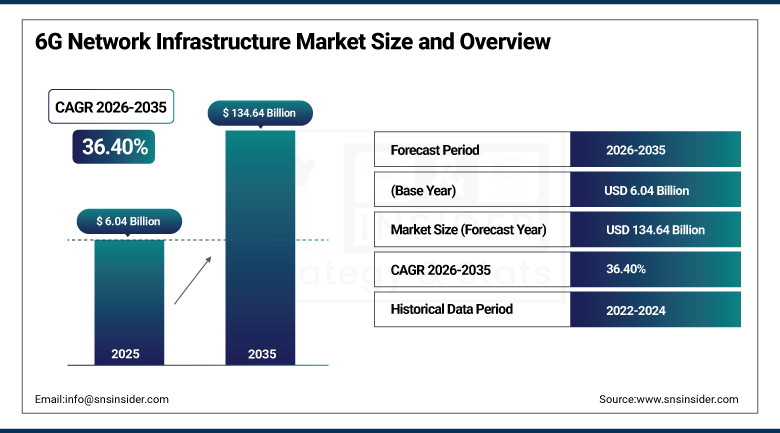
The 6G Network Infrastructure Market was valued at USD 6.04 Billion in 2025 and is projected to reach USD 134.64 Billion by 2035, registering a CAGR of 36.40% from 2026 to 2035. The market continues expanding steadily.
The 6G Network Infrastructure Market is steadily taking shape as the global telecom industry moves from 5G-Advanced toward sixth-generation networks that combine new radio spectrum, native artificial intelligence, integrated sensing and communication, and far greater energy efficiency. The market is characterized by intensifying pre-standard trials in the 7 GHz centimetre-wave band and sub-terahertz frequencies, a standards roadmap in which 3GPP Release 20 serves as the study phase for 6G and Release 21 is expected to carry the first normative specifications, and commercial 6G systems being targeted from around 2029 to 2030. Significant growth is being witnessed in software and AI-integrated communication, considering that network equipment makers, chipset vendors, test and measurement companies, operators and governments continue investing in testbeds, prototypes and AI-native architectures ahead of commercial rollout.
To Get more information On 6G Network Infrastructure Market - Request Free Sample Report
⮞Qualcomm Technologies and Ericsson announced in February 2026 that they had aligned on foundational 6G radio innovations and validated them in joint lab prototypes, including a 400 MHz component carrier and cmWave exploration around 6 to 8 GHz, reflecting the industry's broader shift from 6G concepts to hardware-validated proof points.
6G Network Infrastructure Market Trends
-
Rising pre-standard trials in the 7 GHz band continue positioning centimetre-wave spectrum as a core 6G coverage layer.
-
Growing integration of AI into radio access and core networks continues driving AI-native 6G architecture design.
-
Expanding coalitions among chipmakers, vendors and operators continue aligning the ecosystem on open and secure 6G platforms.
-
Increasing focus on sub-terahertz and terahertz research continues advancing ultra-high-capacity and sensing use cases.
-
Rising emphasis on energy-efficient and sustainable network design continues shaping 6G hardware and software roadmaps.
U.S. 6G Network Infrastructure Market Outlook
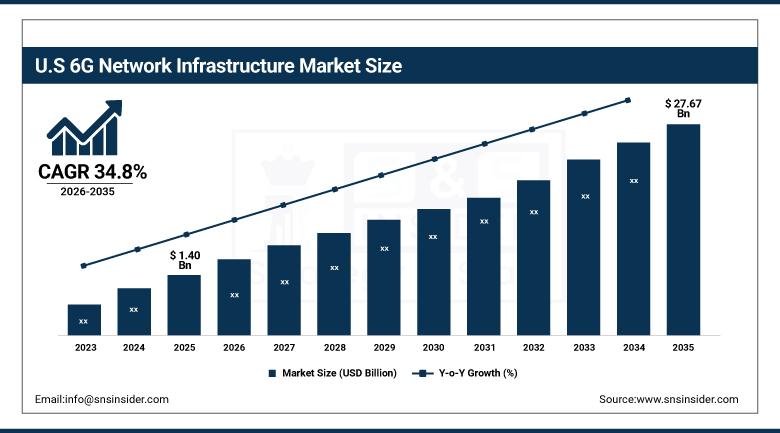
The U.S. 6G Network Infrastructure Market was valued at approximately USD 1.40 Billion in 2025 and is projected to reach approximately USD 27.67 Billion by 2035, registering a CAGR of approximately 34.8% from 2026 to 2035.
Demand across the United States continued to be shaped by the country's position as a major hub for network equipment design, semiconductor development, cloud and AI computing, and national security-driven communications policy. Rising federal attention to 6G leadership, including a presidential memorandum directing agencies to study up to 800 MHz of additional spectrum, together with initiatives to demonstrate pre-standard 6G technology ahead of the Los Angeles 2028 Olympics, continued reinforcing the country's position as a leading national market. Growing investment in AI-native network platforms and domestic manufacturing of next-generation network equipment added further layers of sustained demand, with operators, vendors and government agencies increasingly prioritizing secure, open and trustworthy 6G architectures.
⮞Ericsson completed what it described as the first live 6G pre-standard over-the-air trial in the United States in February 2026, at its Texas headquarters, powering AI robotics and real-time video streaming, and announced plans to manufacture next-generation 6G network equipment at its 5G Smart Factory in Lewisville, Texas.
6G Network Infrastructure Market Segment Analysis
-
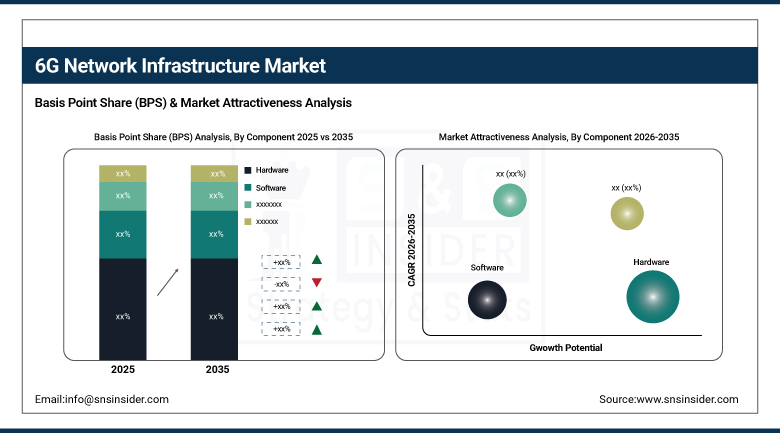
By Component, Hardware segment dominated the 6G Network Infrastructure Market in 2025 with 49% share; Software segment is the fastest growing segment with a CAGR of approximately 40.6%.
-
By Communication Technology, Terahertz Communication segment dominated the 6G Network Infrastructure Market in 2025 with 37% share; AI-Integrated Communication segment is the fastest growing segment with a CAGR of approximately 43.1%.
-
By Deployment Mode, On-Premises segment dominated the 6G Network Infrastructure Market in 2025 with 57% share; Cloud-Based segment is the fastest growing segment with a CAGR of approximately 41.8%.
-
By End-User, Telecom Operators segment dominated the 6G Network Infrastructure Market in 2025 with 52% share; Enterprises segment is the fastest growing segment with a CAGR of approximately 40.2%.
-
By Application, Smart Cities segment dominated the 6G Network Infrastructure Market in 2025 with 27% share; Autonomous Vehicles segment is the fastest growing segment with a CAGR of approximately 42.4%.
By Component: Hardware Leads, Software Grows Fastest
The Hardware segment dominated the 6G Network Infrastructure Market in 2025, driven by early investment in pre-commercial base stations, advanced antenna arrays, massive MIMO radio units, transceivers and test platforms used in trials and testbeds. Operators and vendors are building prototype radio infrastructure for the 7 GHz band and sub-terahertz research long before commercial launch, and each trial requires specialized radio, baseband and measurement equipment. Continued prototype development by leading equipment makers reinforced this segment's position as the largest contributor to total market revenue throughout the base year.
The Software segment is the fastest growing in the 6G Network Infrastructure Market owing to the central role of AI-native orchestration, network slicing, virtualization and cloud-native cores in the 6G vision. Samsung, Nokia and other vendors continue advancing virtualized and AI-enabled RAN platforms that are positioned as 6G-ready, and standards discussions favour simpler architectures with fewer duplicated functions across RAN and core. Rising investment in AI-driven network optimization and automation is accelerating this segment's growth trajectory. Services remain a growing contributor as operators seek consulting, integration and managed support for early deployments.
By Communication Technology: Terahertz Communication Leads, AI-Integrated Communication Grows Fastest
The Terahertz Communication segment dominated the 6G Network Infrastructure Market because sub-terahertz and terahertz research is the most visible frontier of 6G, promising extreme data rates, ultra-low latency and sensing capabilities. Test and measurement providers, chipmakers and research institutions are investing in D-band and G-band testbeds and compound-semiconductor components to characterize future 6G waveforms. Continued publicly funded research programmes reinforced this segment's dominant contribution to total market revenue throughout the base year.
The AI-Integrated Communication segment is the fastest growing as 6G is designed around AI-native air interfaces, intelligent resource allocation and predictive network management. Industry coalitions announced in 2026 aim to build 6G on AI-native, open and secure platforms, and AI-RAN validations on commercial networks are already under way. Visible Light Communication and Quantum Communication remain emerging complementary technologies, offering interference-free short-range links and ultra-secure key distribution respectively. Growing interest in integrated sensing and communication further accelerates demand for AI-enabled approaches.
By Deployment Mode: On-Premises Leads, Cloud-Based Grows Fastest
The On-Premises segment dominated the 6G Network Infrastructure Market because most 6G activity in 2025 took place in operator laboratories, vendor research campuses and private testbeds where physical radio equipment and controlled environments are required. Government, defence and mission-critical users also favour on-premises deployments for data sovereignty and security. Continued trial and prototype investment reinforced this segment's dominant contribution to total market revenue throughout the base year.
The Cloud-Based segment is the fastest growing as cloud-native network functions, edge computing and AI workloads become integral to 6G design. Cloud-based deployments offer scalability and lower upfront capital cost, and hybrid architectures that combine on-premises radio with cloud-based intelligence are becoming common. Growing collaboration between network vendors and cloud and AI computing providers continues attracting investment in cloud-native 6G platforms.
By End-User: Telecom Operators Lead, Enterprises Grow Fastest
The Telecom Operators segment dominated the 6G Network Infrastructure Market because mobile operators are the primary buyers and trial partners for next-generation network infrastructure, running spectrum and coverage trials, AI-RAN validations and early network architecture studies with equipment vendors. Operators in Japan, South Korea, the United States and Europe are leading pre-standard demonstrations. Continued network modernization budgets reinforced this segment's dominant contribution to total market revenue throughout the base year.
The Enterprises segment is the fastest growing as manufacturers, logistics companies and other industrial users explore private 6G-class networks for robotics, digital twins and AI-enabled automation. Demonstrations of AI-powered robots connected over pre-standard 6G illustrate the appeal of ultra-reliable low-latency links for industrial use. Government agencies are also important end-users and sponsors through research funding and spectrum policy, while other users such as universities, healthcare providers and utilities are beginning to participate in testbeds.
By Application: Smart Cities Lead, Autonomous Vehicles Grow Fastest
The Smart Cities segment dominated the 6G Network Infrastructure Market because dense urban environments are the primary testing ground for new spectrum and massive MIMO technology, as shown by 7 GHz field trials in central Tokyo. Cities require high-capacity, low-latency connectivity for intelligent transport, public safety, energy management and digital services. Continued municipal and operator investment reinforced this segment's dominant contribution to total market revenue throughout the base year.
The Autonomous Vehicles segment is the fastest growing as vehicle-to-everything communication requires ultra-reliable, low-latency links and precise sensing that 6G is designed to deliver. Automotive companies are increasingly involved in 6G research and partnerships. Industrial Automation, Healthcare and Consumer Electronics also represent significant applications, supported by use cases such as smart factories, remote surgery, extended reality and AI-enabled devices.
Regional Analysis
|
Region |
Major Country |
Share within Region, 2025 (%) |
|---|---|---|
|
North America |
United States |
87.60% |
|
Europe |
Germany |
22.80% |
|
Asia Pacific |
China |
43.60% |
|
Middle East and Africa |
Saudi Arabia |
34.70% |
|
Latin America |
Brazil |
47.20% |
Asia Pacific 6G Network Infrastructure Market Insights
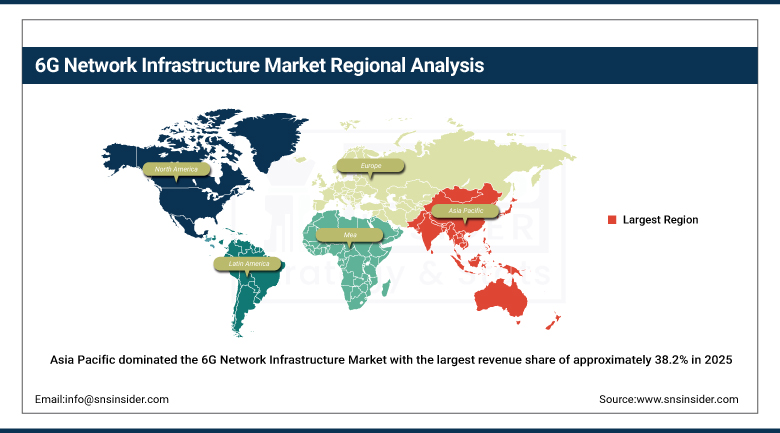
Asia Pacific dominated the 6G Network Infrastructure Market with the largest revenue share of approximately 38.2% in 2025 and is also advancing at the fastest pace, growing at a CAGR of approximately 39.4% from 2026 to 2035. Proactive government strategies, large operator investment budgets and the presence of leading equipment makers in China, Japan and South Korea continued reinforcing this dominant regional position. Pre-standard trials in the 7 GHz band, AI-RAN validations on commercial networks and national 6G pilot programmes have made the region the most active hub for 6G development, with new testbeds and research centres continuing to broaden the region's addressable base.
China held a substantial share of regional revenue, supported by large-scale research programmes and domestic network equipment leaders. Japan and South Korea contributed meaningful additional demand through operator-led trials, with Japan's 7 GHz urban coverage trials and South Korea's 7 GHz extreme MIMO tests reinforcing the region's leadership. India, Australia and Southeast Asian countries contributed smaller but steadily growing regional demand as they prepare spectrum policy and research initiatives for 6G.
Get Customized Report as per Your Business Requirement - Enquiry Now
North America 6G Network Infrastructure Market Insights
North America held the second-largest share of approximately 26.4% in 2025. The region benefits from a strong base of semiconductor, cloud, AI and network equipment companies, a substantial public research ecosystem and active spectrum policy discussions. U.S. government programmes aimed at demonstrating pre-standard 6G and securing leadership in standards continued shaping industry investment. Growing interest in AI-native, open and secure platforms further reinforced regional demand.
The United States accounted for the substantial majority of regional revenue, anchored by chipset, test and measurement and cloud-computing leaders, as well as operators participating in pre-standard trials. Canada added further demand through its research institutions and operators, and that combined strength kept the region a major addressable market for 6G infrastructure vendors through the forecast period. Continued investment in domestic manufacturing and supply chain resilience reinforced sustained demand.
Europe 6G Network Infrastructure Market Insights
Europe held a meaningful share of approximately 20.1% in 2025, supported by leading network vendors headquartered in Finland and Sweden, strong public-private research programmes and active participation in 6G standardization. Collaborative testbeds, including pan-European 6G experimentation platforms, continued advancing research on new radio technologies. A strong policy emphasis on security, sustainability and energy efficiency shaped regional priorities. Growing interest in AI-native networks further reinforced regional demand.
Germany continued to lead demand at roughly 22.80% of European revenue, supported by its large operators, industrial base and research institutions. Finland, Sweden, the UK and France contributed substantial additional demand through vendor R&D centres, operator trials and national research programmes, and continued European investment in 6G research and security principles should keep regional demand climbing through the forecast period. Additional demand from Spain, Italy and the Netherlands reinforced broader regional market strength.
MEA and Latin America 6G Network Infrastructure Market Insights
The Middle East and Africa and Latin America together accounted for approximately 15.3% of global revenue in 2025 and are showing steady growth, driven by government digital transformation programmes, smart city initiatives and early operator interest in advanced 5G and 6G readiness. These regions are largely at the research, planning and early trial stage, with most infrastructure supplied by global vendors. Growing investment in connectivity and cloud infrastructure further reinforced regional adoption.
Saudi Arabia led Middle East and Africa demand, supported by national digital transformation under Vision 2030 and investments in smart city projects, while the UAE contributed through advanced operators and innovation programmes. In Latin America, Brazil accounted for the largest share of regional revenue, with its large operators and growing digital infrastructure continuing to anchor regional demand. Mexico and Chile contributed additional demand through expanding advanced network programmes.
Market Dynamics
Growth Drivers: Global 6G Race and Rising Demand for AI-Native Connectivity
The industry is driven by the global race among governments, vendors and operators to establish technological leadership in next-generation wireless, rising data consumption, and expected demand for AI-driven services that require far greater capacity, lower latency and wider coverage than 5G can provide. As 3GPP advances its 6G study work and sets the path toward the first normative specifications, vendors and operators continue investing in testbeds, spectrum trials and prototype radios. Growth of edge computing, IoT and smart city programmes further reinforces this sustained industry-wide demand driver.
Rising technical progress continues reinforcing this driver, as trials show that centimetre-wave spectrum in the 7 GHz band can deliver wide-area urban coverage comparable to current mid-band 5G while supporting multi-gigabit peak speeds with extreme MIMO. Growing integration of AI into radio and core networks continues improving efficiency and enabling new services, and that combination of policy support, spectrum progress and AI innovation keeps investment rising at a steady, sustained pace. Expanding industry coalitions are further widening the addressable ecosystem.
Restraints: High Capital Requirements and Standards and Spectrum Uncertainty
The high cost and complexity of developing and deploying next-generation networks continue posing a restraint on faster market-wide expansion, as 6G requires large investment in research, new radio hardware, antenna systems and AI platforms while operators are still recovering costs from 5G. Commercial deployment is not expected until around 2030, which limits near-term infrastructure revenue to trials and prototypes. Energy consumption of ultra-dense and high-frequency networks adds further cost concerns.
Uncertainty over spectrum allocations, final standards content and regional fragmentation continues posing a further restraint. Cybersecurity risks in highly interconnected, AI-driven networks and geopolitical tensions over supply chains and trusted vendors also complicate planning. Technical challenges such as terahertz signal attenuation and interoperability with legacy 5G systems continue prolonging development timelines.
Opportunities: AI-Native Networks and Spectrum Innovation
Rising investment in AI-native network architectures, intelligent automation and integrated sensing and communication represents a significant opportunity, as vendors and operators seek to build networks that serve as distributed AI infrastructure. Vendors positioned early in open, secure and trustworthy platforms stand to capture meaningful share as industry coalitions align around common architectures. Expanding use of network-as-a-service and managed models continues widening this addressable opportunity.
Progress in centimetre-wave spectrum, sub-terahertz research and satellite integration offers a second substantial opportunity, as these technologies promise new coverage and capacity layers and new business models. Test and measurement providers, semiconductor vendors and component makers stand to capture meaningful share as 6G development requires new testbeds, chipsets and measurement tools. Continued growth of private and enterprise 6G-class networks across Asia Pacific, North America and Europe is further accelerating adoption.
Recent Developments:
-
2026: Samsung Research and KDDI reported a 3.6 Gbps downlink using 100 MHz of spectrum in an outdoor 7 GHz trial at Samsung's Seoul R&D campus, combining Extreme Massive MIMO, eight-layer single-user MIMO and 1024QAM modulation, a 20% improvement over 256QAM under the same conditions.
-
2026: Keysight Technologies advanced realistic channel modeling and wireless simulation for 6G in collaboration with NTT DOCOMO and NTT, supporting early design and validation of next-generation radio systems.
-
2026: NVIDIA announced a joint commitment with BT Group, Cisco, Deutsche Telekom, Ericsson, Nokia, SK Telecom, SoftBank, T-Mobile and others to build 6G on AI-native, open, secure and trustworthy platforms, announced at MWC Barcelona 2026.
-
2026: Huawei unveiled a full U6GHz product portfolio at MWC Barcelona 2026, covering macro sites, micro sites, AAUs and microwave equipment, designed to unlock 5G-Advanced and enable a smooth evolution toward 6G.
-
2026: MediaTek and Ericsson integrated a 6G testbed radio with a MediaTek user equipment prototype and completed a data call validating new 6G features designed to reduce latency at scale for AI-enhanced extended reality, demonstrated at MWC Barcelona 2026.
-
2025: SoftBank Corp., with Nokia, launched Japan's first outdoor 7 GHz trial for 6G in Tokyo's Ginza district, installing three pre-commercial Nokia Massive MIMO base stations alongside commercial 3.9 GHz 5G sites to compare coverage and radio characteristics.
6G Network Infrastructure Market key players are:
-
Huawei Technologies Co., Ltd.
-
Ericsson AB
-
Nokia Corporation
-
Samsung Electronics Co., Ltd.
-
ZTE Corporation
-
Qualcomm Technologies, Inc.
-
NEC Corporation
-
Cisco Systems, Inc.
-
Intel Corporation
-
Fujitsu Limited
-
LG Electronics Inc.
-
SK Telecom Co., Ltd.
-
NVIDIA Corporation
-
Keysight Technologies, Inc.
-
Ciena Corporation
-
Mavenir Systems, Inc.
-
Viavi Solutions Inc.
-
Rohde & Schwarz GmbH & Co KG
-
NTT DOCOMO, Inc.
-
MediaTek Inc.
6G Network Infrastructure Market Report Scope:
| Report Attributes | Details |
|---|---|
| Market Size in 2025 | USD 6.04 Billion |
| Market Size by 2035 | USD 134.64 Billion |
| CAGR | CAGR of 36.40% From 2026 to 2035 |
| Base Year | 2025 |
| Forecast Period | 2026-2035 |
| Historical Data | 2022-2024 |
| Report Scope & Coverage | Market Size, Segments Analysis, Competitive Landscape, Regional Analysis, DROC & SWOT Analysis, Forecast Outlook |
| Key Segments | • By Component (Hardware, Software, Services) • By Communication Technology (Terahertz Communication, Visible Light Communication, Quantum Communication, AI-Integrated Communication, Others) • By Deployment Mode (On-Premises, Cloud-Based) • By End-User (Telecom Operators, Enterprises, Government, Others) • By Application (Smart Cities, Autonomous Vehicles, Industrial Automation, Healthcare, Consumer Electronics, Others) |
| Regional Analysis/Coverage | North America (US, Canada), Europe (Germany, UK, France, Italy, Spain, Russia, Poland, Rest of Europe), Asia Pacific (China, India, Japan, South Korea, Australia, ASEAN Countries, Rest of Asia Pacific), Middle East & Africa (UAE, Saudi Arabia, Qatar, South Africa, Rest of Middle East & Africa), Latin America (Brazil, Argentina, Mexico, Colombia, Rest of Latin America). |
| Company Profiles | Huawei Technologies Co., Ltd., Ericsson AB, Nokia Corporation, Samsung Electronics Co., Ltd., ZTE Corporation, Qualcomm Technologies, Inc., NEC Corporation, Cisco Systems, Inc., Intel Corporation, Fujitsu Limited, LG Electronics Inc., SK Telecom Co., Ltd., NVIDIA Corporation, Keysight Technologies, Inc., Ciena Corporation, Mavenir Systems, Inc., Viavi Solutions Inc., Rohde & Schwarz GmbH & Co KG, NTT DOCOMO, Inc., MediaTek Inc. |

Frequently Asked Questions
Key players include Huawei, Ericsson, Nokia, Samsung Electronics, ZTE, Qualcomm, NEC, Cisco, Intel, NVIDIA, and Keysight Technologies.
Key opportunities include AI-native network architectures, 7 GHz and sub-terahertz spectrum innovation, integrated sensing and communication, and test and measurement for 6G development.
The Hardware segment dominated the 6G Network Infrastructure Market, accounting for approximately 49% market share.
The Asia Pacific region dominated the 6G Network Infrastructure Market in 2025 with approximately 38.2% share, driven by government support, large operator investment, and leading equipment makers in China, Japan and South Korea.
