
Europe Physical AI Market Report Scope & Overview:
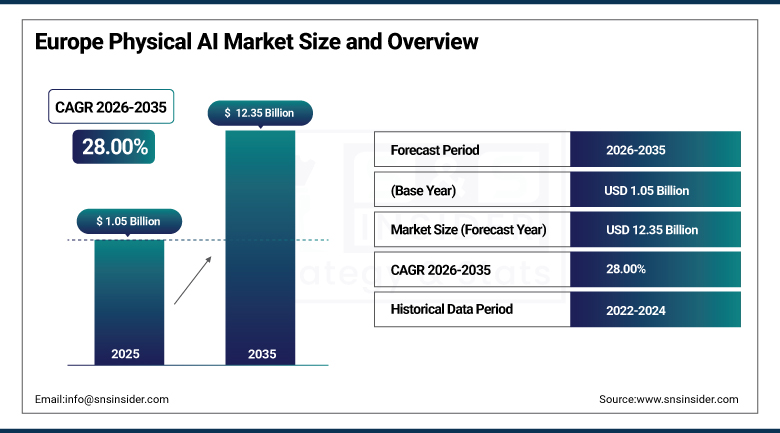
Europe Physical AI Market was valued at USD 1.05 Billion in 2025 and is expected to reach USD 12.35 Billion by 2035, growing at a CAGR of 28.00% from 2026-2035.
The Europe Physical AI Market is expanding as the region’s deep industrial automation base, anchored by Germany’s automotive and machinery sectors, begins integrating AI-driven perception and control into established robotic manufacturing lines. ABB, Siemens, KUKA, and Universal Robots each continue to extend their traditional industrial and collaborative robot portfolios with AI-based vision and planning capabilities, while European Union AI Act compliance requirements are shaping how companies validate and certify physical AI systems before deployment. Growing investment in robotics research clusters across Germany, the United Kingdom, and the Nordic countries is supporting a steady pipeline of new humanoid and mobile robotics ventures, even as the region’s overall capital investment pace trails that of the United States. Rising labor costs and demographic-driven workforce shortages across Western Europe are reinforcing manufacturer interest in automation.
To Get more information On Europe Physical AI Market - Request Free Sample Report
⮞The European Union’s AI Act compliance requirements began phasing in through 2025, creating a structured regulatory pathway that European robotics manufacturers must now navigate before deploying new AI-driven physical systems commercially. North America held approximately 33.25% share of the global Physical AI Market in 2025, while Asia Pacific is forecast to post the fastest regional CAGR of 33.51% from 2026-2035, both outpacing Europe’s growth rate.
Europe Physical AI Market Trends
-
Expanding EU AI Act compliance pathways are shaping how manufacturers certify and deploy new physical AI systems.
-
Continued investment by ABB, Siemens, and KUKA is extending traditional industrial robots with AI-based perception.
-
Growing robotics research funding across Germany, the UK, and the Nordic countries is supporting new humanoid ventures.
-
Rising labor costs and demographic workforce shortages are reinforcing manufacturer interest in automation.
-
Expanding collaborative robot adoption among small and mid-sized manufacturers is broadening the European customer base.
Germany Physical AI Market Outlook
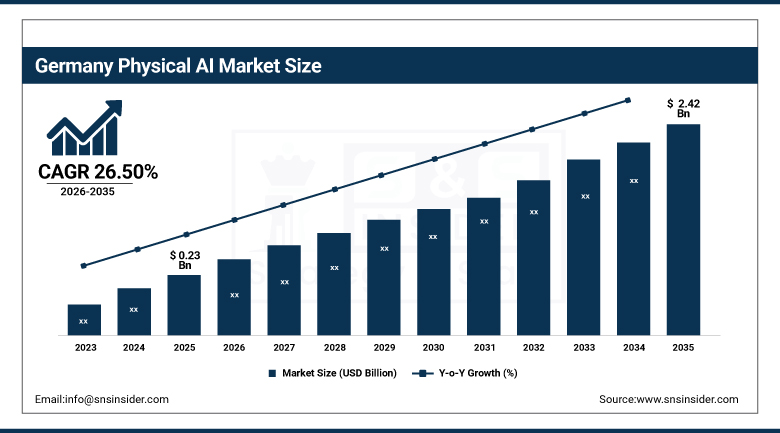
Germany Physical AI Market was valued at USD 0.23 Billion in 2025 and is expected to reach USD 2.42 Billion by 2035, growing at a CAGR of 26.50% from 2026-2035.
The Germany Physical AI Market is the largest in Europe, anchored by the country’s deep automotive and industrial machinery manufacturing base and the global leadership of KUKA, Siemens, and a dense supplier network built around decades of industrial robotics expertise. German manufacturers are increasingly layering AI-based computer vision and predictive maintenance capabilities onto existing robotic production lines rather than deploying entirely new humanoid platforms, reflecting a more incremental adoption path than in the United States. Continued federal and state-level funding for applied AI research, alongside strong vocational training pipelines for robotics technicians, supports a steady innovation base. Growing interest from Mittelstand manufacturers in collaborative robots is also broadening adoption beyond the largest automotive suppliers.
⮞Germany’s Federal Ministry for Economic Affairs continued funding applied robotics and AI research initiatives through 2025, reinforcing the country’s position as Europe’s leading industrial automation research base. This dynamic is expected to persist through the remainder of the 2026-2035 forecast window as manufacturers and investors continue adjusting capacity and strategy to shifting physical AI demand.
Europe Physical AI Market Segment Analysis
-
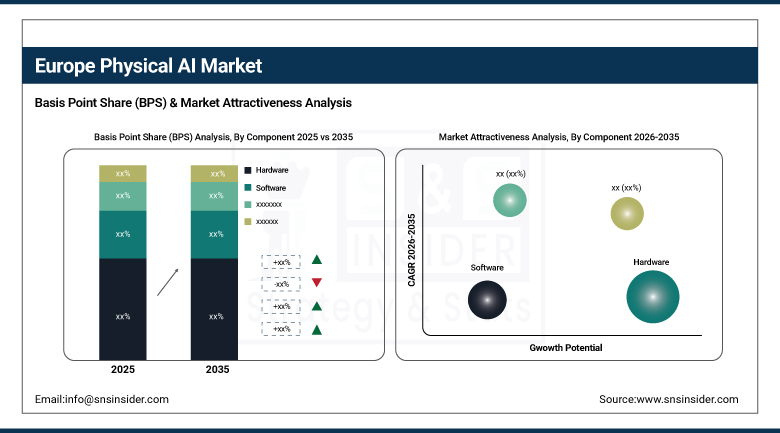
By Component, Hardware dominates the Europe Physical AI Market with 55.10% share in 2025; Software is expected to grow at the fastest CAGR of 31.80% from 2026–2035.
-
By Technology, Computer Vision dominates the Europe Physical AI Market with 43.60% share in 2025; Reinforcement Learning & Control Systems is expected to grow at the fastest CAGR of 29.40% from 2026–2035.
-
By Form Factor, Industrial Robots dominate the Europe Physical AI Market with 39.50% share in 2025; Cobots are expected to grow at the fastest CAGR of 33.20% from 2026–2035.
-
By Application, Manufacturing & Automotive dominates the Europe Physical AI Market with 47.80% share in 2025; Healthcare is expected to grow at the fastest CAGR of 30.50% from 2026–2035.
By Component, Hardware Dominates the Europe Physical AI Market, Software Grows Fastest
Hardware holds the largest European component share given the continued dominance of fixed industrial robotic arms across the region’s automotive and machinery manufacturing base, along with the high unit cost of sensors and actuators layered onto existing production equipment. ABB, KUKA, and Siemens continue to anchor this hardware-centric spending pattern, as most European manufacturers prioritize upgrading proven robotic platforms with AI capability over adopting entirely new form factors. Continued investment in local R&D, manufacturing, and commercial partnerships is expected to reinforce this pattern through 2035 as deployment scales and competitive positioning evolves across the market.
Software is forecast to grow fastest as European manufacturers increasingly license AI vision and planning software that can run across existing ABB, KUKA, and Siemens hardware installations without requiring a full equipment replacement cycle. Growing availability of EU AI Act-compliant software platforms purpose-built for industrial deployment is accelerating this shift, converting one-time hardware purchases into recurring software and subscription revenue. Growing engineering talent availability and expanding commercial deployment partnerships are expected to sustain this trajectory through the remainder of the forecast period.
By Technology, Computer Vision Dominates the Europe Physical AI Market, Reinforcement Learning & Control Systems Grows Fastest
Computer vision remains the largest technology category given its central role in quality inspection and defect detection across Europe’s automotive and precision manufacturing base, where vision systems have already been integrated into production lines over multiple technology upgrade cycles. This established base gives European manufacturers a mature, well-understood technology to build AI-enhanced capability on top of. Rising customer adoption and continued platform investment by leading manufacturers are expected to reinforce this trend across the market through 2035.
Reinforcement learning and control systems are growing fastest as European robotics research institutions and companies increasingly apply simulation-based learning to improve cobot manipulation and mobile robot navigation in warehouse and logistics settings. Growing collaboration between German and UK universities and industrial robotics manufacturers is accelerating commercial technology transfer across the region. This dynamic is expected to persist through the remainder of the 2026-2035 forecast window as manufacturers and investors continue adjusting capacity and strategy to shifting physical AI demand.
By Form Factor, Industrial Robots Dominate the Europe Physical AI Market, Cobots Grow Fastest
Industrial robots remain the largest form factor given Europe’s deep automotive and machinery manufacturing heritage and the decades of integration expertise that German and Italian manufacturers in particular have built around fixed robotic arms. Established safety certification pathways under European machinery directives continue to make traditional industrial robots the default choice for large manufacturers across the region. Continued investment in local R&D, manufacturing, and commercial partnerships is expected to reinforce this pattern through 2035 as deployment scales and competitive positioning evolves across the market.
Cobots are forecast to grow fastest as Universal Robots and a growing field of European collaborative robot manufacturers make automation accessible to small and mid-sized manufacturers that cannot justify the cost and floor-space requirements of traditional industrial robots. Growing EU AI Act clarity on cobot certification pathways is also reducing deployment uncertainty for smaller manufacturers across the region. Growing engineering talent availability and expanding commercial deployment partnerships are expected to sustain this trajectory through the remainder of the forecast period.
By Application, Manufacturing & Automotive Dominates the Europe Physical AI Market, Healthcare Grows Fastest
Manufacturing and automotive applications dominate given the scale of Germany’s automotive supply chain and the broader European machinery and precision manufacturing sectors that have relied on industrial robotics for decades. Continued investment in upgrading existing production lines with AI-based vision and predictive maintenance capability keeps this application the largest revenue contributor across the region. Rising customer adoption and continued platform investment by leading manufacturers are expected to reinforce this trend across the market through 2035.
Healthcare is set to post the fastest growth as European hospital systems and medical device manufacturers increasingly pilot surgical and hospital logistics robotics, supported by growing national health system investment in automation to offset clinical staffing shortages across Germany, France, and the United Kingdom. This dynamic is expected to persist through the remainder of the 2026-2035 forecast window as manufacturers and investors continue adjusting capacity and strategy to shifting physical AI demand.
Regional Analysis
|
Region |
Major Country |
Share within Region, 2025 (%) |
|---|---|---|
|
Europe |
Germany |
22.30% |
|
United Kingdom |
19.00% |
|
|
France |
16.00% |
|
|
Italy |
10.00% |
|
|
Spain |
8.00% |
|
|
Rest of Europe |
24.70% |
Germany Physical AI Market Insights
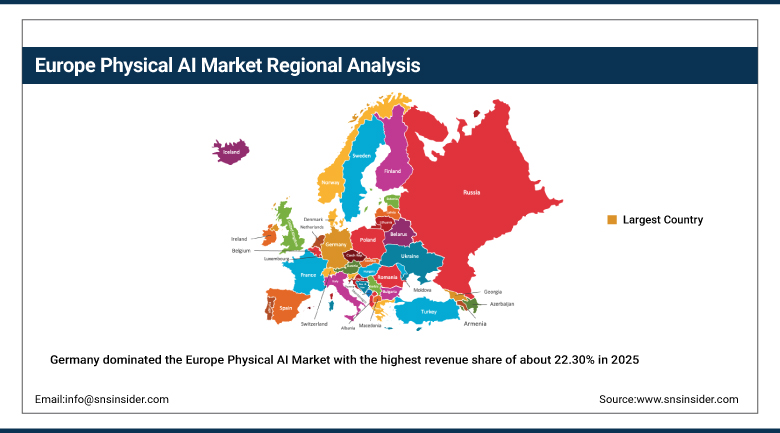
Germany dominated the Europe Physical AI Market with the highest revenue share of about 22.30% in 2025, supported by its deep automotive and industrial machinery manufacturing base, the global leadership of KUKA and Siemens, and a dense network of robotics suppliers built over decades of industrial automation investment. Continued federal funding for applied AI research keeps Germany the leading national contributor to European physical AI revenue. Continued investment in local R&D, manufacturing, and commercial partnerships is expected to reinforce this pattern through 2035 as deployment scales and competitive positioning evolves across the market.
Germany’s strong vocational training pipeline for robotics technicians and growing Mittelstand manufacturer interest in collaborative robots continue to broaden adoption beyond the largest automotive suppliers. Expanding federal and state-level research funding is expected to further reinforce Germany’s leading position within the European market through the remainder of the forecast period. Growing engineering talent availability and expanding commercial deployment partnerships are expected to sustain this trajectory through the remainder of the forecast period.
Get Customized Report as per Your Business Requirement - Enquiry Now
United Kingdom Physical AI Market Insights
The United Kingdom is expected to grow at the fastest CAGR of about 33.00% from 2026–2035, supported by London’s concentration of AI research talent, strong university robotics programs, and growing government funding for AI and robotics commercialization through national innovation agencies. Rising venture capital investment in UK-based robotics startups is accelerating adoption faster than in any other European market. Rising customer adoption and continued platform investment by leading manufacturers are expected to reinforce this trend across the market through 2035.
Continued collaboration between UK universities, including Imperial College London and the University of Oxford, and growing corporate robotics research investment are reinforcing this above-regional growth trajectory. Expanding government innovation funding programs are expected to further support UK robotics commercialization through 2035. This dynamic is expected to persist through the remainder of the 2026-2035 forecast window as manufacturers and investors continue adjusting capacity and strategy to shifting physical AI demand.
France Physical AI Market Insights
The France Physical AI Market benefits from strong national AI research investment and growing industrial robotics adoption across its aerospace and automotive manufacturing sectors, supported by continued government funding for AI commercialization initiatives and a growing cluster of robotics startups around Paris. Continued investment in local R&D, manufacturing, and commercial partnerships is expected to reinforce this pattern through 2035 as deployment scales and competitive positioning evolves across the market.
Italy Physical AI Market Insights
The Italy Physical AI Market is supported by its deep industrial robotics manufacturing heritage centered in northern Italy and growing adoption of collaborative robots among small and mid-sized manufacturers, though overall capital investment pace trails that of Germany and the United Kingdom. Growing engineering talent availability and expanding commercial deployment partnerships are expected to sustain this trajectory through the remainder of the forecast period.
Spain Physical AI Market Insights
The Spain Physical AI Market is expanding as manufacturers gradually adopt industrial and collaborative robots across its automotive and food processing sectors, supported by growing national and regional government funding for digital manufacturing transformation initiatives. Rising customer adoption and continued platform investment by leading manufacturers are expected to reinforce this trend across the market through 2035.
Rest of Europe Physical AI Market Insights
The Rest of Europe Physical AI Market, spanning Poland, Russia, and the Nordic countries, is growing as national governments gradually fund AI and robotics research initiatives and manufacturers across these diverse markets begin adopting industrial automation at a steadily increasing pace. This dynamic is expected to persist through the remainder of the 2026-2035 forecast window as manufacturers and investors continue adjusting capacity and strategy to shifting physical AI demand.
Market Dynamics
Growth Drivers: Rising labor costs and demographic workforce shortages are increasing demand for physical AI across Europe.
Rising labor costs and demographic-driven workforce shortages across Western Europe’s manufacturing base are pushing companies toward AI-enhanced automation to maintain production capacity. Continued investment by ABB, Siemens, and KUKA in layering AI-based vision and planning capability onto existing industrial robot installations is accelerating adoption without requiring full equipment replacement. Growing robotics research funding across Germany, the United Kingdom, and the Nordic countries is also supporting a steady pipeline of new ventures entering the European market. Continued investment in local R&D, manufacturing, and commercial partnerships is expected to reinforce this pattern through 2035 as deployment scales and competitive positioning evolves across the market.
Restraints: EU AI Act compliance requirements and slower capital investment pace continue to limit broader physical AI adoption.
The European Union’s AI Act compliance requirements are creating a more structured, and in some cases slower, regulatory pathway for companies deploying new AI-driven physical systems compared to markets with lighter-touch regulation. Overall venture and corporate capital investment in European robotics startups continues to trail the United States, limiting the pace at which new humanoid and mobile robotics ventures can scale commercially. Fragmented national funding programs across member states also create uneven innovation support across the region. Growing engineering talent availability and expanding commercial deployment partnerships are expected to sustain this trajectory through the remainder of the forecast period.
Opportunities: Expansion into healthcare, defense, and agriculture applications creates significant long-term growth potential.
Use-case expansion into healthcare, defense and security, and agriculture is opening new deployment pathways for physical AI well beyond Europe’s traditional manufacturing and automotive applications. Continued robotics research funding across Germany, the United Kingdom, and the Nordic countries, combined with growing EU-level innovation support programs, is expected to support a broader pipeline of European physical AI ventures through the remainder of the forecast period. Rising customer adoption and continued platform investment by leading manufacturers are expected to reinforce this trend across the market through 2035.
In 2025, the European Union began phasing in AI Act compliance requirements for physical AI systems, a development expected to shape certification pathways for European robotics manufacturers through 2035. This dynamic is expected to persist through the remainder of the 2026-2035 forecast window as manufacturers and investors continue adjusting capacity and strategy to shifting physical AI demand.
Recent Developments:
-
2025 : ABB expanded its AI-enabled robotics portfolio with new vision-guided industrial robot models for European manufacturers.
-
2025 : KUKA advanced its AI-based predictive maintenance software for industrial robot fleets across its European installed base.
-
2025 : Siemens expanded its industrial AI software partnerships to support robotics deployment across German manufacturing customers.
-
2025 : Universal Robots launched new AI-enhanced cobot models targeting small and mid-sized European manufacturers.
Europe Physical AI Market key players are:
-
ABB Ltd
-
Siemens AG
-
KUKA AG
-
Universal Robots A/S
-
SCHUNK GmbH & Co. KG
-
Festo SE & Co. KG
-
Stäubli International AG
-
Comau S.p.A.
-
Franka Robotics GmbH
-
PAL Robotics S.L.
-
SICK AG
-
Pepperl+Fuchs SE
-
Dassault Systèmes SE
-
DeepMind Technologies Limited
-
Wandelbots GmbH
-
Agile Robots SE
-
Ocado Group plc
-
Exotec S.A.S.
-
Milrem Robotics
-
Neura Robotics GmbH
Europe Physical AI Market Report Scope:
| Report Attributes | Details |
|---|---|
| Market Size in 2025 | USD 1.05 Billion |
| Market Size by 2035 | USD 12.35 Billion |
| CAGR | CAGR of 28.00% From 2026 to 2035 |
| Base Year | 2025 |
| Forecast Period | 2026-2035 |
| Historical Data | 2022-2024 |
| Report Scope & Coverage | Market Size, Segments Analysis, Competitive Landscape, Regional Analysis, DROC & SWOT Analysis, Forecast Outlook |
| Key Segments | • By Component (Hardware, Software, Services) • By Technology (Computer Vision, Natural Language Processing, Machine Learning & Deep Learning, Reinforcement Learning & Control Systems, Others) • By Form Factor (Industrial Robots, Cobots, Autonomous Mobile Robots, Humanoids, Drones & UAVs, Others) • By Deployment (On-device, Cloud-based AI, Hybrid) • By Application (Manufacturing & Automotive, Healthcare, Logistics & Supply Chain, Defense & Security, Agriculture, Others) |
| Regional Analysis/Coverage | North America (US, Canada), Europe (Germany, UK, France, Italy, Spain, Russia, Poland, Rest of Europe), Asia Pacific (China, India, Japan, South Korea, Australia, ASEAN Countries, Rest of Asia Pacific), Middle East & Africa (UAE, Saudi Arabia, Qatar, South Africa, Rest of Middle East & Africa), Latin America (Brazil, Argentina, Mexico, Colombia, Rest of Latin America). |
| Company Profiles | ABB Ltd, Siemens AG, KUKA AG, Universal Robots A/S, SCHUNK GmbH & Co. KG, Festo SE & Co. KG, Stäubli International AG, Comau S.p.A., Franka Robotics GmbH, PAL Robotics S.L., SICK AG, Pepperl+Fuchs SE, Dassault Systèmes SE, DeepMind Technologies Limited, Wandelbots GmbH, Agile Robots SE, Ocado Group plc, Exotec S.A.S., Milrem Robotics, Neura Robotics GmbH. |

Frequently Asked Questions
Key players in the Europe Physical AI Market include ABB Ltd, Siemens AG, KUKA AG, Universal Robots A/S, and SCHUNK GmbH & Co. KG, among others.
Key opportunities include expanding healthcare, defense, and agriculture applications and growing EU-level robotics innovation funding programs.
The market is driven by rising labor costs, demographic workforce shortages, and continued integration of AI capability into existing industrial robot installations.
The Hardware segment dominated the Europe Physical AI Market, accounting for approximately 55.10% share in 2025.
Germany dominated the Europe Physical AI Market in 2025 with a 22.30% share, supported by its deep automotive and industrial machinery manufacturing base.
