
Asia Pacific Physical AI Market Report Scope & Overview:
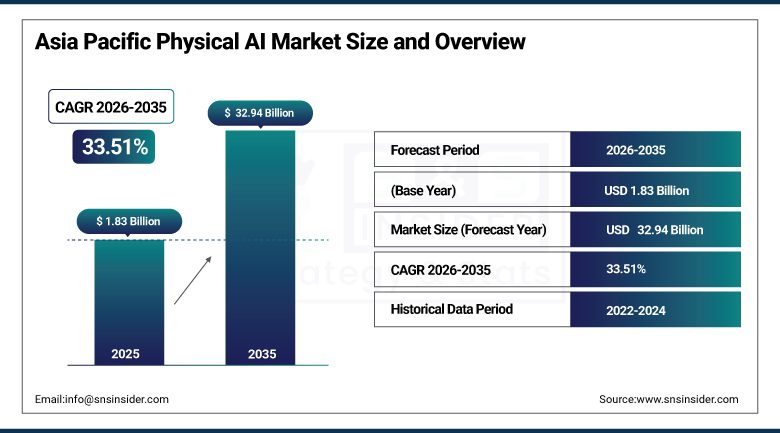
Asia Pacific Physical AI Market was valued at USD 1.83 Billion in 2025 and is expected to reach USD 32.94 Billion by 2035, growing at a CAGR of 33.51% from 2026-2035.
The Asia Pacific Physical AI Market is expanding rapidly as China, Japan, and South Korea each scale domestic robotics manufacturing capacity while racing to close the technology gap with U.S. humanoid and AI compute leaders. China’s government-backed robotics industrial policy is funding a dense field of domestic humanoid and industrial robot manufacturers, while Japan’s established robotics giants FANUC and SoftBank Robotics continue to extend decades of industrial automation expertise with AI-driven perception upgrades. South Korea’s Hyundai Motor Group, through its ownership of Boston Dynamics, is pushing aggressively into humanoid commercialization, and India’s growing manufacturing base is beginning to adopt industrial robotics at an accelerating pace. Oral-cost advantages in regional hardware manufacturing are giving Asia Pacific robot builders a meaningful cost edge over Western competitors in several form factors.
To Get more information On Asia Pacific Physical AI Market - Request Free Sample Report
⮞In 2025, China’s Ministry of Industry and Information Technology continued expanding its national humanoid robotics industrial policy, funding domestic manufacturing capacity and research initiatives aimed at achieving technology self-sufficiency in physical AI. North America held approximately 33.25% share of the global Physical AI Market in 2025, while Asia Pacific itself is forecast to post the fastest regional CAGR of 33.51% from 2026-2035.
Asia Pacific Physical AI Market Trends
-
China’s government-backed robotics industrial policy is funding rapid domestic humanoid and industrial robot manufacturing capacity.
-
Hyundai Motor Group’s ownership of Boston Dynamics is accelerating South Korean humanoid commercialization.
-
Japan’s established robotics manufacturers are layering AI-driven perception upgrades onto decades-old industrial automation platforms.
-
India’s expanding manufacturing base is adopting industrial robotics and automation at an accelerating pace.
-
Lower-cost regional hardware manufacturing is giving Asia Pacific robot builders a meaningful cost edge over Western competitors.
China Physical AI Market Outlook
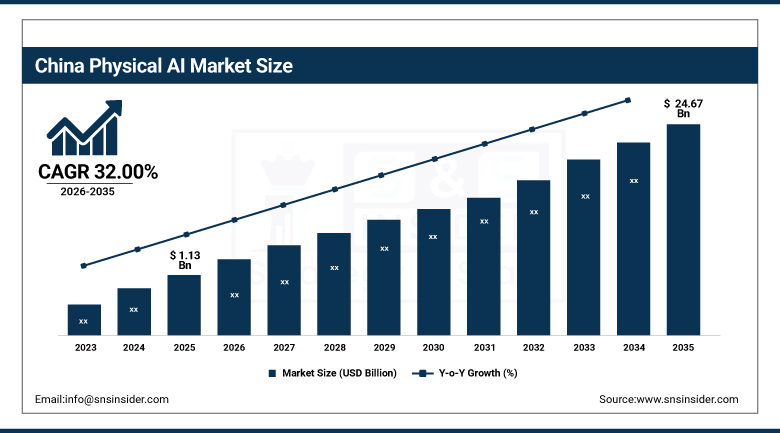
China Physical AI Market was valued at USD 1.13 Billion in 2025 and is expected to reach USD 24.67 Billion by 2035, growing at a CAGR of 32.00% from 2026-2035.
The China Physical AI Market is the largest in the Asia Pacific region, driven by the government’s national humanoid robotics industrial policy, a dense field of domestic manufacturers including UBTech and Mech-Mind Robotics, and aggressive local capital investment aimed at achieving technology self-sufficiency. China’s Ministry of Industry and Information Technology continues to fund regional robotics manufacturing clusters, while domestic AI labs race to close the gap with U.S. foundation model leaders in robot perception and control. Local manufacturers benefit from China’s established electronics and precision component supply chains, giving domestic humanoid and industrial robot builders a meaningful cost advantage. Multinational players including NVIDIA continue to supply compute hardware into the Chinese market even as domestic chip alternatives scale.
⮞In 2026, UBTECH Robotics partnered with Hitachi to explore humanoid robot applications in smart manufacturing, with Walker S2 undergoing operational testing in manufacturing environments, supporting China's transition toward intelligent industrial automation.
Asia Pacific Physical AI Market Segment Analysis
-
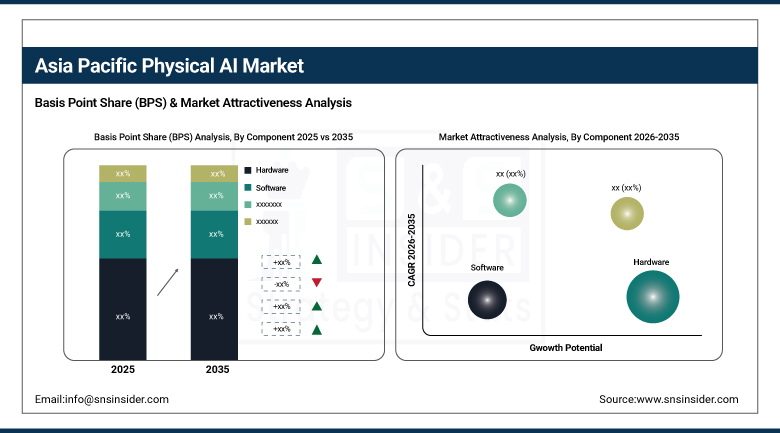
By Component, Hardware dominates the Asia Pacific Physical AI Market with 58.90% share in 2025; Software is expected to grow at the fastest CAGR of 36.70% from 2026–2035.
-
By Technology, Computer Vision dominates the Asia Pacific Physical AI Market with 44.10% share in 2025; Reinforcement Learning & Control Systems is expected to grow at the fastest CAGR of 34.20% from 2026–2035.
-
By Form Factor, Industrial Robots dominate the Asia Pacific Physical AI Market with 38.70% share in 2025; Humanoids are expected to grow at the fastest CAGR of 44.60% from 2026–2035.
-
By Application, Manufacturing & Automotive dominates the Asia Pacific Physical AI Market with 46.50% share in 2025; Logistics & Supply Chain is expected to grow at the fastest CAGR of 37.30% from 2026–2035.
By Component, Hardware Dominates the Asia Pacific Physical AI Market, Software Grows Fastest
Hardware holds the largest regional share given the scale of China’s domestic robot manufacturing base and the high unit cost of actuators, sensors, and compute modules in every deployed unit across the region’s established electronics supply chains. Japan’s FANUC and SoftBank Robotics, alongside China’s growing field of domestic manufacturers, continue to anchor this hardware-centric spending pattern across most commercial deployments. Continued investment in local R&D, manufacturing, and commercial partnerships is expected to reinforce this pattern through 2035 as deployment scales and competitive positioning evolves across the market.
Software is forecast to grow fastest as Chinese and South Korean AI labs race to develop foundation models for robot perception and control that can compete with U.S. platforms, converting what was once imported software dependency into a growing domestic software industry. Hyundai Motor Group’s investment in Boston Dynamics software capability is further accelerating this shift across the region. Growing engineering talent availability and expanding commercial deployment partnerships are expected to sustain this trajectory through the remainder of the forecast period.
By Technology, Computer Vision Dominates the Asia Pacific Physical AI Market, Reinforcement Learning & Control Systems Grows Fastest
Computer vision remains the largest technology category given its central role in quality inspection across the region’s massive electronics and automotive manufacturing base, where vision systems have already been widely deployed across Chinese, Japanese, and South Korean production lines over multiple technology cycles. Rising customer adoption and continued platform investment by leading manufacturers are expected to reinforce this trend across the market through 2035.
Reinforcement learning and control systems are growing fastest as Chinese and South Korean robotics labs increasingly apply simulation-based learning to humanoid locomotion and manipulation, aiming to close the technology gap with U.S. leaders in generalizable robot control. This dynamic is expected to persist through the remainder of the 2026-2035 forecast window as manufacturers and investors continue adjusting capacity and strategy to shifting physical AI demand.
By Form Factor, Industrial Robots Dominate the Asia Pacific Physical AI Market, Humanoids Grow Fastest
Industrial robots remain the largest form factor given Japan’s decades-long robotics manufacturing heritage through FANUC and the scale of China’s electronics and automotive assembly lines, where fixed robotic arms have already been deeply integrated into production processes across the region. Continued investment in local R&D, manufacturing, and commercial partnerships is expected to reinforce this pattern through 2035 as deployment scales and competitive positioning evolves across the market.
Humanoids are forecast to grow fastest as China’s government-backed manufacturers, South Korea’s Hyundai-backed Boston Dynamics, and Japan’s SoftBank Robotics each race to commercialize humanoid platforms, betting that flexible general-purpose robots will capture outsized value as the technology matures across the region. Growing engineering talent availability and expanding commercial deployment partnerships are expected to sustain this trajectory through the remainder of the forecast period.
By Application, Manufacturing & Automotive Dominates the Asia Pacific Physical AI Market, Logistics & Supply Chain Grows Fastest
Manufacturing and automotive applications dominate given the scale of China, Japan, and South Korea’s export-oriented electronics and automotive manufacturing sectors, which have relied on industrial robotics for decades and continue to represent the largest deployment base across the region. Rising customer adoption and continued platform investment by leading manufacturers are expected to reinforce this trend across the market through 2035.
Logistics and supply chain is set to post the fastest growth as China’s major e-commerce and warehousing operators rapidly deploy autonomous mobile robots to handle surging order volumes, supported by continued investment in automated fulfillment infrastructure across the region’s largest logistics hubs. This dynamic is expected to persist through the remainder of the 2026-2035 forecast window as manufacturers and investors continue adjusting capacity and strategy to shifting physical AI demand.
Regional Analysis
|
Region |
Major Country |
Share within Region, 2025 (%) |
|---|---|---|
|
Asia Pacific |
China |
61.70% |
|
Japan |
12.00% |
|
|
South Korea |
9.00% |
|
|
India |
8.00% |
|
|
Australia |
4.00% |
|
|
Rest of Asia Pacific |
5.30% |
China Physical AI Market Insights
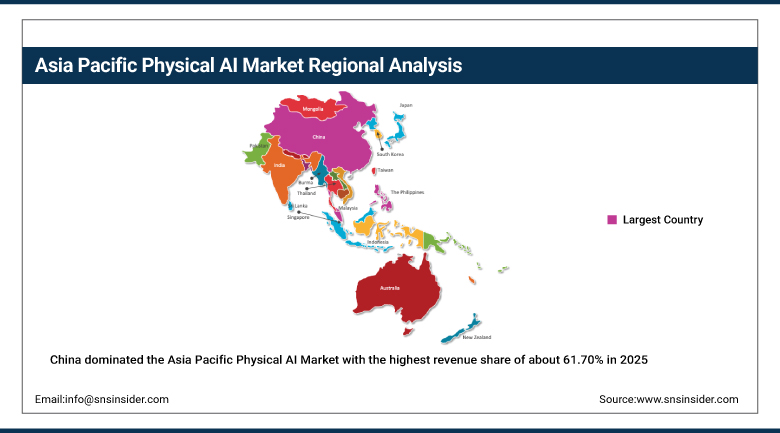
China dominated the Asia Pacific Physical AI Market with the highest revenue share of about 61.70% in 2025, supported by the government’s national humanoid robotics industrial policy, a dense field of domestic manufacturers, and aggressive local capital investment aimed at achieving technology self-sufficiency. Continued funding from China’s Ministry of Industry and Information Technology keeps China the leading national contributor to regional physical AI revenue. Continued investment in local R&D, manufacturing, and commercial partnerships is expected to reinforce this pattern through 2035 as deployment scales and competitive positioning evolves across the market.
China’s established electronics and precision component supply chains continue to give domestic humanoid and industrial robot manufacturers a meaningful cost advantage over international competitors. Expanding domestic chip alternatives and growing export ambitions for Chinese-made robotics hardware are expected to further reinforce China’s dominant position within the regional market through 2035. Growing engineering talent availability and expanding commercial deployment partnerships are expected to sustain this trajectory through the remainder of the forecast period.
Get Customized Report as per Your Business Requirement - Enquiry Now
South Korea Physical AI Market Insights
South Korea is expected to grow at the fastest CAGR of about 38.00% from 2026–2035, driven by Hyundai Motor Group’s aggressive investment in Boston Dynamics humanoid commercialization and growing government funding for domestic AI and robotics research initiatives. Rising corporate investment from Samsung and LG in robotics-adjacent AI capability is accelerating adoption faster than in any other Asia Pacific market. Rising customer adoption and continued platform investment by leading manufacturers are expected to reinforce this trend across the market through 2035.
Continued Hyundai investment in scaling Boston Dynamics humanoid production, combined with South Korea’s advanced semiconductor and battery manufacturing base, is reinforcing the country’s above-regional growth trajectory. Expanding national AI strategy funding is expected to further support this rapid growth through the remainder of the forecast period. This dynamic is expected to persist through the remainder of the 2026-2035 forecast window as manufacturers and investors continue adjusting capacity and strategy to shifting physical AI demand.
Japan Physical AI Market Insights
The Japan Physical AI Market benefits from FANUC and SoftBank Robotics’ decades-long industrial robotics leadership and a rapidly aging population that is driving growing demand for eldercare and service robotics applications, supported by strong national government interest in robotics as a demographic solution. Continued investment in local R&D, manufacturing, and commercial partnerships is expected to reinforce this pattern through 2035 as deployment scales and competitive positioning evolves across the market.
India Physical AI Market Insights
The India Physical AI Market is growing as the country’s expanding manufacturing base, supported by national production-linked incentive programs, increasingly adopts industrial robotics and automation to compete with established Southeast Asian and Chinese manufacturing hubs. Growing engineering talent availability and expanding commercial deployment partnerships are expected to sustain this trajectory through the remainder of the forecast period.
Australia Physical AI Market Insights
The Australia Physical AI Market is supported by growing adoption of autonomous mining and agricultural robotics, reflecting the country’s resource and agricultural sector focus relative to the manufacturing-heavy adoption patterns seen elsewhere in the region. Rising customer adoption and continued platform investment by leading manufacturers are expected to reinforce this trend across the market through 2035.
Rest of Asia Pacific Physical AI Market Insights
The Rest of Asia Pacific Physical AI Market, spanning Southeast Asian manufacturing hubs, is growing as regional governments fund digital manufacturing initiatives and multinational manufacturers expand automated production capacity across these emerging markets. This dynamic is expected to persist through the remainder of the 2026-2035 forecast window as manufacturers and investors continue adjusting capacity and strategy to shifting physical AI demand.
Market Dynamics
Growth Drivers: Government-backed industrial policy and growing domestic manufacturing capacity are sharply increasing physical AI adoption across Asia Pacific.
China’s national humanoid robotics industrial policy continues to fund rapid domestic manufacturing capacity expansion, while Hyundai Motor Group’s investment in Boston Dynamics is accelerating South Korean humanoid commercialization. Japan’s established robotics manufacturers are layering AI-driven perception onto decades-old industrial automation platforms, and India’s expanding manufacturing base is adopting industrial robotics at an accelerating pace. Lower-cost regional hardware manufacturing is giving Asia Pacific robot builders a meaningful cost edge that is broadening adoption across price-sensitive deployment segments throughout the region. Continued investment in local R&D, manufacturing, and commercial partnerships is expected to reinforce this pattern through 2035 as deployment scales and competitive positioning evolves across the market.
Restraints: Technology gaps with U.S. foundation models and uneven regulatory pathways continue to constrain broader adoption.
Most Asia Pacific robotics companies continue to trail U.S. foundation model leaders in general-purpose robot perception and control software, requiring continued catch-up investment even as hardware manufacturing scales rapidly. Regulatory pathways for new physical AI form factors vary significantly between China, Japan, India, and smaller Southeast Asian markets, creating uneven launch sequencing for multinational manufacturers. Export control tensions around advanced AI chips also create supply chain uncertainty for several regional manufacturers dependent on foreign compute hardware. Growing engineering talent availability and expanding commercial deployment partnerships are expected to sustain this trajectory through the remainder of the forecast period.
Opportunities: Expanding domestic manufacturing capacity and humanoid commercialization create substantial long-term growth potential.
China’s rapidly scaling domestic manufacturing base is expected to extend physical AI adoption well beyond its current export-oriented manufacturing applications into broader domestic logistics and service robotics use cases. Hyundai’s continued investment in Boston Dynamics humanoid commercialization is positioning South Korea for outsized growth as the technology matures. Continued government industrial policy support across China, Japan, and South Korea is also expected to gradually narrow the technology gap with U.S. foundation model leaders over the forecast period. Rising customer adoption and continued platform investment by leading manufacturers are expected to reinforce this trend across the market through 2035.
Recent Developments:
-
2025 : UBTech Robotics advanced its humanoid robot manufacturing and deployment partnerships with Chinese industrial manufacturers.
-
2025 : Hyundai Motor Group expanded its investment in Boston Dynamics to accelerate humanoid robot commercialization in South Korea.
-
2025 : FANUC advanced its AI-enabled industrial robot portfolio with new vision-guided models for Japanese manufacturers.
-
2025 : SoftBank Robotics Group expanded its service robotics partnerships across Japan’s eldercare and hospitality sectors.
Asia Pacific Physical AI Market key players are:
-
UBTech Robotics Corp.
-
Mech-Mind Robotics Technologies Ltd.
-
FANUC Corporation
-
SoftBank Robotics Group
-
Toyota Motor Corporation
-
Doosan Robotics Inc.
-
Hanson Robotics Limited
-
Hyundai Motor Group
-
Samsung Electronics Co., Ltd.
-
LG Electronics Inc.
-
Fourier Intelligence Pte. Ltd.
-
Unitree Robotics Co., Ltd.
-
Siasun Robot & Automation Co., Ltd.
-
Estun Automation Co., Ltd.
-
Kawasaki Heavy Industries, Ltd.
-
Yaskawa Electric Corporation
-
NVIDIA Corporation
-
Tata Consultancy Services Limited
-
Reliance Industries Limited
-
Keenon Robotics Co., Ltd.
Asia Pacific Physical AI Market Report Scope:
| Report Attributes | Details |
|---|---|
| Market Size in 2025 | USD 1.83 Billion |
| Market Size by 2035 | USD 32.94 Billion |
| CAGR | CAGR of 33.51% From 2026 to 2035 |
| Base Year | 2025 |
| Forecast Period | 2026-2035 |
| Historical Data | 2022-2024 |
| Report Scope & Coverage | Market Size, Segments Analysis, Competitive Landscape, Regional Analysis, DROC & SWOT Analysis, Forecast Outlook |
| Key Segments | • By Component (Hardware, Software, Services) • By Technology (Computer Vision, Natural Language Processing, Machine Learning & Deep Learning, Reinforcement Learning & Control Systems, Others) • By Form Factor (Industrial Robots, Cobots, Autonomous Mobile Robots, Humanoids, Drones & UAVs, Others) • By Deployment (On-device, Cloud-based AI, Hybrid) • By Application (Manufacturing & Automotive, Healthcare, Logistics & Supply Chain, Defense & Security, Agriculture, Others) |
| Regional Analysis/Coverage | North America (US, Canada), Europe (Germany, UK, France, Italy, Spain, Russia, Poland, Rest of Europe), Asia Pacific (China, India, Japan, South Korea, Australia, ASEAN Countries, Rest of Asia Pacific), Middle East & Africa (UAE, Saudi Arabia, Qatar, South Africa, Rest of Middle East & Africa), Latin America (Brazil, Argentina, Mexico, Colombia, Rest of Latin America). |
| Company Profiles | UBTech Robotics Corp., Mech-Mind Robotics Technologies Ltd., FANUC Corporation, SoftBank Robotics Group, Toyota Motor Corporation, Doosan Robotics Inc., Hanson Robotics Limited, Hyundai Motor Group, Samsung Electronics Co., Ltd., LG Electronics Inc., Fourier Intelligence Pte. Ltd., Unitree Robotics Co., Ltd., Siasun Robot & Automation Co., Ltd., Estun Automation Co., Ltd., Kawasaki Heavy Industries, Ltd., Yaskawa Electric Corporation, NVIDIA Corporation, Tata Consultancy Services Limited, Reliance Industries Limited, Keenon Robotics Co., Ltd. |

Frequently Asked Questions
Key players in the Asia Pacific Physical AI Market include UBTech Robotics Corp., Mech-Mind Robotics Technologies Ltd., FANUC Corporation, SoftBank Robotics Group, and Hyundai Motor Group, among others.
The market is driven by government-backed industrial policy, growing domestic manufacturing capacity, and rapid humanoid commercialization across the region.
The Hardware segment dominated the Asia Pacific Physical AI Market, accounting for approximately 58.90% share in 2025.
China dominated the Asia Pacific Physical AI Market in 2025 with a 61.70% share, supported by its government-backed robotics industrial policy and domestic manufacturing scale.
