
Abrasion Resistant Rubber Pipe Market Report Scope & Overview:
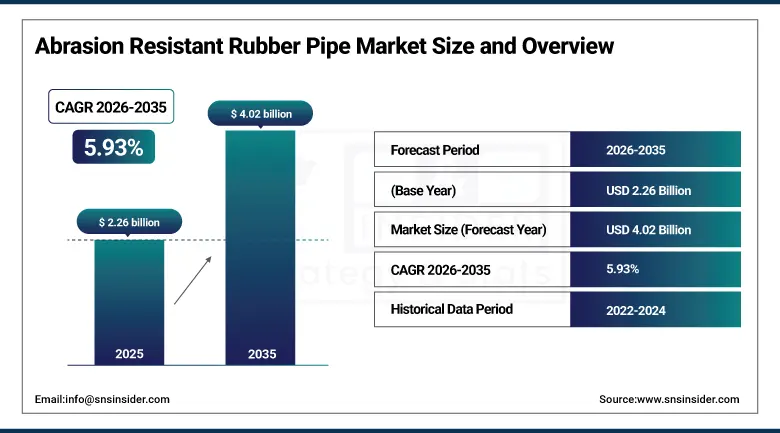
The Abrasion Resistant Rubber Pipe Market was valued at USD 2.26 billion in 2025 and is expected to reach USD 4.02 billion by 2035, growing at a CAGR of 5.93% from 2026–2035.
The Abrasion Resistant Rubber Pipe Market is experiencing steady global growth owing to increasing demand for durable and high-performance piping systems in mining, construction, and industrial slurry transport applications, along with rising need for efficient handling of abrasive fluids such as sand, cement, ore, and chemical mixtures. Expansion of mining and mineral processing activities, rapid infrastructure development, and growing industrialization in emerging economies are further supporting market growth. Advancements in rubber compounding technologies, development of high-strength synthetic elastomers, ceramic-lined hybrid pipes, and improved wear-resistant coatings are also accelerating global market expansion.
Government initiatives such as the U.S. Infrastructure Investment and Jobs Act, China’s industrial modernization plans, and the EU Green Deal are supporting adoption of abrasion-resistant pipe systems by promoting efficient slurry transport and sustainable infrastructure development.
Rising investments in mining and heavy industries are driving demand for durable alternatives to metal pipelines. Focus on reducing downtime and adopting IoT-based monitoring and predictive maintenance technologies is further accelerating market growth.
Market Size and Forecast
-
Market Size in 2025: USD 2.26 Billion
-
Market Size by 2035: USD 4.02 Billion
-
CAGR: 5.93% from 2026 to 2035
-
Base Year: 2025
-
Forecast Period: 2026–2035
-
Historical Data: 2022–2024
To Get more information on Abrasion Resistant Rubber Pipe Market - Request Free Sample Report
Abrasion Resistant Rubber Pipe Market Trends
-
Rising adoption of advanced abrasion-resistant rubber compounds is improving pipeline durability, wear resistance, and operational efficiency in mining and slurry transport applications globally.
-
Increasing demand from mining and mineral processing industries is accelerating the use of rubber-lined pipes for high-abrasion slurry, ore, and tailings transportation systems.
-
Growing deployment of rubber-lined steel and hybrid composite piping systems is enhancing strength, flexibility, and resistance in extreme industrial environments.
-
Rising replacement of conventional steel and PVC pipelines with abrasion-resistant rubber pipes is driven by lower maintenance costs and longer service life.
-
Expansion of industrial infrastructure and construction activities in emerging economies is boosting demand for high-performance piping solutions for cement, sand, and aggregate handling.
-
Development of synthetic rubber and thermoplastic elastomer-based pipes is improving chemical resistance, temperature tolerance, and performance in harsh operating conditions.
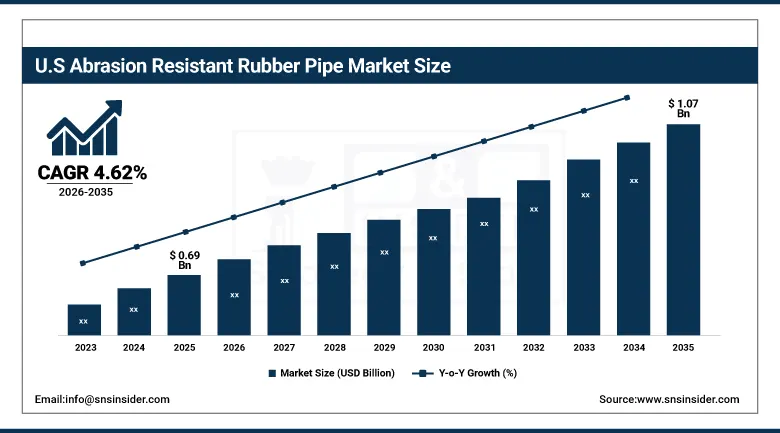
U.S. Abrasion Resistant Rubber Pipe Market was valued at USD 0.69 billion in 2025 and is expected to reach around USD 1.07 billion by 2035, growing at a CAGR of 4.62% from 2026–2035.
U.S. Abrasion Resistant Rubber Pipe Market is considered one of the most advanced industrial piping markets globally owing to strong mining, oil & gas, construction, and chemical processing infrastructure, along with increasing demand for high-durability piping systems for abrasive slurry, cement, sand, and industrial waste transport. Major companies such as Trelleborg AB, Parker Hannifin Corporation, Eaton Corporation, and The Weir Group are actively focusing on expanding high-performance rubber-lined pipe solutions and advanced wear-resistant industrial hose systems.
Strict safety regulations, infrastructure modernization, and growing adoption of cost-efficient pipeline solutions are driving demand for abrasion-resistant rubber pipes in the U.S. Rising focus on reducing downtime and improving operational efficiency is further supporting investments in advanced rubber materials and smart pipeline technologies.
Abrasion Resistant Rubber Pipe Market Segment Analysis
-
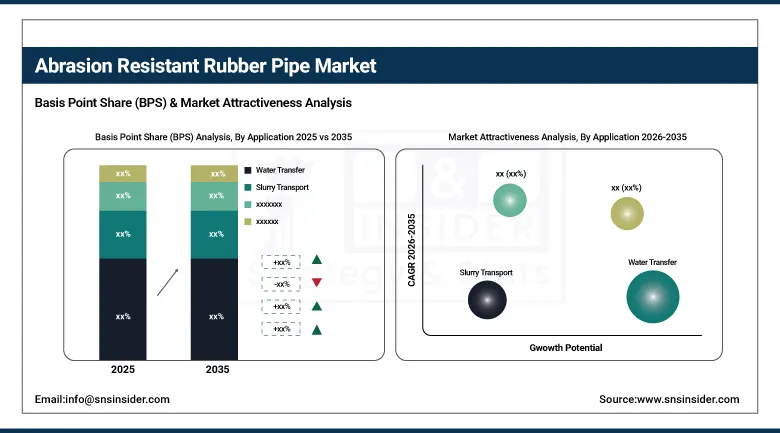
By Application, Water Transfer dominated the Abrasion Resistant Rubber Pipe Market with 28.45% share in 2025; Slurry Transport fastest growing (CAGR).
-
By Type, Natural Rubber dominated the Abrasion Resistant Rubber Pipe Market with 44.85% share in 2025; Thermoplastic Elastomers fastest growing (CAGR).
-
By End Use Industry, Mining Minerals dominated the Abrasion Resistant Rubber Pipe Market with 35.12% share in 2025; Chemicals and Materials fastest growing (CAGR).
-
By Temperature Resistance, High Temperature dominated the Abrasion Resistant Rubber Pipe Market with 39.96% share in 2025; Medium Temperature fastest growing (CAGR).
By Application, Water Transfer dominates the Abrasion Resistant Rubber Pipe Market, while Slurry Transport is the fastest-growing segment.
Water Transfer segment dominated the Abrasion Resistant Rubber Pipe Market with the highest revenue share of about 28.45% in 2025 owing to increasing demand for efficient fluid transportation systems across mining, industrial processing, irrigation, and municipal water management applications. High durability, corrosion resistance, flexibility, and low maintenance requirements further supported widespread adoption in continuous water handling operations.
Slurry Transport segment is expected to grow at the fastest CAGR from 2026–2035 due to rising mining exploration activities, increasing demand for mineral processing, and expanding use of abrasive material handling systems in industrial sectors. Growing need for high-performance pipes capable of withstanding harsh slurry conditions and reducing operational downtime is accelerating segment growth.
By Type, Natural Rubber dominates the Abrasion Resistant Rubber Pipe Market, while Thermoplastic Elastomers are the fastest-growing segment.
The Natural Rubber segment held the dominant market position in the Abrasion Resistant Rubber Pipe Market by registering the largest share in terms of revenue contribution at about 44.85% in 2025 owing to high flexibility, high abrasion resistance, high tensile strength, and cost-efficiency in the transportation of slurries and industrial goods. It was most preferred on account of high toughness.
Thermoplastic Elastomers segment will exhibit the highest CAGR during 2026 to 2035 due to the rising demands for light weight, eco-friendly, and chemical resistance material for pipes. The reasons behind their high demand include durability, ease of processing, low maintenance, and increasing usage in fluid transfer applications.
By End Use Industry, Mining Minerals dominates the Abrasion Resistant Rubber Pipe Market, while Chemicals and Materials is the fastest-growing segment.
Mining Minerals segment dominated the Abrasion Resistant Rubber Pipe Market with the highest revenue share of about 35.12% in 2025 due to extensive use of abrasion-resistant pipes in slurry transportation, ore processing, tailings handling, and mineral extraction operations. Growing global mining activities and increasing demand for durable, high-pressure piping systems further supported the segment’s strong market dominance.
Chemicals and Materials segment is expected to grow at the fastest CAGR from 2026–2035 owing to rising demand for corrosion and abrasion-resistant piping solutions in chemical processing plants and material handling applications.
By Temperature Resistance, High Temperature dominates the Abrasion Resistant Rubber Pipe Market, while Medium Temperature is the fastest-growing segment.
High Temperature segment dominated the Abrasion Resistant Rubber Pipe Market with the highest revenue share of about 39.96% in 2025 owing to its extensive usage in mining, power generation, metallurgy, and chemical processing industries where pipes are exposed to extreme heat, abrasive slurry materials, and harsh operating conditions requiring superior durability, thermal stability, and longer service life.
Medium Temperature segment is expected to grow at the fastest CAGR from 2026–2035 due to increasing adoption across water treatment, industrial processing, construction, and manufacturing applications that require cost-effective abrasion resistance with moderate thermal performance.
Regional Insights
|
Region |
Major Country |
Share (%) |
|---|---|---|
|
North America |
United States |
82.35% |
|
Europe |
Germany |
33.25% |
|
Asia Pacific |
China |
39.80% |
|
Middle East & Africa |
UAE |
21.35% |
|
Latin America |
Brazil |
45.60% |
North America Abrasion Resistant Rubber Pipe Market Insights
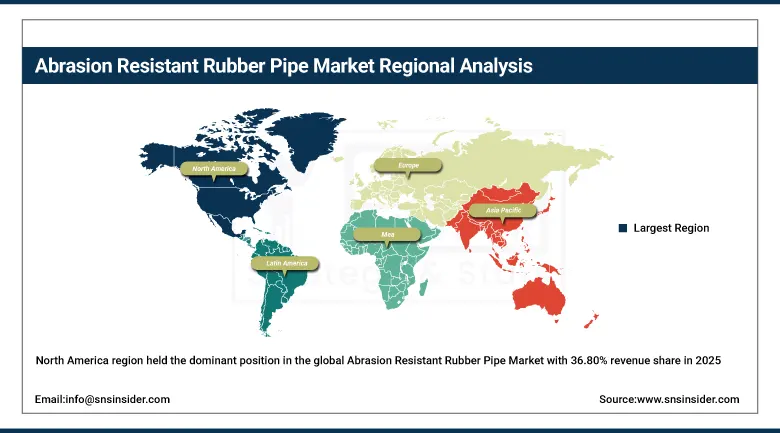
The North America region held the dominant position in the global Abrasion Resistant Rubber Pipe Market with 36.80% revenue share in 2025 owing to strong industrial infrastructure, high mining and oil & gas activity, and rising demand for durable slurry transport systems. The market growth is further supported by advanced manufacturing capabilities and increasing replacement of traditional steel pipelines with rubber-lined systems for improved efficiency and reduced maintenance. The United States remains the leading country due to large-scale mining operations, construction activities, and heavy industrial applications requiring high abrasion resistance piping solutions.
Get Customized Report as per Your Business Requirement - Enquiry Now
Asia Pacific Abrasion Resistant Rubber Pipe Market Insights
Asia Pacific is projected to register the highest CAGR of 7.42% from 2026–2035, driven by rapid industrialization, expanding mining activities, and increasing infrastructure development projects. The Asia-Pacific region is expected to witness the fastest growth rate in the Abrasion Resistant Rubber Pipe Market owing to rising demand for efficient slurry handling systems and growing investments in construction and mineral processing industries across countries such as China, India, and Australia.
China holds a strong share in the Asia Pacific Abrasion Resistant Rubber Pipe Market due to large-scale mining, industrial growth, and infrastructure expansion. India, Japan, South Korea, and Australia are also driving demand through mining and infrastructure development and increasing use of abrasion-resistant pipes.
Europe Abrasion Resistant Rubber Pipe Market Insights
The Abrasion Resistant Rubber Pipe Market is highly significant in Europe because of strong demand from chemical processing industries, mining operations, and advanced infrastructure systems. Major countries include Germany, the UK, France, and Italy. Rising focus on industrial efficiency, sustainability, and reduced operational downtime is driving market growth across the region.
European industrial safety and environmental regulations are supporting adoption of high-performance rubber piping systems. The region is witnessing increasing use of abrasion-resistant pipes in chemical transport, wastewater management, and heavy-duty industrial applications.
Middle East & Africa and Latin America Abrasion Resistant Rubber Pipe Market Insights
The Middle East & Africa region is witnessing steady growth in the Abrasion Resistant Rubber Pipe Market owing to increasing mining activities, oil & gas expansion, and rising industrial infrastructure development. UAE, Saudi Arabia, and South Africa are emerging as key regional markets due to growing investments in industrial modernization and resource extraction projects.
In Latin America, countries such as Brazil and Chile are contributing to market growth due to expanding mining operations, infrastructure development, and increasing demand for slurry and mineral transport systems. Favourable industrial expansion and rising adoption of durable piping solutions are further supporting regional market growth.
Growth Drivers: Rising demand from mining and slurry-intensive industries driving abrasion-resistant rubber pipe adoption globally
With the increasing exploitation of mining and mineral processing operations, the requirement for abrasion-resistant rubber pipes is on a rise because of their ability to effectively convey highly abrasive materials such as slurries, ores, and tailings. Operations within the mining industry necessitate pipes that can withstand the wear caused and have high wear resistance in order to ensure that breakdowns and downtimes can be reduced to a minimum. They can withstand impacts better than ordinary steel pipes and last longer. The rising mineral extraction around the globe, particularly in Asia-Pacific, North America, and Latin America regions, has contributed immensely.
Restraints: Availability of Alternative Pipe Materials and Performance Limitations Under Extreme Pressure Conditions Restricting Wider Market Expansion
Increased accessibility of various kinds of piping material including high-density polyethylene, alloyed steel, ceramic lined pipes, and composites creates intense competition for abrasion-resistant rubber pipe producers. Various industries may choose their preferred alternative depending on operational specifications, which include pressure resistance, chemical resistance, and thermal tolerance. Rubber pipes may lack some operational capabilities in terms of very high pressure situations and highly corrosive applications; hence, limiting their use in various industries. Longevity in extreme environmental conditions may also be considered when making choices about purchasing products by potential customers. There will be continued challenges for market growth because of increased technological performances of alternative substitute material.
Opportunities: Rapid Expansion of Renewable Energy, Dredging, and Wastewater Treatment Industries Creating New Growth Potential for Rubber Pipe Manufacturers
Growing investment in renewable energy projects, dredging activities, and effluent treatment plants has created significant opportunities for abrasion resistant rubber pipe manufacturers. These applications require durable pipe systems capable of handling abrasive materials, sludge, slurry, and industrial waste efficiently. Government investments in environmental management and industrial infrastructure are supporting demand for advanced rubber piping solutions. Increasing focus on reducing maintenance costs and improving operational efficiency is further driving market growth. Continuous innovations and developments in rubber piping technologies are expected to create additional growth opportunities in the coming years.
Recent Developments
-
2026: Expansion of abrasion-resistant rubber pipe systems increased across North America and Asia-Pacific due to rising demand from mining and slurry transport industries handling abrasive materials.
-
2025: Major companies such as Trelleborg AB, Parker Hannifin, and The Weir Group expanded abrasion-resistant rubber hose and pipe portfolios using advanced synthetic rubber materials
-
2024: Adoption of rubber-lined abrasion-resistant piping solutions increased across mining, construction, and chemical industries due to infrastructure modernization and replacement of traditional steel pipelines.
Abrasion Resistant Rubber Pipe Market Key Players
-
Trelleborg AB
-
Continental AG
-
Gates Corporation
-
Eaton Corporation
-
The Weir Group
-
Goodyear Tire & Rubber Company
-
Bridgestone Corporation
-
Semperit AG Holding
-
Kuriyama Holdings Corporation
-
Flexicraft Industries
-
Hose Master LLC
-
Saint-Gobain Performance Plastics
-
Polyhose India Pvt. Ltd.
-
Kanaflex Corporation
-
RYCO Hydraulics
-
Novaflex Group
-
Salem-Republic Rubber Company
-
Pacific Hoseflex
Abrasion Resistant Rubber Pipe Market Report Scope:
| Report Attributes | Details |
|---|---|
| Market Size in 2025 | USD 2.26 Billion |
| Market Size by 2035 | USD 4.02 Billion |
| CAGR | CAGR of 5.93% From 2026 to 2035 |
| Base Year | 2025 |
| Forecast Period | 2026-2035 |
| Historical Data | 2022-2024 |
| Report Scope & Coverage | Market Size, Segments Analysis, Competitive Landscape, Regional Analysis, DROC & SWOT Analysis, Forecast Outlook |
| Key Segments | • By Application (Water Transfer, Slurry Transport, Mining, Construction, Chemicals and Materials) • By Type (Natural Rubber, Synthetic Rubber, Thermoplastic Elastomers) • By End Use Industry (Mining Minerals, Construction, Oil Gas, Agriculture, Chemicals and Materials) • By Temperature Resistance (High Temperature, Medium Temperature, Low Temperature) |
| Regional Analysis/Coverage | North America (US, Canada), Europe (Germany, UK, France, Italy, Spain, Russia, Poland, Rest of Europe), Asia Pacific (China, India, Japan, South Korea, Australia, ASEAN Countries, Rest of Asia Pacific), Middle East & Africa (UAE, Saudi Arabia, Qatar, South Africa, Rest of Middle East & Africa), Latin America (Brazil, Argentina, Mexico, Colombia, Rest of Latin America). |
| Company Profiles | Trelleborg AB, Parker Hannifin Corporation, Continental AG, Gates Corporation, Eaton Corporation, The Weir Group, Goodyear Tire & Rubber Company, Bridgestone Corporation, Semperit AG Holding, Kuriyama Holdings Corporation, Flexicraft Industries, Hose Master LLC, Dunlop Hiflex, Saint-Gobain Performance Plastics, Polyhose India Pvt. Ltd., Kanaflex Corporation, RYCO Hydraulics, Novaflex Group, Salem-Republic Rubber Company, Pacific Hoseflex |
Frequently Asked Questions
The Abrasion Resistant Rubber Pipe Market is expected to grow at a CAGR of 5.93% from 2026 to 2035
Increasing demand from mining, slurry transport, construction, and industrial processing industries for durable and abrasion-resistant piping systems is the major growth factor driving the market.
The Abrasion Resistant Rubber Pipe Market was valued at USD 2.26 billion in 2025.
The Water Transfer segment dominated the Abrasion Resistant Rubber Pipe Market in 2025.
North America dominated the Abrasion Resistant Rubber Pipe Market in 2025.
Get in Touch
