
Adventure Tourism Market Report Scope & Overview:
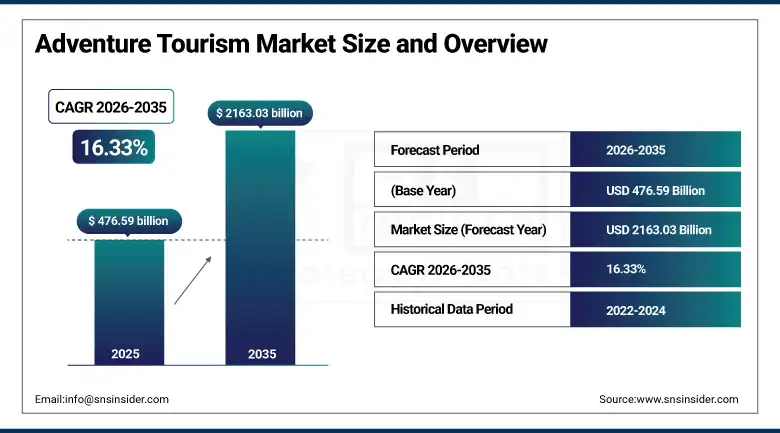
The Adventure Tourism Market was valued at USD 476.59 Billion in 2025 and is expected to reach USD 2163.03 Billion by 2035, growing at a CAGR of 16.33% from 2026 to 2035.
The Adventure Tourism Market is growing rapidly due to increased consumer demand for experiential travel and recreational or nature-based tourism experiences. Higher levels of disposable income, particularly amongst younger tourists, have resulted in greater engagement in adventure pursuits like trekking, water sports, and wildlife safaris. Increased online booking portals and improved travel connections are facilitating access to adventure sites. The increasing popularity of health and wellness-related vacations is another factor aiding market growth. Moreover, the involvement of governments in encouraging eco-tourism and sustainable tourism is fueling growth alongside the popularity of corporate travel programs for team building exercises.
According to the UN World Tourism Organization (UNWTO), global international tourist arrivals reached approximately 1.3 billion in 2023, reflecting a strong recovery and nearing pre-pandemic levels, driven by reopening destinations and renewed international travel demand worldwide tourism activity globally. According to the UNWTO, tourism accounts for about 3–4% of global GDP directly, and up to 10% when including indirect impacts, highlighting its significant contribution to employment, services, and broader economic development worldwide across economies sectors.
Market Size and Forecast
-
Market Size in 2026E: USD 554.48 Billion
-
Market Size by 2035: USD 2163.03 Billion
-
CAGR: 16.33% from 2026 to 2035
-
Fastest Growing Region: Asia Pacific
-
Largest Region: Europe
To Get more information On Adventure Tourism Market - Request Free Sample Report
Adventure Tourism Market Trends
-
Rising consumer preference for experiential travel and outdoor activities is driving the adventure tourism market.
-
Growing interest in activities such as trekking, mountaineering, scuba diving, and wildlife safaris is boosting market growth.
-
Expansion of global travel connectivity and tourism infrastructure is fueling destination accessibility.
-
Increasing focus on wellness, exploration, and offbeat travel experiences is shaping adoption trends.
-
Advancements in travel booking platforms, digital navigation tools, and safety equipment are enhancing traveler experience and security.
The U.S. Adventure Tourism Market Outlook
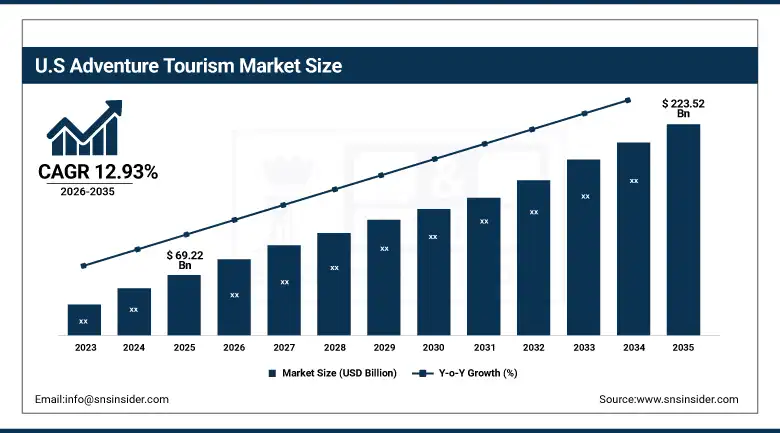
The U.S. Adventure Tourism Market was valued at USD 69.22 Billion in 2025 and is expected to reach USD 223.52 Billion by 2035, growing at a CAGR of 12.93%.
The United States is the world's largest domestic adventure tourism market and one of the largest international adventure travel origin countries, supported by exceptional national park and public land infrastructure, a deeply embedded outdoor recreation culture, and a consumer economy whose discretionary travel spending capacity sustains premium adventure experience investment across the domestic market.
The American Outdoor Industry Association documented 168 million active outdoor recreation participants in the United States in 2024, generating USD 780 billion in direct consumer spending on outdoor recreation products and experiences.
Adventure Tourism Market Segment Analysis
-
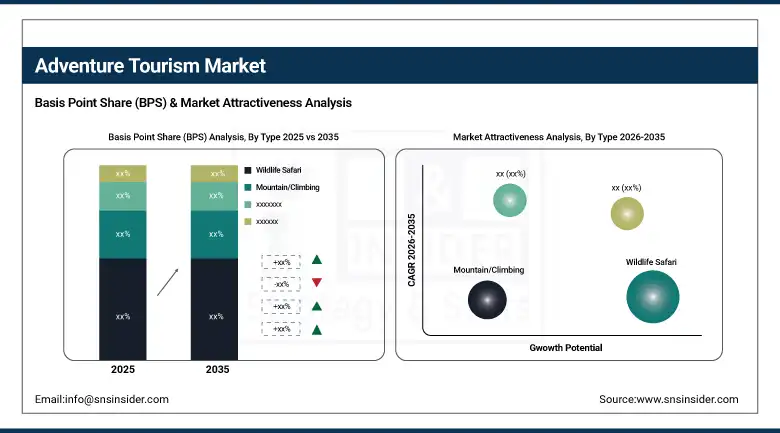
By Type, Wildlife Safari segment dominated the Adventure Tourism Market in 2025 with 29% share; Eco-Adventure segment is the fastest growing segment.
-
By Activity, Trekking & Hiking segment dominated the market in 2025 with 26% share; Paragliding segment is the fastest growing segment.
-
By Traveler Type, Solo segment dominated the market in 2025 with 31% share; Group segment is the fastest growing segment.
-
By Booking Mode, Online Travel Agencies segment dominated the market in 2025 with 48% share; Direct Booking segment is the fastest growing segment.
-
By Accommodation Type, Hotels & Resorts segment dominated the market in 2025 with 42% share; Adventure Camps segment is the fastest growing segment.
-
By Purpose, Leisure segment dominated the market in 2025 with 44% share; Corporate/Team Building segment is the fastest growing segment.
By Type, wildlife safari segment dominates the adventure tourism market, eco-adventure segment expected to grow fastest
Wildlife Safari dominated the Adventure Tourism Market in 2025 due to its popularity as an experience-oriented travel offering that provides a thrilling experience of close interaction with exotic wildlife in nature. Increased awareness of the importance of preserving biological diversity, established and well-marketed safari locations, and improved infrastructure for conservation efforts have greatly increased participation. Growth in disposable incomes and increasing preference for experience travel also contributed to demand. Marketing by government bodies and travel agencies made the wildlife safari one of the most popular adventure tourism experiences.
The Eco-Adventure segment is the fastest growing because of increasing global awareness about sustainable tourism practices. More and more travelers are opting for environmentally friendly experiences that not only involve experiencing the outdoors but also preserving biodiversity and engaging with communities. The preference for responsible tourism practices, carbon-neutral vacations, and authentic outdoor experiences has resulted in rapid growth in this area. Governments and travel agencies also played their part by promoting eco-certified and sustainable destinations.
By Activity, trekking & hiking segment dominates the adventure tourism market, paragliding segment expected to grow fastest
Trekking & Hiking dominated the market in 2025 due to its affordability, accessibility, and availability on varied geographic terrains. Trekking & Hiking has an appeal to both novice and seasoned adventure travelers, making it one of the most preferred outdoor activities. The popularity of trekking & hiking routes that are well established, increased consciousness towards physical well-being, and preference for nature-oriented trips have enhanced its acceptance. Additionally, minimal investment in specialist equipment is needed to undertake such activities. This explains the large market share of the activity.
Paragliding is the fastest growing segment owing to its increasing preference among tourists looking for high-adrenaline and thrilling aerial adventure activities. Improved technology in terms of equipment and training facilities has enabled more tourists to engage in the activity. Moreover, the rising inclination toward experience-based tourism and the increasing number of adventure tourism locations around mountains and coastlines has boosted demand. Social media has played a crucial role in increasing the number of tourists interested in the activity.
By Traveler Type, solo segment dominates the adventure tourism market, group segment expected to grow fastest
The Solo segment dominated the market in 2025 because more people are looking for flexible and personalized adventure experiences when travelling alone. Higher confidence levels for solo travel, development of booking websites, and enhanced safety structures have enabled more individuals to travel independently. Adventure tourism firms now provide special packages that are aimed at helping solo travellers to have unique experiences. Increased importance on discovery, flexibility in designing itinerary plans, and experiential travels are some of the reasons why this segment performs well.
The Group segment is the fastest growing because of the rising demand for adventure experiences that can be undertaken by a group. Group travelling provides cost savings, safety, and an opportunity to engage with others socially. More companies and education establishments are organizing group travels for their members; therefore, leading to higher demand for this type of travel experiences. Travel operators are also providing special packages for those groups who are interested in having adventure experiences.
By Booking Mode, online travel agencies segment dominates the adventure tourism market, direct booking segment expected to grow fastest
Online Travel Agencies dominated the market in 2025 owing to their ease of use, availability of diverse options, and comparison of prices and experiences. Digitization of travel planning processes and high rates of smartphone adoption make online booking an attractive option for majority of travelers. OTAs offer bundled packages, traveler reviews, convenient cancelation terms, and discounts, making them extremely popular with the customers. Their worldwide presence and smooth booking processes are further contributing factors to their dominance in adventure tourism.
Direct Booking is the fastest growing segment due to consumers’ increasing preference for booking their trips through websites or mobile apps owned by the adventure travel operators to save from paying additional intermediary charges and get special offers. The enhanced technology and loyalty programs adopted by adventure travel operators are helping to create this trend. Better engagement by the adventure travel operators has also contributed to increased use of direct booking.
Regional Analysis
|
Region |
Major Country |
Share within Region, 2025 (%) |
|---|---|---|
|
Europe |
France |
22.84% |
|
North America |
United States |
84.73% |
|
Asia Pacific |
China |
32.84% |
|
Middle East & Africa |
UAE |
24.73% |
|
Latin America |
Brazil |
43.84% |
North America Adventure Tourism Market Insights
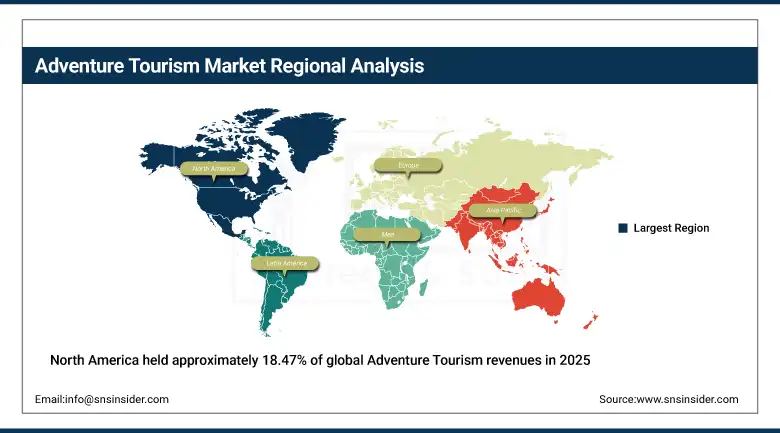
North America held approximately 18.47% of global Adventure Tourism revenues in 2025, with the United States accounting for approximately 84.73% of regional revenue through its world-class national park system, vast public land adventure recreation infrastructure, and a domestic adventure tourism operator ecosystem whose commercial scale and geographic reach is unmatched globally.
According to the US National Park Service (NPS), US national parks recorded over 325 million recreational visits in 2023, representing one of the highest global outdoor tourism volumes, driven by hiking, wildlife viewing, camping, and nature-based travel demand.
According to the U.S. Bureau of Economic Analysis (BEA), outdoor recreation contributes over $1 trillion to the U.S. economy, including adventure tourism, hiking, water sports, and wildlife activities, highlighting its major role in employment and GDP contribution.
Canada contributes significant regional demand through its Rocky Mountain adventure tourism, Arctic expedition travel, coastal sea kayaking, and wilderness camping offerings whose natural environment quality and remoteness attract both domestic and international adventure travellers seeking undisturbed wilderness experiences increasingly difficult to find in more densely populated adventure destinations.
According to Parks Canada, national parks receive over 25 million visits annually, supporting trekking, camping, and wildlife tourism, driven by increasing demand for nature-based travel experiences and outdoor recreation among domestic and international visitors across destinations.
Get Customized Report as per Your Business Requirement - Enquiry Now
Europe Adventure Tourism Market Insights
Europe dominated the global Adventure Tourism market in 2025, holding approximately 37.90% of global revenues. The continent's leadership reflects its extraordinary geographic diversity from Arctic Norway to Alpine Switzerland to Mediterranean coast wilderness trails, its well-developed outdoor recreation and adventure tourism infrastructure, and a consumer culture that places high value on active, nature-immersive, and culturally enriching travel experiences.
France accounts for approximately 22.84% of European revenues through its world-leading alpine tourism infrastructure, its camino and long-distance hiking trail network, and its role as the world's most visited country whose adventure tourism component attracts millions of international visitors to its mountain, coastal, and rural adventure destinations annually.
According to the European Commission tourism statistics, EU residents make over 2.8 billion tourism trips annually, with a significant share focused on domestic nature and outdoor travel, reflecting strong preference for accessible, experience-driven leisure activities across Europe.
Asia Pacific Adventure Tourism Market Insights
Asia Pacific is the fastest-growing regional Adventure Tourism market, driven by rapid middle-class income growth creating new adventure travel consumers across China, India, Southeast Asia, Australia, and New Zealand, improved air connectivity enabling access to previously remote adventure destinations, and the explosive growth of domestic and international adventure travel among young Asian consumers whose travel aspirations are shaped by social media exposure to global adventure destinations.
According to the UN World Tourism Organization (UNWTO) Asia-Pacific Tourism Report, Asia-Pacific accounts for over 30% of global international tourist arrivals, highlighting its growing role in global tourism flows driven by regional mobility and rising demand.
China accounts for approximately 32.84% of Asia Pacific revenues through its enormous domestic adventure tourism market in national parks, mountain regions, and coastal destinations, combined with growing outbound adventure travel whose rapid income growth creates demand for international adventure experiences.
According to the Ministry of Culture and Tourism of the People's Republic of China, China supports over 6 billion domestic tourist trips annually including mountain trekking eco-tourism and adventure parks reflecting massive domestic travel demand and infrastructure scale.
MEA & Latin America Adventure Tourism Market Insights
Middle East and Latin America are commercially significant and growing Adventure Tourism markets whose exceptional natural environments, diverse cultural heritage, and improving tourism infrastructure are creating expanding adventure destination appeal for both regional and international travellers. The UAE leads MEA revenues at approximately 24.73% of the regional total through its desert safari tourism infrastructure, its development of adventure sports facilities in Dubai and Abu Dhabi, and its role as a regional aviation hub whose connectivity enables both domestic and international adventure travel.
Brazil leads Latin American revenues at approximately 43.84% of the regional total through its Amazon rainforest ecotourism, Pantanal wildlife safari, and Atlantic coast adventure surfing and diving destinations whose global reputation attracts substantial international adventure traveller volumes alongside large domestic adventure recreation participation.
Market Dynamics
Growth Drivers: Post-pandemic shift toward experiential travel and social media-driven discovery is structurally increasing adventure tourism demand globally.
Adventure tourism's commercial growth is driven by the structural alignment between what contemporary consumers, particularly millennials and Generation Z, want from their discretionary spending and what adventure tourism uniquely delivers. Experiences over possessions as a spending philosophy is documented across multiple generations of consumer research, and adventure travel represents the category of experience whose emotional impact, memorable intensity, personal growth potential, and social media shareability most comprehensively satisfies the experience-seeker's spending motivation.
The UNWTO's documentation that adventure tourism grew 40% faster than conventional tourism in the post-pandemic recovery period confirms a structural consumer preference shift rather than a temporary post-lockdown release of pent-up demand. Social media platforms including Instagram and TikTok whose algorithmic amplification of visually compelling adventure content drives destination discovery and aspiration among global audiences continue to generate demand cycles in which viral destination content creates traveller interest that tour operators and infrastructure developers respond to commercially.
Restraints: Climate change impacts on adventure destinations and safety incident liability concerns constrain specific activity and destination market development.
Climate change is progressively affecting adventure tourism viability across sensitive destination categories. Alpine operations experience shorter seasons as glacier retreat and snowpack reduction alter their physical environment. Coral reef diving destinations suffer bleaching events that degrade underwater ecosystems. Wildfire risks are extending limitation periods at forest and wilderness destinations across North America, Australia, and Southern Europe. Operators and destinations must invest in climate adaptation strategies and seasonal flexibility that manage environmental change without eliminating the natural quality making adventure destinations commercially attractive.
Opportunities: Emerging destinations and sustainability-focused tourism are creating high-value growth opportunities and differentiated positioning for adventure tourism operators.
Geographic diversification of adventure tourism into emerging and less-visited destinations represents both a commercial opportunity for forward-looking operators and a sustainability imperative as overcrowding at overtouristed adventure destinations including Iceland, Patagonia, and Nepal's Everest region creates environmental damage and experience quality degradation. Destinations including Greenland, Bhutan, Rwanda, Kazakhstan, and the Faroe Islands are attracting growing adventurous traveller volumes whose willingness to pay premium prices for exclusive, uncrowded, and authentic adventure experiences creates commercial viability for small-scale, high-impact adventure tourism that distributes economic benefit to local communities with minimal environmental impact.
Recent Developments:
-
2025: G Adventures expanded its Wanderers & Warriors women-only adventure tour collection with 45 new itineraries across 30 countries, responding to record demand from the fastest-growing adventure tourism demographic and establishing a dedicated programme architecture for women solo travellers seeking community, safety structure, and independent discovery simultaneously.
-
2025: Intrepid Travel reported record USD 750 million annual revenue driven by exceptional small group adventure travel demand, validating the commercial viability of carbon-neutral, indigenous community-partnered adventure tourism whose sustainability credentials are primary purchase motivators for its millennial and Generation Z customer demographic.
-
2024: REI Adventures launched a dedicated climate change impact series of conservation-active adventure tours across 12 destinations, integrating habitat restoration volunteer activities, conservation organisation partnerships, and climate scientist-guided interpretation into adventure travel itineraries that appeal to environmentally motivated travellers seeking tourism participation that contributes to rather than exploits the natural environments they visit.
Adventure Tourism Market Key Players are:
-
TUI Group
-
Expedia Group
-
Thomas Cook
-
Travelopia
-
Intrepid Travel
-
G Adventures
-
REI Adventures
-
Abercrombie & Kent
-
Butterfield & Robinson
-
Mountain Travel Sobek
-
Austin Adventures
-
Natural Habitat Adventures
-
Backroads
-
National Geographic Expeditions
-
Exodus Travels
-
ROW Adventures
-
Wild Frontiers Adventure Travel
-
O.A.R.S.
-
Geckos Adventures
-
World Expeditions
Adventure Tourism Market Report Scope:
| Report Attributes | Details |
|---|---|
| Market Size in 2025 | USD 476.59 Billion |
| Market Size by 2035 | USD 2163.03 Billion |
| CAGR | CAGR of 16.33% From 2026 to 2035 |
| Base Year | 2025 |
| Forecast Period | 2026-2035 |
| Historical Data | 2022-2024 |
| Report Scope & Coverage | Market Size, Segments Analysis, Competitive Landscape, Regional Analysis, DROC & SWOT Analysis, Forecast Outlook |
| Key Segments | • By Type (Eco-Adventure, Wildlife Safari, Mountain/Climbing, Water Sports, Extreme Sports, Others) • By Activity (Trekking & Hiking, Rafting & Kayaking, Paragliding, Bungee Jumping, Scuba Diving, Mountain Biking, Skiing & Snowboarding, Others) • By Traveler Type (Solo, Family, Group, Corporate, Students, Others) • By Booking Mode (Online Travel Agencies, Direct Booking, Travel Agents, Tour Operators, Others) • By Accommodation Type (Hotels & Resorts, Campsites, Lodges, Adventure Camps, Others) • By Purpose (Leisure, Recreation, Fitness & Wellness, Corporate/Team Building, Others) |
| Regional Analysis/Coverage | North America (US, Canada), Europe (Germany, UK, France, Italy, Spain, Russia, Poland, Rest of Europe), Asia Pacific (China, India, Japan, South Korea, Australia, ASEAN Countries, Rest of Asia Pacific), Middle East & Africa (UAE, Saudi Arabia, Qatar, South Africa, Rest of Middle East & Africa), Latin America (Brazil, Argentina, Mexico, Colombia, Rest of Latin America). |
| Company Profiles | TUI Group, Expedia Group, Thomas Cook, Travelopia, Intrepid Travel, G Adventures, REI Adventures, Abercrombie & Kent, Butterfield & Robinson, Mountain Travel Sobek, Austin Adventures, Natural Habitat Adventures, Backroads, National Geographic Expeditions, Exodus Travels, ROW Adventures, Wild Frontiers Adventure Travel, O.A.R.S., Geckos Adventures, World Expeditions |
Frequently Asked Questions
The Adventure Tourism Market is expected to grow at a CAGR of 16.33% from 2026 to 2035.
The Adventure Tourism Market was valued at USD 476.59 Billion in 2025.
Post-pandemic shift toward experiential travel and social media-driven discovery is structurally increasing adventure tourism demand globally.
The family segment dominated the Adventure Tourism Market with 32.67% share in 2025.
Europe dominated the Adventure Tourism Market in 2025.
