
Aerospace Composites market report scope & overview:
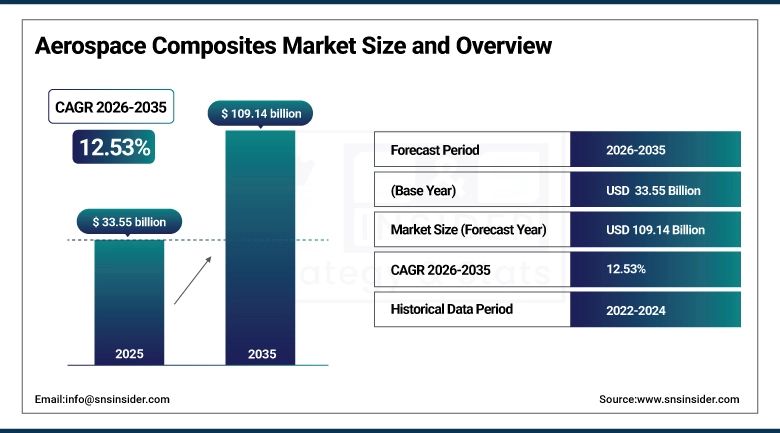
The Aerospace Composites Market size is valued at USD 33.55 Billion in 2025 and is expected to reach USD 109.14 Billion by 2035 and grow at a CAGR of 12.53% over the forecast period 2026-2035.
The demand for Aerospace Composites is anticipated to increase with the growing need for fuel-efficient and lightweight aircrafts in commercial, military, and space applications. Increasing aircraft manufacturing and defense modernization programmes are increasing the use of advanced composites materials to improve performance and lower operating costs. Advances in carbon fiber, thermoplastic composites, automated manufacturing and additive production are enhancing structural efficiency, durability as well as overall scale. Further investments in R&D, favorable aerospace regulations, and increasing application of composites in new-generation aircraft platforms are accelerating market acceptance leading to significant growth opportunities over the forecast period.
According to industry studies, over half of Aerospace Composites demand is driven by commercial and military aircraft programs, fueled by the need for lightweight structures, fuel efficiency, and high-performance materials.
To Get More Information On Aerospace Composites Market - Request Free Sample Report
Aerospace Composites Market Trends:
-
Carbon fiber composites dominate due to high strength-to-weight ratio.
-
Growth driven by commercial aircraft, military programs, and defense modernization.
-
Thermoplastic and hybrid composites adoption is rising for faster, durable production.
-
Advanced manufacturing like automated fiber placement and 3D weaving is increasing.
-
Focus on lightweight, fuel-efficient designs to reduce operational costs.
U.S. Specialty Aerospace Composites Market Insights:
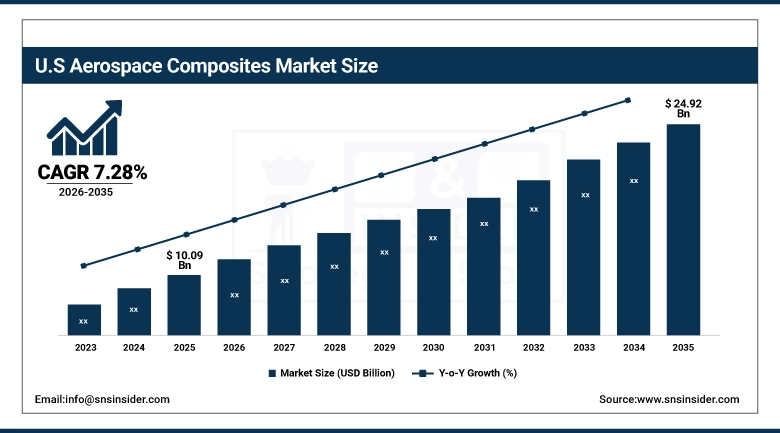
The U.S. Aerospace Composites Market size is USD 10.09 Billion in 2025 and is expected to reach USD 24.92 Billion by 2035, growing at a CAGR of 7.28% over the forecast period of 2026-2035.
Growing aircraft production and demand for lightweight, fuel-efficient components has led to increased U.S. Aerospace Composites market demand along with an increase in defense modernization programs. Development of carbon fiber and thermoplastic composites, automation of manufacturing technologies improve performance and scaling and Government support, R&D investment and aerospace program expansions are driving market adoption.
Aerospace Composites Market Growth Drivers:
-
Demand for Lightweight and Fuel-Efficient Aircraft
Rising demand for effective last-mile delivery means the Aerospace Composites market is going to escalate in value. Businesses are looking to more quickly, cost-efficiently and scalably deliver to keep pace with heightened consumer demands. As per industry reports, more than 50% of Aerospace Composites requirement is based on last-mile delivery, making aerospace composite the most widely adopted in the market. Furthermore, the increasing demand to minimize delivery time and operational cost also supplements the market growth.
Aerospace Composites Market Growth Restraints:
-
High Costs and Manufacturing Challenges
The growth of the market is restricted due to the high costs involved with composite materials and complex production standards. Moreover, the use of dedicated facilities, high cost manpower and long cycle for production add to the expense of production and limit scalability. This is according to research that suggests 40% of aerospace manufacturers report material and processing cost as barriers to adoption. In addition, strict regulations and certification regulatory processes and long testing cycles hinder the expansion of market.
Aerospace Composites Market Growth Opportunities:
-
Advancements in Manufacturing and Space Applications
Opportunities are emerging from new developments in automation and additive production, thermoplastic composites that contribute to cost-effectiveness, recyclability and structural efficacy. Rising utilization in spacecraft, UAVs and future-generation defense aircraft also unlock additional growth opportunities. Market reports suggest the use of advanced composites in space and unmanned systems is growing rapidly with considerable long-term potential. R&D investments and new aerospace programs in developed as well as emerging regions are also fueling market growth.
Aerospace Composites Market Segment:
-
By Material Type: In 2025, Carbon Fiber Reinforced Polymer dominated the market due to its high strength-to-weight ratio; Ceramic Matrix Composites are the fastest-growing segment during 2026–2035 driven by rising engine and high-temperature applications.
-
By Resin Type: In 2025, Thermoset Composites dominated owing to their widespread use in structural components; Thermoplastic Composites are the fastest-growing segment during 2026–2035 due to recyclability and faster processing capabilities.
-
By Aircraft Type: In 2025, Commercial Aircraft dominated the market supported by high production volumes; Spacecraft is the fastest-growing segment during 2026–2035 driven by expanding satellite and space exploration programs.
-
By Application Type: In 2025, Primary Structures dominated due to extensive composite use in fuselage and wings; Engine Components are the fastest-growing segment during 2026–2035 fueled by demand for high-performance and heat-resistant materials.
Aerospace Composites Market Segment Analysis:
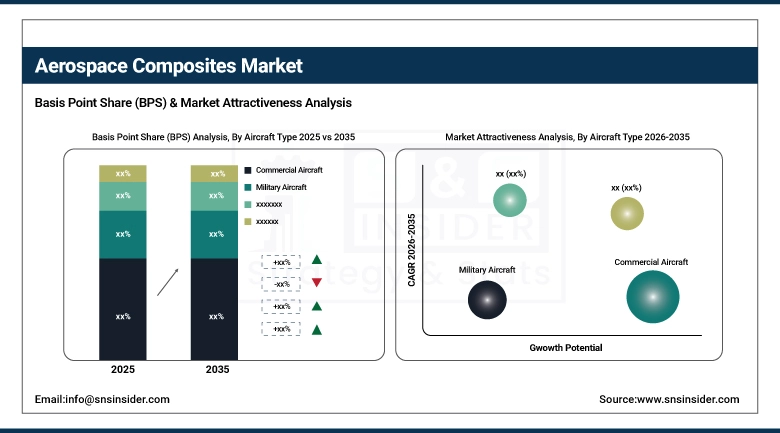
By Aircraft Type: Commercial Aircraft Lead as Spacecraft Accelerate.
Commercial aircraft is the major application segment owing to large production volumes and significant use of composites in structural parts. Strong demand remains underpinned by increasing global air travel and the fleet expansion.
Spacecraft are pushing the limit in most metro areas as satellite coverage expands, space exploration becomes a reality and private investment funds. Demand for light weight high performance materials in harsh conditions are among the reasons why this segment is anticipated to grow rapidly.
By Material Type: Carbon Fiber Reinforced Polymer Leads as Ceramic Matrix Composites Expand Rapidly.
The dominance of Carbon Fiber Reinforced Polymer in Aerospace Composites is a result of its high strength-to-weight ratio and widespread application in primary aircraft components that includes fuselage and wings. Its strength-to-weight ratio helps improve fuel efficiency and other performance in commercial and military aviation programs.
The market for CMCs is growing rapidly due to the high temperature requirement of engine components and future aircraft generations. The development of heat-resistant materials and increasing utilization in propulsion systems is speeding up its acceptance among different applications, primarily in the military and space field.
By Resin Type: Thermoset Composites Lead as Thermoplastic Composites Gain Momentum.
Thermoset composites are the most widely used as a result of their extensive heritage in aerospace structural applications, excellent mechanical properties and certification standards. Their trustworthiness and established performance grounds them as the #1 revenue category.
Thermoplastic composites are becoming more popular, as manufacturers are looking to achieve shorter curing times, greater impact resistance, and recyclability. Increasing demand toward sustainable aviation along with development of automated manufacturing techniques will further drive the thermoplastic market share.
By Application: E-commerce & Retail Lead as Food & Grocery Delivery Expands.
Primary structures dominate the market due to extensive composite integration in fuselage, wings, and tail assemblies to enhance fuel efficiency and structural strength. High material volume usage in these components supports segment leadership.
Engine components are expanding steadily driven by demand for lightweight, heat-resistant materials in propulsion systems. Increasing use of advanced composites in engine casings and high-temperature parts is contributing to segment growth.
Aerospace Composites Market Regional Analysis:
North America Aerospace Composites Market Insights:
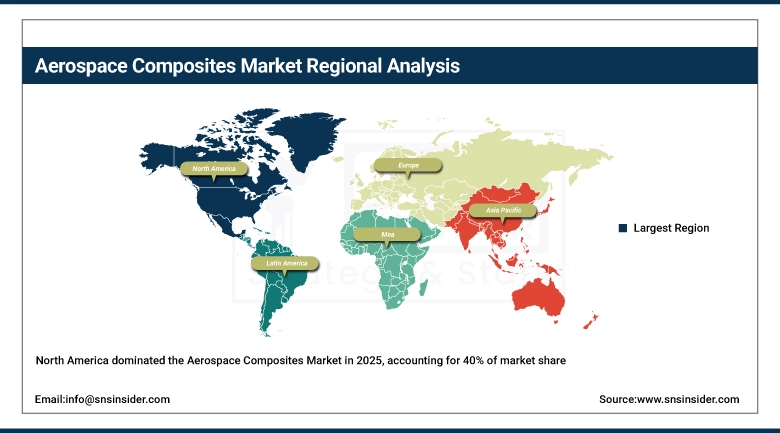
In 2025, North America’s Aerospace Composites Market accounting for the highest regional revenue share of approximately 40% in 2025. By region, North America is at the forefront due to large presence of major aircraft manufacturers and composite material suppliers in addition to significant production of aircraft in both commercial and defense fields. Large-scale adoption has been facilitated by advanced manufacturing capacity, considerable investment on R&D for light-weight and high-performance materials, and early uptake of new composites technologies. Moreover, strong demand for defense spending, space expedition programs and the presence of established aerospace supply chain industry in the region has boosted market growth.
Get Customized Report as Per Your Business Requirement - Enquiry Now
Asia Pacific Aerospace Composites Market Insights:
Asia Pacific represents a high-growth region for the Aerospace Composites market, registering a CAGR of 16.04% during 2026–2035. This rapid growth can be attributed to the rising factors such as commercial aircraft production, defense budgets and investments in domestic aerospace manufacturing among others in countries including China, India and Japan. The increasing air traffic passenger volumes as well as fleet expansion plans in the region are generating substantial demand for light weight and fuel efficient materials. Moreover, government initiatives towards aerospace self sufficiency, space exploration programmes and developments in composite manufacturing technologies are increasingly promoting its adoption which is further facilitating market expansion over 2026-35.
Europe Aerospace Composites Market Insights:
Strong Aircraft Production Capabilities, presence of major players such as Airbus and demand for lightweight & low fuel consuming aircrafts to bolster demand for Aerospace Composites in Europe. Increasing defense modernization programmes and increased focus on investments in sustainable aviation technologies will also drive growth for composites adoption. In addition, strict environmental policies to reduce the emissions are driving toward the increased use of advanced composite materials in commercial and military aircraft programs.
Latin America Aerospace Composites Market Insights:
The Latin American Aerospace Composites Market is being aided by the increasing regional aircraft manufacturing, majorly in Brazil and rising MRO activities. Growing traffic by air and fleet-upgradation plans are raising the demand for lightweight materials to increase fuel efficiency. Government initiatives to boost in-country aerospace manufacturing and defense modernization programs also play a crucial role in driving a sustained market expansion across the region.
Middle East and Africa Aerospace Composites Market Insights:
Emerging airline businesses, growing demand for air travel and advancements in next generation aircraft support the growth of the Middle East & Africa Aerospace Composites market. The aviation hub development and defense modernization programs will continue to promote the use of composite materials in the region. Furthermore, rising space and satellite programs in some countries are opening up new opportunities for advanced aerospace composite applications.
Aerospace Composites Market Competitive Landscape:
Toray Industries, Inc. is manufacturer of Aerospace Composites with superior carbon fiber and high-performance composite materials which are used in commercial aircraft, space launch vehicles, satellites, military and other specialized applications. The firm provides lightweight, high strength materials to the major aircraft OEMs (original equipment manufacturers) and targeted at fuel efficiency, structural performance and next-gen sustainable aviation. Toray is a leading supplier in global carbon fiber production and emerging in carbon fiber technologies.
-
Toray has expanded its aerospace-grade carbon fiber production capacity to meet growing demand from next-generation commercial aircraft and defense programs, strengthening long-term supply agreements with major global OEMs.
Hexcel Corporation serves commercial aerospace, space and defense and industrial markets with a range of composites products including carbon fibers; matrix systems; prepregs; honeycombs and engineered core. The company collaborates with the world's premier aircraft manufacturers on lightweight structural advancements that lower cost, reduce waste, and further fuel efficiency and durability. Hexcel is a leading producer of advanced composite materials with extensive and vertically integrated operations.
-
Hexcel secured long-term supply agreements with major commercial aircraft manufacturers to support increased production rates of next-generation narrow-body and wide-body aircraft programs.
Solvay SA is a world leader in high-performance specialty materials for aviation and provides thermoset composite materials to the aerospace structures and propulsion markets. The business specialises in innovative resin systems, lightweight structural materials and technology solutions that support more fuel efficient aircraft to reduce CO2 emissions. Solvay is recognised for its expertise in high-temperature resistant materials for aeroengines, both civil and military.
-
Solvay has advanced its thermoplastic composite technologies to support faster aircraft manufacturing cycles and improved recyclability, aligning with the aviation industry's sustainability goals.
Aerospace Composites Market Key Players:
-
Toray Industries Inc.
-
Hexcel Corporation
-
Solvay SA
-
Mitsubishi Chemical Group Corporation
-
SGL Carbon SE
-
Teijin Limited
-
Owens Corning
-
Materion Corporation
-
Gurit Holding AG
-
TenCate Advanced Composites BV
-
Park Aerospace Corp.
-
Huntsman Corporation
-
Evonik Industries AG
-
Kineco Kaman Composites India Pvt. Ltd.
-
Spirit AeroSystems Inc.
-
Lee Aerospace Inc.
-
General Electric Company
-
Safran SA
-
Lockheed Martin Corporation
-
Airbus SE
| Report Attributes | Details |
|---|---|
| Market Size in 2025 | USD 33.55 Billion |
| Market Size by 2035 | USD 109.14 Billion |
| CAGR | CAGR of 12.53% From 2026 to 2035 |
| Base Year | 2025 |
| Forecast Period | 2026-2035 |
| Historical Data | 2022-2024 |
| Report Scope & Coverage | Market Size, Segments Analysis, Competitive Landscape, Regional Analysis, DROC & SWOT Analysis, Forecast Outlook |
| Key Segments | •By Material Type: (Carbon Fiber Reinforced Polymer , Glass Fiber Reinforced Polymer , Ceramic Matrix Composites) •By Resin Type: (Thermoset Composites, Thermoplastic Composites, Hybrid Composites) •By Aircraft Type: (Commercial Aircraft, Military Aircraft, Spacecraft) •By Application Type: (Primary Structures, Secondary Structures, Engine Components) |
| Regional Analysis/Coverage | North America (US, Canada), Europe (Germany, UK, France, Italy, Spain, Russia, Poland, Rest of Europe), Asia Pacific (China, India, Japan, South Korea, Australia, ASEAN Countries, Rest of Asia Pacific), Middle East & Africa (UAE, Saudi Arabia, Qatar, South Africa, Rest of Middle East & Africa), Latin America (Brazil, Argentina, Mexico, Colombia, Rest of Latin America). |
| Company Profiles | Toray Industries Inc., Hexcel Corporation, Solvay SA, Mitsubishi Chemical Group Corporation, SGL Carbon SE, Teijin Limited, Owens Corning, Materion Corporation, Gurit Holding AG, TenCate Advanced Composites BV, Park Aerospace Corp., Huntsman Corporation, Evonik Industries AG, Kineco Kaman Composites India Pvt. Ltd., Spirit AeroSystems Inc., Lee Aerospace, Inc., General Electric Company, Safran SA, Lockheed Martin Corporation, Airbus SE |
Frequently Asked Questions
The key drivers of the Aerospace Composites market are demand for lightweight aircraft, rising production, defense needs, and advanced composite technologies.
The Carbon Fiber Reinforced Polymer (CFRP) segment dominated the Aerospace Composites market due to its high strength-to-weight ratio and extensive use in commercial and military aircraft.
North-America dominated the Aerospace Composites market in 2025.
The Aerospace Composites market is expected to grow at a CAGR of 12.53% during 2026-2035.
The market was valued at USD 33.55 Billion in 2025 and is projected to reach USD 109.14 Billion by 2035.
