
UAV Parachute Recovery Systems Market Report Scope & Overview:
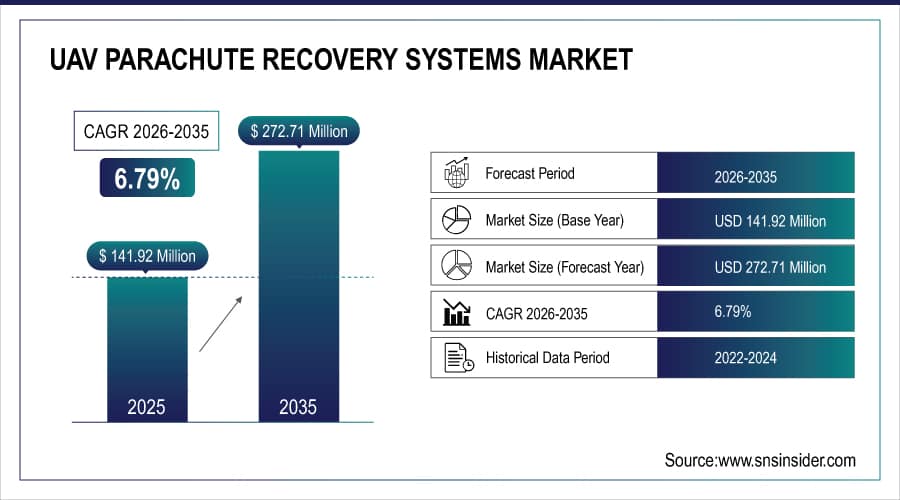
The UAV Parachute Recovery Systems Market size is estimated at USD 141.92 Million in 2025 and is expected to reach USD 272.71 Million by 2035 and grow at a CAGR of 6.79% over the forecast period of 2026-2035.
Rising adoption of unmanned aerial vehicles (UAVs) across defense, commercial, and industrial applications is supporting UAV parachute recovery systems market growth. Growing UAV use in urban and constrained airspace is driving demand for trusted safety and recovery systems to avoid loss of assets, information, and potential liability, according to a new market intelligence report. Parachute recovery systems assist in controlled landings during emergencies, system failures, or loss of communication. Market growth is also driven by growing regulatory focus on UAV safety standards, growing investment in more sophisticated UAV technologies and increasing penetration of high value UAV systems globally during the forecast period.
87% of high-value UAV operators deployed parachute recovery systems driven by urban operations, regulatory mandates, and safety needs to mitigate crash risks and protect critical assets.
To Get More Information On UAV Parachute Recovery Systems Market - Request Free Sample Report
UAV Parachute Recovery Systems Market Trends
-
Rising adoption of safety and compliance measures driving increased installation of parachute recovery systems in commercial UAVs
-
Advancements in lightweight materials and compact deployment mechanisms improving reliability without compromising UAV performance
-
Growing demand from defense and government sectors to reduce mission risk and protect high-value unmanned assets
-
Expansion of BVLOS operations increasing need for certified recovery systems to meet aviation regulatory requirements
-
Increasing integration of parachute systems in fixed-wing and hybrid VTOL drones for controlled emergency landings
-
Strong growth in industrial inspection and logistics drones fueling adoption of reliable fail-safe recovery technologies
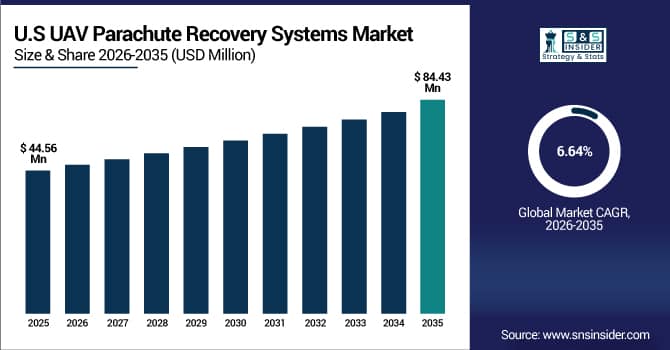
The U.S. UAV Parachute Recovery Systems Market is valued at USD 44.56 Million in 2025 and is expected to reach USD 84.43 Million by 2035, growing at a CAGR of 6.64 % from 2026-2035.
U.S. UAV Parachute Recovery Systems Market is growing due to increasing use of drones in defense, commercial, and industrial applications. Rising emphasis on UAV safety, prevention of equipment damage, and regulatory compliance is driving adoption. Advanced parachute recovery systems ensure controlled landings during emergencies, system failures, or communication loss, supporting steady market growth.
UAV Parachute Recovery Systems Market Growth Drivers:
-
Increasing use of commercial and defense UAVs, along with stricter safety regulations, is driving adoption of parachute recovery systems to minimize crash risks
The rapid growth of commercial and military UAV deployments across surveillance, logistics, agriculture, mapping, and defense missions has raised safety concerns related to mid-air failures and ground impact risks. Aviation authorities are introducing stricter regulations to ensure safe drone operations, particularly in populated or sensitive areas. Parachute recovery systems provide an effective risk-mitigation solution by enabling controlled descent during emergencies. Their ability to reduce damage to UAVs, payloads, and people on the ground is encouraging wider adoption among manufacturers and operators seeking regulatory compliance and enhanced operational safety.
85% of commercial and defense UAV operators adopted parachute recovery systems to comply with safety regulations and reduce crash-related risks.
UAV Parachute Recovery Systems Market Restraints:
-
High system costs and additional payload weight restrict adoption among small drone operators and limit integration in lightweight UAV platforms
Parachute recovery systems add both cost and weight to UAV platforms, which can be challenging for small drone operators and lightweight UAV designs. High upfront costs may discourage adoption among hobbyists, small commercial operators, and cost-sensitive applications. Additionally, increased payload weight can reduce flight time, operational efficiency, and payload capacity, particularly for small UAVs. These limitations restrict widespread integration, especially in compact or low-cost drones, slowing overall market penetration despite the recognized safety benefits of parachute recovery technologies.
77% of small drone operators avoided parachute recovery systems due to high costs and added payload weight, limiting use in lightweight UAVs.
UAV Parachute Recovery Systems Market Opportunities:
-
Growing demand for BVLOS operations and autonomous drones creates opportunities for advanced parachute recovery systems supporting regulatory compliance and operational safety
Beyond Visual Line of Sight (BVLOS) and autonomous drone operations are gaining traction across logistics, surveillance, and industrial applications. These missions require enhanced safety measures to satisfy regulatory and operational requirements. Parachute recovery systems play a critical role in enabling safe emergency responses when human intervention is limited. As authorities gradually approve BVLOS operations, UAV operators are increasingly required to integrate fail-safe mechanisms. This creates significant opportunities for advanced recovery systems designed to support autonomy, improve compliance, and enable long-range drone operations safely.
82% of BVLOS drone operators adopted advanced parachute recovery systems to meet regulatory safety requirements and enable scalable autonomous operations.
UAV Parachute Recovery Systems Market Segment Analysis
-
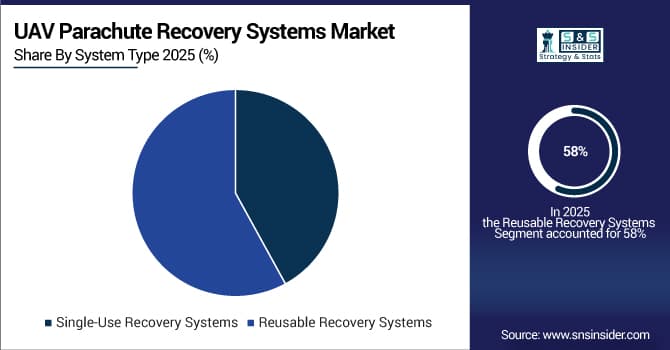
By System Type: Reusable Recovery Systems led with 58% share and is also the fastest-growing segment.
-
By UAV Type: Fixed-Wing UAVs led with 46% share, while Hybrid VTOL UAVs is the fastest-growing segment.
-
By Parachute Type: Ballistic Parachute Systems led with 41% share, while Ram-Air (Parafoil) Parachutes is the fastest-growing segment.
-
By Application: Commercial UAV Operations led with 36% share, while Military & Defense UAVs is the fastest-growing segment.
-
By End User: Drone Manufacturers (OEMs) led with 34% share, while Commercial Drone Operators is the fastest-growing segment.
By System Type: Reusable Recovery Systems led and is also the fastest-growing segment.
Reusable recovery systems dominate and grow fastest due to cost efficiency and sustainability. Unlike single-use systems, reusable solutions can be deployed multiple times without replacement, reducing operational expenses for UAV operators. Integration with telemetry and autonomous deployment mechanisms enhances safety and reliability. Demand is accelerating as operators seek long-term, scalable solutions that maintain UAV asset protection while lowering overall system lifecycle costs.
By UAV Type: Fixed-Wing UAVs led, while Hybrid VTOL UAVs is the fastest-growing segment.
Fixed-Wing UAVs dominate the parachute recovery systems market due to their widespread use in commercial, agricultural, and surveillance applications. These UAVs typically cover long distances at high speeds, making reliable recovery systems critical to protect expensive payloads and prevent damage during emergencies. High adoption among commercial operators, government agencies, and military reconnaissance programs ensures Fixed-Wing UAVs remain the largest segment by revenue and deployment volume in the market.
Hybrid VTOL UAVs are the fastest-growing segment as their versatility combines the endurance of fixed-wing aircraft with the vertical takeoff and landing capability of rotary-wing drones. Growth is driven by rising investments in eVTOL and hybrid UAV technologies, regulatory mandates for emergency recovery, and adoption by both commercial operators and defense agencies. The segment’s rapid expansion reflects the market’s shift toward multi-functional and adaptable UAV platforms.
By Parachute Type: Ballistic Parachute Systems led, while Ram-Air (Parafoil) Parachutes is the fastest-growing segment.
Ballistic parachute systems dominate due to their fast, reliable deployment and suitability for a wide range of UAV sizes. These systems use explosive or spring-loaded deployment mechanisms to ensure rapid deceleration, minimizing damage during emergency descents. High demand across OEMs and regulatory-driven safety standards reinforces the dominance of ballistic systems in the UAV parachute recovery market.
Ram-Air or parafoil parachutes are the fastest-growing segment due to their ability to control descent trajectory and enable precise landings. They are increasingly used in high-value payload delivery, research UAVs, and military applications requiring controlled recovery. Rising adoption in commercial logistics, precision delivery, and autonomous UAV operations is driving rapid growth, positioning ram-air parachutes as a key innovation segment in the market.
By Application: Commercial UAV Operations led, while Military & Defense UAVs is the fastest-growing segment.
Commercial UAV operations dominate the market as delivery, surveillance, agriculture, and infrastructure inspection drones increasingly rely on parachute recovery systems for safety. High-volume drone deployments across logistics, construction, and mapping industries ensure sustained demand. Safety-focused policies and risk mitigation for densely populated or sensitive operational areas make parachute recovery systems essential. As commercial drone fleets expand globally, the commercial UAV segment continues to lead revenue and adoption in the parachute recovery systems market.
Military and defense UAVs are the fastest-growing application segment, reflecting increasing adoption of unmanned systems for reconnaissance, combat support, and tactical missions. Growth is fueled by rising defense budgets, modernization programs, and UAV deployment across border surveillance, strategic operations, and training exercises. Advanced AI-enabled UAVs and autonomous missions increase the need for reliable recovery solutions, driving rapid adoption and high CAGR in military applications.
By End-User: Drone Manufacturers (OEMs) led, while Commercial Drone Operators is the fastest-growing segment.
Drone manufacturers dominate adoption as OEMs integrate parachute recovery systems during production to ensure safety, regulatory compliance, and product reliability. Partnerships with component suppliers and adoption of advanced technologies strengthen their market leadership. High-volume production and widespread distribution of drones make OEMs the primary purchasers and influencers of parachute recovery solutions globally.
Commercial drone operators are the fastest-growing end-user segment due to increasing drone adoption in logistics, agriculture, surveillance, and inspection services. Operators are increasingly investing in integrated recovery solutions to minimize financial losses and enhance operational safety. Expansion of commercial UAV fleets globally, coupled with insurance and safety mandates, is driving strong adoption growth, positioning commercial operators as a high-growth end-user segment in the market.
UAV Parachute Recovery Systems Market Regional Analysis
North America UAV Parachute Recovery Systems Market Insights:
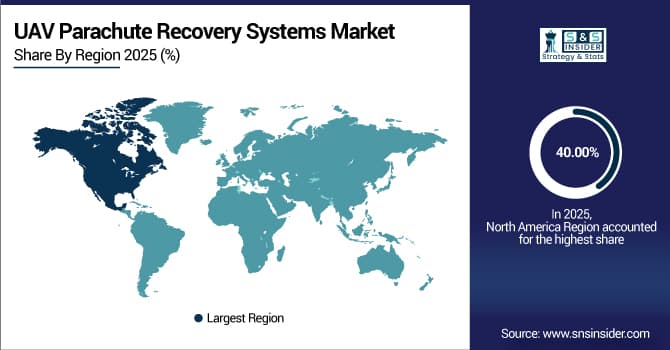
North America dominated the UAV Parachute Recovery Systems Market with a 40.00% share in 2025 due to strong adoption of commercial and defense UAVs, stringent aviation safety regulations, and the presence of leading drone manufacturers and technology providers. High investment in R&D, testing programs, and regulatory compliance requirements further drove widespread integration of parachute recovery systems.
Get Customized Report as Per Your Business Requirement - Enquiry Now
Asia Pacific UAV Parachute Recovery Systems Market Insights
Asia Pacific is expected to grow at the fastest CAGR of about 8.47% from 2026–2035, driven by rapid expansion of drone usage across agriculture, logistics, surveillance, and infrastructure inspection. Increasing government support, rising UAV manufacturing capabilities, and growing emphasis on operational safety standards are accelerating demand for parachute recovery systems across the region.
Europe UAV Parachute Recovery Systems Market Insights
Europe held a notable share in the UAV Parachute Recovery Systems Market in 2025, supported by stringent aviation safety regulations, growing adoption of commercial drones, and strong focus on airspace integration and compliance. The presence of established aerospace manufacturers, increasing use of UAVs in inspection and mapping, and emphasis on risk mitigation further strengthened regional demand.
Middle East & Africa and Latin America UAV Parachute Recovery Systems Market Insights
The Middle East & Africa and Latin America together showed emerging growth in the UAV Parachute Recovery Systems Market, driven by expanding use of drones in oil & gas, agriculture, mining, and infrastructure monitoring. Improving regulatory frameworks, rising investments in UAV programs, and increasing awareness of flight safety and asset protection are gradually boosting adoption across both regions.
UAV Parachute Recovery Systems Market Competitive Landscape:
Butler Parachute Systems
Butler Parachute Systems is a leading provider of parachute recovery solutions for UAVs, drones, and manned aircraft. The company specializes in designing reliable, high-quality parachute systems that enhance safety during mid-air emergencies or system failures. Butler’s products include single-use and reusable parachute systems suitable for various UAV sizes and applications, including commercial, defense, and research operations. Their focus on innovative materials, precision engineering, and stringent safety standards has made them a trusted name in aerial recovery solutions worldwide.
-
April 2025, Butler Parachute Systems introduced the AeroSafe Tactical, a ruggedized parachute recovery system designed for Group 3 unmanned aircraft systems (UAS) weighing up to 250 kg, used by U.S. defense and allied forces.
EKOFASTBA S.L.
EKOFASTBA S.L., based in Spain, is an innovative manufacturer of UAV parachute recovery systems and safety solutions. The company develops advanced parachute deployment mechanisms that ensure controlled descent and damage mitigation in drones and UAVs. Serving commercial, industrial, and defense sectors, EKOFASTBA focuses on reliability, lightweight design, and ease of integration. Their systems are tested under rigorous conditions to meet international safety standards, making them a preferred choice for UAV operators seeking efficient and dependable recovery solutions.
-
June 2025, EKOFASTBA launched EKOPARACHUTE ULTRA, the first parachute recovery system certified under EASA’s new SC-VTOL-01 standard for pilotless electric vertical takeoff and landing (eVTOL) aircraft.
ParaZero Ltd.
ParaZero Ltd. is an Israeli company specializing in UAV safety systems, including parachute recovery technologies for drones of all sizes. Their products are designed to prevent accidents and minimize damage during drone failures, ensuring safe landings for both the vehicle and surroundings. ParaZero’s solutions combine rapid deployment mechanisms with smart electronics for precise activation. Trusted by commercial, industrial, and government operators globally, the company emphasizes innovation, regulatory compliance, and enhanced UAV operational safety across multiple applications, from inspection to delivery services.
-
January 2025, ParaZero launched the SafeAir Enterprise API, enabling drone operators to monitor, manage, and analyze parachute events across entire fleets in real time.
UAV Parachute Recovery Systems Market Key Players:
Some of the UAV Parachute Recovery Systems Market Companies are
-
Butler Parachute Systems
-
EKOFASTBA S.L.
-
ParaZero Ltd.
-
Indemnis
-
Drone Rescue Systems GmbH
-
Fruity Chutes
-
Mars Parachutes
-
Skycat
-
Galaxy GRS
-
CIMSA Ingeniería de Sistemas S.A.
-
Appareo Systems
-
Raven Industries
-
DJI
-
SenseFly
-
Microdrones
-
Airborne Systems
-
Opale Parachutes
-
Vector Save
-
UAVOS Inc.
-
Aerial Vehicle Safety Solutions (AVSS)
| Report Attributes | Details |
|---|---|
| Market Size in 2025 | USD 141.92 Million |
| Market Size by 2035 | USD 272.71 Million |
| CAGR | CAGR of 6.79% From 2026 to 2035 |
| Base Year | 2025 |
| Forecast Period | 2026-2035 |
| Historical Data | 2022-2024 |
| Report Scope & Coverage | Market Size, Segments Analysis, Competitive Landscape, Regional Analysis, DROC & SWOT Analysis, Forecast Outlook |
| Key Segments | • By UAV Type: Fixed-Wing UAVs, Rotary-Wing UAVs, Hybrid VTOL UAVs • By Parachute Type: Round Parachutes, Ram-Air (Parafoil) Parachutes, Ballistic Parachute Systems • By System Type: Single-Use Recovery Systems, Reusable Recovery Systems • By Application: Commercial UAV Operations, Military & Defense UAVs, Government & Law Enforcement, Research & Academic Use • By End User: Drone Manufacturers (OEMs), Defense Organizations, Commercial Drone Operators, Research Institutes & Universities |
| Regional Analysis/Coverage | North America (US, Canada), Europe (Germany, UK, France, Italy, Spain, Russia, Poland, Rest of Europe), Asia Pacific (China, India, Japan, South Korea, Australia, ASEAN Countries, Rest of Asia Pacific), Middle East & Africa (UAE, Saudi Arabia, Qatar, South Africa, Rest of Middle East & Africa), Latin America (Brazil, Argentina, Mexico, Colombia, Rest of Latin America). |
| Company Profiles | Butler Parachute Systems, EKOFASTBA S.L., ParaZero Ltd., Indemnis, Drone Rescue Systems GmbH, Fruity Chutes, Mars Parachutes, Skycat, Galaxy GRS, CIMSA Ingeniería de Sistemas S.A., Appareo Systems, Raven Industries, DJI, SenseFly, Microdrones, Airborne Systems, Opale Parachutes, Vector Save, UAVOS Inc., Aerial Vehicle Safety Solutions (AVSS) |
Frequently Asked Questions
The UAV Parachute Recovery Systems Market was valued at USD 141.92 Million in 2025.
The UAV Parachute Recovery Systems Market is expected to grow at a CAGR of 6.79% from 2026 to 2035.
North America dominated the UAV Parachute Recovery Systems Market in 2025.
Commercial UAV Operations dominated the UAV Parachute Recovery Systems Market.
Growth is driven by increasing UAV adoption across defense, commercial, and industrial applications, rising safety regulations, and demand for emergency recovery systems.
