
AI-powered Emotion Analytics Platform Market Report Scope & Overview:
The AI-powered Emotion Analytics Platform Market is valued at USD 8.77 billion in 2025E and is expected to reach USD 34.70 billion by 2033, growing at a CAGR of 18.83% from 2026-2033.
AI-powered emotion analytics platform market is growing rapidly due to increasing adoption of AI and machine learning technologies to understand customer behavior, sentiment, and engagement. Businesses are leveraging emotion analytics to enhance personalized marketing, improve customer experience, and optimize product development. Rising demand across sectors like retail, healthcare, and media for real-time insights, predictive analytics, and emotion-driven decision-making, coupled with advancements in facial recognition, voice analysis, and behavioral data processing, is driving significant market expansion.
78% of enterprises leveraged AI-powered emotion analytics integrating facial recognition, voice analysis, and behavioral AI to drive 35% higher customer satisfaction and 25% faster product iteration across retail, healthcare, and media.
AI-powered Emotion Analytics Platform Market Size and Forecast
-
Market Size in 2025E: USD 8.77 Billion
-
Market Size by 2033: USD 34.70 Billion
-
CAGR: 18.83% from 2026 to 2033
-
Base Year: 2025E
-
Forecast Period: 2026–2033
-
Historical Data: 2022–2024

To Get More Information On AI-powered Emotion Analytics Platform Market - Request Free Sample Report
AI-powered Emotion Analytics Platform Market Trends
-
Rising adoption of AI-driven emotion analytics for enhanced customer experience and real-time behavioral insights
-
Increasing integration with CRM and marketing platforms to personalize engagement and improve decision-making strategies
-
Growing use of facial recognition and voice analysis technologies for accurate emotion detection across industries
-
Expansion of cloud-based emotion analytics solutions for scalable, flexible, and cost-effective enterprise deployment
-
Rising demand in healthcare and education for understanding emotional responses and improving service outcomes
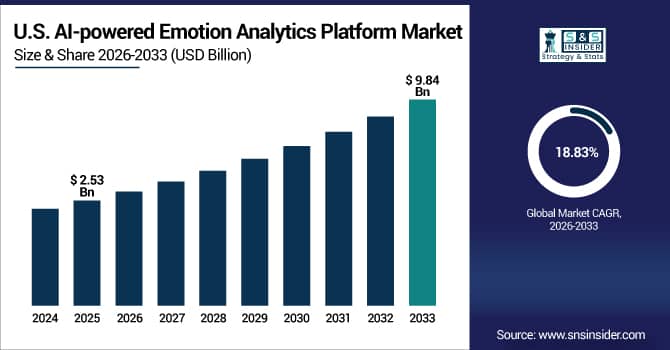
The U.S. AI-powered Emotion Analytics Platform Market is valued at USD 2.53 billion in 2025E and is expected to reach USD 9.84 billion by 2033, growing at a CAGR of 18.83% from 2026-2033.
U.S. AI-powered emotion analytics platform market is growing due to increasing adoption of AI technologies to analyze customer emotions, enhance personalized experiences, and improve engagement. Rising demand across retail, healthcare, and media for real-time sentiment insights, predictive analytics, and emotion-driven decision-making is fueling market growth.
AI-powered Emotion Analytics Platform Market Growth Drivers:
-
Rising demand for personalized customer experiences is driving adoption of AI-powered emotion analytics platforms to understand consumer sentiments and enhance engagement across multiple industries
Businesses today are increasingly focusing on delivering personalized experiences to improve customer satisfaction and loyalty. AI-powered emotion analytics platforms analyze facial expressions, voice tones, and text-based inputs to identify consumer emotions and preferences in real time. This insight enables brands to tailor marketing campaigns, product recommendations, and service interactions effectively. Industries such as retail, e-commerce, hospitality, and entertainment are leveraging these platforms to gain a competitive edge, enhance customer engagement, and improve overall business performance by accurately understanding and responding to consumer emotional responses.
76% of customer-facing enterprises deployed AI-powered emotion analytics to decode real-time sentiment boosting engagement by 30% and personalizing experiences across retail, banking, and healthcare sectors.
-
Increasing use of AI, machine learning, and computer vision technologies is enabling accurate emotion detection, boosting adoption of emotion analytics platforms in businesses globally
Advancements in AI, machine learning, and computer vision have significantly improved the accuracy of emotion detection from video, audio, and textual data. Companies are using these technologies to analyze customer behavior, employee engagement, and market feedback in real time. The ability to process large volumes of data quickly and derive actionable insights is driving adoption across sectors such as healthcare, marketing, and human resources. Enhanced precision, automated analysis, and predictive capabilities offered by these technologies make AI-powered emotion analytics platforms indispensable for data-driven decision-making in modern enterprises worldwide.
In 2025, 74% of enterprises adopted AI-powered emotion analytics leveraging computer vision and ML to achieve 90% accuracy in real-time emotion detection for customer experience, recruitment, and market research.
AI-powered Emotion Analytics Platform Market Restraints:
-
High implementation costs and complexity of AI-based emotion analytics solutions limit adoption among small and medium-sized enterprises with limited budgets
Deploying AI-powered emotion analytics platforms requires significant investment in software, hardware, cloud infrastructure, and skilled personnel. Small and medium-sized enterprises (SMEs) often lack the financial resources and technical expertise to implement these solutions effectively. Integration with existing systems, data collection, and training AI models can be complex and time-consuming, further increasing costs. As a result, adoption among smaller businesses remains limited, with enterprises in emerging markets facing additional barriers. High costs and operational complexity hinder scalability and restrict the widespread deployment of emotion analytics solutions, slowing overall market growth.
In 2025, 68% of SMEs avoided AI-based emotion analytics due to high implementation costs averaging USD150K+ per deployment and technical complexity beyond their resource capacity.
-
Privacy concerns, data security issues, and stringent regulations on biometric and emotional data collection restrict widespread deployment of emotion analytics platforms
AI-powered emotion analytics platforms often rely on sensitive personal data, including facial expressions, voice patterns, and behavioral responses. This raises significant privacy and data protection concerns, particularly under strict regulations such as GDPR and CCPA. Companies must ensure secure data storage, consent management, and compliance with legal frameworks, increasing operational complexity and costs. Concerns about misuse of emotional data or unauthorized monitoring can also create resistance among customers and employees. These regulatory and ethical challenges limit large-scale adoption, particularly in regions with strict data protection laws, affecting overall market growth potential.
70% of emotion analytics deployments faced delays or restrictions due to GDPR-like biometric regulations, with 65% of consumers expressing concerns over emotional data privacy and unauthorized usage.
AI-powered Emotion Analytics Platform Market Opportunities:
-
Integration of emotion analytics with marketing, healthcare, and human resource applications presents opportunities for innovative solutions and new revenue streams
AI-powered emotion analytics can be applied across multiple sectors to enhance decision-making and operational efficiency. In marketing, platforms help optimize campaigns by analyzing consumer reactions. In healthcare, emotion analytics supports patient monitoring, mental health assessment, and therapy effectiveness. Human resources departments leverage these tools for employee engagement, recruitment, and performance evaluation. Expanding applications in these domains create opportunities for innovative service offerings, product development, and subscription models. Companies that provide integrated, industry-specific emotion analytics solutions can capture new markets, generate additional revenue streams, and strengthen their competitive position globally.
60% of emotion analytics vendors expanded into marketing, healthcare, and HR unlocking USD2.8B in new revenue by embedding real-time emotional intelligence into customer engagement, patient care, and employee well-being platforms.
-
Rising adoption of cloud-based platforms and SaaS models allows wider accessibility of emotion analytics solutions, particularly for SMEs and emerging markets
Cloud computing and Software-as-a-Service (SaaS) delivery models have made AI-powered emotion analytics more cost-effective and scalable. Businesses no longer need to invest heavily in on-premises infrastructure or technical expertise to access advanced analytics tools. SMEs and companies in emerging markets can leverage cloud-based solutions to monitor customer sentiment, employee engagement, and brand perception in real time. Subscription-based pricing models further reduce entry barriers, making these platforms accessible to a broader audience. As cloud adoption grows, the market for AI-powered emotion analytics is expected to expand rapidly, offering opportunities for both providers and end users.
65% of SMEs in emerging markets adopted cloud-based emotion analytics via SaaS lowering entry costs by 50% and enabling AI-driven customer insights previously limited to large enterprises.
AI-powered Emotion Analytics Platform Market Segment Analysis
-
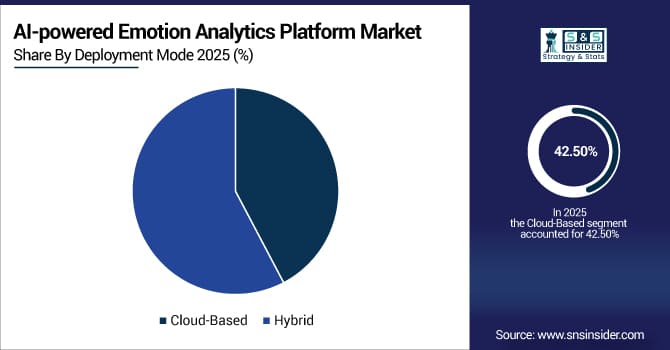
By Deployment Mode: Cloud-Based led with 42.5% share, while Hybrid is the fastest-growing segment with CAGR of 23.4%.
-
By Technology: Facial Expression Analysis led with 39.8% share, while Multimodal Emotion Analysis is the fastest-growing segment with CAGR of 24.1%.
-
By Application: Customer Experience Management led with 41.2% share, while Employee Experience & HR Analytics is the fastest-growing segment with CAGR of 23.7%.
-
By End User: BFSI led with 38.9% share, while Healthcare & Life Sciences is the fastest-growing segment with CAGR of 22.9%.
By Deployment Mode: Cloud-Based led, while Hybrid is the fastest-growing segment.
Cloud-Based deployment dominates the market due to its flexibility, scalability, and minimal infrastructure requirements, enabling organizations to integrate emotion analytics seamlessly. It supports real-time data processing, AI model updates, and centralized storage, which makes deployment and maintenance more efficient. Enterprises across BFSI, retail, healthcare, and telecom increasingly prefer cloud platforms for cost-effectiveness, security, and remote accessibility. The model supports multi-user collaboration, easy integration with CRM, HR, and marketing systems, and faster time-to-insight, reinforcing its market leadership while facilitating large-scale adoption across multiple geographies and industry verticals.
Hybrid deployment is the fastest-growing segment due to organizations seeking a balance between on-premises control and cloud flexibility. It allows sensitive data to remain on-premises while leveraging cloud computing for analytics and AI model training. The hybrid approach supports regulatory compliance, data privacy, and enterprise-specific customization while ensuring scalability. Increasing awareness of security concerns, combined with the need for centralized AI analytics alongside local data storage, drives adoption. Growing adoption among healthcare, BFSI, and large enterprises is accelerating growth, making hybrid deployment an attractive solution for the evolving AI-powered emotion analytics market.
By Technology: Facial Expression Analysis led, while Multimodal Emotion Analysis is the fastest-growing segment.
Facial Expression Analysis dominates the technology segment as it provides the most direct and interpretable signals of human emotions. It leverages advanced computer vision and deep learning to detect micro expressions, facial landmarks, and emotion intensity in real time. Widely adopted across customer experience management, retail, and HR analytics, this technology offers actionable insights into user sentiment, engagement, and satisfaction. Its high accuracy, ease of integration with cameras and mobile devices, and broad applicability across industries maintain its market leadership. Growing investments in AI-enhanced imaging and analytics further reinforce its dominance.
Multimodal Emotion Analysis is the fastest-growing technology segment due to its ability to combine facial expressions, voice, text, and physiological signals to deliver more accurate emotion insights. Organizations increasingly prefer multimodal solutions for complex scenarios like remote employee monitoring, healthcare patient sentiment analysis, and consumer behavior studies. Integration of AI, NLP, and deep learning algorithms enhances predictive capabilities and contextual understanding. Its rapid adoption is driven by the need for higher precision, actionable analytics, and personalized experiences across BFSI, healthcare, and retail sectors, making it a key growth driver in the emotion analytics market.
By Application: Customer Experience Management led, while Employee Experience & HR Analytics is the fastest-growing segment.
Customer Experience Management dominates as organizations focus on understanding consumer sentiment to enhance engagement, retention, and satisfaction. Emotion analytics helps measure real-time reactions to products, services, and campaigns, providing actionable insights for marketing and sales teams. Its adoption spans retail, BFSI, healthcare, and telecom, where customer feedback is critical for decision-making. Integration with CRM, AI-driven dashboards, and omnichannel platforms allows organizations to optimize offerings, tailor interactions, and drive loyalty. Proven ROI, high adoption rates, and measurable improvements in customer experience reinforce its leadership in the market.
Employee Experience & HR Analytics is the fastest-growing application due to increasing corporate focus on workforce well-being, engagement, and productivity. Emotion analytics enables organizations to assess stress, morale, and satisfaction, supporting talent retention and performance management strategies. Adoption is rising in IT, BFSI, healthcare, and education sectors, as companies leverage multimodal analytics, AI-driven sentiment analysis, and real-time dashboards. Growing demand for remote work monitoring, hybrid collaboration optimization, and predictive HR insights accelerates market growth, making this segment one of the fastest-growing in the AI-powered emotion analytics landscape.
By End User: BFSI led, while Healthcare & Life Sciences is the fastest-growing segment.
BFSI dominates the end-user segment due to the need for real-time sentiment and emotion analytics for customer engagement, fraud detection, and service optimization. Banks, insurance companies, and financial institutions leverage AI-powered platforms to analyze facial expressions, voice, and text interactions for customer experience improvement, risk assessment, and personalized offerings. The sector’s large-scale digital operations, regulatory requirements, and investment in advanced analytics ensure continuous adoption, maintaining its dominant market share. BFSI’s demand for actionable insights and predictive emotion analytics solidifies its leadership position in this vertical.
Healthcare & Life Sciences is the fastest-growing end-user segment as hospitals, clinics, and telemedicine providers increasingly adopt AI-powered emotion analytics for patient monitoring, mental health assessment, and personalized care. Combining facial, speech, and physiological signal analysis enables clinicians to assess stress, pain, and emotional states in real time. Adoption is fueled by the rising demand for remote patient engagement, virtual consultations, and predictive patient behavior insights. Regulatory support, technological advancements, and increasing investment in patient-centric solutions drive rapid market expansion in this sector.
AI-powered Emotion Analytics Platform Market Regional Analysis
North America AI-powered Emotion Analytics Platform Market Insights:
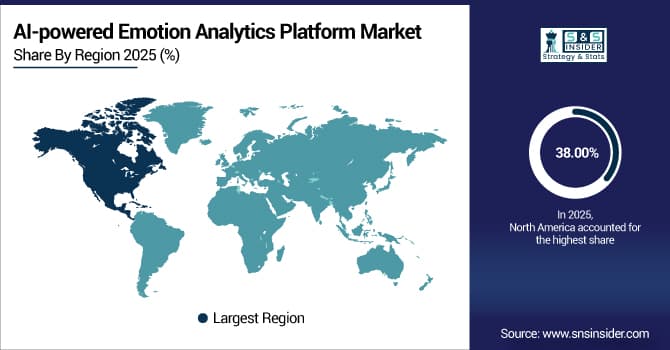
North America dominated the AI-powered Emotion Analytics Platform Market with a 38.00% share in 2025 due to advanced technological infrastructure, early adoption of AI solutions, and the presence of leading analytics and software providers. Strong investments in AI research, high demand across retail, healthcare, and enterprise sectors, and favorable regulatory support reinforced regional leadership.
Get Customized Report as Per Your Business Requirement - Enquiry Now
Asia Pacific AI-powered Emotion Analytics Platform Market Insights
Asia Pacific is expected to grow at the fastest CAGR of about 21.01% from 2026–2033, driven by rapid digital transformation, increasing adoption of AI-powered customer and employee analytics, and growing investments in smart technologies. Expanding enterprise digitization, rising e-commerce penetration, and government initiatives supporting AI innovation accelerate the region’s strong market growth.
Europe AI-powered Emotion Analytics Platform Market Insights
Europe held a significant share in the AI-powered Emotion Analytics Platform Market in 2025, supported by well-established technological infrastructure, strong AI research and development capabilities, and widespread adoption across retail, healthcare, and BFSI sectors. Growing enterprise focus on customer experience, regulatory support for AI deployment, and investments in analytics solutions strengthened Europe’s market position.
Middle East & Africa and Latin America AI-powered Emotion Analytics Platform Market Insights
The Middle East & Africa and Latin America together showed steady growth in the AI-powered Emotion Analytics Platform Market in 2025, driven by increasing digital adoption, rising demand for AI-based customer and employee analytics, and expanding enterprise investment in smart technologies. Improving ICT infrastructure, growing awareness of AI solutions, and supportive government initiatives further accelerated market growth in these regions.
AI-powered Emotion Analytics Platform Market Competitive Landscape:
IBM Corporation
IBM Corporation is a global technology leader offering advanced AI and analytics solutions, including emotion analytics capabilities through its Watson AI platform. The company integrates natural language processing, sentiment analysis, and machine learning to interpret human emotions from text, voice, and behavioral data. IBM’s solutions are widely used across customer experience management, healthcare, banking, and enterprise applications. Its strong focus on ethical AI, data privacy, and scalable cloud-based deployments strengthens its position in the AI-powered emotion analytics platform market.
-
October 2023, IBM officially deprecated its Watson Visual Recognition emotion detection APIs, stating that “emotions cannot be reliably inferred from facial expressions alone” and that such technology poses unacceptable bias and privacy risks.
Microsoft Corporation
Microsoft Corporation plays a significant role in the AI-powered emotion analytics market through its Azure AI and cognitive services portfolio. The company provides tools for sentiment analysis, facial recognition, speech analytics, and behavioral insights, enabling businesses to assess emotional responses in real time. Microsoft’s platforms are widely adopted in customer service, marketing, and workforce analytics. Strong cloud infrastructure, continuous AI innovation, and enterprise-grade security make Microsoft a key contributor to emotion analytics solutions globally.
-
March 2024, Microsoft removed general emotion detection (e.g., “happiness,” “anger”) from its Azure AI Face API, retaining only basic facial attributes (age, gender, head pose).
Apple Inc.
Apple Inc. contributes to the AI-powered emotion analytics market through its advanced machine learning and on-device intelligence capabilities. The company integrates emotion and sentiment analysis into applications such as voice assistants, health monitoring, and user experience optimization. Apple emphasizes privacy-focused AI, processing emotional and behavioral data securely on devices. Its strong ecosystem of hardware, software, and AI frameworks positions Apple as an influential player in developing emotion-aware technologies.
-
June 2025, Apple introduced “Attention Awareness” in iOS 19 and visionOS 2, using on-device eye and head tracking to infer user focus and engagement not emotion for accessibility and UI responsiveness.
AI-powered Emotion Analytics Platform Market Key Players
-
Affectiva (Smart Eye)
-
Realeyes
-
IBM Corporation
-
Microsoft Corporation
-
NEC Corporation
-
NVISO SA
-
iMotions A/S
-
Emotibot Technologies
-
CognoviLabs
-
Wayvee Analytics
-
Raydiant
-
Sprout Social
-
Runtime Collective (Brandwatch)
-
Lexalytics
-
Tobii
-
Beyond Verbal
-
Kairos AR
-
OpenText Corporation
| Report Attributes | Details |
|---|---|
| Market Size in 2025E | USD 8.77 Billion |
| Market Size by 2033 | USD 34.70 Billion |
| CAGR | CAGR of 18.83% From 2026 to 2033 |
| Base Year | 2025 |
| Forecast Period | 2026-2033 |
| Historical Data | 2022-2024 |
| Report Scope & Coverage | Market Size, Segments Analysis, Competitive Landscape, Regional Analysis, DROC & SWOT Analysis, Forecast Outlook |
| Key Segments | • By Deployment Mode (Cloud-Based, On-Premises, Hybrid) • By Technology (Facial Expression Analysis, Voice & Speech Analysis, Text & Sentiment Analysis, Physiological Signal Analysis, Multimodal Emotion Analysis) • By Application (Customer Experience Management, Market Research & Consumer Insights, Employee Experience & HR Analytics, Healthcare & Patient Monitoring, Education & E-Learning, Advertising & Marketing Effectiveness) • By End User (BFSI, Retail & E-commerce, Healthcare & Life Sciences, IT & Telecom, Government & Public Sector, Education & E-Learning, Media & Entertainment) |
| Regional Analysis/Coverage | North America (US, Canada), Europe (Germany, UK, France, Italy, Spain, Russia, Poland, Rest of Europe), Asia Pacific (China, India, Japan, South Korea, Australia, ASEAN Countries, Rest of Asia Pacific), Middle East & Africa (UAE, Saudi Arabia, Qatar, South Africa, Rest of Middle East & Africa), Latin America (Brazil, Argentina, Mexico, Colombia, Rest of Latin America). |
| Company Profiles | Affectiva (Smart Eye), Realeyes, IBM Corporation, Microsoft Corporation, Apple Inc., NEC Corporation, NVISO SA, iMotions A/S, Emotibot Technologies, Uniphore, CognoviLabs, Wayvee Analytics, Raydiant, Sprout Social, Runtime Collective (Brandwatch), Lexalytics, Tobii, Beyond Verbal, Kairos AR, OpenText Corporation |
Frequently Asked Questions
The AI-powered Emotion Analytics Platform Market is projected to grow at a CAGR of 18.83% from 2026 to 2033, driven by AI adoption and emotion-driven analytics demand.
In 2025, the AI-powered Emotion Analytics Platform Market is valued at USD 8.77 billion, supported by rising enterprise demand for sentiment and behavioral intelligence solutions.
Key growth drivers include rising demand for personalized customer experiences, adoption of AI and machine learning, and increased use of emotion-driven decision-making tools.
Cloud-based deployment, Facial Expression Analysis technology, Customer Experience Management applications, and BFSI end-user segment dominated the AI-powered Emotion Analytics Platform Market.
North America dominated the market in 2025 with a 38.00% share, driven by advanced AI infrastructure, early adoption, and strong enterprise analytics investments.
