
Aircraft Cabin Interior Market Report Scope & Overview:
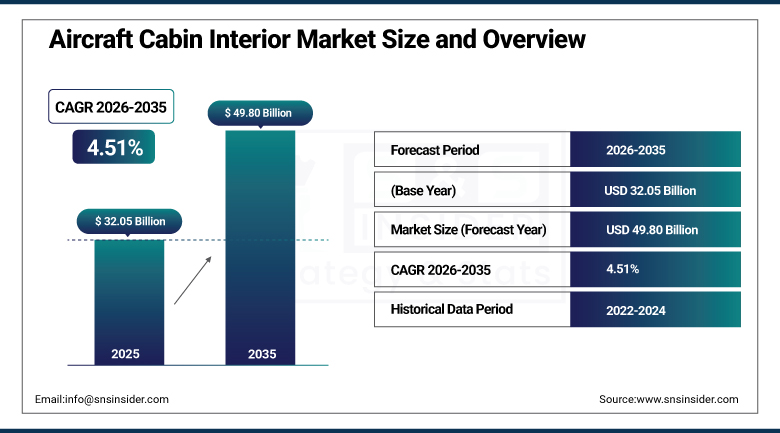
The Aircraft Cabin Interior Market was valued at USD 32.05 Billion in 2025 and is projected to reach USD 49.80 Billion by 2035, expanding at a CAGR of 4.51% during the forecast period 2026–2035.
The increasing expansion of global commercial aviation fleets, rising airline investments in passenger comfort improvement and increasing retrofit demand for fuel efficient lightweight cabin systems drive the global aircraft cabin interior market. Airlines are now integrating intelligent seating systems, AI-enabled cabin management platforms, smart lighting technologies and high-speed in-flight connectivity solutions to enhance passenger experience and operational efficiency. Market expansion is further accelerated by growing aircraft production rates, increasing demand for premium air travel and modernisation of ageing aircraft fleets across developed and emerging aviation economies.
Several global airlines and aircraft OEMs boosted investments in AI-integrated cabin monitoring systems, lightweight composite seating platforms and next-generation in-flight connectivity technologies to improve operational efficiency and passenger personalisation capabilities in 2025-2026.
To Get more information On Aircraft Cabin Interior Market- Request Free Sample Report
Aircraft Cabin Interior Market Trends:
-
Increasing deployment of lightweight composite-based aircraft seating systems.
-
Rising integration of AI-enabled cabin management and passenger personalization technologies.
-
Growing adoption of high-speed in-flight entertainment & connectivity (IFEC) platforms.
-
Expansion of premium economy and business-class cabin refurbishment programs.
-
Increasing investments in smart lighting, modular galleys, and fuel-efficient cabin equipment systems.
U.S. Aircraft Cabin Interior Market Size Outlook:
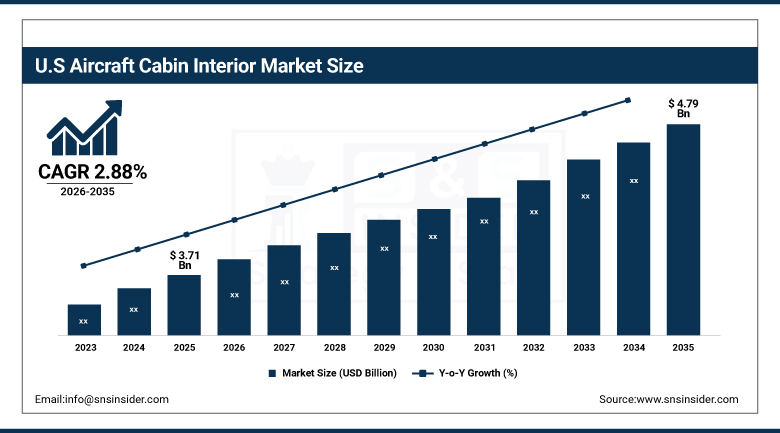
The U.S. Aircraft Cabin Interior Market was valued at USD 3.71 billion in 2025 and is expected to reach approximately USD 4.79 billion by 2035, expanding at a CAGR of 2.88% during 2026–2035.
High levels of commercial aviation activity, large aircraft retrofit programmes and growing investment in passenger-oriented cabin technologies continue to make the United States a strong market for aircraft cabin interiors. Airlines and aircraft interior manufacturers are increasingly deploying lightweight seating systems, AI-enabled cabin analytics, high-speed satellite connectivity and smart cabin management platforms to improve passenger comfort and airline operational performance. Strong demand for fleet modernisation and rising traffic for premium air travel continue to drive growth in the market across the country.
By 2026, several US-based airlines accelerated adoption of next-generation in-flight entertainment and connectivity (IFEC) systems by leveraging AI-powered passenger engagement and real-time cabin monitoring solutions across their long-haul aircraft fleets.
Aircraft Cabin Interior Market Segment Analysis:
-
By Interior Type, aircraft seating dominated the market with 38.01% share in 2025, while in-flight entertainment & connectivity (IFEC) is projected to witness the fastest growth with 6.50% CAGR during the forecast period.
-
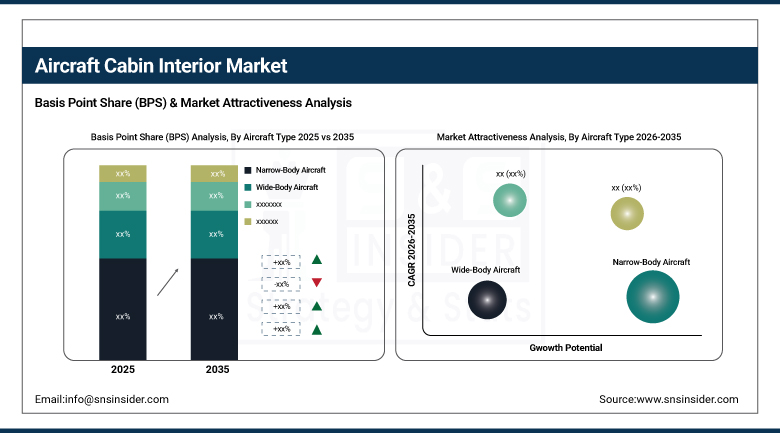
By Aircraft Type, narrow-body aircraft dominated the market with 49.00% share in 2025, while regional & business aircraft are projected to witness the fastest growth with 5.07% CAGR during the forecast period.
-
By End User, commercial airlines dominated the market with 79.00% share in 2025, while business aviation is projected to witness the fastest growth with 6.27% CAGR during the forecast period.
By Interior Type, aircraft seating dominated, while in-flight entertainment & connectivity (IFEC) is fastest-growing.
The aircraft seating segment accounted for the largest revenue share of 38.01% in 2025 owing to increasing global aircraft deliveries, rising retrofit demand, and growing airline focus on lightweight and fuel-efficient seating systems. Airlines are increasingly investing in ergonomic seating designs, premium economy upgrades, and composite-based seating structures to improve passenger comfort while optimizing fuel efficiency.
The in-flight entertainment & connectivity (IFEC) segment is projected to register the fastest CAGR of 6.50% during the forecast period owing to rising passenger demand for uninterrupted connectivity, personalized digital entertainment, and real-time on board communication services. Airlines are increasingly deploying satellite-based broadband systems, cloud-enabled content delivery platforms, and AI-powered passenger engagement technologies to enhance travel experience and improve customer retention strategies.
By Aircraft Type, narrow-body aircraft dominated, while regional & business aircraft are fastest-growing.
The narrow-body aircraft segment accounted for the dominant market share of 49.00% in 2025 owing to strong short-haul passenger traffic growth, increasing low-cost carrier expansion, and rising aircraft procurement across emerging economies. Airlines are increasingly investing in cabin modernization programs, lightweight interiors, and space-optimized seating configurations to maximize operational efficiency and passenger capacity. Continuous growth in domestic and regional air travel is further strengthening demand for advanced cabin interior solutions within narrow-body fleets. During 2025–2026, several commercial aircraft operators expanded retrofit programs for narrow-body fleets featuring lightweight cabin equipment and next-generation passenger seating systems.
Regional & business aircraft are projected to witness the fastest CAGR of 5.07% during the forecast period owing to increasing private aviation demand, growing corporate air travel, and rising investments in premium cabin personalization technologies. Business jet operators are increasingly adopting luxury seating platforms, AI-enabled cabin automation systems, smart lighting technologies, and high-speed connectivity solutions to improve passenger experience and operational flexibility.
By End User, commercial airlines dominated, while business aviation is fastest-growing.
The commercial airlines segment accounted for the largest market share of 79.00% in 2025 owing to increasing global passenger traffic, rising aircraft deliveries, and growing investments in cabin refurbishment programs. Airlines are increasingly adopting lightweight seating systems, advanced cabin lighting, modular galley structures, and next-generation IFEC platforms to improve operational efficiency and enhance passenger satisfaction. Rising competition among full-service and low-cost carriers continues to support large-scale cabin interior modernization initiatives globally.
The business aviation segment is projected to register the fastest CAGR of 6.27% during the forecast period owing to increasing demand for luxury travel experiences, personalized cabin configurations, and intelligent on board connectivity solutions. Aircraft operators are increasingly deploying premium seating systems, smart environmental controls, AI-enabled cabin automation technologies, and high-speed communication platforms to enhance passenger convenience and operational efficiency. Growing private aviation utilization across corporate and high-net-worth customer segments continues to support long-term market expansion. In 2026, several private jet manufacturers launched next-generation connected cabin platforms integrated with AI-driven passenger customization and intelligent cabin control technologies.
Regional Analysis:
|
Region |
Major Country |
Share within Region, 2025 (%) |
|---|---|---|
|
North America |
United States |
91.00% |
|
Europe |
Germany |
28.00% |
|
Asia Pacific |
China |
27.00% |
|
Middle East & Africa |
UAE |
6.00% |
|
Latin America |
Brazil |
5.00% |
North America Aircraft Cabin Interior Market Insights
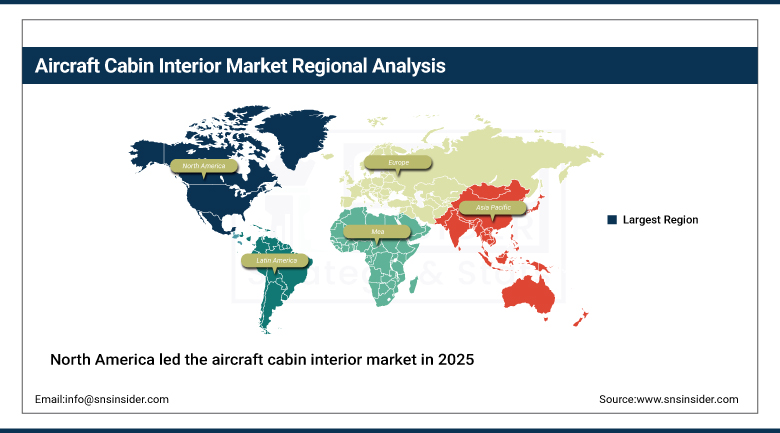
North America led the aircraft cabin interior market in 2025 accounting for a revenue share of close to 34.00% owing to robust commercial aviation infrastructure, surging aircraft retrofit activities, and increasing adoption of advanced passenger comfort technologies across the United States and Canada. Airlines and aircraft OEMs across the region are investing heavily in lightweight cabin systems, AI-enabled cabin management platforms, smart seating technologies, and high-speed IFEC solutions to enhance the passenger experience and operational efficiency. Growing premium travel demand, robust aircraft modernisation investments, and expanding fleet replacement programmes continue to drive regional market growth.
Several North American airlines in 2026 expanded deployment of next-generation connected cabin systems integrated with AI-driven passenger engagement and real-time cabin analytics technologies.
Get Customized Report as per Your Business Requirement - Enquiry Now
Europe Aircraft Cabin Interior Market Insights
In 2025, Europe represented about 27.79% share in the global aircraft cabin interior market due to growing investments in sustainable aviation technologies, robust aircraft manufacturing capabilities and increasing airline focus on passenger comfort enhancement. Airlines and cabin interior suppliers throughout Germany, France and the UK are increasingly adopting lightweight composite cabin structures, advanced seating, smart lighting and next-generation IFEC platforms in order to reduce operational costs and improve passenger retention. Strong regulatory focus on fuel efficiency and sustainable aviation operations is further bolstering regional market modernization initiatives.
A number of European aviation suppliers accelerated the commercialization of lightweight aircraft cabin systems integrated with AI-powered passenger management and intelligent connectivity technologies in 2025–2026.
Asia Pacific Aircraft Cabin Interior Market Insights
During the forecast period, Asia Pacific is expected to see the fastest CAGR of 6.94% with rapid commercial aviation expansion, increasing middle-class air passenger traffic, and growing aircraft procurement in countries like China, India, Japan, and South-east Asia. Airlines in the region are increasingly investing in modern cabin interiors, premium seating systems, smart connectivity platforms and fuel-efficient cabin equipment to enhance operational efficiency and passenger satisfaction. The continued growth of international travel demand and expansion of low-cost carrier networks are driving the deployment of advanced cabin interior technologies across the region.
Several Asia Pacific airlines launched upgraded AI-enabled IFEC and smart cabin management systems on new narrow-body and wide-body aircraft fleets delivered in 2026.
Middle East & Africa and Latin America Aircraft Cabin Interior Market Insights
The Middle East & Africa aircraft cabin interior market is experiencing steady growth on account of increasing investments in premium airline services, growing long-haul aviation networks, and increasing deployment of luxury cabin technologies across Gulf-based carriers. Airlines are more and more introducing high-end seat systems, mood lighting technology and advanced IFEC platforms to strengthen the premium passenger experience and improve competitive positioning in international aviation markets. UAE and Saudi Arabia are still seeing the expansion of their fleet programmers, which is keeping the regional market demand buoyant.
Latin America held almost 5.00% market share in 2025 due to growing commercial aviation modernization initiatives, increasing regional passenger traffic, and surging retrofit demand across Brazil and Mexico. Increasing number of airlines are investing in lightweight cabin interiors and advanced passenger connectivity systems to enhance operational performance and customer experience.
Market Dynamics:
Growth Drivers: Increase in passenger experience enhancement and fleet modernization investments.
The global aircraft cabin interiors market is witnessing a surge in demand owing to increasing emphasis on passenger comfort, airline operational efficiency, and cabin personalisation. Airlines and aircraft OEMs are increasingly incorporating lightweight seating systems, AI-enabled cabin analytics, advanced lighting technologies and high-speed connectivity solutions to enhance passenger retention and optimise aircraft performance. The increase in air passenger traffic worldwide and the growing purchase of commercial aircraft also support the growth of the market in the long term.
A few aviation companies launched enhanced smart cabin platforms with AI-enabled passenger engagement and cloud-connected operational analytics technologies in 2025-2026.
Restraints: Costly retrofit, regulatory certification hurdles.
The global aircraft cabin interiors market is witnessing a surge in demand owing to increasing emphasis on passenger comfort, airline operational efficiency, and cabin personalization. Airlines and aircraft OEMs are increasingly incorporating lightweight seating systems, AI-enabled cabin analytics, advanced lighting technologies and high-speed connectivity solutions to enhance passenger retention and optimize aircraft performance. The increase in air passenger traffic worldwide and the growing purchase of commercial aircraft also support the growth of the market in the long term. Operational challenges for cabin interior manufacturers and airline operators are also presented by complex aviation certification requirements, strict safety compliance regulations and long aircraft maintenance schedules. The delays in the supply chain of aerospace components also impact the efficiency of production and timing of retrofits.
In 2026, aviation regulators updated the certification standards for cabin safety and materials for next generation lightweight aircraft interior systems.
Opportunities: Growth of connected aircraft ecosystems Demand for premium travel.
The growth in connected aircraft ecosystems and the increased demand for premium travel globally is creating a significant growth opportunity for aircraft cabin interior providers. Airlines are increasing spend on AI-driven cabin automation systems, smart seating technologies, cloud-based passenger engagement platforms and smart connectivity solutions to improve operational efficiency and passenger personalisation capabilities. Sustainable aviation initiatives and the growing development programmers for electric aircraft are also creating long-term growth opportunities.
In 2025, a number of aviation technology companies introduced cloud-connected cabin intelligence platforms that are integrated with predictive maintenance analytics and AI-powered passenger experience management technologies.
Recent Developments:
-
2026: Safran SA expanded commercialization of lightweight smart seating systems integrated with AI-enabled passenger comfort monitoring technologies.
-
2026: Panasonic Avionics Corporation introduced upgraded satellite-connected IFEC platforms supporting real-time streaming and intelligent passenger engagement capabilities.
-
2025: Collins Aerospace accelerated deployment of modular cabin systems designed for fuel-efficient aircraft modernization programs.
-
2025: Thales Group expanded its connected cabin technology portfolio with AI-powered passenger personalization and advanced onboard connectivity solutions.
Aircraft Cabin Interior Market Key Players are:
-
Safran SA
-
Collins Aerospace
-
Panasonic Avionics Corporation
-
Thales Group
-
Diehl Aviation
-
RECARO Aircraft Seating GmbH & Co. KG
-
Gogo Inc.
-
JAMCO Corporation
-
ST Engineering Aerospace
-
Lufthansa Technik AG
-
Astronics Corporation
-
Honeywell International Inc.
-
Geven S.p.A.
-
Aviointeriors S.p.A.
-
FACC AG
-
Airbus SE
-
Boeing Company
-
Acro Aircraft Seating Ltd.
-
Haeco Group
-
Cobham Aerospace Communications
Aircraft Cabin Interior Market Report Scope:
| Report Attributes | Details |
|---|---|
| Market Size in 2025 | USD 32.05 Billion |
| Market Size by 2035 | USD 49.08 Billion |
| CAGR | CAGR of 4.51% From 2026 to 2035 |
| Base Year | 2025 |
| Forecast Period | 2026-2035 |
| Historical Data | 2022-2024 |
| Report Scope & Coverage | Market Size Analysis, Revenue Forecasting, Segment Analysis, Competitive Landscape, Regional Analysis, Retail Automation Assessment, Smart Checkout Technology Trends, AI-Enabled Retail Infrastructure Analysis, DROC & SWOT Analysis, Investment Trends, Supply Chain Evaluation, Consumer Transaction Technology Assessment, and Future Market Opportunity EvaluationChain Evaluation, Industrial Packaging Demand Analysis, Sustainability Assessment, DROC & SWOT Analysis, Regulatory Framework Analysis, Innovation Benchmarking, and Future Market Opportunity Evaluation |
| Key Segments | • By Interior Type (Aircraft Seating, In-Flight Entertainment & Connectivity (IFEC), Cabin Equipment (Galley, Lavatory, Bins, Panels)) • By Aircraft Type (Narrow-Body Aircraft, Wide-Body Aircraft, Regional & Business Aircraft) • By End User (Commercial Airlines, Business Aviation, Military & Government Aviation) |
| Regional Analysis/Coverage | North America (US, Canada), Europe (Germany, UK, France, Italy, Spain, Russia, Poland, Rest of Europe), Asia Pacific (China, India, Japan, South Korea, Australia, ASEAN Countries, Rest of Asia Pacific), Middle East & Africa (UAE, Saudi Arabia, Qatar, South Africa, Rest of Middle East & Africa), Latin America (Brazil, Argentina, Mexico, Colombia, Rest of Latin America). |
| Company Profiles | Safran SA, Collins Aerospace, Panasonic Avionics Corporation, Thales Group, Diehl Aviation, RECARO Aircraft Seating GmbH & Co. KG, Gogo Inc., JAMCO Corporation, ST Engineering Aerospace, Lufthansa Technik AG, Astronics Corporation, Honeywell International Inc., Geven S.p.A., Aviointeriors S.p.A., FACC AG, Airbus SE, Boeing Company, Acro Aircraft Seating Ltd., Haeco Group, Cobham Aerospace Communications |
Frequently Asked Questions
The Aircraft Cabin Interior Market was valued at USD 32.05 billion in 2025.
The market is projected to reach USD 49.80 billion by 2035.
The market is expected to expand at a CAGR of 4.51% during the forecast period.
North America dominated the global market owing to strong airline modernization investments and increasing adoption of advanced passenger comfort technologies.
Aircraft Seating accounted for the largest revenue share of 38.01% in 2025.
