
Automotive Diagnostic Tool Market Report Scope & Overview:
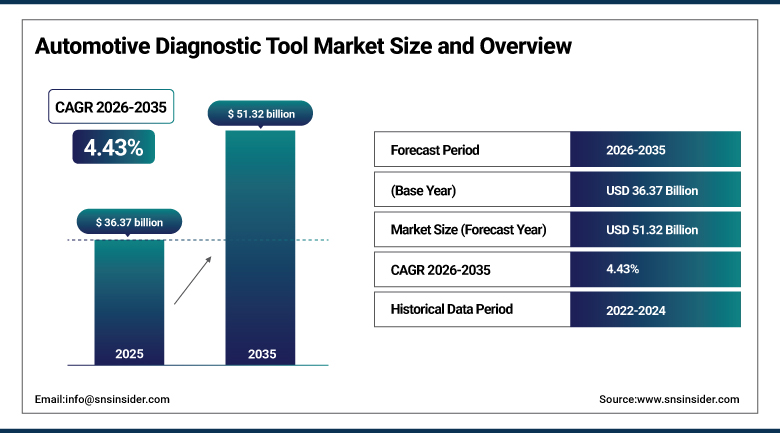
The Automotive Diagnostic Tool Market was valued at USD 36.37 Billion in 2025 and is expected to reach USD 51.32 Billion by 2035, growing at a CAGR of 4.43% from 2026 to 2035.
The automobile diagnostic tools are the devices used by auto mechanics, fleet managers, and automobile users to analyze the electronics system on board the vehicle responsible for almost all operations of today’s automobiles. Technology has revolutionized the nature of diagnosis in vehicle engineering. As opposed to the vehicles of the 1980s with few electronics systems, modern vehicles operate on hundreds of electronic control units whose sensors generate diagnostic information beyond what can be accessed by traditional methods. It takes sophisticated automobile diagnostic tools designed specifically for the job to collect and analyze diagnostic data from such complex electronic systems on board the vehicles.
Autel launched its MaxiSYS Ultra EV diagnostic platform in 2025, designed specifically for the comprehensive diagnostic requirements of battery electric and plug-in hybrid vehicles. The platform integrates high-voltage safety management, battery health assessment, thermal system diagnostics, and motor performance analysis with Autel's established OBD-II and ADAS calibration capabilities, providing professional technicians with a unified tool for the full spectrum of EV service requirements that separate conventional and EV diagnostic tools had previously required them to manage across two distinct platforms.
Market Size and Forecast
-
Market Size in 2026E: USD 37.98 Billion
-
Market Size by 2035: USD 51.32 Billion
-
CAGR: 4.43% from 2026 to 2035
-
Fastest Growing Region: Asia Pacific
-
Largest Region: North America
To Get more information Automotive Diagnostic Tool Market - Request Free Sample Report
Automotive Diagnostic Tool Market Trends
-
Electric vehicle growth is increasing demand for advanced diagnostic tools supporting battery, high-voltage, and EV drivetrain analysis.
-
Cloud-connected diagnostic platforms with AI-based fault detection and remote repair guidance are replacing traditional standalone scan tools.
-
ADAS calibration integration is becoming essential as modern vehicles require sensor recalibration after repairs and maintenance.
-
Smartphone-based DIY OBD-II diagnostic tools are gaining popularity for vehicle health monitoring and maintenance tracking.
-
Fleet operators are adopting predictive maintenance platforms combining diagnostics, telematics, and AI-driven service scheduling.
The U.S. Automotive Diagnostic Tool Market Outlook
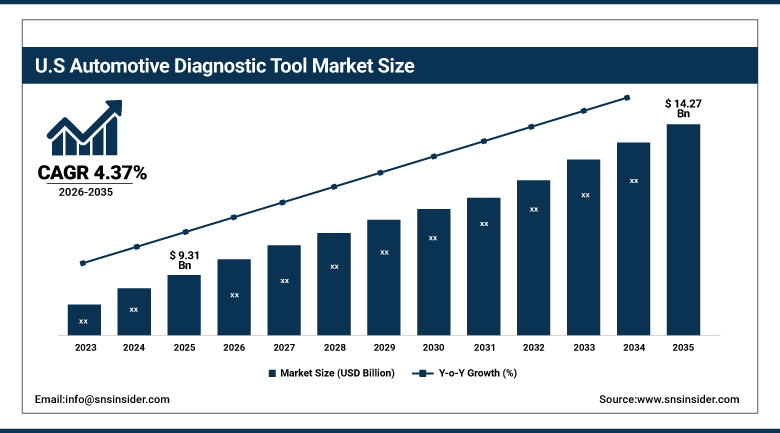
The U.S. Automotive Diagnostic Tool Market was valued at approximately USD 9.31 Billion in 2025 and is expected to reach approximately USD 14.27 Billion by 2035, growing at a CAGR of approximately 4.37%.
United States dominates the market for automotive diagnostics tools due to having the world's largest vehicle fleet base at 290 million registered vehicles, a mature automotive after-market services industry, and increasing use of advanced driver-assistance systems which are necessitating new diagnostic categories following repairs. Environmental Protection Agency programs in the US that mandate emission testing through On-Board Diagnostic System II ensure there is commercial demand for diagnostic tool purchases by both government inspection facilities and private garages.
Snap-on Incorporated, the world's leading premium automotive diagnostic tool manufacturer, expanded its ZEUS+ advanced diagnostic platform with new EV-specific modules in 2025, incorporating high-voltage circuit analysis, battery cell balancing diagnostic capability, and OEM-level EV programming functions into its flagship professional technician platform.
Automotive Diagnostic Tool Market Segment Analysis
-
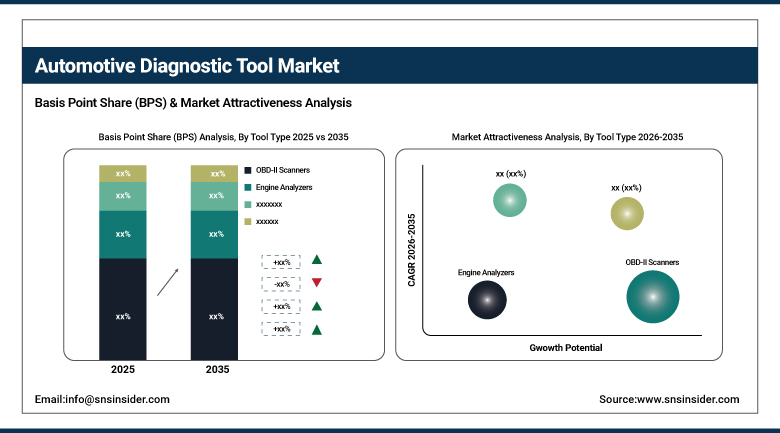
By Tool Type, the OBD-II scanners segment dominated the automotive diagnostic tool market with 38.72% share in 2025, while engine analyzers are the fastest growing tool type with a CAGR of 6.37% during 2026 to 2035.
-
By Vehicle Type, the passenger cars segment dominated the automotive diagnostic tool market with 52.63% share in 2025, while two-wheelers are the fastest growing vehicle type with a CAGR of 6.21% during the forecast period.
-
By End User, the workshops segment dominated the automotive diagnostic tool market with 45.87% share in 2025, while DIY users are the fastest growing end user with a CAGR of 6.45% through 2026 to 2035.
-
By Distribution Channel, the offline retail segment dominated the automotive diagnostic tool market with 48.19% share in 2025, while online retail is the fastest growing channel with a CAGR of 6.12% during 2026 to 2035.
By Tool Type, OBD-II scanners dominate, engine analyzers grow fastest
OBD-II scanners generated 38.72% of automotive diagnostic tool market revenue in 2025. Their commercial dominance reflects the universality of OBD-II compliance across the global passenger vehicle fleet built since 1996 in the United States and since 2001 across European markets, combined with the practical diagnostic value of standardized fault code retrieval that makes OBD-II scanning the entry point for virtually every vehicle diagnosis across both professional and consumer channels. The OBD-II standard's mandated availability of fault code data, emissions readiness monitor status, and selected live data parameters without tool authorization requirements makes OBD-II scanners the most accessible and commercially broadly distributed category in automotive diagnostics.
Engine analyzers are growing fastest with a CAGR of 6.37%, driven by the growing complexity of engine management systems in both conventional internal combustion and hybrid drivetrains whose combustion efficiency, emission system health, and fuel delivery system parameters require comprehensive engine-specific analysis beyond OBD-II generic fault codes to diagnose efficiently.
By End User, workshops dominate, DIY users grow fastest
Workshops generated 45.87% of automotive diagnostic tool market revenue in 2025, reflecting the professional automotive service industry's role as the primary high-capability diagnostic tool customer whose productivity-driven investment rationale and regulatory compliance requirements justify premium diagnostic platform expenditure. Professional automotive workshops whose technician labor rates generate direct revenue from diagnostic efficiency improvements provide the most commercially motivated diagnostic tool buyers in the market.
DIY users are growing fastest with a CAGR of 6.45%, driven by increasing vehicle owner sophistication in diagnostic engagement, the commercial availability of capable and affordable consumer-grade OBD-II scanners, and the proliferation of digital repair guidance content on YouTube, manufacturer apps, and specialist automotive websites that enable motivated non-professional users to interpret and act on diagnostic data that previously required professional expertise to use productively.
Regional Analysis
|
Region |
Major Country |
Share within Region, 2025 (%) |
|---|---|---|
|
North America |
United States |
82.47% |
|
Europe |
Germany |
28.47% |
|
Asia Pacific |
China |
38.47% |
|
Middle East & Africa |
UAE |
22.84% |
|
Latin America |
Brazil |
43.84% |
North America Automotive Diagnostic Tool Market Insights
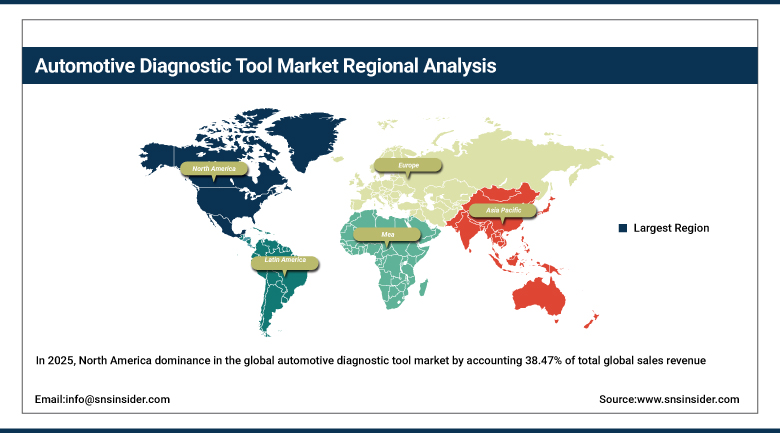
In 2025, North America captured dominance in the global automotive diagnostic tool market by accounting for approximately 38.47% of total global sales revenue. This region has the U.S., which alone makes up roughly 82.47% of total regional revenue, thanks to its vast vehicle parc and established after-market services landscape, along with being home to the maximum number of franchised dealer service centers and independent specialists around the world. The huge after-market sector of the U.S., which rakes in revenues of more than USD 500 billion per annum, creates an environment where premium-level diagnostic tools can be purchased commercially.
Get Customized Report as per Your Business Requirement - Enquiry Now
Europe Automotive Diagnostic Tool Market Insights
The European region accounted for around 24.84% of the worldwide Automotive Diagnostic Tools revenue in 2025. Germany, France, the UK, Italy, and Spain are some of the dominant national markets, as they have large automotive manufacturing industries as well as after-market services industries. European countries have regulations for emission tests; thus, emission norms introduced by the EU are increasingly stringent, making it mandatory to use Automotive Diagnostic Tools in all manufacturers authorized and independent workshops. Germany represents about 28.47% of the European region's revenue due to the presence of premium car manufacturer headquarters and dealerships in the country.
Asia Pacific Automotive Diagnostic Tool Market Insights
Asia-Pacific is currently experiencing rapid growth to become the top-regional Automotive Diagnostic Tools market due to having the largest and fastest-growing markets for vehicles in the world which include China, India, Japan, South Korea, and Southeast Asia where the annual vehicle production as well as increasing parc sizes have helped create more demand for diagnostic tools in both workshops and consumers. The leading contributor to Asia-Pacific revenues is China with almost 38.47% of market revenues thanks to its dominant automotive production industry, rapidly growing fleet of electric vehicles where demand for diagnostic needs is helping create a new demand for diagnostic categories, as well as the presence of major Chinese diagnostic tool brands such as Autel, Launch, and TOPDON whose global distribution is driving more sales in Asian markets internationally.
MEA & Latin America Automotive Diagnostic Tool Market Insights
Middle East and Latin America are growing automotive diagnostic tool markets where expanding vehicle parcs, improving organised aftermarket service infrastructure, and growing technical training standards for automotive technicians are creating progressive diagnostic tool adoption. The UAE leads MEA revenues at approximately 22.84% of the regional total through its high-income consumer vehicle market, concentration of premium brand authorized service centers, and exposure to international aftermarket technology through its automotive import and distribution sector. Brazil leads Latin American revenues at approximately 43.84% of the regional total through its large and growing vehicle parc, established automotive manufacturing sector, and professional automotive service market whose technician training programmes are progressively improving diagnostic technology competency.
Market Dynamics
Growth Drivers: Increasing vehicle electronic complexity and rapid EV adoption are driving demand for advanced automotive diagnostic tools across professional and consumer markets.
The continuous addition of electronic control systems, software-defined vehicle functions, and network-connected vehicle features to every new vehicle platform ensures that diagnostic tool capability requirements escalate with each model year. The average modern vehicle contains over 100 million lines of software code, 70 to 100 ECUs, and multiple CAN bus, LIN, and Ethernet communication networks whose diagnostic accessibility requires tools with the hardware interfaces, software drivers, and protocol support to communicate with every system simultaneously. The global EV fleet's rapid expansion is amplifying this complexity mandate, as EV diagnostic requirements span high-voltage electrical safety, battery electrochemistry, thermal management, and regenerative braking system analysis that requires entirely new diagnostic tool hardware and software capability categories.
Restraints: Rapid advancements in vehicle technologies are increasing diagnostic tool upgrade costs and shortening product replacement cycles.
The pace of vehicle technology development creates a persistent tool obsolescence challenge for diagnostic tool manufacturers and their professional customers whose tool libraries must continuously expand to maintain diagnostic coverage of new vehicle platforms, new electronic systems, and new communication protocols. OEM-authorized diagnostic access restrictions, where vehicle manufacturers limit advanced programming, coding, and calibration functions to authorized dealer tools whose licensing model generates significant recurring software subscription revenue, create commercial tension with independent workshop operators whose customers expect equivalent capability at lower cost. Right-to-repair legislative developments across the United States and European Union are progressively addressing this access restriction issue, but the pace of legislative resolution has not matched the pace of technology restriction implementation.
Opportunities: AI-powered remote diagnostic services and ADAS calibration tool integration represent high-value commercial growth frontiers for the automotive diagnostic tool industry.
Remote diagnostic services that enable experienced technicians at centralized diagnostic centers to remotely access vehicle data through cloud-connected scan tools installed at partner workshops represent a commercially significant service model evolution. This architecture enables small independent workshops without senior diagnostic expertise to offer premium fault diagnosis quality by accessing specialist knowledge remotely, creating a business model innovation whose commercial viability is improving with cloud connectivity, diagnostic platform standardization, and remote expert service market development. ADAS calibration systems that enable post-collision and post-repair sensor and camera recalibration are the fastest-growing workshop revenue category in the automotive aftermarket, generating calibration fees that can exceed USD 500 per vehicle and requiring capital investment in precision calibration target systems and space requirements whose management is creating significant aftermarket consolidation.
Recent Developments:
-
2025: Autel launched its MaxiSYS Ultra EV diagnostic platform with comprehensive battery electric and plug-in hybrid vehicle diagnostic capability including high-voltage safety management, battery health assessment, and motor performance analysis, providing professional technicians with a unified tool for complete EV service requirements.
-
2025: Snap-on expanded its ZEUS+ advanced diagnostic platform with EV-specific modules including high-voltage circuit analysis, battery cell balancing diagnostics, and OEM-level EV programming functions, maintaining its premium market position by matching its highest-capability tools to the growing EV diagnostic requirements of franchise dealer and specialist workshop customers.
-
2024: Launch Tech launched its X-431 PAD V EV Edition diagnostic platform with integrated EV battery health assessment, online programming for EV systems, and AI-assisted fault analysis for over 200 EV and PHEV models, expanding its professional diagnostic tool portfolio to address the growing demand from independent workshops servicing the rapidly expanding global EV fleet.
Automotive Diagnostic Tool Market Key Players are:
-
Robert Bosch GmbH
-
Snap-on Incorporated
-
Autel Intelligent Technology Corp. Ltd.
-
Launch Tech Co. Ltd.
-
Continental AG
-
Delphi Technologies (BorgWarner)
-
Denso Corporation
-
Hella GmbH & Co. KGaA
-
Actia Group SA
-
Softing AG
-
TOPDON Technology Co. Ltd.
-
Innova Electronics Corporation
-
OTC Tools (Bosch)
-
Matco Tools Corporation
-
Mahle GmbH
-
Opus IVS (Solera Holdings)
-
AutoZone Inc. (Duralast tools)
-
Carly Solutions GmbH
-
BlueDriver (Lemur Vehicle Monitors)
-
Drew Technologies Inc. (Solera)
Automotive Diagnostic Tool Market Report Scope:
| Report Attributes | Details |
|---|---|
| Market Size in 2025 | USD 36.37 Billion |
| Market Size by 2035 | USD 51.32 Billion |
| CAGR | CAGR of 4.43% From 2026 to 2035 |
| Base Year | 2025 |
| Forecast Period | 2026-2035 |
| Historical Data | 2022-2024 |
| Report Scope & Coverage | Market Size, Segments Analysis, Competitive Landscape, Regional Analysis, DROC & SWOT Analysis, Forecast Outlook |
| Key Segments | • By Tool Type (OBD-II Scanners, Engine Analyzers, Battery Testers, Digital Pressure Testers, Emissions Analyzers, Others) • By Vehicle Type (Passenger Cars, Commercial Vehicles, Two-Wheelers, Electric Vehicles) • By End User (Workshops, Fleet Operators, DIY Users, OEM Dealers) • By Distribution Channel (Offline Retail, Online Retail, OEM/Direct Sales) |
| Regional Analysis/Coverage | North America (US, Canada), Europe (Germany, UK, France, Italy, Spain, Russia, Poland, Rest of Europe), Asia Pacific (China, India, Japan, South Korea, Australia, ASEAN Countries, Rest of Asia Pacific), Middle East & Africa (UAE, Saudi Arabia, Qatar, South Africa, Rest of Middle East & Africa), Latin America (Brazil, Argentina, Mexico, Colombia, Rest of Latin America). |
| Company Profiles | Robert Bosch GmbH, Snap-on Incorporated, Autel Intelligent Technology Corp. Ltd., Launch Tech Co. Ltd., Continental AG, Delphi Technologies (BorgWarner), Denso Corporation, Hella GmbH & Co. KGaA, Actia Group SA, Softing AG, TOPDON Technology Co. Ltd., Innova Electronics Corporation, OTC Tools (Bosch), Matco Tools Corporation, Mahle GmbH, Opus IVS (Solera Holdings), AutoZone Inc. (Duralast tools), Carly Solutions GmbH, BlueDriver (Lemur Vehicle Monitors), Drew Technologies Inc. (Solera) |
Frequently Asked Questions
The Automotive Diagnostic Tool Market is expected to grow at a CAGR of 4.43% from 2026 to 2035.
The Automotive Diagnostic Tool Market was valued at USD 36.37 Billion in 2025.
The primary growth factors are rising vehicle electronic complexity requiring increasingly sophisticated diagnostic tools, the rapidly expanding global EV fleet creating demand for EV-specific battery and high-voltage diagnostic capability.
The OBD-II scanners segment dominated the Automotive Diagnostic Tool Market with 38.72% share in 2025.
