
Linear Motion Systems Market Report Scope & Overview:
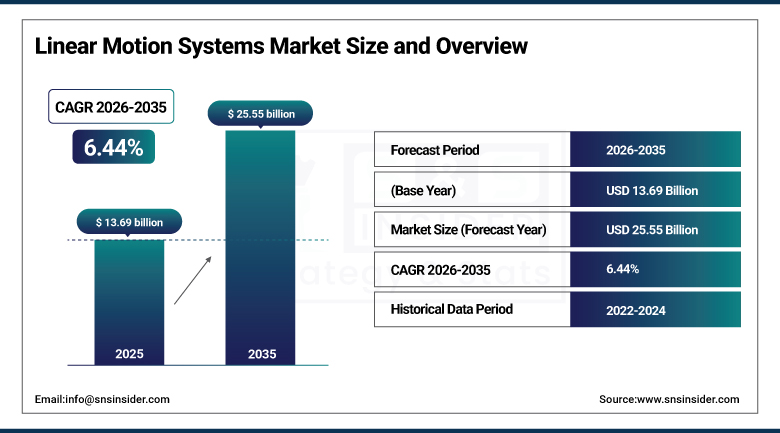
The Linear Motion Systems Market was valued at USD 13.69 Billion in 2025 and is expected to reach USD 25.55 Billion by 2035, growing at a CAGR of 6.44% from 2026 to 2035.
Linear Motion System or Linear Motion Device or Linear Actuator is a mechanical system that gives controlled movements in one direction only through the use of linear bearings, guides, and drive systems that are fixed to a base or frame to provide precision movement in one linear path only. This increase is caused by the increasing need for precise positioning in automotive, semiconductor, and automated warehousing industries and due to increased investments in digital factory in which motion components are used in the Industrial Internet of Things network. Linear motion systems are commonly used in manufacturing industry, aerospace industry, healthcare industry, automotive industry, food and beverages industry, packaging industry and electronics industry worldwide to give efficient and flexible positioning at relatively cheaper costs compared to other positioning systems.
The Rollon Company extended its TH ball-screw driven linear actuator series in May 2025 with a size 200 model addition, which was done in response to a general trend towards the use of standardized and modular components that have high-performance characteristics in adverse conditions.
Market Size and Forecast
-
Market Size in 2026E: USD 14.57 Billion
-
Market Size by 2035: USD 25.55 Billion
-
CAGR: 6.44% from 2026 to 2035
-
Fastest Growing Region: Asia Pacific
-
Largest Region: Asia Pacific
To Get more information Linear Motion Systems Market - Request Free Sample Report
Linear Motion Systems Market Trends
-
Regulatory influence from IEC-62443 cybersecurity standards is driving competitive advantage toward connected motion control products with robust security features.
-
Rapid integration of Industry 4.0 techniques, including IoT, data analytics, and connectivity, continues influencing market growth.
-
Growing traction of electric vehicles and rising construction of smart factories continue propelling market expansion.
-
Over seventy-two percent of manufacturing plants are integrating linear motion components for enhanced precision.
-
More than sixty-eight percent of small to mid-size manufacturers have begun transitioning to automated linear guides and actuators.
United States Linear Motion Systems Market Outlook
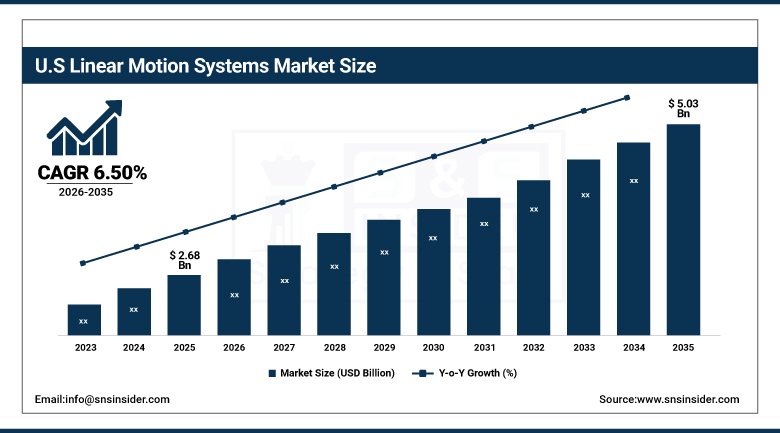
The United States Linear Motion Systems Market was valued at USD 2.68 Billion in 2025 and is expected to reach USD 5.03 Billion by 2035, growing at a CAGR of 6.50% from 2026 to 2035.
There is continued demand for automation within the applications of manufacture in the United States, and increased knowledge about the environmentally friendly characteristics of linear motion system components regarding their low levels of carbon emissions. The use of linear motion components within the process of manufacturing vehicles in the stages of sorting, handling, and material supply continued fueling the market throughout the year along with demand from the aerospace, health care, and electronic sectors.
THK, a major manufacturer of linear motion components from Japan with significant operations in America, continued to expand its range of linear guides and ball screws in January 2025.
Linear Motion Systems Market Segment Analysis
-
By Type, the Multi-Axis segment held the largest share in 2025, while the Single-Axis segment is the fastest growing.
-
By Component, the Linear Guides segment held the largest share in 2025, while the Controllers segment is the fastest growing.
-
By Application, the Automotive segment held approximately 40.42% share in 2025, while the Semiconductor Electronics segment is the fastest growing.
By Type, Multi-Axis Segment Dominates the Market
The Multi-Axis segment dominated the type category in 2025, as these platforms can deliver synchronized movement across several degrees of freedom, a capability prized in complex robotic cells and high-density storage grids. That synchronized multi-degree-of-freedom capability continues to keep multi-axis systems firmly at the top of the broader type segmentation across nearly every major advanced automation deployment worldwide.
The Single-Axis segment is projected to grow at the fastest rate during the forecast period, with demand having grown by over fifty-seven percent, driven by its application in 3D printing, semiconductor inspection, and laser cutting systems. Rising adoption of single-axis systems for these increasingly precise, specialized applications continues pushing this type category's growth rate ahead of the broader type segmentation.
By Component, Linear Guides Segment Dominates the Market
The Linear Guides segment held the largest share of the component segmentation in 2025, anchored by their foundational role in providing the smooth, reliable motion path along a single plane that nearly every linear motion system configuration requires. That foundational, universally-required function continues to keep linear guides firmly at the top of the broader component segmentation, with actuators and ball screws continuing to represent substantial additional component categories.
The Controllers segment is projected to grow at the fastest CAGR during the forecast period, as regulatory influence from IEC-62443 cybersecurity standards continues driving competitive advantage toward companies that can demonstrate robust security features in their connected motion control products. Rising integration of motion components into Industrial Internet of Things networks continues pushing this component category's growth rate ahead of the broader component segmentation.
By Application, Automotive Segment Dominates the Market
The Automotive segment accounted for approximately 40.42% of total market revenue in 2025, driven by extensive use in welding, inspection, and battery-pack production across automotive assembly lines worldwide. That extensive, well-established automotive manufacturing application continues to keep this application segment firmly at the top of the broader application segmentation, with material handling equipment, machine tools, and robotics continuing to represent substantial additional application categories.
The Semiconductor Electronics segment is projected to grow at the fastest CAGR during the forecast period, supported by increased adoption of linear motion systems as falling production costs, improving fabrication techniques, and growing demand for advanced equipment continue propelling growth in the global electronics and semiconductor industry. Rising semiconductor manufacturing investment continues pushing this application category's growth rate ahead of the broader application segmentation.
Regional Insights
|
Region |
Major Country |
Share within Region, 2025 (%) |
|---|---|---|
|
Asia Pacific |
China |
37.60% |
|
North America |
United States |
84.70% |
|
Europe |
Germany |
27.40% |
|
Middle East & Africa |
UAE |
26.30% |
|
Latin America |
Brazil |
37.10% |
North America Linear Motion Systems Market Insights
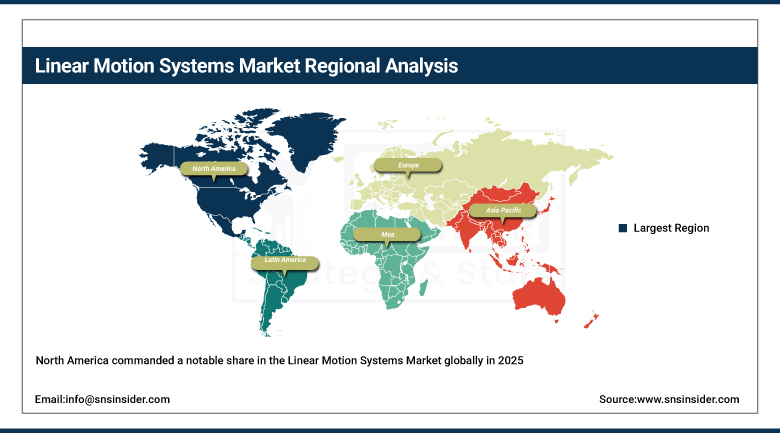
North America commanded a notable share in the Linear Motion Systems Market globally in 2025, owing to the rising popularity of automation in manufacturing processes and growing awareness about environmentally sustainable linear motion systems within the region. Adoption of linear motion systems in automotive manufacturing remained a major driver for the regional demand for the same all through 2025.
The US generated about 84.70% of regional revenue from the sales of linear motion systems due to its concentration of prominent automotive, aerospace, and semiconductor companies. Canada generated a smaller yet consistently increasing share of regional revenue for linear motion systems, owing to increased adoption of industrial automation within the country.
Get Customized Report as per Your Business Requirement - Enquiry Now
Europe Linear Motion Systems Market Insights
Europe held a meaningful share of the global Linear Motion Systems Market in 2025, supported by strong industrial automation manufacturing capability and comprehensive Industry 4.0 adoption across the continent. Germany accounted for roughly 27.40% of regional revenue, supported by its concentration of precision engineering and automotive manufacturing companies.
France, Italy, and the United Kingdom followed a broadly similar trajectory, as continued smart factory investment extended linear motion systems demand across the continent's largest industrial manufacturing markets. Continued regulatory emphasis on connected equipment cybersecurity is expected to keep supporting steady European demand through the remainder of the forecast period.
Asia Pacific Linear Motion Systems Market Insights
Asia Pacific held the largest share of the global Linear Motion Systems Market in 2025, at approximately 40.12%, and is also projected to grow at the fastest rate of approximately 9.21% through 2030, propelled by Chinese and Japanese manufacturing upgrades across the region's largest industrial economies. Continued digital-factory investment and expanding automotive and semiconductor manufacturing capacity continued reinforcing this dual leadership position throughout the year.
China accounted for roughly 37.60% of regional revenue, supported by its massive domestic manufacturing base and expanding automation adoption. Japan and South Korea contributed significant additional regional demand through their own advanced precision manufacturing and semiconductor industries, reinforcing Asia Pacific's position as the clear global leader in this market.
MEA & Latin America Linear Motion Systems Market Insights
The Middle East and Africa region recorded steady growth in linear motion systems adoption in 2025, driven by expanding industrial diversification investment and growing manufacturing automation across the Gulf states in particular. The UAE accounted for roughly 26.30% of regional revenue, supported by national industrial development strategies and rising enterprise demand for automated positioning technology.
Latin America expanded at a comparable pace, led by Brazil at roughly 37.10% of regional revenue, where growing automotive and industrial manufacturing investment continued to support category growth. Mexico and Argentina followed a similar trajectory as regional manufacturing automation adoption expanded further through the remainder of the forecast period.
Growth Drivers: Industrial Automation Expansion and Digital Factory Integration
Rising demand for high-precision positioning in the automotive, semiconductor, and warehouse automation sectors continues to be the central force behind linear motion systems market growth. Stronger digital-factory investments that integrate motion components into Industrial Internet of Things networks continue reinforcing structural demand growth across nearly every major manufacturing region worldwide.
The rising demand for automation in the manufacturing applications, along with increasing awareness towards the eco-friendly properties of linear motion system devices in reducing carbon emissions, continues primarily driving the global linear motion system market. Growing traction of electric vehicles and rising construction of smart factories continue reinforcing sustained market expansion through the forecast period.
Restraints: Cybersecurity Compliance Costs and Component Standardization Challenges
Regulatory compliance with IEC-62443 cybersecurity standards continues requiring substantial engineering investment for manufacturers seeking to demonstrate robust security features in connected motion control products. That compliance burden continues concentrating the most advanced, cybersecurity-compliant linear motion technology among well-resourced manufacturers.
The complexity of achieving standardized component design across machine screw, stainless steel, and ball screw variants while maintaining consistent physical dimensions continues requiring sustained engineering investment. That standardization challenge continues limiting the pace at which smaller manufacturers can compete against established linear motion technology leaders.
Opportunities: Semiconductor Manufacturing Expansion and Modular Component Innovation
Continued growth in semiconductor manufacturing investment presents substantial opportunity for linear motion system manufacturers positioned to serve this increasingly precision-demanding application category. Manufacturers capable of delivering nanoscale-precision motion systems stand to capture a growing share of demand as semiconductor fabrication capacity continues expanding globally.
Continued development of standardized, modular components offering both high performance and adaptability in harsh conditions, including offshore wind, oil and gas, and food processing environments, presents a further significant growth avenue. Manufacturers capable of delivering these versatile, corrosion-resistant product lines stand to capture meaningful new revenue streams through 2035.
Recent Developments:
-
2025: Bosch Rexroth continued expanding its linear motion technology portfolio, strengthening its position serving industrial automation customers requiring high-precision positioning and guidance systems.
-
2025: SKF continued advancing its linear motion and actuator technology, targeting manufacturers seeking integrated, digitally-monitored positioning solutions for Industry 4.0 applications.
-
2025: Thomson Industries continued developing its linear guide and ball screw product lines, reinforcing its position within the Regal Rexnord portfolio serving global industrial automation customers.
Linear Motion Systems Companies are:
-
Thomson Industries, Inc.
-
THK Co., Ltd.
-
HepcoMotion
-
NSK Ltd.
-
Altra Industrial Motion Corp.
-
Bosch Rexroth AG
-
SKF Group
-
Schaeffler AG
-
Parker Hannifin Corporation
-
IKO International, Inc.
-
PBC Linear
-
Festo SE & Co. KG
-
SMC Corporation
-
Nook Industries, Inc.
-
Bishop-Wisecarver Corporation
-
Ewellix AB
-
Hiwin Technologies Corp.
-
Regal Rexnord Corporation
Linear Motion Systems Market Report Scope:
| Report Attributes | Details |
|---|---|
| Market Size in 2025 | USD 13.69 Billion |
| Market Size by 2035 | USD 25.55 Billion |
| CAGR | CAGR of 6.44% From 2026 to 2035 |
| Base Year | 2025 |
| Forecast Period | 2026-2035 |
| Historical Data | 2022-2024 |
| Report Scope & Coverage | Market Size, Segments Analysis, Competitive Landscape, Regional Analysis, DROC & SWOT Analysis, Forecast Outlook |
| Key Segments | • By Type (Multi-Axis, Single-Axis) • By Component (Linear Guides, Actuators, Ball Screws, Controllers) • By Application (Automotive, Semiconductor Electronics, Material Handling Equipment, Machine Tools, Robotics) |
| Regional Analysis/Coverage | North America (US, Canada), Europe (Germany, UK, France, Italy, Spain, Russia, Poland, Rest of Europe), Asia Pacific (China, India, Japan, South Korea, Australia, ASEAN Countries, Rest of Asia Pacific), Middle East & Africa (UAE, Saudi Arabia, Qatar, South Africa, Rest of Middle East & Africa), Latin America (Brazil, Argentina, Mexico, Colombia, Rest of Latin America). |
| Company Profiles | Thomson Industries, Inc., THK Co., Ltd., HepcoMotion, NSK Ltd., Rollon S.p.A., Altra Industrial Motion Corp., Bosch Rexroth AG, SKF Group, Schaeffler AG, Parker Hannifin Corporation, IKO International, Inc., PBC Linear, Igus GmbH, Festo SE & Co. KG, SMC Corporation, Nook Industries, Inc., Bishop-Wisecarver Corporation, Ewellix AB, Hiwin Technologies Corp., Regal Rexnord Corporation |
Frequently Asked Questions
The Linear Motion Systems Market is expected to grow at a CAGR of 6.44% from 2026 to 2035.
The Linear Motion Systems Market was valued at USD 13.69 Billion in 2025.
Rising demand for high-precision positioning in automotive and semiconductor sectors combined with digital-factory investment is the major growth factor.
The Automotive segment held approximately 40.42% share in 2025.
Asia Pacific held the largest share of the Linear Motion Systems Market in 2025, at approximately 40.12%, and was also the fastest-growing region.
