
B2B Digital Payment Market Report Scope & Overview:
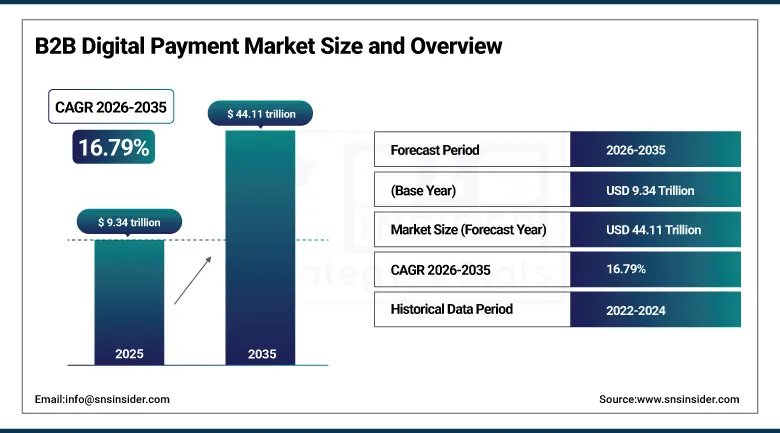
The B2B Digital Payment Market was valued at USD 9.34 trillion in 2025 and is expected to reach USD 44.11 trillion by 2035, growing at a CAGR of 16.79% from 2026–2035.
The B2B Digital Payment Market is experiencing a time when its structural growth is high, due to an increasing trend among businesses where companies transition from payments through paper and manual processes to payments that are fast and efficient, which involve the use of digital processes to manage transactions. This need for efficiency applies to all sectors where transactions take place since businesses are increasingly faced with the task of improving the speed and efficiency of transactions while cutting the cost of processing transactions.
Governments and central banks in major economies are also actively modernizing their digital financial infrastructure. National real-time payment systems such as the U.S. Federal Reserve's FedNow service, the EU's SEPA Instant Credit Transfer scheme, and similar initiatives across Asia Pacific are creating the rails on which enterprise digital payment adoption is accelerating.
To Get more information on B2B Digital Payment Market - Request Free Sample Report
B2B Digital Payment Market Trends
-
Rapid adoption of real-time payment systems enabling instant fund settlement and improving enterprise cash flow management globally.
-
Growing integration of AI and machine learning into payment platforms for fraud detection, invoice processing automation, and predictive cash flow analytics.
-
Widespread expansion of blockchain-based payment solutions delivering greater transparency, security, and efficiency in cross-border B2B transactions.
-
Accelerating shift away from paper checks and manual wire transfers toward API-driven, automated digital payment workflows among enterprises of all sizes.
-
Rising demand from SMEs for affordable, scalable digital payment platforms that reduce transaction costs and speed up supplier settlements.
-
Increasing embedding of payment capabilities into ERP, procurement, and supply chain platforms, reducing the need for standalone payment systems.
-
Growth of virtual card adoption for corporate procurement providing enhanced transaction controls, spend visibility, and working capital flexibility.
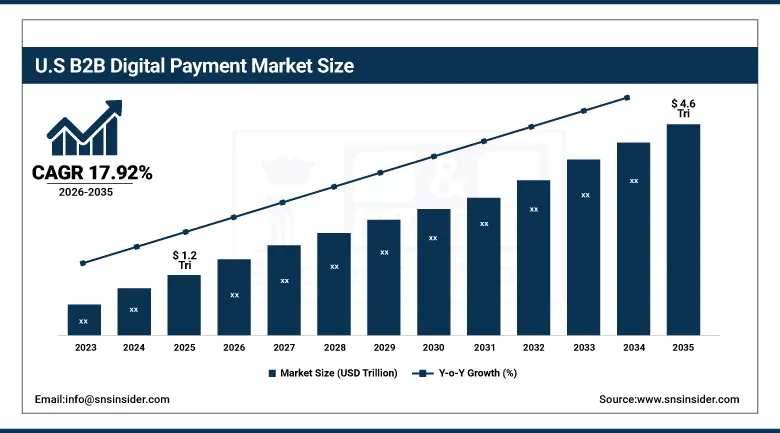
U.S. B2B Digital Payment Market was valued at USD 1.2 trillion in 2025 and is expected to reach USD 4.6 trillion by 2035, registering a CAGR of 17.92% during 2026–2035.
The US is considered to be one of the most developed and fast-growing B2B digital payments markets in the world. The financial industry, technology sector, and presence of numerous big companies in the United States generate a stable need for advanced digital payments systems. The introduction of the FedNow service by the Federal Reserve of the US increased the availability of payment systems operating in real time and thus made it easier for companies to switch from conventional payments to digital alternatives.
Strong momentum in AI-powered payment platforms and blockchain adoption, combined with growing enterprise demand for automated accounts payable and receivable solutions, is accelerating digital payment adoption across U.S. businesses. Canada within the broader North American region is also demonstrating aggressive growth as national initiatives to implement real-time payment infrastructure come to fruition, further strengthening regional market dynamics through 2035.
B2B Digital Payment Market Segment Insights
-
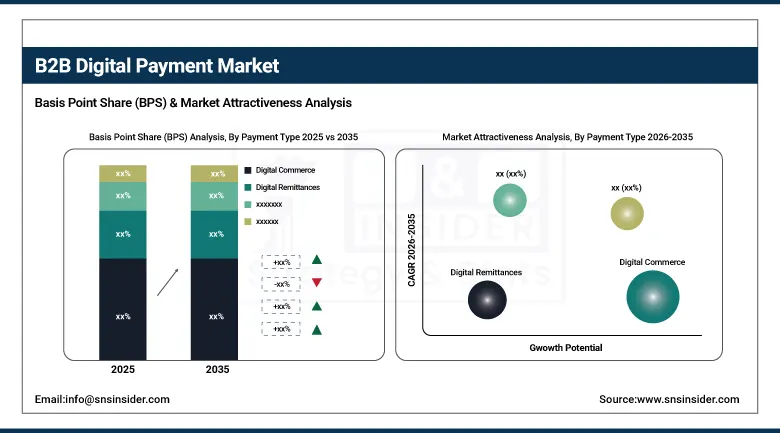
Based on Payment Type, Digital Commerce accounted for the largest market share (~58%) in 2025; Digital Remittances segment expected to be the fastest-growing segment (CAGR).
-
Based on Component, Payment Gateways accounted for the largest market share in 2025; Services segment expected to be the fastest-growing segment (CAGR).
-
Based on Deployment Mode, Cloud-Based accounted for the largest market share in 2025; Cloud-Based segment expected to continue as the fastest-growing segment (CAGR).
-
Based on Enterprise Size, Large Enterprises accounted for the largest market share in 2025; SMEs expected to be the fastest-growing segment (CAGR).
-
Based on End-Use, IT & Telecom accounted for the largest market share in 2025; Retail segment expected to be the fastest-growing segment (CAGR).
B2B Digital Payment Market Segment Analysis
By Payment Type, Digital Commerce dominates the B2B Digital Payment Market, Digital Remittances expected to grow fastest
The digital commerce vertical captured the maximum market share in the B2B digital payment market in 2025, contributing to about 58% of the total revenue generated. The rapid expansion of online business operations, B2B e-commerce networks, and digital marketplaces has generated substantial demand for efficient and effective payment processing facilities. Firms functioning within the B2B e-commerce network need payment services capable of performing large-scale payment settlements, automating invoicing procedures, supporting multilingual currency payments, and integrating with the purchase order management process. These payment platforms are grabbing the maximum share of enterprise payment expenditure.
The digital remittances segment is expected to register the fastest CAGR throughout the forecast period of 2026 to 2035. The increasing globalization of supply chains and the growing need for efficient, low-cost international fund transfers between business partners are driving demand for digital remittance platforms. SMEs in particular are shifting rapidly toward fintech-driven remittance solutions that offer significantly lower fees and faster settlement times than traditional banking channels. Blockchain-powered remittance platforms are gaining meaningful traction in this segment and are expected to drive its growth well above the overall market average through 2035.
By Component, Payment Gateways segment dominates the B2B Digital Payment Market, Services segment expected to grow fastest
Payment gateways were the market leaders in the digital payment ecosystem for business-to-business transactions by 2025. These represent the base layer of technology that helps ensure safe digital payment transactions between two businesses. Payment gateways can be found everywhere within the enterprise environment, especially where digital B2B payments take place. They help in accepting multiple currencies, reducing cart abandonment during B2B transactions, and interfacing with enterprise resource planning systems.
The services segment is expected to grow at the fastest rate during the forecast period. As digital payment technology becomes increasingly complex and as compliance requirements multiply across jurisdictions, enterprises are turning to specialist implementation, consulting, and managed service providers to ensure their payment systems operate efficiently, securely, and in full regulatory compliance.
By Deployment Mode, Cloud-Based segment dominates the B2B Digital Payment Market, expected to grow fastest
The cloud-based deployment model contributed the maximum share towards the generation of revenue within the B2B digital payments market in 2025. This deployment type is expected to remain at the top during the forecast period, mainly due to the numerous advantages offered by the cloud-native payment solution, including scalability, affordability, faster time-to-value, and simple integration capabilities. Using cloud computing solutions, organizations do not have to maintain any complex payment functionality in-house, thus reducing the burden on their IT staff and allowing for quicker adoption of new payment capabilities.
On-premises deployment remains relevant for organizations with strict data sovereignty requirements, particularly in regulated sectors such as banking, insurance, and government. However, the balance is shifting steadily toward cloud as security capabilities of cloud platforms improve and as regulatory frameworks increasingly accommodate cloud-based financial infrastructure.
By Enterprise Size, Large Enterprises dominate the B2B Digital Payment Market, SMEs expected to grow fastest
Large firms have been driving the growth of the B2B digital payment sector since 2025, due to their large transaction volume, elaborate payment processing requirements, and ample capital availability for investment in digital payments technology. Generally, large corporations have to process thousands of suppliers, conduct international business, and perform accounts payable and receivable automation that necessitates the use of advanced systems that are available only through digital payment technologies for large businesses. The size of large corporations makes the benefits of digital payment adoption even more significant, thus offering an ROI.
The SME segment is projected to grow at the highest CAGR from 2026 to 2035. An expanding range of affordable, cloud-based digital payment solutions specifically designed for smaller businesses is making high-quality payment automation accessible to organizations that previously could not justify the cost. As SMEs increasingly engage in cross-border trade and integrate into global supply chains, the need for reliable digital payment capabilities has become a practical business requirement rather than an optional upgrade. Fintech platforms targeting SME payment needs are growing rapidly and are expected to drive significant incremental market expansion throughout the forecast period.
By End-Use, IT & Telecom segment dominates the B2B Digital Payment Market, Retail segment expected to grow fastest
In 2025, it was the IT and telecommunications industry that set the pace for B2B digital payments, and it was also the leader in terms of market share among end-use industries. IT and telecom companies have been operating in a highly digitized environment, handling numerous subscriptions billing, vendor payments, and cloud computing payments on an almost continuous basis. It is for this reason that their demand for AI-driven payment platforms and real-time processing has propelled them to the forefront of B2B digital payments.
The retail segment is expected to grow at the fastest CAGR during the forecast period. The expansion of omnichannel retail strategies, the growth of B2B e-commerce platforms serving retail supply chains, and the increasing complexity of retailer-supplier payment relationships are driving demand for scalable digital payment solutions across the sector. Retailers are increasingly requiring their suppliers to transact digitally, and the volume growth in retail B2B transactions is creating a strong tailwind for digital payment platform adoption throughout 2026 to 2035.
B2B Digital Payment Market Regional Analysis
|
Region |
Major Country |
Share within Region (%) |
|---|---|---|
|
North America |
United States |
78% |
|
Europe |
United Kingdom |
35% |
|
Asia Pacific |
China |
42% |
|
Middle East & Africa |
UAE |
36% |
|
Latin America |
Brazil |
52% |
Asia Pacific B2B Digital Payment Market Insights
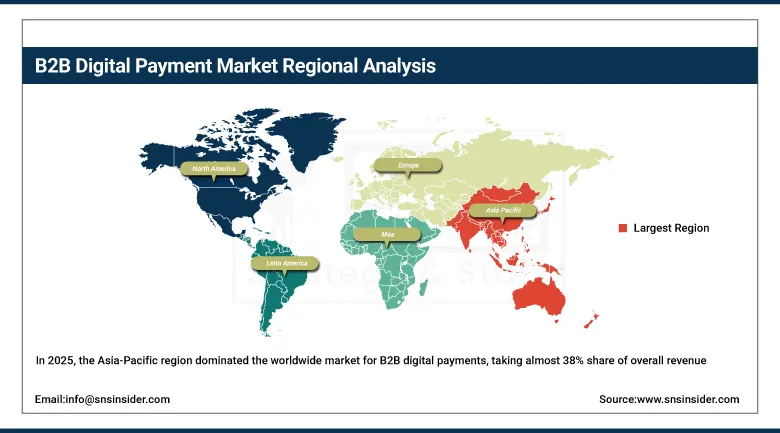
In 2025, the Asia-Pacific region dominated the worldwide market for B2B digital payments, taking almost 38% share of overall revenues. The main reason behind such leadership is the massive population of SMEs, fast-growing B2B ecommerce environments, and growing international trade relations between China, India, Southeast Asia, and many other countries of the world. Digital payment regulations set up by governments and their initiatives to develop cashless economies in China, India, Singapore, and other big markets favor the use of digital payments in this region. China plays an important role in dominating the Asia-Pacific market due to the development of its fintech sector, mobile payment usage, and many active digitally-focused companies.
Get Customized Report as per Your Business Requirement - Enquiry Now
North America B2B Digital Payment Market Insights
North America is anticipated to witness the highest CAGR in the business-to-business digital payments market between 2026 and 2035. The region is backed by a vibrant fintech ecosystem, sound banking systems, and the increasing adoption of artificial intelligence-driven B2B payment automation platforms among enterprises. The ongoing developments around the real-time payment network, especially the FedNow program in the United States, provide an opportunity for the instantaneous settling of B2B payments, fueling enterprise adoption of the solution. Canada is also supporting the growth momentum of the region through initiatives related to building a real-time payment infrastructure.
Europe B2B Digital Payment Market Insights
The Europe region presents an established and ever-growing digital payment market in the B2B segment, backed by an advanced fintech landscape and a strong push towards digitization of the financial ecosystem. In terms of the Europe market, the United Kingdom stands out as the leading player due to its status as a global financial center and mature open banking model, coupled with the early adoption of digital payments systems among enterprises. Within the larger EU region, the SEPA Instant Credit Transfer system has offered key infrastructure for instant settlement of B2B transactions, enabling faster migration away from legacy banking methods.
Middle East & Africa and Latin America B2B Digital Payment Market Insights
Adoption of digital payments among companies is gaining momentum in the Middle East and Africa region, especially within the Gulf Cooperation Council countries where digital financial systems are being developed as part of efforts to develop economies beyond oil revenues. In addition, the United Arab Emirates is at the forefront of the adoption of digital payment solutions in the region due to its highly networked business ecosystem and government efforts towards promoting fintech innovations. Moreover, Latin America region is emerging fast as a B2B digital payments market, with Brazil contributing most to revenue in the region.
B2B Digital Payment Market Growth Drivers:
-
Growing demand for real-time, secure, and transparent payment processing across global enterprises
The key factor driving growth in the business-to-business digital payments market is the constant demand from companies to have quicker, smoother, and more transparent payment processing. Companies within every sector are forced to cut down on payment processing time, optimize their working capital management processes, and minimize errors from traditional forms of payment processing. Digital payment solutions offer an efficient solution for meeting all of these demands through instant money transfer, automatic reconciliation, live transaction monitoring, and easy system integration.
Industry data consistently confirms that businesses adopting real-time payment infrastructure report measurable improvements in cash flow efficiency, supplier relationship quality, and operational cost reduction. These concrete benefits are driving accelerating enterprise adoption across all geographies and sectors throughout the forecast period, as organizations recognize that digital payment capability is no longer optional but a core component of competitive financial operations.
B2B Digital Payment Market Restraints
-
Fragmented global payment infrastructure and inconsistent regulatory frameworks limiting cross-border efficiency
One limitation that can have a notable impact on the growth of the B2B digital payment market is the fragmentation that occurs in the realm of payment infrastructure and regulations globally. There are various countries around the world with their own sets of payment protocols, compliance regulations, currency exchange practices, and data handling requirements. Therefore, developing a completely integrated cross-border system for payments is not easy. The lack of a universal payment network and the uneven progress in modernizing regulations make it harder to move forward with digitizing all B2B payment transactions worldwide.
B2B Digital Payment Market Opportunities
-
Expansion of embedded finance and integrated payment capabilities within enterprise software ecosystems
One of the main areas of growth opportunity in the B2B digital payments industry is the fast-paced advancement in the realm of embedded finance solutions on ERP, procurement, and supply chain management software solutions. By integrating the capabilities of the payment function directly into the software used by companies to perform their accounting operations, companies can make the payment process much smoother and encourage businesses which have no interest in adopting digital payment software to adopt those solutions. This trend is estimated to produce huge revenues for the providers of payment platforms between 2026 and 2035.
Recent Developments:
- 2026: The global B2B digital payment market continued its strong expansion trajectory, with enterprises across North America and Asia Pacific accelerating investment in AI-powered payment automation and real-time payment infrastructure. Multiple central banks in major economies advanced or completed rollouts of national instant payment systems, providing businesses with new settlement capabilities and reducing dependence on traditional correspondent banking channels.
- 2025 (April): PayPal partnered with Coinbase to eliminate transaction fees on its PYUSD stablecoin and enable USD redemption, strengthening its position in blockchain-based global B2B payments and decentralized finance applications.
- 2025 (February): Stripe acquired Bridge for USD 1.1 billion, significantly expanding its crypto payment and B2B payment capabilities and positioning itself more competitively in the cross-border enterprise payment segment.
- 2025 (February): American Express partnered with Alipay to allow global American Express cardholders to link their cards to the Alipay digital wallet, bridging two major payment ecosystems and improving access for enterprises operating across North America and Asia Pacific.
B2B Digital Payment Market Key Players
Some of the B2B Digital Payment Market Companies
-
Mastercard Inc.
-
Visa Inc.
-
PayPal Holdings Inc.
-
American Express Company
-
Stripe Inc.
-
Square Inc. (Block Inc.)
-
Fiserv Inc.
-
JPMorgan Chase & Co.
-
Adyen N.V.
-
Global Payments Inc.
-
Worldpay Inc. (FIS)
-
SAP SE
-
Bottomline Technologies
-
Coupa Software
-
AvidXchange Inc.
-
Wise plc
-
Revolut Business
-
Airwallex
-
Bill.com Holdings, Inc.
-
Payoneer Global Inc.
B2B Digital Payment Market Report Scope
| Report Attributes | Details |
|---|---|
| Market Size in 2025 | USD 9.34 Trillion |
| Market Size by 2035 | USD 44.11 Trillion |
| CAGR | CAGR of 16.79% From 2026 to 2035 |
| Base Year | 2025 |
| Forecast Period | 2026-2035 |
| Historical Data | 2022-2024 |
| Report Scope & Coverage | Market Size, Segments Analysis, Competitive Landscape, Regional Analysis, DROC & SWOT Analysis, Forecast Outlook |
| Key Segments | • By Payment Type (Digital Commerce, Digital Remittances, Others) • By Component (Payment Gateways, Software Platforms, Services) • By Deployment Mode (Cloud-Based, On-Premises) • By Enterprise Size (Large Enterprises, SMEs) • By End-Use (IT & Telecom, BFSI, Retail, Healthcare, Manufacturing, Transportation & Logistics, Others) |
| Regional Analysis/Coverage | North America (US, Canada), Europe (Germany, UK, France, Italy, Spain, Russia, Poland, Rest of Europe), Asia Pacific (China, India, Japan, South Korea, Australia, ASEAN Countries, Rest of Asia Pacific), Middle East & Africa (UAE, Saudi Arabia, Qatar, South Africa, Rest of Middle East & Africa), Latin America (Brazil, Argentina, Mexico, Colombia, Rest of Latin America). |
| Company Profiles | Mastercard Inc., Visa Inc., PayPal Holdings Inc., American Express Company, Stripe Inc., Square Inc. (Block Inc.), Fiserv Inc., JPMorgan Chase & Co., Adyen N.V., Global Payments Inc., Worldpay Inc. (FIS), SAP SE, Bottomline Technologies, Coupa Software, AvidXchange Inc., Wise plc, Revolut Business, Airwallex, Bill.com Holdings, Inc., Payoneer Global Inc. |
Frequently Asked Questions
Asia Pacific dominated the B2B Digital Payment Market in 2025, accounting for approximately 38% of global market share.
The Digital Commerce segment dominated the B2B Digital Payment Market in 2025, accounting for approximately 58% of total revenue.
The growing enterprise demand for real-time, secure, and transparent payment processing, combined with the rapid expansion of cross-border commerce and the integration of AI and blockchain technologies into digital payment platforms.
The B2B Digital Payment Market was valued at USD 9.34 trillion in 2025.
The B2B Digital Payment Market is expected to grow at a CAGR of 16.79% from 2026 to 2035.
