
Composable Applications Market Report Scope & Overview:
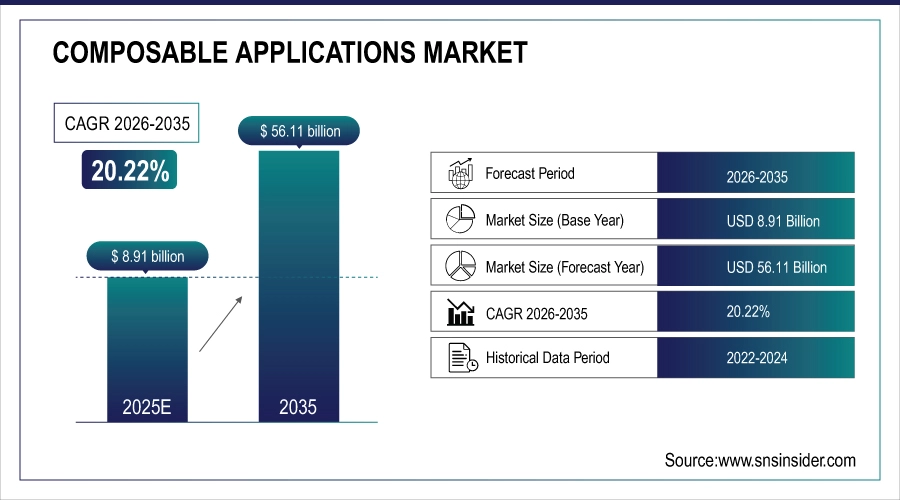
The Composable Applications Market was valued at USD 8.91 Billion in 2025 and is expected to reach USD 56.11 Billion by 2035, growing at a CAGR 20.22% of from 2026-2035.
The Composable Applications Market comprises software solutions built from modular, reusable components, enabling rapid development, deployment, and scaling of applications. Growth is driven by increasing demand for agility, faster time-to-market, and personalized digital experiences. Enterprises leverage these solutions to integrate diverse systems, automate workflows, and support digital transformation initiatives, enhancing operational efficiency and business flexibility across industries.
Around 58% of global enterprises are implementing composable applications to improve agility, scalability, and integration across cloud and on-premise systems.
To Get more information on Composable Applications Market - Request Free Sample Report
Key Trends in the Composable Applications Market
-
API-First Architectures: Enterprises are increasingly adopting modular, reusable API components to enhance scalability and flexibility.
-
Cloud & Hybrid Deployments: Cloud and hybrid solutions enable fast, secure, and efficient rollout of composable applications.
-
Low-Code/No-Code Platforms: The use of low-code and no-code platforms accelerates development and empowers business users.
-
Automation & AI Integration: Automation and AI integration improve workflows, orchestration, and intelligent application management.
-
Agility & Personalization: Composable applications support faster time-to-market while delivering personalized digital experiences.
U.S. Composable Applications Market Insights:
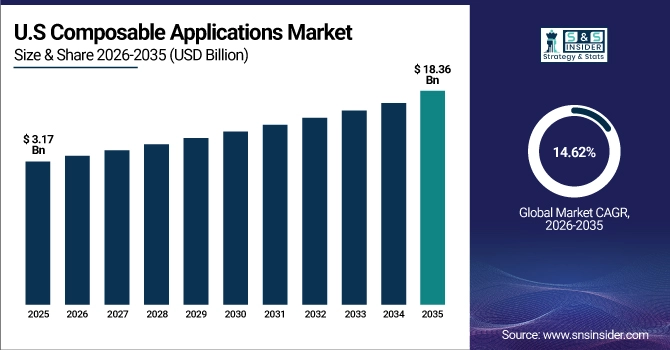
The U.S. Composable Applications Market is projected to grow from USD 3.17 Billion in 2025 to USD 18.36 Billion by 2035, at a CAGR of 14.62%. Growth driven by rising adoption of cloud-native architectures, API-led integration, low-code/no-code platforms, increasing digital transformation across enterprises, and demand for agile, scalable, and modular composable application solutions.
Composable Applications Market Growth Drivers:
-
API-First and Modular Architectures Driving Market Growth
The rapid adoption of API-first and modular architectures is a key driver for the composable applications market, as it allows enterprises to build scalable, flexible, and reusable application components. APIs enable seamless integration across cloud, on-premise, and hybrid environments, supporting faster development and digital transformation initiatives. According to recent studies, over 62% of enterprises globally have implemented API-driven strategies, reflecting the increasing reliance on modular systems to enhance agility, improve operational efficiency, and accelerate time-to-market.
Composable Applications Market Restraints:
-
Data Security and Compliance Challenges in Multi-Cloud Deployments
Data security and compliance concerns are major challenges in multi-cloud and hybrid composable application deployments. Enterprises managing sensitive information across multiple platforms face risks such as data breaches, unauthorized access, and regulatory non-compliance. Ensuring secure operations requires robust measures, including encryption, identity and access management, and governance frameworks. These safeguards are essential for maintaining trust, protecting critical business data, and enabling reliable, compliant deployment of composable applications across diverse cloud and hybrid environments.
Composable Applications Market Opportunities:
-
AI and Automation Enhancing Composable Applications
AI and automation integration is transforming composable applications by streamlining workflows, improving orchestration, and enabling intelligent decision-making. Automated processes reduce manual intervention, accelerate task completion, and ensure consistent performance across distributed systems. AI-driven analytics provide actionable insights, optimize resource allocation, and enhance operational efficiency. By embedding AI and automation, enterprises can achieve smarter application management, faster response to changing business needs, and improved scalability, ultimately driving greater agility and innovation in digital transformation initiatives.
Composable Applications Market Segment:
-
By Component: In 2025, APIs & services dominated with 45% share; Integration & orchestration tools fastest growing segment during 2026-2035
-
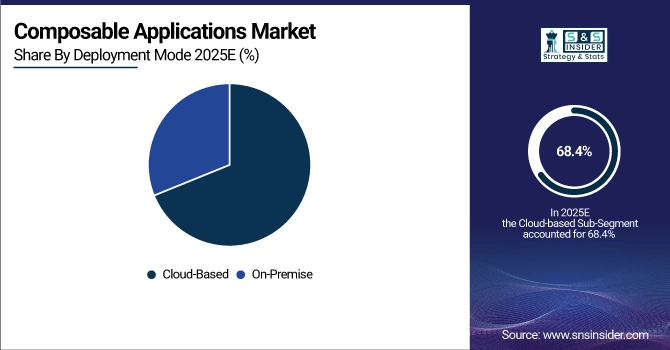
By Deployment Mode: In 2025, Cloud-based dominated with 68% share; On-premise fastest growing segment during 2026-2035
-
By Organization Size: In 2025, Large enterprises dominated with 60% share; SMEs fastest growing segment during 2026-2035
-
By End-Use Industry: In 2025, IT & telecom dominated with 29% share; Healthcare fastest growing segment during 2026-2035
Composable Applications Market Segment Analysis:
By Deployment Mode: Cloud-Based Dominates as On-Premise Shows Accelerated Growth
Cloud-based deployment dominates the market with a 68.4% share, owing to its scalability, flexibility, and lower upfront investment compared to on-premise solutions. Cloud platforms enable rapid deployment of composable applications, seamless updates, and global accessibility, making them the preferred choice for enterprises undergoing digital transformation.
On-premise deployment is the fastest-growing segment, driven by industries requiring enhanced data security, regulatory compliance, and integration with legacy systems. Organizations are increasingly adopting hybrid models that combine cloud scalability with on-premise control for sensitive workloads.
By Component: APIs & Services Dominates as Integration & Orchestration Tools Show Accelerated Growth
APIs & services dominate the component segment as they provide the essential modular building blocks that enable seamless connectivity, data exchange, and reusable functionality across composable applications. This segment is critical for accelerating application development, supporting microservices architectures, and integrating cloud-native solutions efficiently.
Integration & orchestration tools are the fastest-growing segment, driven by increasing demand for automated workflows, real-time data synchronization, and end-to-end management of distributed application components. Enterprises are adopting these tools to simplify complex integrations, improve operational efficiency, and support agile digital transformation initiatives.
By Organization Size: Large Enterprises Dominate as SMEs Show Accelerated Growth
Large enterprises dominate the market with 60.2% share, leveraging composable applications to modernize IT infrastructure, optimize workflows, and enhance digital experiences at scale. These organizations benefit from robust IT budgets, skilled teams, and early adoption of cloud-native architectures.
SMEs are the fastest-growing segment, fueled by the rise of low-code/no-code platforms, SaaS-based composable solutions, and cost-effective digital transformation strategies. SMEs are increasingly embracing composable applications to improve agility, competitiveness, and customer experience without heavy IT investments.
By End-Use Industry: IT & Telecom Dominates as Healthcare Shows Accelerated Growth
IT & telecom dominates the end-use industry segment with 28.7% share, driven by high adoption of API-first architectures, cloud services, and digital transformation initiatives. Enterprises in this sector leverage composable applications to accelerate service deployment, optimize IT operations, and innovate rapidly.
Healthcare is the fastest-growing segment, driven by the digitalization of patient care, telemedicine expansion, and the need for flexible, interoperable systems. Composable applications in healthcare enable scalable solutions for electronic health records, patient engagement platforms, and data integration across hospitals and clinics.
Composable Applications Market - Regional Analysis
North America Composable Applications Market Insights:
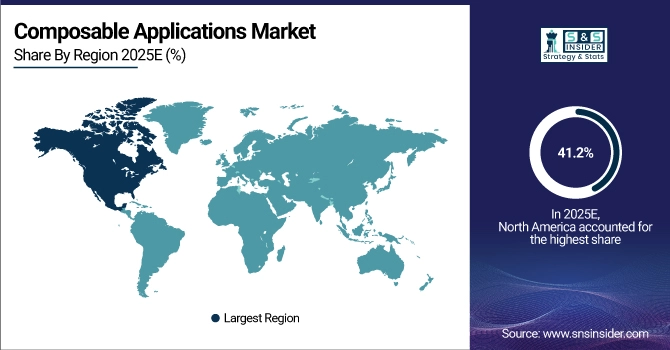
In 2025, North America dominates the Composable Applications Market, holding a market share of 41.2%. The region’s leadership is driven by early adoption of cloud-native architectures, API-led integration, and a mature digital ecosystem. Strong enterprise demand for scalable, modular, and agile application solutions, combined with the presence of leading technology providers and widespread SaaS adoption, reinforces North America’s position as the largest and most advanced regional market.
Get Customized Report as per Your Business Requirement - Enquiry Now
Europe Composable Applications Market Insights:
Europe holds a significant position in the Composable Applications Market, driven by strong digital transformation initiatives and growing adoption of cloud-native and API-first solutions. Enterprises across the region are increasingly leveraging modular, scalable, and composable application architectures to improve operational efficiency, accelerate application development, and deliver enhanced digital experiences. The market benefits from a mature IT infrastructure, supportive government policies, and a focus on innovation across industries such as BFSI, healthcare, and retail.
Asia-Pacific Composable Applications Market Insights:
Asia-Pacific is the fastest-growing region in the Composable Applications Market, it is projected to grow at a CAGR of 24.48% during 2026–2035, driven by rapid enterprise modernization, cloud adoption, and expanding digital transformation initiatives. The market in this region is expanding as organizations increasingly adopt modular, scalable, and API-driven solutions to enhance agility, improve operational efficiency, and deliver personalized digital experiences across industries.
Latin Composable Applications Market Insights:
Latin America is witnessing growing adoption of composable applications as enterprises modernize IT systems and embrace cloud-based, modular solutions. Businesses are leveraging these applications to improve operational efficiency, accelerate digital transformation, and deliver flexible, scalable, and agile solutions, particularly across retail, BFSI, and manufacturing sectors.
Middle East & Africa Composable Applications Market Insights:
Middle East & Africa market is gradually adopting composable applications, driven by increasing digital transformation initiatives and cloud adoption across enterprises. Organizations in the region are leveraging modular, API-driven solutions to enhance agility, streamline operations, and support scalable, flexible applications, particularly in BFSI, healthcare, and government sectors.
Composable Applications Market Competitive Landscape:
MuleSoft (Salesforce), headquartered in San Francisco, California, USA, is a leading player in the composable applications and integration market, specializing in API-led connectivity and integration platforms that enable enterprises to build modular, scalable, and reusable applications. The company focuses on connecting applications, data, and devices across cloud and on-premise environments, helping organizations accelerate digital transformation and improve operational agility.
-
In April 2025: MuleSoft expanded its Any point Platform capabilities by introducing enhanced API management and integration tools, supporting faster composable application development and seamless connectivity across enterprise systems.
Dell Boomi, headquartered in Chesterbrook, Pennsylvania, USA, is a prominent player in the composable applications market, offering a cloud-native integration platform that enables organizations to connect applications, data, and workflows across multi-cloud and hybrid environments. The company emphasizes low-code integration, API management, and workflow automation to accelerate business agility and digital transformation.
-
In 2025: Dell Boomi launched advanced AI-driven integration features within its Atom Sphere platform, enhancing automation, orchestration, and scalability for composable application deployments across enterprises.
Composable Applications Market Key Players
-
MuleSoft (Salesforce)
-
Dell Boomi
-
Red Hat
-
Appian
-
Microsoft (Power Platform & Azure)
-
IBM
-
SAP
-
Software AG
-
ServiceNow
-
TIBCO Software
-
Pega Systems
-
Workday
-
Salesforce (Heroku & MuleSoft)
-
Google Cloud (Apigee & Cloud Functions)
-
Camunda
-
Kong Inc.
-
SnapLogic
-
Zapier
| Report Attributes | Details |
|---|---|
| Market Size in 2025 | USD 8.91 Billion |
| Market Size by 2035 | USD 56.11 Billion |
| CAGR | CAGR of 20.22% From 2026 to 2035 |
| Base Year | 2025 |
| Forecast Period | 2026-2035 |
| Historical Data | 2022-2024 |
| Report Scope & Coverage | Market Size, Segments Analysis, Competitive Landscape, Regional Analysis, DROC & SWOT Analysis, Forecast Outlook |
| Key Segments | •By Component: (APIs & services, Application building blocks, Integration & orchestration tools) • By Deployment Mode: (Cloud-based, On-premise) • By Organization Size: (Large enterprises, SMEs) • By End-Use Industry: (BFSI, Retail & e-commerce, IT & telecom, Healthcare, Manufacturing) |
| Regional Analysis/Coverage | North America (US, Canada), Europe (Germany, UK, France, Italy, Spain, Russia, Poland, Rest of Europe), Asia Pacific (China, India, Japan, South Korea, Australia, ASEAN Countries, Rest of Asia Pacific), Middle East & Africa (UAE, Saudi Arabia, Qatar, South Africa, Rest of Middle East & Africa), Latin America (Brazil, Argentina, Mexico, Colombia, Rest of Latin America). |
| Company Profiles | MuleSoft (Salesforce), Dell Boomi, Red Hat, Appian, OutSystems, Microsoft (Power Platform & Azure), IBM, Oracle, SAP, Software AG, ServiceNow, TIBCO Software, Pega Systems, Workday, Salesforce (Heroku & MuleSoft), Google Cloud (Apigee & Cloud Functions), Camunda, Kong Inc., SnapLogic, Zapier |
Frequently Asked Questions
The “cloud-based” segment dominated during the projected period.
North America dominated the Composable Applications Market in 2025.
The key drivers of the Composable Applications Market include adoption of API-first architectures, cloud-native platforms, low-code/no-code tools, demand for agility, faster time-to-market, scalable applications, and enterprise-wide digital transformation initiatives.
The market was valued at USD 8.91 Billion in 2025 and is projected to reach USD 56.11 Billion by 2035.
The Composable Applications Market is expected to grow at a CAGR of 20.22% during 2026–2035.
