
AI in Telehealth & Telemedicine Market Report Scope & Overview:
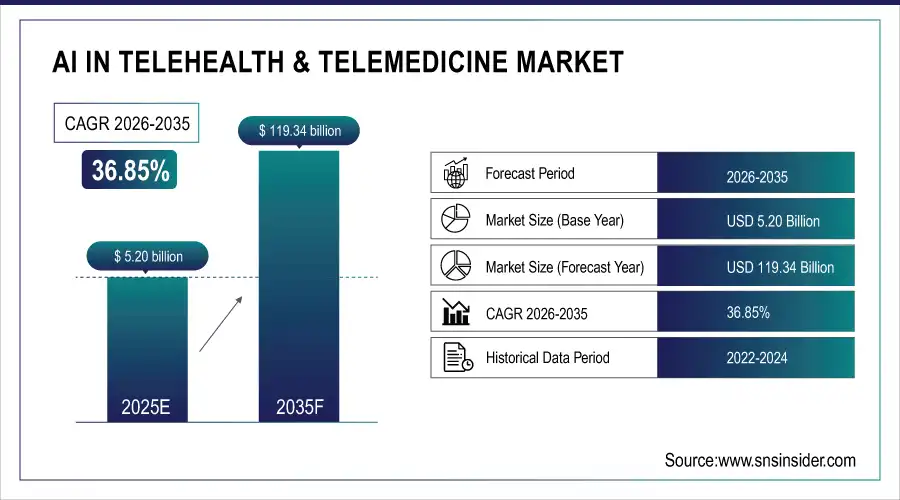
The AI in Telehealth & Telemedicine Market is valued at USD 5.20 billion in 2025 and is expected to reach USD 119.34 billion by 2035, growing at a CAGR of 36.85 % from 2026-2035.
The AI in Telehealth & Telemedicine Market is experiencing rapid growth due to rising demand for remote healthcare services and improved access to medical care. AI-powered solutions enable virtual consultations, remote patient monitoring, clinical decision support, and personalized treatment plans, improving efficiency and outcomes. Growing prevalence of chronic diseases, aging populations, and shortages of healthcare professionals are accelerating adoption. Additionally, advancements in machine learning, natural language processing, and data analytics, along with increasing investment in digital health infrastructure and supportive regulatory frameworks, are strongly driving market expansion.
89% of healthcare systems integrated AI into telehealth and telemedicine driven by chronic disease burdens, workforce shortages, and advances in machine learning to deliver scalable, efficient, and personalized remote care globally.
To Get more information On AI in Telehealth & Telemedicine Market - Request Free Sample Report
AI in Telehealth & Telemedicine Market Trends
-
Rising adoption of AI-powered virtual consultations to enhance diagnostic accuracy and clinician productivity
-
Increasing use of remote patient monitoring supported by AI for chronic disease management and early intervention
-
Growing integration of natural language processing to automate clinical documentation and patient interaction workflows
-
Expansion of AI-driven triage and symptom checker tools to reduce care delivery costs and wait times
-
Rising demand for personalized treatment recommendations enabled by real-time analytics and patient data insights
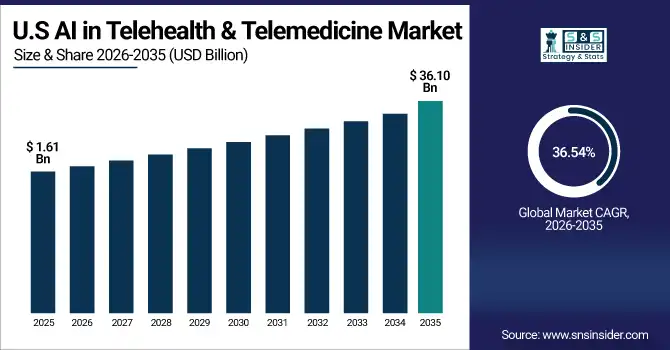
U.S. AI in Telehealth & Telemedicine Market is valued at USD 1.61 billion in 2025 and is expected to reach USD 36.10 billion by 2035, growing at a CAGR of 36.54 % from 2026-2035.
The U.S. AI in Telehealth & Telemedicine Market is growing rapidly due to increasing demand for remote healthcare and virtual consultations. AI-driven solutions enhance patient monitoring, clinical decision-making, and personalized care, while addressing provider shortages. Rising chronic disease prevalence, aging populations, technological advancements, and supportive digital health initiatives are further driving market expansion across the country.
AI in Telehealth & Telemedicine Market Growth Drivers:
-
Rising demand for remote healthcare services and virtual consultations is accelerating adoption of AI-powered telehealth platforms to improve accessibility, efficiency, and clinical decision-making
The increasing need for convenient, cost-effective healthcare delivery has significantly accelerated adoption of telehealth solutions. AI-powered platforms enable faster triage, automated symptom analysis, and intelligent scheduling, improving access to care for urban and remote populations alike. Hospitals and clinics are leveraging AI to reduce physician workload, improve diagnostic accuracy, and enhance patient engagement. Post-pandemic behavioral shifts toward virtual care continue to sustain demand, while AI-driven insights support personalized treatment plans, early disease detection, and efficient resource utilization across global healthcare systems.
87% of healthcare organizations adopted AI-powered telehealth platforms fueled by surging demand for virtual care to enhance accessibility, streamline clinical workflows, and support real-time, data-driven decision-making.
-
Growing prevalence of chronic diseases and aging populations is increasing reliance on AI-enabled remote monitoring and predictive analytics to enhance long-term patient care outcomes
The global rise in chronic conditions such as diabetes, cardiovascular disorders, and respiratory diseases, combined with an aging population, is driving demand for continuous and remote patient monitoring. AI-enabled tools analyze real-time health data from wearable devices and home monitoring systems to detect early warning signs and predict complications. These technologies support proactive care management, reduce hospital admissions, and improve quality of life for elderly patients. Healthcare providers increasingly adopt AI-based analytics to deliver personalized care, optimize treatment adherence, and manage long-term conditions more effectively.
84% of healthcare providers leveraged AI-enabled remote monitoring and predictive analytics driven by rising chronic disease burdens and aging populations to improve long-term care outcomes, reduce hospitalizations, and enable proactive interventions.
AI in Telehealth & Telemedicine Market Restraints:
-
Data privacy concerns, cybersecurity risks, and regulatory compliance challenges limit large-scale deployment of AI-driven telehealth solutions across healthcare systems globally
AI-driven telehealth platforms rely heavily on sensitive patient data, raising concerns related to data privacy, security breaches, and unauthorized access. Strict healthcare regulations, such as data protection and patient confidentiality laws, require compliance that can be complex and costly. Cybersecurity threats further increase hesitation among providers and patients to fully adopt AI-based solutions. Variations in regulatory frameworks across regions also create barriers to scaling telehealth platforms globally. These challenges slow adoption rates, increase operational costs, and limit the widespread deployment of AI-enabled telemedicine services.
81% of healthcare systems delayed large-scale AI-driven telehealth deployment due to escalating data privacy concerns, cybersecurity vulnerabilities, and complex regulatory compliance requirements hindering seamless global scalability.
-
Limited digital infrastructure, interoperability issues, and low technology adoption in rural regions restrict effective implementation of AI-based telemedicine services
In many rural and underserved areas, inadequate internet connectivity and limited access to digital devices hinder the adoption of AI-based telemedicine solutions. Interoperability challenges between healthcare systems and legacy IT infrastructure further complicate implementation. Healthcare providers in these regions often lack technical expertise and training to effectively use advanced AI tools. Additionally, patient resistance to digital healthcare platforms due to limited digital literacy reduces utilization. These infrastructural and adoption barriers restrict market penetration, especially in developing regions, slowing the overall growth of AI in telehealth and telemedicine markets.
79% of rural healthcare providers struggled to deploy AI-based telemedicine due to inadequate digital infrastructure, poor system interoperability, and low technology adoption widening the urban-rural divide in virtual care access.
AI in Telehealth & Telemedicine Market Opportunities:
-
Advancements in machine learning, natural language processing, and computer vision create opportunities to enhance diagnostics, personalized treatment, and virtual patient engagement in telehealth
Rapid technological advancements in AI, including machine learning, NLP, and computer vision, are transforming telehealth capabilities. These technologies enable more accurate diagnostics, automated clinical documentation, and intelligent virtual assistants that enhance patient engagement. AI-driven imaging analysis supports early disease detection, while NLP improves communication between patients and providers. Personalized treatment recommendations based on patient data improve care outcomes. Continuous innovation in AI technologies allows telehealth platforms to offer advanced, scalable solutions, creating significant opportunities for differentiation, improved efficiency, and expanded adoption across global healthcare systems.
In 2025, 86% of telehealth platforms integrated advanced machine learning, NLP, and computer vision enabling AI-driven diagnostics, personalized care pathways, and immersive virtual patient engagement to transform remote healthcare delivery.
-
Expanding government support, reimbursement policies, and investments in digital health infrastructure provide strong growth opportunities for AI-enabled telehealth and telemedicine platforms
Governments worldwide are increasingly supporting digital healthcare transformation through favorable reimbursement policies, funding programs, and infrastructure investments. Regulatory approvals for telemedicine services and AI-driven diagnostics are encouraging healthcare providers to adopt advanced digital solutions. Public-private partnerships and national digital health initiatives are strengthening healthcare IT ecosystems. Improved reimbursement structures reduce financial barriers for providers and patients, accelerating adoption. These supportive policy frameworks and investments create a conducive environment for AI-enabled telehealth platforms to scale operations, expand service offerings, and drive sustained market growth globally.
85% of AI-enabled telehealth platforms expanded rapidly fueled by government backing, improved reimbursement frameworks, and strategic investments in digital health infrastructure enhancing access, equity, and scalability in virtual care delivery.
AI in Telehealth & Telemedicine Market Segment Highlights
-
By Component: Software led with 68% share, while Services is the fastest-growing segment.
-
By Technology: Natural Language Processing (NLP) led with 32% share, while Deep Learning is the fastest-growing segment.
-
By Application: Virtual Consultations & Clinical Decision Support led with 34% share, while Remote Patient Monitoring is the fastest-growing segment.
-
By End User: Hospitals & Clinics led with 44% share, while Homecare Settings are the fastest-growing segment.
AI in Telehealth & Telemedicine Market Segment Analysis
By Component: Software led, while Services is the fastest-growing segment.
Software dominates the AI in Telehealth & Telemedicine market as it forms the backbone of virtual care delivery, data analytics, and clinical decision support. AI-powered software platforms enable automated triage, symptom analysis, virtual assistants, documentation, and workflow optimization. High scalability, cloud deployment, and subscription-based models make software widely accessible to healthcare providers. Integration with electronic health records, imaging systems, and remote monitoring devices further strengthens adoption. As healthcare systems prioritize cost efficiency, interoperability, and rapid deployment, software remains the primary revenue-generating component across telehealth and telemedicine ecosystems.
Services are the fastest-growing component due to increasing demand for implementation, customization, training, and managed AI solutions. Healthcare providers adopting advanced AI platforms require ongoing technical support, system integration, cybersecurity, and regulatory compliance assistance. Growth is further driven by smaller clinics and telehealth startups outsourcing AI operations to reduce complexity. Consulting and analytics services also help optimize care pathways and patient engagement strategies. As AI adoption deepens and systems become more complex, service providers play a critical role in ensuring operational efficiency and long-term value realization.

By Technology: Natural Language Processing (NLP) led, while Deep Learning is the fastest-growing segment.
Natural Language Processing leads the technology segment due to its extensive use in conversational AI, virtual assistants, clinical documentation, and patient engagement tools. NLP enables real-time voice and text interactions, automated medical transcription, symptom extraction, and clinical summarization during virtual consultations. Its ability to improve communication efficiency and reduce physician administrative burden drives widespread adoption. NLP-based chatbots and triage systems are integral to telehealth platforms, supporting scalable patient interactions. Strong performance in multilingual environments and integration with clinical workflows further reinforce NLP’s dominance in AI-driven telemedicine solutions.
Deep learning is the fastest-growing technology segment as it enables advanced pattern recognition across imaging, video, and physiological data streams. In telehealth, deep learning enhances remote diagnostics, medical imaging interpretation, and predictive analytics for disease progression. Growing availability of large healthcare datasets, improved computing infrastructure, and higher clinical confidence are accelerating adoption. Deep learning models support more accurate and personalized care decisions, particularly in complex cases. As telemedicine expands beyond basic consultations to advanced diagnostics, deep learning continues to gain momentum as a high-growth AI technology.
By Application: Virtual Consultations & Clinical Decision Support led, while Remote Patient Monitoring is the fastest-growing segment.
Virtual consultations and clinical decision support dominate the application segment as they represent the core use case of telehealth. AI enhances virtual visits through automated triage, symptom checking, diagnostic recommendations, and real-time clinical insights. High patient volumes, rising physician shortages, and demand for remote access to care drive adoption. These solutions improve care efficiency, reduce wait times, and support consistent clinical decision-making. Integration with scheduling, billing, and electronic health records further strengthens their value, making virtual consultation platforms the largest contributor to AI-enabled telehealth adoption.
Remote patient monitoring is the fastest-growing application as healthcare systems shift toward continuous, home-based care models. AI-driven analytics process data from wearables, sensors, and connected medical devices to detect early signs of deterioration. Growing prevalence of chronic diseases, aging populations, and post-acute care needs accelerate adoption. Remote monitoring improves patient outcomes while reducing hospital readmissions and healthcare costs. Increased reimbursement support and integration with telehealth platforms further drive rapid growth, positioning remote patient monitoring as a key expansion area in AI-enabled telemedicine.
By End User: Hospitals & Clinics led, while Homecare Settings are the fastest-growing segment.
Hospitals and clinics dominate the market as primary adopters of AI-enabled telehealth solutions. These institutions leverage AI to extend care delivery beyond physical settings, optimize clinician workflows, and manage high patient volumes. Strong financial capacity, regulatory readiness, and access to skilled personnel support large-scale AI deployment. Hospitals use telemedicine AI for virtual consultations, diagnostics, and care coordination across departments. The need for operational efficiency, standardized care, and improved patient outcomes reinforces hospitals and clinics as the leading end-user segment.
Homecare settings are the fastest-growing end-user segment due to rising demand for decentralized and patient-centric care. AI-powered telehealth solutions enable continuous monitoring, virtual check-ins, and personalized care plans within patients’ homes. Growth is driven by aging populations, chronic disease management, and preference for cost-effective care alternatives. Advances in wearable devices, mobile health apps, and AI analytics support rapid adoption. As healthcare shifts toward preventive and long-term care models, homecare settings are emerging as a major growth driver for AI in telemedicine.
AI in Telehealth & Telemedicine Market Regional Analysis
North America AI in Telehealth & Telemedicine Market Insights:
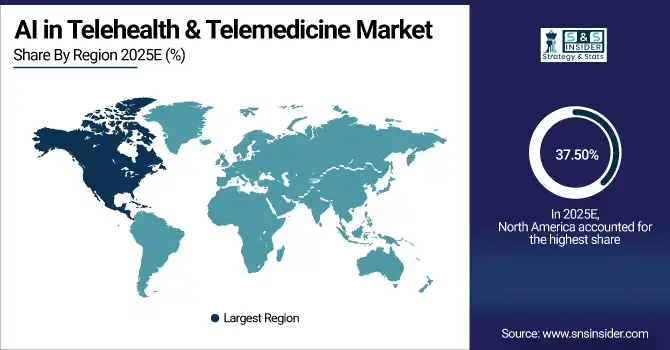
North America dominated the AI in Telehealth & Telemedicine Market with a 37.50% share in 2025 due to advanced digital health infrastructure, high adoption of AI-enabled virtual care platforms, and strong reimbursement support. The presence of major technology players, widespread broadband access, and growing demand for remote consultations further reinforced regional market leadership.
Get Customized Report as per Your Business Requirement - Enquiry Now
Asia Pacific AI in Telehealth & Telemedicine Market Insights
Asia Pacific is expected to grow at the fastest CAGR of about 38.33% from 2026–2035, driven by rapid digitalization of healthcare systems, expanding telehealth adoption in emerging economies, and rising smartphone and internet penetration. Increasing government initiatives, shortages of healthcare professionals, and growing demand for affordable, AI-driven remote care solutions accelerate regional growth.
Europe AI in Telehealth & Telemedicine Market Insights
Europe held a significant share of the AI in Telehealth & Telemedicine Market in 2025, supported by strong public healthcare systems, growing adoption of digital health solutions, and favorable regulatory initiatives promoting telemedicine. Increasing use of AI for remote diagnostics, chronic disease management, and virtual consultations further strengthened Europe’s market position.
Middle East & Africa and Latin America AI in Telehealth & Telemedicine Market Insights
The Middle East & Africa and Latin America together demonstrated emerging growth in the AI in Telehealth & Telemedicine Market, driven by improving digital healthcare infrastructure, expanding mobile connectivity, and rising demand for remote care access. Government-led digital health programs, growing private sector investments, and efforts to address healthcare access gaps are gradually accelerating adoption across these regions.
AI in Telehealth & Telemedicine Market Competitive Landscape:
Koninklijke Philips N.V.
Koninklijke Philips N.V. is a global leader in health technology, offering AI-powered solutions for telehealth, remote patient monitoring, and clinical decision support. The company integrates AI into telemedicine platforms to enhance diagnostics, workflow efficiency, and personalized care. Philips’ solutions enable real-time monitoring, predictive analytics, and seamless virtual consultations, helping healthcare providers improve patient outcomes. Its AI-driven telehealth systems are widely adopted across hospitals and outpatient care settings, positioning Philips as a key player in the AI-enabled telemedicine market.
-
May 2024, Philips expanded its Virtual Care Platform with AI-powered predictive analytics for chronic disease management, enabling proactive interventions for high-risk patients.
Medtronic
Medtronic, a global medical technology company, leverages AI to enhance telehealth and remote patient management solutions. Its AI-enabled platforms allow continuous monitoring of chronic conditions, predictive analytics, and real-time patient data integration for clinicians. Medtronic combines telemedicine with AI-driven decision support to improve patient care, reduce hospital readmissions, and optimize treatment plans. Its solutions are particularly focused on cardiovascular, diabetes, and chronic disease management, making Medtronic a leading contributor to AI in telehealth and telemedicine.
-
November 2023, Medtronic launched CareLink AI, an intelligent extension of its CareLink remote monitoring ecosystem for cardiac devices (pacemakers, ICDs) and diabetes therapy (MiniMed insulin pumps).
GE Healthcare
GE Healthcare integrates AI into telehealth platforms, medical imaging, and remote patient monitoring solutions. Its AI algorithms support early diagnosis, predictive analytics, and personalized treatment recommendations in virtual care settings. Through AI-powered telemedicine systems, GE Healthcare enhances workflow efficiency, clinical decision-making, and patient engagement. The company’s telehealth solutions are widely adopted in hospitals, clinics, and home-care environments, enabling scalable virtual care and remote monitoring, which positions GE Healthcare as a major player in the AI-driven telehealth and telemedicine market.
-
February 2025, GE Healthcare integrated Edison AI into its GE Health Cloud to power AI-assisted tele-radiology and virtual ICU support, especially for underserved regions.
AI in Telehealth & Telemedicine Market Key Players
Some of the AI in Telehealth & Telemedicine Market Companies are:
-
Koninklijke Philips N.V.
-
Medtronic
-
Epic Systems Corporation
-
Oracle
-
Teladoc Health
-
American Well (Amwell)
-
Cisco Systems Inc.
-
Included Health
-
Babylon Health
-
Ada Health
-
K Health
-
Infermedica
-
HealthTap
-
Amazon Web Services
-
Microsoft Corporation
-
Google LLC (Google Health)
-
IBM Corporation
-
AliveCor Inc.
| Report Attributes | Details |
|---|---|
| Market Size in 2025E | USD 5.20 Billion |
| Market Size by 2035 | USD 119.34 Billion |
| CAGR | CAGR of 36.85% From 2026 to 2035 |
| Base Year | 2025 |
| Forecast Period | 2026-2035 |
| Historical Data | 2022-2024 |
| Report Scope & Coverage | Market Size, Segments Analysis, Competitive Landscape, Regional Analysis, DROC & SWOT Analysis, Forecast Outlook |
| Key Segments | • By Component: Software, Hardware, Services • By Technology: Machine Learning, Deep Learning, Natural Language Processing (NLP), Computer Vision • By Application: Virtual Consultations & Clinical Decision Support, Remote Patient Monitoring, Medical Imaging & Diagnostics, Mental Health & Behavioral Therapy, Chronic Disease Management • By End User: Hospitals & Clinics, Telehealth Service Providers, Homecare Settings, Payers & Insurance Providers |
| Regional Analysis/Coverage | North America (US, Canada), Europe (Germany, UK, France, Italy, Spain, Russia, Poland, Rest of Europe), Asia Pacific (China, India, Japan, South Korea, Australia, ASEAN Countries, Rest of Asia Pacific), Middle East & Africa (UAE, Saudi Arabia, Qatar, South Africa, Rest of Middle East & Africa), Latin America (Brazil, Argentina, Mexico, Colombia, Rest of Latin America). |
| Company Profiles | Koninklijke Philips N.V., Medtronic, GE Healthcare, Epic Systems Corporation, Oracle, Teladoc Health, American Well (Amwell), Siemens Healthineers, Cisco Systems Inc., Included Health, Babylon Health, Ada Health, K Health, Infermedica, HealthTap, Amazon Web Services, Microsoft Corporation, Google LLC (Google Health), IBM Corporation, AliveCor Inc. |
Frequently Asked Questions
North America dominated the AI in Telehealth & Telemedicine Market in 2025.
Virtual Consultations & Clinical Decision Support dominated the AI in Telehealth & Telemedicine Market by application.
Rising demand for remote healthcare services, virtual consultations, and AI-enabled clinical decision support is the major growth factor driving market expansion.
The AI in Telehealth & Telemedicine Market was valued at USD 5.20 billion in 2025.
The AI in Telehealth & Telemedicine Market is expected to grow at a CAGR of 36.85% from 2026 to 2035.
