
Ballistic Missile Market Report Scope & Overview:
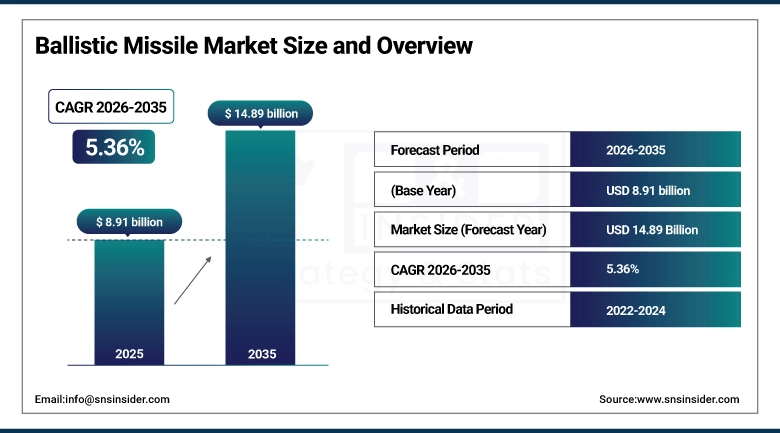
The Ballistic Missile Market size is valued at USD 8.91 Billion in 2025 and is projected to reach USD 14.89 Billion by 2035, growing at a CAGR of 5.36% during the forecast period 2026–2035.
The Ballistic Missile Market Analysis Report is an extensive study of the forces that affect the market, innovation, and applications. The market is driven by increasing geopolitical tension, defense modernization, investments in missile defense systems, and improvements in propulsion and guidance systems during the forecast period 2026–2035.
Deployment of ballistic missiles exceeded 12,000 active units in 2025, fueled by the integration of hypersonic glide vehicles, MIRVs, and advanced composite propellants.
Market Size and Forecast:
-
Market Size in 2025: USD 8.91 Billion
-
Market Size by 2035: USD 14.89 Billion
-
CAGR: 5.36% from 2026 to 2035
-
Base Year: 2025
-
Forecast Period: 2026–2035
-
Historical Data: 2022–2024
To Get more information on Ballistic Missile Market - Request Free Sample Report
Ballistic Missile Market Trends:
-
Rising geopolitical tensions and regional conflicts driving demand for deterrence capabilities.
-
Continuous defense modernization programs in the U.S., China, India, and NATO countries.
-
Increasing focus on hypersonic glide vehicles (HGVs) and maneuverable reentry vehicles to bypass missile defense systems.
-
Shift toward solid and advanced composite propellants for faster launch readiness and reliability.
-
Expansion of mobile launch systems to enhance survivability and reduce vulnerability to preemptive strikes.
-
Growing deployment of MIRVs (Multiple Independently Targetable Reentry Vehicles) for strategic advantage.
-
Rising investments in sea-based platforms (SLBMs) to strengthen second-strike capabilities.
-
Integration of AI and advanced guidance systems for improved accuracy and targeting.
-
Increasing collaboration between defense contractors and governments for R&D in next-generation missiles.
-
Heightened emphasis on missile defense systems (THAAD, Aegis, GMD) spurring countermeasure innovations.
U.S. Ballistic Missile Market Insights:
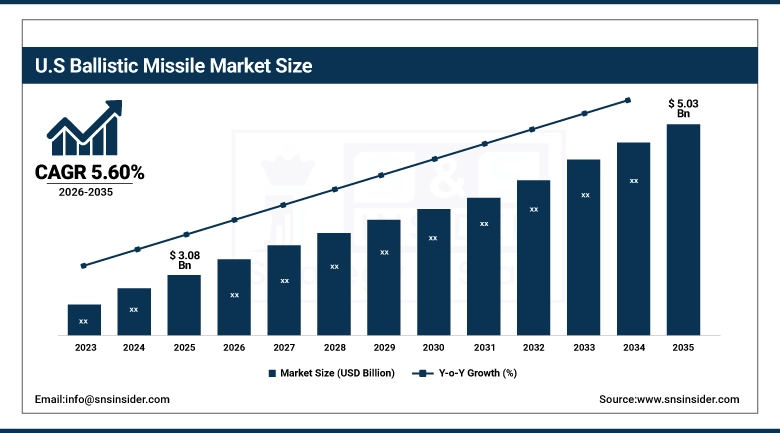
The U.S. Ballistic Missile Market is projected to grow from USD 3.08 Billion in 2025 to USD 5.03 Billion by 2035, at a CAGR of 5.60%. Growth is supported by increasing geopolitical rivalries and regional clashes, constant efforts at improving defense systems within leading nations, extensive use of modern propulsion systems and navigation systems, and development of new launch mechanisms such as ground, shipborne, air-launched, and mobile launchers.
Ballistic Missile Market Growth Drivers:
-
Rising geopolitical tensions and strategic military competition driving demand for long-range precision strike capabilities.
The increase in cross-border disputes, nuclear deterrence, and competition among large economies are the main factors contributing to the growing demand for ballistic missiles. Advanced intercontinental and intermediate range ballistic missiles are being adopted by defense organizations in various countries as a means of enhancing their deterrence capacity, achieving second-strike capabilities, and gaining strategic supremacy. The upgrading of nuclear triads, advancements in missile defense penetration systems, and the use of MIRV systems have further fueled investments in this sector.
Over 60% of major defense forces are actively modernizing or expanding their ballistic missile arsenals in 2025 to strengthen strategic deterrence, ensure second-strike capability, and maintain regional balance of power.
Ballistic Missile Market Restraints:
-
Stringent international arms control regulations and export restrictions limiting ballistic missile development and proliferation.
International laws and strict pacts such as MTCR (Missile Technology Control Regime) and defense deals between two nations play an essential role as regulatory constraints in the ballistic missile industry. International laws prohibit any transfers of technology across national boundaries that involve collaboration on long-range missiles within other countries. Due to stringent international laws and treaties, only a few technologically superior countries are capable of designing, manufacturing, and implementing ballistic missiles, thus limiting market growth.
More than 65% of ballistic missile development programs are constrained by stringent international arms control regimes, high R&D costs, and export restrictions, limiting technology transfer, cross-border collaboration.
Ballistic Missile Market Opportunities:
-
Growing development of targeted biologics and personalized immunosuppressive therapies presents significant market expansion opportunities.
Growing development of targeted biologics and personalized immunosuppressive therapies presents significant opportunities for the Ballistic Missile Market. Hospitals, specialty clinics, and home healthcare providers are increasingly adopting these advanced therapies to prevent transplant rejection and manage autoimmune and inflammatory disorders. Pharmaceutical companies introducing innovative, safe, and patient-friendly formulations can leverage this trend. Ongoing advancements in oral, injectable, and intravenous delivery systems, combined with improved efficacy and adherence, support broader adoption across organ transplantation and chronic disease management.
Over 55% of defense organizations are increasingly investing in hypersonic integration, AI-enabled guidance systems, and next-generation propulsion technologies in 2025 to enhance missile speed, accuracy, survivability, and penetration capability.
Ballistic Missile Market Segmentation Analysis:
-
By Range (Product Type), Short-Range Ballistic Missiles (SRBM) held the largest market share of 38.45% in 2025, while Medium-Range Ballistic Missiles (MRBM) are expected to grow at the fastest CAGR of 6.07% during 2026–2035.
-
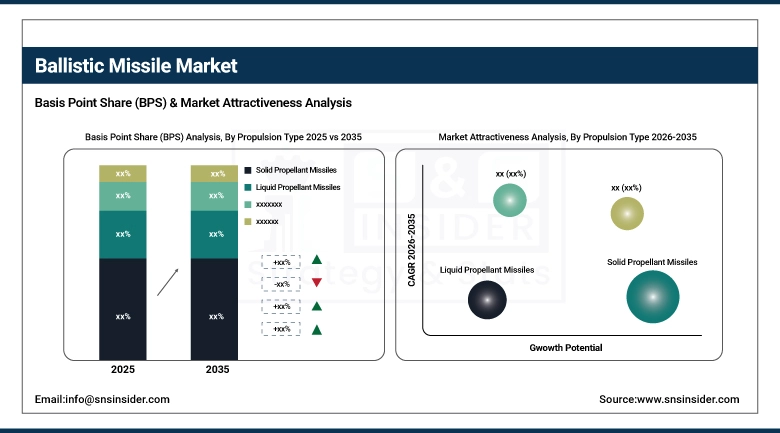
By Propulsion Type, Solid Propellant Missiles dominated with 54.89% market share in 2025, whereas Advanced / Composite Propellant Systems are projected to record the fastest CAGR of 7.87% through 2026–2035.
-
By Warhead Type, Nuclear Warheads accounted for the highest market share of 45.61% in 2025, while Multiple Independently Targetable Reentry Vehicles (MIRV) are expected to grow at the fastest CAGR of 7.97% during the forecast period.
-
By Platform / Launch Mode, Land-Based Missiles dominated with a 48.96% share in 2025, while Mobile Launch Systems are anticipated to expand at the fastest CAGR of 7.04% through 2026–2035.
By Range (Product Type), Short-Range Ballistic Missiles (SRBM) Dominates While Medium-Range Ballistic Missiles (MRBM) Grows Rapidly:
Short Range Ballistic Missile (SRBM) was the most dominant product category owing to its widespread use in tactical operations, quick-response ability, and affordability on the battlefields. Short-Range Ballistic Missiles have been extensively used for regional deterrence, border protection, and short-range strike operations.
Medium Range Ballistic Missiles (MRBM) segment is the fastest growing product category, mainly due to high demand for extended strike range and increased capacity for regional deterrence. Medium-Range Ballistic Missiles are finding extensive adoption in order to fill the void between short-range tactical missiles and long-range strategic missiles.
By Propulsion Type, Solid Propellant Dominates While Advanced / Composite Systems Grow Rapidly:
The Solid Propellant Missiles Segment accounted for the dominant share in the market due to its reliability, easy and quick launch ability, and simplicity in storage and handling. The solid propulsion system is used extensively in both strategic and tactical missile systems since it enables faster preparations before launching missiles. It ensures the ease of use and increased efficiency and reliability due to its durability and longer shelf life.
Advanced / Composite Propellant Systems are the fastest-growing segment, driven by increasing demand for higher efficiency, extended range, and improved thrust control in next-generation missile programs. These systems are gaining traction due to advancements in material science, propulsion engineering, and performance optimization, enabling enhanced maneuverability, payload capacity, and mission adaptability.
By Warhead Type, Nuclear Warheads Dominate While Multiple Independently Targetable Reentry Vehicles (MIRV) Systems Grow Rapidly:
The Nuclear Warheads segment held a dominant share due to their importance in deterrence strategy and national security doctrines within nuclear-capable countries. The warheads continue to be key components in second-strike doctrine and balance of power considerations, among others, especially since their inclusion in intercontinental missiles.
The Multiple Independently Targetable Reentry Vehicle (MIRV) segment is the fastest growing one, owing to rising demand for efficient strikes against multiple targets and improved ability to penetrate sophisticated missile defense shields. MIRVs allow one missile to strike multiple targets using different warheads.
By Platform / Launch Mode, Land-Based Dominates While Mobile Launch Systems Grow Rapidly:
The Land-Based Missiles category was the dominant in terms of market share owing to its widespread use in fixed and hardened sites within the military defense system. Land-Based Missiles constitute the core of any strategic missile arsenal and play a vital role in providing effective deterrence and offensive capabilities.
Mobile Launch Systems have been witnessing the fastest growth rate in terms of revenue generation. It is due to the rising emphasis on mobility, survivability, and quick deployment. Transporter-Erector-Launchers (TELs) and road-mobile launch systems have many advantages.
Ballistic Missile Market Regional Analysis:
North America Ballistic Missile Market Insights:
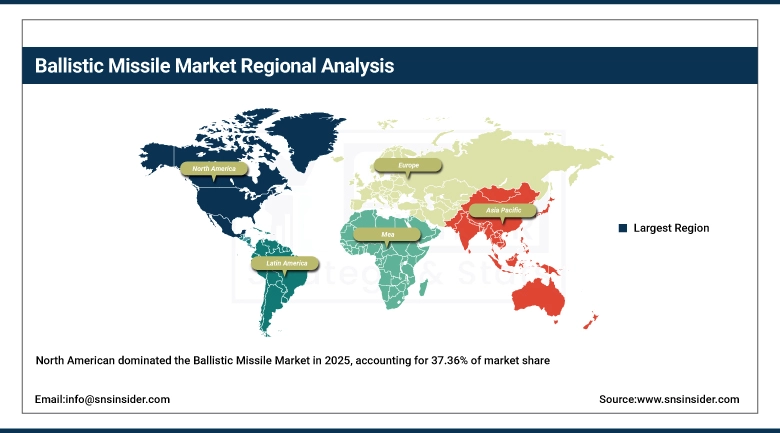
North America is the leader in the ballistic missiles market, having almost 37.36% share of the market by 2025 due to the modernization of missiles in the US along with the large defense budget allocation in the country. Advanced missile defense systems, an already built infrastructure base for manufacturing missiles, and alliances such as NATO and NORAD support the North American market. Innovations in the field of ICBMs, SLBMs, and mobility of missiles further strengthen its dominance. Canada helps with surveillance and defense, whereas innovations are being made by the USA.
Get Customized Report as per Your Business Requirement - Enquiry Now
U.S. Ballistic Missile Market Insights:
The U.S. holds sway over the North American ballistic missiles market. Factors driving growth include modernizing Minuteman III ICBM systems through the Sentinel initiative, Columbia class SLBMs, and missile defense programs such as THAAD and GMD. Significant research and development spending, improved guidance systems, and MIRV capabilities improve strategic deterrence.
Asia-Pacific Ballistic Missile Market Insights:
Asia-Pacific Region is the fastest growing region with almost 6.20% CAGR expected during 2026-2035. Geopolitical tension, especially in South Asia and East Asia regions, increases demand for SRBM, MRBM, and even hypersonic weapons. China and India dominate the region through their comprehensive missile programs, whereas Japan and South Korea invest in missile defense systems. Increase in defense spending, technological innovation through research & development, and the use of mobile launching systems are factors driving the market. Advanced propulsion systems and the concept of survivability make Asia-Pacific the most dynamic region in the world.
China Ballistic Missile Market Insights:
China is at the forefront of the ballistic missile industry in the Asia-Pacific region due to substantial investments made in ICBMs, SLBMs, and hypersonic gliders. China’s DF series of missiles and its Multiple Independently targetable Reentry Vehicles bolster the nation’s strategic deterrence capabilities, while the mobility of its launchers makes them more resistant to attack. Regular research and development by CASC and CASIC ensure technological progress.
Europe Ballistic Missile Market Insights:
Europe currently accounts for good amount share total ballistic missiles market owing to the region's NATO requirements and deterrent strategies against potential threats in the area. The two countries in Europe that possess nuclear deterrence capabilities in terms of SLBMs include France and the United Kingdom. Germany and other countries within the European Union are engaged in developing missile defenses and upgrading their missiles. Joint efforts made through MBDA, BAE Systems, and Thales facilitate innovation in propulsion and guidance systems.
Germany Ballistic Missile Market Insights:
Germany is an important player in the European market for ballistic missiles due to it focuses on defense and deterrence projects within NATO. Although not a nuclear power, Germany is one of the largest investors in MRBM missiles, surveillance systems, and launching vehicles. Collaboration with companies which include MBDA helps enhance technology. Increased defense spending is fueling the growth of the market.
Latin America Ballistic Missile Market Insights:
Latin America represents a small percentage in Industry, of the international ballistic missile industry, with only a few being deployed due to budget constraints for defense. Brazil emerges as the front-runner within Latin America, concentrating on rocket technology intended for launching objects into space, not strategic ballistic missiles. Most countries in the region are preoccupied with developing surveillance capabilities and missile defense systems. While growth remains modest compared to North America and Asia-Pacific, Latin America’s role is shaped by niche technological development and international defense partnerships.
Middle East & Africa Ballistic Missile Market Insights:
The Middle East & Africa continent, the industry for ballistic missiles as there are only a few of them available due to budget limitations for defensive purposes. Brazil leads other nations in the area in its efforts for developing rocket systems that are used to launch things into space but not for use in strategic missiles. The Latin American continent accounts for less than 5% of the industry for ballistic missiles; there are only a few of them available due to budget limitations for defensive purposes. Brazil leads other nations in the area in its efforts for developing rocket systems that are used to launch things into space but not for use in strategic missiles.
Ballistic Missile Market Competitive Landscape:
Lockheed Martin Corporation
Lockheed Martin is a prominent U.S. defense contractor that plays an important part in the production of the ballistic missile. The firm produces a wide range of interceptor missiles called PAC-3 MSE and Precision Strike Missile (PrSM). Lockheed Martin pays great attention to improving its missiles in terms of guidance, propulsion, and survival. High demand for the firm’s products, Foreign Military Sales, and its investments in new hypersonic technologies and ramjet-powered anti-ship ballistic missiles support Lockheed Martin's position on the market. The company is also expanding its role in integrated missile defense systems and international collaborations, reinforcing its leadership in advanced strike and deterrence capabilities.
-
In January 2026, Lockheed Martin secured a several USD billion contract from the U.S. Department of Defense to ramp up production of PAC-3 MSE missiles, tripling annual output to meet rising global demand.
Northrop Grumman Corporation
The Northrop Grumman Corporation occupies an important position within the American ballistic missile industry since it is the primary contractor of the Sentinel ICBM project aimed at replacing the outdated Minuteman III ICBMs. The corporation’s product line centers around strategic deterrence, propulsion technology, and nuclear triad integration. Northrop Grumman’s commitment to infrastructure prototyping, logistics readiness, and rapid acquisition is indicative of its dominance in missile technologies of the future. The company is also expanding its role in hypersonic missile development and advanced guidance systems, reinforcing its leadership in next‑generation strike capabilities.
-
In March 2026, Northrop Grumman and the U.S. Air Force announced accelerated progress on the Sentinel program, targeting a first flight test in 2027 and initial capability in the early 2030s.
Boeing Company
The Boeing Corporation continues to play a crucial role in the manufacture of ballistic missiles, especially with its knowledge in missile systems integration and guidance systems technology. Despite the Boeing Corporation being more specialized in missile defense systems than the other two companies, it still plays a pivotal part in the missile industry in the United States and internationally. Boeing is also actively engaged in modernization programs and collaborative defense initiatives, ensuring its continued relevance in next‑generation missile and aerospace systems.
-
In December 2025, Boeing’s continued participation in U.S. missile defense initiatives and contributions to modernization programs, though its role is less dominant than Lockheed Martin and Northrop Grumman.
Ballistic Missile Market Key Players:
Some of the Ballistic Missile Market Companies are:
- Lockheed Martin Corporation
- Northrop Grumman Corporation
- Boeing Company
- Raytheon Technologies Corporation
- BAE Systems PLC
- General Dynamics Corporation
- Thales Group
- Leonardo S.p.A.
- MBDA Missile Systems
- Saab AB
- Rafael Advanced Defense Systems Ltd.
- Israel Aerospace Industries (IAI)
- Mitsubishi Heavy Industries Ltd.
- Hanwha Corporation
- Bharat Dynamics Limited (BDL)
- Defence Research and Development Organisation (DRDO), India
- China Aerospace Science and Technology Corporation (CASC)
- China Aerospace Science and Industry Corporation (CASIC)
- Rostec (Russia)
- Almaz-Antey (Russia)
| Report Attributes | Details |
|---|---|
| Market Size in 2025 | USD 8.91 Billion |
| Market Size by 2035 | USD 14.89 Billion |
| CAGR | CAGR of 5.36% From 2026 to 2035 |
| Base Year | 2025 |
| Forecast Period | 2026-2035 |
| Historical Data | 2022-2024 |
| Report Scope & Coverage | Market Size, Segments Analysis, Competitive Landscape, Regional Analysis, DROC & SWOT Analysis, Forecast Outlook |
| Key Segments | • By Range (Short-Range Ballistic Missiles (SRBM), Medium-Range Ballistic Missiles (MRBM), Intermediate-Range Ballistic Missiles (IRBM), Intercontinental Ballistic Missiles (ICBM), Others), • By Propulsion Type (Solid Propellant Missiles, Liquid Propellant Missiles, Hybrid Propellant Missiles, Advanced / Composite Propellant Systems, Others), • By Warhead Type (Nuclear Warheads, Conventional Warheads, Thermonuclear Warheads, Multiple Independently Targetable Reentry Vehicles (MIRV), Others), • By Platform / Launch Mode (Land-Based Missiles, Sea-Based Missiles, Air-Launched Ballistic Missiles (ALBM), Mobile Launch Systems, Others) |
| Regional Analysis/Coverage | North America (US, Canada), Europe (Germany, UK, France, Italy, Spain, Russia, Poland, Rest of Europe), Asia Pacific (China, India, Japan, South Korea, Australia, ASEAN Countries, Rest of Asia Pacific), Middle East & Africa (UAE, Saudi Arabia, Qatar, South Africa, Rest of Middle East & Africa), Latin America (Brazil, Argentina, Mexico, Colombia, Rest of Latin America). |
| Company Profiles | Lockheed Martin Corporation, Northrop Grumman Corporation, Boeing Company, Raytheon Technologies Corporation, BAE Systems PLC, General Dynamics Corporation, Thales Group, Leonardo S.p.A., MBDA Missile Systems, Saab AB, Rafael Advanced Defense Systems Ltd., Israel Aerospace Industries (IAI), Mitsubishi Heavy Industries Ltd., Hanwha Corporation, Bharat Dynamics Limited (BDL), DRDO (India), China Aerospace Science and Technology Corporation (CASC), China Aerospace Science and Industry Corporation (CASIC), Rostec (Russia), Almaz-Antey (Russia). |
Frequently Asked Questions
North America dominated with a 37.36% share in 2025, while Asia-Pacific is the fastest-growing region, expected to expand at a CAGR of 6.20% during 2026–2035.
Solid Propellant Missiles dominated with a 54.89% share in 2025, while Biologics & Advanced / Composite Propellant Systems are projected to grow at the fastest CAGR of 7.87% during 2026–2035.
Growth is driven by rising geopolitical tensions and regional conflicts, continuous defense modernization programs, advancements in propulsion and guidance technologies, increasing demand for strategic deterrence capabilities (ICBM, SLBM).
The market is valued at USD 8.91 Billion in 2025 and is projected to reach USD 14.89 Billion by 2035.
The Ballistic Missile Market is projected to grow at a CAGR of 5.36% during 2026–2035.
