
Anti-Tank Anti-personnel IED Detection Systems Market Report Scope & Overview:
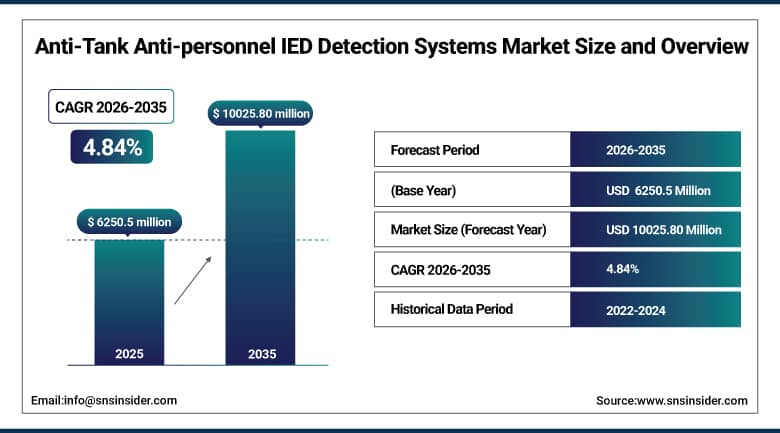
The Anti-Tank Anti-personnel IED Detection Systems Market size was valued at USD 6250.5 Million in 2025 and is projected to reach USD 10025.80 Million by 2035, growing at a CAGR of 4.84% during 2026–2035.
The Anti-Tank and Anti-Personnel IED Detection Systems market is driven due to growing tensions at cross-border and rising IEDs deployment, and the increasing complexity of hybrid explosive threats of military-grade material with improvised components. There has been an increasing demand for improved detection technologies to detect hidden and remote triggered explosives in defence and security operations. Governments are investing in multi-sensor systems, robotics, and artificial intelligence-enabled detection solutions to advance threat identification and personnel safety. Moreover, the transition to automated and high-precision detection platforms is further supporting the growth of this market as they enhance operational capabilities while minimizing risks in vital, high-threat environments.
On December 21, 2025, As border security threats increased and the demand for sophisticated detection systems mounted, Thailand's Second Army Area recovered a modified Cambodian IED fashioned from a TM-57 anti-tank mine.
Anti-Tank Anti-personnel IED Detection Systems Market Size and Forecast:
-
Market Size in 2025: USD 6250.5 Million
-
Market Size by 2035: USD 10025.80 Million
-
CAGR: 4.84% (from 2026 to 2035)
-
Base Year: 2025
-
Forecast Period: 2026–2035
-
Historical Data: 2022–2024
To Get More Information On Anti-Tank Anti-personnel IED Detection Systems Market - Request Free Sample Report
Anti-Tank Anti-personnel IED Detection Systems Market Highlights:
-
Increasing global security threats and asymmetric warfare driving demand for advanced counter-IED solutions
-
Vehicle-mounted systems dominate due to wide-area detection and integration with military operations
-
Rapid growth of robotic and autonomous systems to reduce human risk in hazardous environments
-
Ground-penetrating radar (GPR) leads technology segment with high accuracy in subsurface detection
-
Rising adoption of AI, multi-sensor fusion, and real-time detection technologies
-
Strong investments from defense and homeland security agencies supporting market expansion
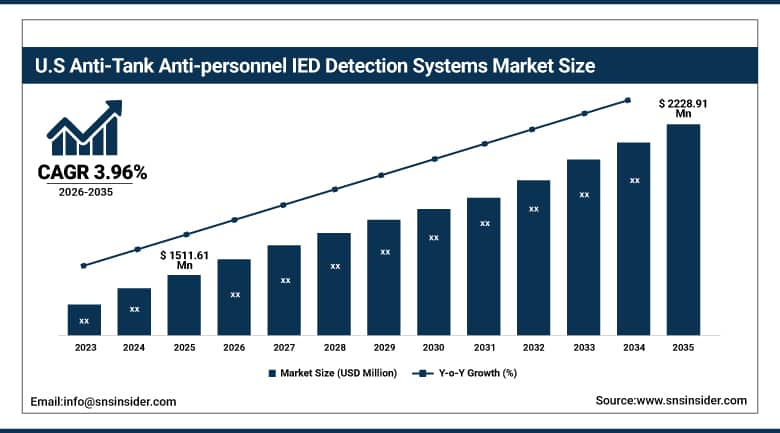
The U.S. Anti-Tank Anti-personnel IED Detection Systems Market size was valued at USD 1511.61 Million in 2025 and is projected to reach USD 2228.91 Million by 2035, growing at a CAGR of 3.96% during 2026–2035. Expansion is being fueled by greater defense modernization programs, high demand for effective counter-IED technologies, and sustained investment in AI-enabled detection, robotics, and multi-sensor development. Also, the concentration on safeguarding troops, homeland security, and faster deploying capabilities is also fuelling market growth among military and security agencies.
Anti-Tank Anti-personnel IED Detection Systems Market Drivers:
-
Increasing Adoption of Vehicle-Mounted GPR Systems Driving Market Growth
The increasing use of vehicle-mounted GPR systems is one of the major factors driving the growth of the anti-tank and anti-personnel IED detection systems market. As a result, defense forces are adopting advanced mine detection vehicles combined with broad-area radar arrays, capable of detecting both metallic as well as non-metallic explosive threats, to improve detection capabilities. This will allow for the convoy not only to continue moving and performing operations, but the systems allow the convoy to be able to sense where a buried IED may be at the same time. Also, the demand for better safety of the crew aboard, fast clearing of routes, and flexibility of operability in different terrains is pushing up the investments in these platforms, contributing to modernization of military engineering establishments and enhancing overall counter-IED capabilities globally.
On December 2, 2025, Egypt unveiled the ST-108 GPR mine detection vehicle at EDEX 2025, as it features a full-width ground-penetrating radar system for use during route clearance operations to facilitate the detection of anti-tank mines and any IEDs.
Anti-Tank Anti-personnel IED Detection Systems Market Restraints:
-
High Implementation Costs and Technical Limitations Impacting Market Growth
The ultimate development of the Anti-Tank and Anti-Personnel IED Detection Systems is restrained due to the high price for the large number of advanced detection technologies especially artificial-intelligence (AI) enabled systems, multi-sensor platforms, and robotic solutions. Acquisition, upkeep, and personnel cost and strain taxpayer dollars especially in nations with small military budgets. Moreover, sophisticated operational constraints, false alarm rates, and difficulties in identifying objects buried at depth or non-metallic explosives degrade efficiency. While security threats are on the rise and demand for advanced counter-IED solutions is increasing, this mass-market opportunity is, in fact, constrained due to integration issues with existing military infrastructure necessitating continuous technological upgrades.
Anti-Tank Anti-personnel IED Detection Systems Market Opportunities:
-
Rising Adoption of AI-Enabled Autonomous Detection Systems Creating New Growth Opportunities
With the rising emphasis on adoption of artificial intelligence in IED and mine detection systems, the Anti-Tank and Anti-Personnel IED Detection Systems market is likely to have major market opportunity during the forecast period. The increasing demand for automated target recognition and real-time threat identification, with minimal human intervention, is pushing the boundaries of innovation in advanced detection technologies. Defense agencies are on the lookout for tactical solutions that integrates sensors, AI algorithms, and unmanned platforms ensuring operational effectiveness and safety. The move towards autonomous, sensor systems with AI based intelligence is anticipated to create new opportunities for technology providers, decrease time to market and increase adoption across modern battlefield and security environments.
On April 8, 2026, the U.S. Army sought AI-based systems to automatically detect anti-tank mines, anti-personnel mines, and IEDs, emphasizing the need for advanced detection technologies.
Anti-Tank Anti-personnel IED Detection Systems Market Segment Highlights:
-
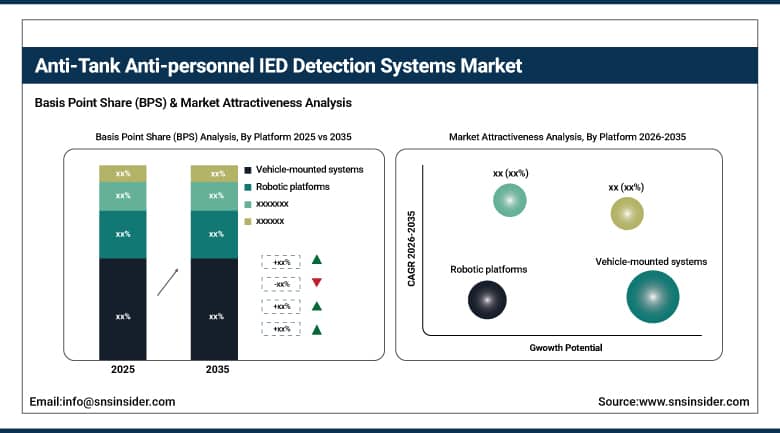
By Platform: Dominant – Vehicle-mounted systems (45.60% in 2025 → 42.40% in 2035); Fastest Growing – Robotic platforms (14.80% in 2025 → 21.20% in 2035)
-
By Technology: Dominant – Ground-penetrating radar (GPR) (27.40% in 2025 → 26.10% in 2035); Fastest Growing – Biosensors (13.70% in 2025 → 18.90% in 2035)
-
By Application: Dominant – Defense operations (62.80% in 2025 → 58.60% in 2035); Fastest Growing – Homeland security missions (24.70% in 2025 → 27.90% in 2035)
-
By Operational Mode: Dominant – Manned systems (48.90% in 2025 → 39.70% in 2035); Fastest Growing – Autonomous detection systems (18.50% in 2025 → 25.50% in 2035)
Anti-Tank Anti-personnel IED Detection Systems Market Segment Analysis:
Vehicle-mounted Systems (Dominant) and Robotic Platforms (Fastest-Growing) – By Platform
The broader segment under this category is Vehicle-mounted systems which is expected to continue its dominance over the forecast period owing to the extensive use of vehicle-mounted systems in military convoys, route clearance, and large-area surveillance. Increased detection range, multi-sensor integration and safety of ground troops have made these systems a vital part of counter-IED operations. In addition, aggressive investments in defense and regular advancements in armored vehicle technologies continue to account for their ongoing adoption. However, the fastest growth is anticipated with respect to the Robotic platforms segment, as increasing demand for unmanned and remote-operated solutions to minimize human risk in high-threat environments is expected to drive this segment. The use of robotics, AI-based detection, and autonomous navigation systems is also witnessing a surge as they are used for accurate identification and neutralization of explosive threats.
Ground-penetrating Radar (GPR) (Dominant) and Biosensors (Fastest-Growing) – By Technology
Ground-penetrating radar (GPR) segment will dominate the market for physical clearance and grow at the largest share over the forecast period. This system is ideal for military route-clearance operations due to its real-time subsurface imaging capability and vehicle-mounted platform integration. This is further complemented by increased radar resolution and better signal processing. On the other hand, the Biosensors segment is estimated to be the fastest growing segment during the forecast period due to its high-sensitivity detection of explosive materials on a molecular scale. Demand for more sophisticated chemical detection, portability and rapid reaction systems is steering the migration from traditional counter-IED solutions to biosensor-based technologies.
Defense Operations (Dominant) and Homeland Security Missions (Fastest-Growing) – By Application
The Defense operations segment holds a major portion of the market and is also anticipated to hold a major share owing to the large application of IED detection systems in military missions, battlefield monitoring and convoy protection. Global conflicts on the rise, continual sending of troops to dangerous regions, and higher investments in advanced counter-IED technologies are key factors supporting the demand in defense segments. Moreover, multi-sensor systems and unmanned platforms are also duly integrated to improve operational efficiency. The Homeland security missions segment is also expected to propel the highest growth due to the increasing terrorism, urban security issues, and also critical infrastructure vulnerabilities. This segment is experiencing rapid growth, supported by significant investments by governments in advanced detection technologies across airports, public spaces, and border security.
Manned Systems (Dominant) and Autonomous Detection Systems (Fastest-Growing) – By Operational Mode
The Manned systems segment held the largest market share and continues to be the largest segment by virtue of reliability, input from human in the control process (real-time feedback process) and its long-standing use in the traditional sense of warfare. The systems are predominantly used for manual inspection, tactical operations, and in scenarios where the decision made by the operator matters, hence the human in the loop. These are also already well-established infrastructures and they're not as technologically complex with regards to initial phases of use. However, the Autonomous detection systems segment is expected to grow at the highest growth rate due to the rising demand for limiting human exposure to harmful environments. Modern Counter-IED operations are performing at much higher levels of safety, stability and efficiency, thanks to the proliferation of advances in AI, ML and on-the-fly autonomous navigation at the sensor level to create highly effective self-operating detection systems.
Anti-Tank Anti-personnel IED Detection Systems Market Regional Highlights:
-
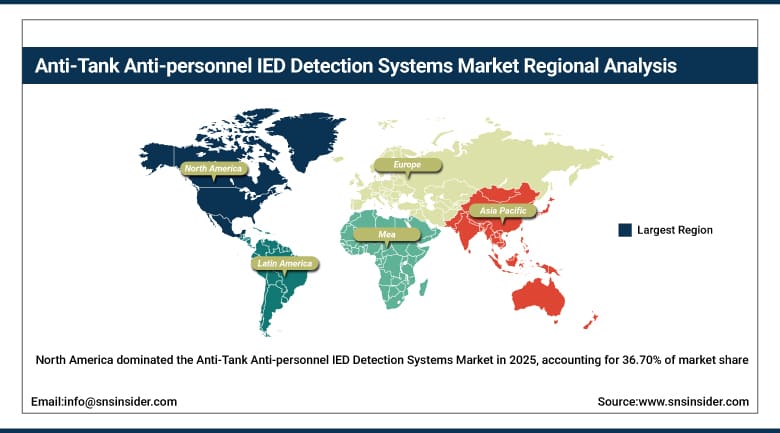
North America (Dominating – 36.70% in 2025 → 34.20% in 2035, CAGR 4.10%)
-
Asia-Pacific (Fastest Growing – 22.80% in 2025 → 26.70% in 2035, CAGR 6.50%)
-
Europe (27.90% in 2025 → 26.40% in 2035, CAGR 4.26%)
-
Latin America (6.30% in 2025 → 6.50% in 2035, CAGR 5.17%)
-
Middle East & Africa (6.30% in 2025 → 6.20% in 2035, CAGR 4.67%)
Anti-Tank Anti-personnel IED Detection Systems Market Regional Analysis:
North America Anti-Tank Anti-personnel IED Detection Systems Market Insights:
North America leads the global Anti-Tank and Anti-Personnel IED Detection Systems market due to strong defense budgets, advanced military modernization programs, and continuous investment in counter-IED technologies. The presence of major defense contractors and high adoption of vehicle-mounted and robotic detection systems further strengthen regional dominance. Additionally, increasing focus on homeland security, border protection, and technological innovation, including AI-enabled detection and sensor integration, supports sustained market growth across the United States and Canada.
Get Customized Report as Per Your Business Requirement - Enquiry Now
U.S. Anti-Tank Anti-personnel IED Detection Systems Market Insights:
The U.S. Anti-Tank and Anti-Personnel IED Detection Systems market continues to grow gradually due to increase in expenditure on defense, growing counter-IED operations and sound investments on advanced detection technologies such as AI-based systems, robotics, and sensor integration to strengthen battlefield/homeland security capabilities.
Asia-Pacific Anti-Tank Anti-personnel IED Detection Systems Market Insights:
Asia Pacific is the fastest growing region in the Anti-Tank and Anti-Personnel IED Detection Systems market due to rising defense budgets, increasing cross-border tensions, and modernization of military capabilities across countries such as China, India, and South Korea. Growing investments in advanced surveillance, counter-IED technologies, and unmanned systems are accelerating adoption. Additionally, expanding homeland security initiatives, infrastructure protection needs, and government focus on indigenous defense manufacturing further support rapid market growth across the region.
China Anti-Tank Anti-personnel IED Detection Systems Market Insights:
China is the dominating and fastest growing Anti-Tank and Anti-Personnel IED Detection Systems market, Led by rising defense budgets, rapid advancement of technologies, proliferating military capabilities as well as firm government strategies supporting the indigenous counter-IED and surveillance systems.
Europe Anti-Tank Anti-personnel IED Detection Systems Market Insights:
Rising security concerns in the region along with growing defense modernization programs and extensive investments towards the development and use of advanced counter-IED technologies are some of the factors augmenting the market demand for Anti-Tank and Anti-Personnel IED Detection Systems in Europe and the market is anticipated to witness a steady growth in the upcoming years. Nations like the UK, France, and Germany are concentrating on developing military capabilities and developing advanced deterrent systems (including robot- and sensor systems). The other factors promoting market growth in the region include NATO partnerships, border security programs and focus on technological innovation.
Germany Anti-Tank Anti-personnel IED Detection Systems Market Insights:
The Germany Anti-Tank and Anti-Personnel IED Detection Systems Market is forecast to be driven by the growing need for defense modernisation implemented by the German Government resulting in bolstered NATO commitments as well as rising investments in advanced detection technologies such as robotics, sensors and integrated counter IED with an aim to enhance operational readiness in the coming years.
Latin America Anti-Tank Anti-personnel IED Detection Systems Market Insights:
The Latin America Anti-Tank and Anti-Personnel IED Detection Systems market is witnessing a gradual rise, driven by increasing focus on internal security, border protection, and counter-narcotics operations. Governments across countries such as Brazil and Mexico are investing in advanced surveillance and detection technologies to address evolving threats. Additionally, growing collaboration with international defense organizations and modernization of security infrastructure are supporting steady adoption of IED detection systems across the region.
Brazil Anti-Tank Anti-personnel IED Detection Systems Market Insights:
Brazil is the largest market in the Latin America Anti-Tank and Anti-Personnel IED Detection Systems industry due to the rising defense investments, internal security operations, and ongoing adoption of advanced detection technologies for border protection and threat mitigation.
Middle East & Africa Anti-Tank Anti-personnel IED Detection Systems Market Insights:
The Middle East & Africa Anti-Tank and Anti-Personnel IED Detection Systems market is undergoing rapid growth as a result of persistent regional tensions as well as global terrorism threats and boosts in defense expenses. Demand for improvised explosive device (IED) detection and interrogation systems has risen rapidly due to international security threats across the Middle East and Africa (MEA), with countries in the region increasingly investing in next-generation counter-IED technologies, including vehicle-based and robotic systems, to augment military and border security capabilities. Moreover, increasing demand for protection of critical infrastructure, defense forces collaboration, and modernization coupled with others is further boosting the demand for global defense security market in the region.
Saudi Arabia Anti-Tank Anti-personnel IED Detection Systems Market Insights:
High defense spending, advanced military procurement programs, and strong focus on counter-terrorism and border security have all made Saudi Arabia the leading country in the Middle East & Africa Anti-Tank and Anti-Personnel IED Detection Systems market.
Anti-Tank Anti-personnel IED Detection Systems Market Competitive Landscape:
Elbit Systems is an Israel-based company which specializes in defense technology and was founded in the year 1966 where it was dealing with all advanced military electronics, electronic warfare, intelligence systems and other electronic systems and has some counter-UAS solutions as well. It offers integrated defense systems, by integrating radar, SIGINT, and electro-optical technologies for battlefield awareness, giving an edge in drone neutralization and protection of armored vehicles in land, air, and naval applications worldwide.
-
On Jan 2026, Elbit Systems was awarded a USD 60 million NATO contract on to supply its ReDrone multi-layer Counter-UAS system integrating radar, SIGINT, electronic warfare, and electro-optical sensors for detecting, tracking, and neutralizing hostile drones, enhancing battlefield situational awareness and electronic attack capabilities in mobile and stationary configurations.
Anti-Tank Anti-personnel IED Detection Systems Market Key Players:
-
Northrop Grumman Corporation
-
BAE Systems
-
Raytheon Technologies Corporation
-
Lockheed Martin Corporation
-
General Dynamics Corporation
-
L3Harris Technologies, Inc.
-
Thales Group
-
Elbit Systems Ltd.
-
Leonardo S.p.A.
-
Saab AB
-
Rheinmetall AG
-
Chemring Group PLC
-
FLIR Systems, Inc.
-
QinetiQ Group plc
-
Textron Systems
-
Israel Aerospace Industries Ltd.
-
Cobham plc
-
Ultra Electronics Holdings plc
-
SRC, Inc.
-
ITT Inc.
| Report Attributes | Details |
|---|---|
| Market Size in 2025 | USD 6250.5 Million |
| Market Size by 2035 | USD 3513.30 Million |
| CAGR | CAGR of 5.76% From 2026 to 2035 |
| Base Year | 2025 |
| Forecast Period | 2026-2035 |
| Historical Data | 2022-2024 |
| Report Scope & Coverage | Market Size, Segments Analysis, Competitive Landscape, Regional Analysis, DROC & SWOT Analysis, Forecast Outlook |
| Key Segments | • By Platform (Vehicle-mounted systems, Tank-integrated systems, Handheld portable units and Robotic platforms) • By Technology(Biosensors, Ground-penetrating radar (GPR), Metal detection, Infrared/thermal imaging and Chemical explosive trace detection) • By Application(Defense operations, Homeland security missions and Commercial infrastructure protection) • By Operational Mode(Manned systems, remotely operated systems and autonomous detection systems) |
| Regional Analysis/Coverage | North America (US, Canada), Europe (Germany, UK, France, Italy, Spain, Russia, Poland, Rest of Europe), Asia Pacific (China, India, Japan, South Korea, Australia, ASEAN Countries, Rest of Asia Pacific), Middle East & Africa (UAE, Saudi Arabia, Qatar, South Africa, Rest of Middle East & Africa), Latin America (Brazil, Argentina, Mexico, Colombia, Rest of Latin America). |
| Company Profiles | Northrop Grumman Corporation, BAE Systems, Raytheon Technologies Corporation, Lockheed Martin Corporation, General Dynamics Corporation, L3Harris Technologies, Inc., Thales Group, Elbit Systems Ltd., Leonardo S.p.A., Saab AB, Rheinmetall AG, Chemring Group PLC, FLIR Systems, Inc., QinetiQ Group plc, Textron Systems, Israel Aerospace Industries Ltd., Cobham plc, Ultra Electronics Holdings plc, SRC, Inc., ITT Inc. |
Frequently Asked Questions
North America dominated the Anti-Tank Anti-personnel IED Detection Systems Market in 2025.
The “Vehicle-mounted systems” segment dominated during the projected period.
Rising asymmetric warfare threats, increasing defense spending, and growing need for advanced counter-IED and force protection technologies drive market growth.
The Market was valued at USD 6250.5 Million in 2025 and is projected to reach USD 10025.80 Million by 2035.
The Market is expected to grow at a CAGR of 4.84% during 2026–2035.
