
Turboprop Engine Market Report Scope & Overview:
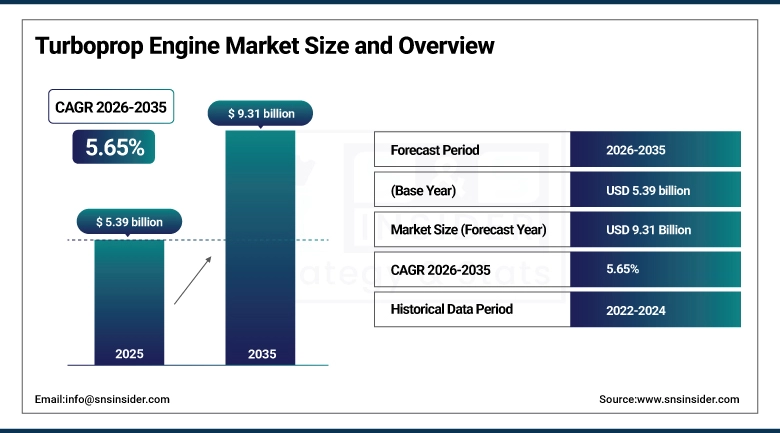
The Turboprop Engine Market size is valued at USD 5.39 Billion in 2025 and is projected to reach USD 9.31 Billion by 2035, growing at a CAGR of 5.65% during the forecast period 2026–2035.
In Turboprop Engine Market research report, a comprehensive insight into the trends and analysis in the dynamics, innovation in engines, and demand by applications in commercial aviation, military aviation, cargo aviation, and business aviation has been discussed. Increasing demand for fuel-efficient regional aircraft, growing military expenditure on modernization, rising air traffic links in developing countries, and development in hybrid electric propulsion engines are some factors leading to continuous growth in the market from 2026 to 2035.
The use of turboprop engines accounted for more than 68 million flight hours in 2025.
Market Size and Forecast:
-
Market Size in 2025: USD 5.39 Billion
-
Market Size by 2035: USD 9.31 Billion
-
CAGR: 5.65% from 2026 to 2035
-
Base Year: 2025
-
Forecast Period: 2026–2035
-
Historical Data: 2022–2024
To Get More Information On Turboprop Engine Market - Request Free Sample Report
Turboprop Engine Market Trends:
-
Growing demand for regional and short-haul air connectivity is driving increased adoption of fuel-efficient turboprop engines.
-
Rising defense modernization programs and military transport requirements are boosting long-term procurement of advanced turboprop propulsion systems.
-
Expansion of cargo and freight aviation networks is improving utilization of turboprop-powered aircraft for short-distance logistics efficiency.
-
Development of next-generation fuel-efficient and low-emission engines is enhancing operational performance and regulatory compliance.
-
Increasing integration of predictive maintenance systems and digital engine monitoring is improving reliability and reducing lifecycle costs.
-
Collaborations between engine OEMs, aircraft manufacturers, and aerospace technology providers are accelerating innovation in hybrid-electric propulsion systems.
U.S. Turboprop Engine Market Insights:
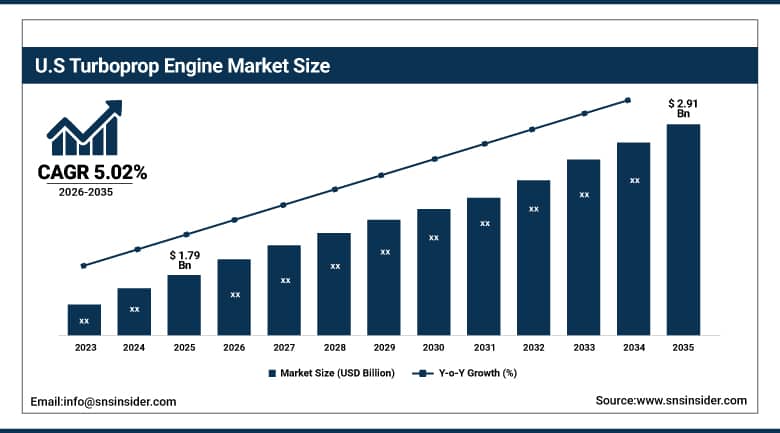
The U.S. Turboprop Engine Market is projected to grow from USD 1.79 Billion in 2025 to USD 2.91 Billion by 2035, at a CAGR of 5.02%. The growth will be fueled by increasing demand for regional airline connectivity, growing programs of defense aircrafts, strong acceptance of efficient turboprop propulsion technology and hybrid-electric engine technology advancements in commercial and cargo airlines and defense forces.
Turboprop Engine Market Growth Drivers:
-
Rising demand for regional and short-haul air connectivity driving turboprop engine adoption across commercial aviation fleets.
Increased demand for regional aviation connectivity and short-range flights is one of the major factors driving the Turboprop Engine Market. With rising costs associated with jet fuels, there has been a notable uptake of efficient fuel-operated engines by regional airlines and aircraft owners for transportation services, freight movements, and private flights. There has been an increased procurement of turboprop aircraft by the defense forces for military transport purposes. Technological advancements are making these engines more reliable and efficient in reducing emissions from aircrafts.
Over 62% of regional airlines and defense aviation were operating turboprop aircraft in 2025 owing to their efficiency and cost-effectiveness.
Turboprop Engine Market Restraints:
-
High acquisition and operating costs of turboprop engines are restraining adoption in cost-sensitive regional aviation markets.
The expensive nature of advanced turboprop engines coupled with higher costs for maintenance, overhaul, and operation costs is one of the primary restraints faced by the market of turboprop engines. There are budgetary limitations faced by airlines and cargo companies that do not allow such companies to update their fleet, thus leaving behind older engines systems.
Turboprop Engine Market Opportunities:
-
Expanding regional aviation networks and underserved route connectivity present significant growth opportunities for the Turboprop Engine Market.
With an increase in regional infrastructure development coupled with high demands in terms of connectivity in second and third-tier cities, the market is witnessing a huge potential due to the Turboprop Engine market. There is an increasing demand from airlines, cargo operators, and military aviation programs to use turboprop engines due to these types of engines are more efficient in providing fuel consumption savings, cost efficiencies, and enhanced performance on shorter runways compared to other jet engines.
More than 49% of the routes expanded through turboprop engines in 2025.
Turboprop Engine Market Segmentation Analysis:
-
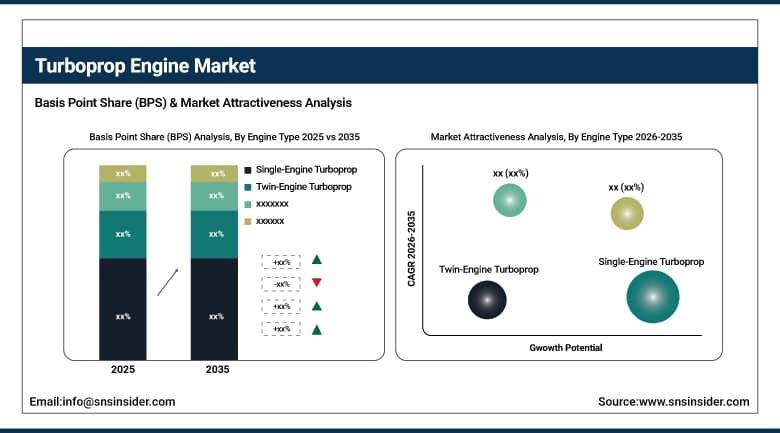
By Engine Type, Single-Engine Turboprop held the largest market share of 58.75% in 2025, while Twin-Engine Turboprop is expected to grow at the fastest CAGR of 6.66% during 2026–2035.
-
By Application, Commercial Aviation (Regional passenger aircraft) dominated with a 46.05% market share in 2025, while Cargo & Freight Aviation is projected to record the fastest CAGR of 7.77% during 2026–2035.
-
By Component, Turbine accounted for the largest share of 28.85% in 2025, while Gearbox is expected to grow at the fastest CAGR of 5.87% during the forecast period.
-
By End User, Aircraft OEMs held the largest share of 38.12% in 2025, while MRO Service Providers are expected to grow at the fastest CAGR of 6.14% during 2026–2035.
-
By Technology, Conventional Turboprop Engines dominated with a 74.23% market share in 2025, while Hybrid-Electric Turboprop Engines are projected to grow at the fastest CAGR of 9.84% during the forecast period.
By Engine Type, Single-Engine Turboprop Dominates While Twin-Engine Turboprop Grows Rapidly:
Single-Engine Turboprop segment dominated the market in terms of market share owing to its high usage in regional passenger flights, utility aviation, and short-haul connectivity flights. This is attributed to its low purchase price, better fuel consumption, and ability to operate in remote airstrips.
Twin-Engine Turboprop is the fastest-growing segment, is projected to record the highest growth rate in the market, spurred by growing requirements for increased payload capacity, safety, and operational performance in military transport, cargo flights, and regional connectivity.
By Application, Commercial Aviation Dominates While Cargo & Freight Aviation Grows Rapidly:
Commercial Aviation (Regional passenger aircraft) segment dominated due to the high demand for short-haul connections, expansion of regional flights, and efficient operations of the aircraft. Airlines still depend heavily on turboprop-driven aircraft in order to be able to conduct low-density flight operations.
Cargo & Freight Aviation is the fastest-growing segment due to rising demand for logistics, growth in e-commerce businesses, and efficient deliveries. The demand for turboprop engines is increasing for the purpose of conducting short haul flights that have less sophisticated airport facilities.
By Component, Turbine Dominates While Gearbox Grows Rapidly:
Turbine segment dominated the market due to its critical role in power generation, efficiency optimization, and overall engine performance in turboprop systems. It remains a core component across commercial and military aviation engines, supported by high operational demand and continuous maintenance requirements.
Gearbox is the fastest-growing segment, driven by increasing demand for advanced power transmission systems in modern turboprop engines. Rising focus on fuel efficiency, noise reduction, and torque management is accelerating innovation and adoption.
By End User, Aircraft OEMs Dominate While MRO Service Providers Grow Rapidly:
Aircraft OEMs segment dominated the market due to its prominent involvement in the integration of turboprop engines, production of airplanes, and fleet management agreements. The partnership between the aircraft manufacturers, engine suppliers, and defense procurement agencies guarantees constant requirement for turboprop engines.
MRO Service Providers are the fastest-growing segment, It is explained by the rising need for maintenance, repair, overhaul, and lifecycle management services for turboprop engines used in aircrafts. Increased attention toward the longevity of engines is boosting the trend toward maintenance services.
By Technology, Conventional Turboprop Engines Dominate While Hybrid-Electric Turboprop Engines Grow Rapidly:
Conventional Turboprop Engines segment dominated the market due to extensive application within commercial, military, and cargo air travel. The reliability of these engines, coupled with their proven design and low-cost operation, makes them the most suitable option for regional flights.
Hybrid-Electric Turboprop Engines are the fastest-growing segment, owing to its emphasis on efficiency, emissions, and sustainability efforts in aviation. Investments in the research and development of new engine types are contributing to this trend.
Turboprop Engine Market Regional Analysis:
North America Turboprop Engine Market Insights:
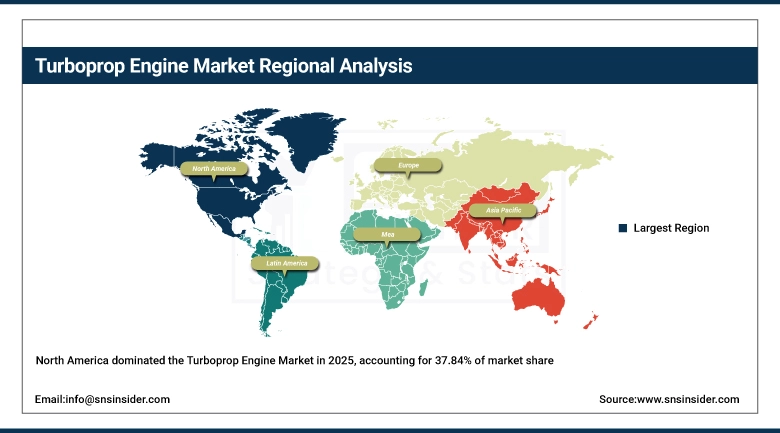
The North America Turboprop Engine Market is dominated, holding a 37.84% share in 2025, backed by a large network of regional airlines, rapid modernization rate of engine fleets, and significant presence of top engine suppliers and aircraft OEMs in the U.S. and Canada. Large-scale use of fuel-efficient turboprop engines in regional airliners, military transports, and cargo aviation underpin the country’s leadership. Growth in defense procurement initiatives, superior maintenance facilities, and advanced maintenance repair overhaul (MRO) services contribute to the regional dominance. Consistent improvements in engine efficiency, digital monitoring systems, and hybrid propulsion systems add to the region’s leadership in the turboprop engine market.
Get Customized Report as Per Your Business Requirement - Enquiry Now
U.S. Turboprop Engine Market Insights:
The U.S. Turboprop Engine Market is fueled by robust demand for regional air connectivity, state-of-the-art defense aviation initiatives, and an advanced aerospace manufacturing sector. Extensive use of turboprop engines in commercial regional airlines, cargo aviation, and military fleets contributes to continued growth. Large presence of key OEMs, continuous fleet renewals, and huge investments in fuel-efficient and next-generation propulsion systems help maintain North America’s lead.
Asia-Pacific Turboprop Engine Market Insights:
The Asia-Pacific Turboprop Engine Market is the fastest-growing region, projected to expand at a CAGR of 6.99% during 2026–2035. This trend has been fueled by the rapid growth of regional air connectivity, growing demand for short-haul flights, and rising cargo aviation operations in China, India, Japan, and Southeast Asia. The growing market has been underpinned by the development of airport infrastructure, modernization programs in the defense sector, and increased use of efficient turboprop aircraft. Investments in the expansion of the aircraft fleet, along with an increasing emphasis on fuel-efficient engines and advanced propulsion technologies, are driving market growth.
China Turboprop Engine Market Insights:
The China Turboprop Engine Market has experienced significant growth due to the growing demand for regional air connectivity, increased development of domestic aviation infrastructure, and the growing use of fuel-efficient aircraft. Growth in the short-haul air transport industry, cargo transport operations, and military aviation has resulted in the rising use of turboprop engines.
Europe Turboprop Engine Market Insights:
The Europe Turboprop Engine Market is propelled by an established air transport network within the region, rising demands for short haul travel connections, and well-developed aerospace production capacity. The market growth in Europe is being supported by efforts such as fleet upgrade initiatives, defense aviation programs, and the utilization of fuel-efficient turboprop engine aircraft. Additional factors driving regional demand include expanding cargo airways and robust investment in innovative engine technologies and maintenance services.
Germany Turboprop Engine Market Insights:
Germany constitutes an important contributor to the turboprop engine market in Europe, powered by established aerospace engineering capabilities and robust industrial aviation infrastructure within the country. Increasing adoption of fuel-efficient engine-powered regional transport aircraft and defense aviation operations drives market growth within the country. Investment in research & development activities and engine maintenance serves as a catalyst in modernizing the regional industry.
Latin America Turboprop Engine Market Insights:
The Latin America Turboprop Engine Market is witnessing positive growth owing to rising demands for regional connectivity, air cargo transport, and cost-effective aviation solutions. Brazil, Mexico, and Argentina are some countries contributing to the growth by way of fleet expansions, airport developments, and rising adoption rates of turboprop aircraft. Higher demands for military aviation solutions and MRO activities are also contributing to growth. Poor infrastructure in remote areas is also favoring the market growth due to the operational advantages offered by turboprop aircraft.
Middle East & Africa Turboprop Engine Market Insights:
The Middle East & Africa Turboprop Engine Market is showing positive growth owing to increased military aviation investments, rising regional air transport needs, and increased demand for cargo connectivity. Some of the leading adopters include Saudi Arabia, United Arab Emirates, and South Africa through modernizing their fleets, and developing aviation infrastructure. Growing usage of turboprop aircraft for surveillance, training, and short-range transport applications is fueling demands for the market.
Turboprop Engine Market Competitive Landscape:
Pratt & Whitney Canada stands out as one of the top manufacturers of turboprop engines across the globe. It is highly regarded for developing modern propulsion engines, including PW100 and PW150, that have been used in some of the best regional aircraft in the world such as the ATR and De Havilland aircraft models. One of the key strengths that this firm enjoys in this industry includes the efficiency of their engines, high levels of reliability, and the global servicing and maintenance capabilities it provides for engine lifecycles.
-
In September 2025, Pratt & Whitney Canada announced advancement of its hybrid-electric regional propulsion demonstrator program, aimed at improving fuel efficiency, reducing emissions, and supporting next-generation sustainable turboprop aircraft development across commercial aviation markets.
GE Aerospace is one of the key players in the turboprop engine market, having extensive knowledge in modern propulsion technology and integration systems in various applications for military transports, cargo, and special purpose aircraft. The firm concentrates on increasing the efficiency and durability of engines along with their digital monitoring via advanced analytics and predictive maintenance tools. GE Aerospace enjoys robust military contracts and a logistics network along with ongoing development in new generation propulsion systems.
-
In August 2025, GE Aerospace expanded its ATP (Advanced Turboprop) engine development program to support next-generation military transport aircraft, focusing on improved power efficiency, reduced fuel burn, and enhanced operational reliability for defense aviation fleets.
Rolls-Royce plc is a key competitor in the turboprop engine market, known for its engineering excellence and advanced propulsion solutions across civil and defense aviation sectors. The company emphasizes innovation in fuel-efficient engine architectures, digital engine control systems, and sustainable aviation technologies. Its strong engineering base and partnerships with aircraft OEMs support long-term competitiveness in regional aviation and special mission aircraft programs. Rolls-Royce continues to invest in next-generation propulsion systems aimed at improving performance, reducing emissions, and enhancing operational efficiency.
-
In July 2025, Rolls-Royce plc announced progress in its small gas turbine and hybrid propulsion development program, targeting improved efficiency for regional aircraft applications and supporting future low-emission turboprop and hybrid-electric aviation platforms.
Turboprop Engine Market Key Players:
Some of The Turboprop Engine Market Companies are:
-
Pratt & Whitney Canada
-
GE Aerospace
-
Rolls-Royce plc
-
Safran Aircraft Engines
-
Honeywell Aerospace
-
Leonardo S.p.A.
-
Textron Aviation
-
Lockheed Martin Corporation
-
Airbus SE
-
Embraer S.A.
-
Mitsubishi Heavy Industries Aero Engines
-
ITP Aero
-
Kawasaki Heavy Industries Aerospace
-
Honeywell Aerospace Technologies
-
MTU Aero Engines AG
-
Klimov (Rostec)
-
Ivchenko-Progress
-
United Engine Corporation (UEC)
-
Hindustan Aeronautics Limited (HAL)
-
Williams International
| Report Attributes | Details |
|---|---|
| Market Size in 2025 | USD 5.39 Billion |
| Market Size by 2035 | USD 9.31 Billion |
| CAGR | CAGR of 5.65% From 2026 to 2035 |
| Base Year | 2025 |
| Forecast Period | 2026-2035 |
| Historical Data | 2022-2024 |
| Report Scope & Coverage | Market Size, Segments Analysis, Competitive Landscape, Regional Analysis, DROC & SWOT Analysis, Forecast Outlook |
| Key Segments | • By Engine Type (Single-Engine Turboprop, Twin-Engine Turboprop, Others) • By Application (Commercial Aviation, Military Aviation, Cargo & Freight Aviation, Business & General Aviation, Others) • By Component (Compressor, Turbine, Propeller System, Gearbox, Fuel System, Others) • By End User (Aircraft OEMs, Airlines & Operators, Defense Forces, Leasing Companies, MRO Service Providers, Others) • By Technology (Conventional Turboprop Engines, Fuel-Efficient Advanced Engines, Hybrid-Electric Turboprop Engines, Others) |
| Regional Analysis/Coverage | North America (US, Canada), Europe (Germany, UK, France, Italy, Spain, Russia, Poland, Rest of Europe), Asia Pacific (China, India, Japan, South Korea, Australia, ASEAN Countries, Rest of Asia Pacific), Middle East & Africa (UAE, Saudi Arabia, Qatar, South Africa, Rest of Middle East & Africa), Latin America (Brazil, Argentina, Mexico, Colombia, Rest of Latin America). |
| Company Profiles | Pratt & Whitney Canada, GE Aerospace, Rolls-Royce plc, Safran Aircraft Engines, Honeywell Aerospace, Leonardo S.p.A., Textron Aviation, Lockheed Martin Corporation, Airbus SE, Embraer S.A., Mitsubishi Heavy Industries Aero Engines, ITP Aero, Kawasaki Heavy Industries Aerospace, Honeywell Aerospace Technologies, MTU Aero Engines AG, Klimov (Rostec), Ivchenko-Progress, United Engine Corporation (UEC), Hindustan Aeronautics Limited (HAL), Williams International |
Frequently Asked Questions
North America dominated with a 37.84% share in 2025, while Asia-Pacific is the fastest-growing region, expected to expand at a CAGR of 6.99% during 2026–2035.
Single-Engine Turboprop dominated with a 58.75% share in 2025, while Twin-Engine Turboprop are projected to grow at the fastest CAGR of 6.66% during 2026–2035.
Growth is driven by rising demand for regional air connectivity, increasing fleet modernization, defense aviation expansion, and growing adoption of fuel-efficient and hybrid propulsion technologies.
The market is valued at USD 5.39 Billion in 2025 and is projected to reach USD 9.31 Billion by 2035.
The Turboprop Engine Market is projected to grow at a CAGR of 5.65% during 2026–2035.
