
Bandpass Filters Market Report Scope & Overview:
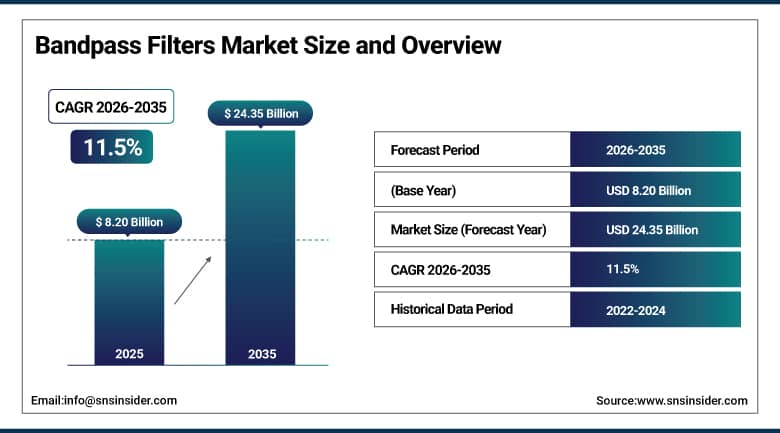
The Bandpass Filters Market was valued at USD 8.20 Billion in 2025 and is expected to reach USD 24.35 Billion by 2035, growing at a CAGR of 11.5% from 2026 to 2035.
Every connected device, from a 5G phone to a satellite terminal to a fiber-optic network node, needs to isolate exactly the frequency or wavelength it cares about from a genuinely crowded spectrum, and bandpass filters are the quiet component making that isolation possible. The market spans both RF and electronic bandpass filters, which dominate wireless communication infrastructure including 4G and 5G base stations, satellite systems, and radar, and optical bandpass filters, which flourish in imaging, photonics, and fiber-optic networks as wavelength selectivity and dense wavelength-division multiplexing keep growing more demanding. The global rollout of 5G networks, rapid proliferation of IoT devices, and increasing spectrum complexity kept driving demand for advanced filtering technologies throughout 2025, and rising deployment of higher frequencies, multi-standard integration, and connected vehicle systems continued reshaping RF filter design across the industry.
In 2025, Qorvo expanded its portfolio of bulk acoustic wave and surface acoustic wave RF filters supporting mid-band and high-band 5G frequencies, strengthening its position in the smartphone and infrastructure filter markets as carriers worldwide continued densifying network coverage.
To Get More Information On Bandpass Filters Market - Request Free Sample Report
Bandpass Filters Market Trends:
-
Expansion of 5G networks kept accelerating demand for high-frequency and miniaturized RF bandpass filters across mobile devices and base-station equipment.
-
Rising spectrum congestion and demand for selective interference suppression in densely connected environments continued driving filter innovation.
-
Growth in defense, satellite, and radar applications kept increasing development of robust, reliable filter solutions for critical communications.
-
Miniaturization of electronics continued driving widespread integration of MEMS-based and tunable bandpass filters in mobile and wearable devices.
-
Rising demand for dense wavelength-division multiplexing in fiber-optic networks kept expanding demand for high-precision optical bandpass filters.
U.S. Bandpass Filters Market Outlook:
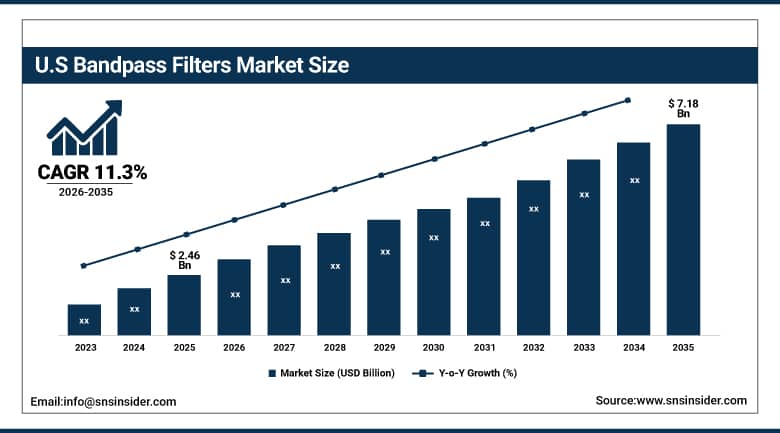
The U.S. Bandpass Filters Market was valued at approximately USD 2.46 Billion in 2025 and is expected to reach approximately USD 7.18 Billion by 2035, growing at a CAGR of approximately 11.3% from 2026 to 2035.
The United States was the dominant market in North America during 2025 due to considerable investments made into the development of telecommunication, health care, and defense industries. The deployment of 5G network, along with the integration of optical sensors in autonomous cars and smart cities, demonstrated the significance of high precision filters in different sectors of American economy. During 2024 the mobile data traffic in the United States reached record-highs of 132 trillion MB, growing by 35% per year (CTIA). There were over 651 thousand cellular infrastructure sites operating in the country, and fast-growing data consumption, along with V2X technology application in cars, contributed to the increased complexity of RF front end and filter demand during 2025.
Skyworks Solutions continued the development of its product range of 5G BAW filters suitable for smartphone front end modules in 2025, maintaining its status as one of the largest American suppliers of high-end RF filters.
Bandpass Filters Market Segment Analysis:
-
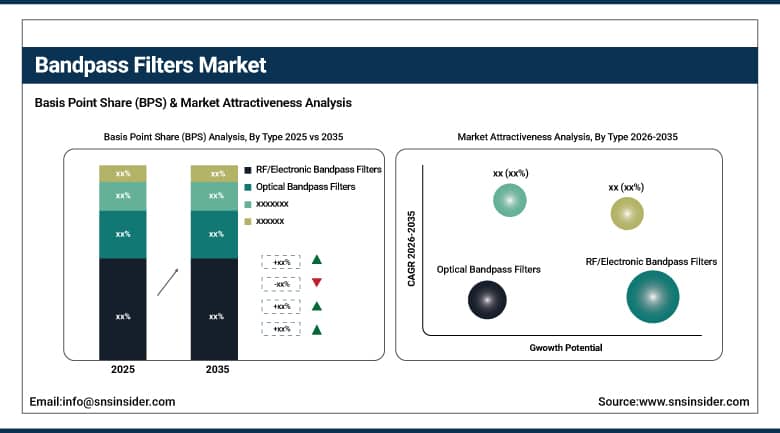
By Type, RF/Electronic Bandpass Filters led the market with an estimated 68.5% share in 2025, while Optical Bandpass Filters were the fastest-growing type, supported by expanding fiber-optic and imaging applications.
-
By Material, Ceramic filters led with an estimated 40.2% share in 2025, while Polymer filters were the fastest-growing material, prized for flexible, lightweight integration into wearable and 5G-enabled electronics.
-
By Application, Telecommunications led with an estimated 43.0% share in 2025, while Automotive was the fastest-growing application, driven by advanced driver assistance and V2X communication systems.
By Type, RF/Electronic Bandpass Filters lead, Optical Bandpass Filters grow fastest
RF & Electronic bandpass filters accounted for the higher market share of 68.5% in 2025 due to their importance in the functioning of the wireless communication infrastructure such as 4G & 5G base stations, satellites, and radars. The reason why this class of filters enjoys the structural benefit is the capability of operating with low losses at high frequencies, which is necessary for good signal quality over long distances, while the increasing expenditure on telecom infrastructure was strengthening their dominance in the market.
Optical Bandpass Filters had the highest growth rate among filter types in 2025 by thriving in applications of imaging, photonics, and fiber optics owing to the development in wavelength selectivity and performance, resulting in more applications being created. The use of optical filters was gaining pace in the fields of medicine, environment, and communications because of increasingly strict demands for dense wavelength-division multiplexing, thus pushing their growth rate ahead of the growth of the dominating RF & electronic filters category.
By Material, Ceramic leads, Polymer grows fastest
The ceramic bandpass filters accounted for the largest material market share in 2025, with a forecast of 40.2%, owing to its exceptional properties of thermal stability and accuracy, required for applications in high frequency telecoms, aerospace and critical infrastructure sectors. The unique combination of ability to withstand extreme operating temperatures and maintaining performance made ceramics the preferred material choice for all the high-value end user applications.
Polymers accounted for the fastest material growth in 2025, on account of flexibility and lightweight features which made them suitable for incorporation in wearables and 5G enabled consumer electronics. With the demand for slim and light electronic products becoming more prevalent, polymers gained popularity owing to the inflexibility and heavy nature of ceramics.
By Application, Telecommunications leads, Automotive grows fastest
Telecom was the leading application in 2025 with a projected revenue share of 43.0%, as it was characterized by consistent investments into 5G, broadband, and smart infrastructures across the globe. Filter technology continued to play an essential role in facilitating high speed digital communications, especially amid increased population density and the need for better connections, making telecom the biggest application in the market by a wide margin.
Automotive applications saw fast-paced growth in 2025, being the fastest growing among all categories, as more advanced driver-assistance systems, in-vehicle infotainment, and vehicle-to-everything communications became reliant on effective bandpass filters. Collaborations between filter manufacturers and automotive original equipment makers, as well as the overall growth of connected mobility, were continuously propelling this application towards becoming the fastest growing in the market.
Regional Analysis:
|
Region |
Major Country |
Share within Region, 2025 (%) |
|---|---|---|
|
North America |
United States |
80.60% |
|
Europe |
Germany |
24.70% |
|
Asia Pacific |
China |
32.60% |
|
Middle East & Africa |
UAE |
26.15% |
|
Latin America |
Brazil |
35.35% |
North America Bandpass Filters Market Insights
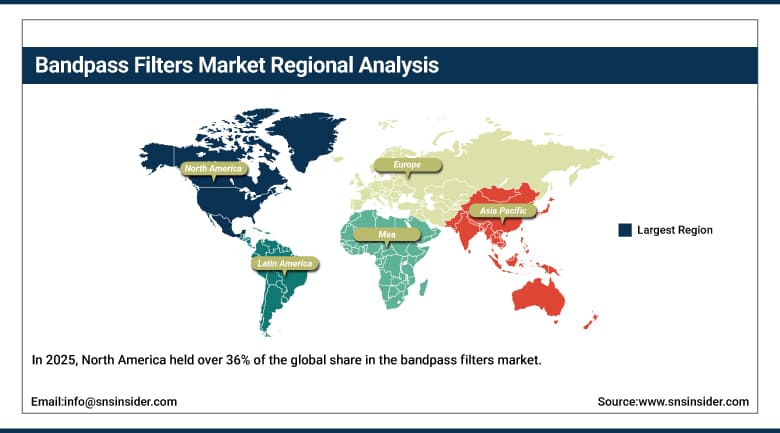
In 2025, North America held over 36% of the global share in the bandpass filters market owing to the highly developed telecom infrastructures, heavy defense expenditures, and 5G rollouts fueled by government efforts to free up spectrum. North America’s dominance in the development of bulk acoustic wave filters in combination with the rapid growth of mobile data usage and the extensive wireless infrastructural network made North America the dominant player in the market.
United States captured around 80.60% of the regional revenue in 2025 owing to their highly invested sectors like telecommunication, healthcare, and defense. Canada contributed to the additional demand within the region through its own telecom infrastructure upgrade and automation measures under the USMCA trade agreement framework.
Get Customized Report as Per Your Business Requirement - Enquiry Now
Europe Bandpass Filters Market Insights
The Europe region had a considerable market share in the worldwide bandpass filters market in 2025, backed by investments made in defense and aerospace electronics in addition to the increasing construction of 5G infrastructure in the region's leading countries. Investments in the development of secure and reliable communication infrastructure have driven the demand for accurate RF and optical filters in Europe.
Germany had the highest demand in the region, accounting for about 24.70% of revenue generated in Europe, owing to the large electronics base in the country. There was also significant demand coming from the UK and France. Increased European investments in defense systems and 5G infrastructure construction will help maintain the demand for bandpass filters in the region.
Asia Pacific Bandpass Filters Market Insights
The Asia Pacific region emerged as the fastest-growing region in 2025, owing to the ongoing development of the 5G network by China and India, along with a robust smartphone manufacturing base that is responsible for more than 60% of worldwide production. This combination of large-scale manufacturing and rapid 5G expansion enabled the Asia Pacific region to grow faster than all other regions reported in this study.
China was the leading player in the region, contributing nearly 32.60% of regional revenue due to its large electronics manufacturing base and quick deployment of 5G network in the country. Countries like Japan and South Korea were also significant contributors to the demand, thanks to their matured electronics and telecommunications manufacturing base.
MEA & Latin America Bandpass Filters Market Insights
The Middle East & Africa, as well as Latin America, witnessed a stable increase in the use of bandpass filters in 2025 due to growing investments in telecommunication infrastructure, increasing defense modernization efforts, and growing government interest in digital connectivity in both regions. With both regions continuing to develop their communications infrastructure, bandpass filters were critical for efficient, interference-free signal transmission.
In terms of the Middle East & Africa, the UAE had the largest demand for bandpass filters because of the high level of investments in the region's telecom infrastructure and its general digital connectivity. Further demand for bandpass filters was driven by Saudi Arabia with its telecom infrastructure modernization programs. In Latin America, Brazil remained the market leader with the highest revenue share.
Market Dynamics:
Growth Drivers: Global 5G rollout and rising spectrum complexity
Bandpass filters market was significantly fueled in 2025 by the worldwide implementation of 5G networks, widespread IoT adoption, and the emergence of complex spectrum requiring more sophisticated filters. As investments in 5G continued growing towards reaching the estimated market worth of USD 123 billion within the first half of the next decade, advanced RF filters stayed important for providing interference-free communication in dense networks deployments.
High-frequency bands, multi-standard requirements, and development of connected car systems continued changing the landscape of RF filters design in 2025, while mobile phone communication continued being the main driving factor behind the applications demand due to the necessity to provide multiple frequency band communication on 4G, 5G, Wi-Fi 6E, and Bluetooth-based devices. Satellite communication showed a very good progress as low-Earth-orbit constellations continued growing in size and integrated into automobiles, marine and aircraft communication systems to provide worldwide connectivity.
Restraints: Intense competition and raw material cost pressure
Intense competition among established and emerging filter manufacturers kept driving down average selling prices throughout 2025, compressing margins even as unit volumes continued climbing. Fluctuating raw material availability and specialized ceramic substrate requirements continued challenging RF component producers, adding real cost and supply-planning uncertainty to manufacturing operations.
Rising demand for higher filter efficiency standards from communication service providers kept increasing pressure on manufacturers to improve product precision without correspondingly raising prices, a genuine tension that continued to squeeze margins across the industry. In advanced applications, where more than half of high-frequency systems required ultra-low signal loss and improved thermal stability for reliable communication performance, meeting those specifications while remaining cost-competitive remained a persistent operational challenge.
Opportunities: Tunable filter technology and satellite communication expansion
Rising demand for tunable filters, accelerating rapidly to meet the need for flexible spectrum management in cognitive radios, software-defined systems, and dynamic spectrum sharing, represented a genuinely significant opportunity in 2025. As industry trends continued favoring integrated, high-performance filters that could be embedded into increasingly compact systems, vendors offering genuinely adaptive, software-configurable filtering technology stood to capture meaningful share of this emerging premium category.
Expanding satellite communication applications offered a second substantial opportunity throughout 2025, fueled by growing low-Earth-orbit constellation deployment and increasing filter integration across automotive, maritime, and aviation systems requiring reliable global connectivity. As satellite-based connectivity kept expanding well beyond its traditional government and enterprise stronghold into broader commercial and consumer applications, vendors with proven, space-qualified filter technology stood to capture meaningful share of this rapidly growing application category.
Recent Developments:
-
2025: Skyworks Solutions continued expanding its bulk acoustic wave filter portfolio for 5G smartphone front-end modules, targeting improved insertion loss and selectivity for mid-band and high-band frequency ranges used by major device manufacturers.
-
2025: Murata Manufacturing introduced additional ceramic bandpass filter variants optimized for base station and small-cell infrastructure, addressing carrier demand for denser 5G network deployment in urban environments.
-
2025: NXP Semiconductors expanded its RF front-end filter portfolio to support automotive V2X and advanced driver assistance applications, reflecting growing OEM demand for robust, automotive-qualified bandpass filtering components.
Bandpass Filters Market key players are:
-
Murata Manufacturing Co., Ltd.
-
Qorvo, Inc.
-
Skyworks Solutions, Inc.
-
Broadcom Inc.
-
Analog Devices, Inc.
-
NXP Semiconductors N.V.
-
Qualcomm Technologies, Inc.
-
Taiyo Yuden Co., Ltd.
-
Kyocera Corporation (AVX)
-
TDK Corporation
-
Knowles Corporation
-
Akoustis Technologies, Inc.
-
Pasternack Enterprises, Inc.
-
Anatech Electronics, Inc.
-
K&L Microwave, Inc.
-
Corning Incorporated
-
Edmund Optics, Inc.
-
Newport Corporation (MKS Instruments, Inc.)
-
Omega Optical, LLC
-
Alluxa, Inc.
Bandpass Filters Market Report Scope:
| Report Attributes | Details |
|---|---|
| Market Size in 2025 | USD 8.20 Billion |
| Market Size by 2035 | USD 24.35 Billion |
| CAGR | CAGR of 11.5% From 2026 to 2035 |
| Base Year | 2025 |
| Forecast Period | 2026-2035 |
| Historical Data | 2022-2024 |
| Report Scope & Coverage | Market Size, Segments Analysis, Competitive Landscape, Regional Analysis, DROC & SWOT Analysis, Forecast Outlook |
| Key Segments | • by Type (RF/Electronic Bandpass Filters, Optical Bandpass Filters) • by Material (Ceramic, Polymer, Dielectric Coating, Others) • by Application (Telecommunications, Automotive, Medical & Imaging, Aerospace & Defense, Industrial, Others) |
| Regional Analysis/Coverage | North America (US, Canada, Mexico), Europe (Eastern Europe [Poland, Romania, Hungary, Turkey, Rest of Eastern Europe] Western Europe] Germany, France, UK, Italy, Spain, Netherlands, Switzerland, Austria, Rest of Western Europe]), Asia Pacific (China, India, Japan, South Korea, Vietnam, Singapore, Australia, Rest of Asia Pacific), Middle East & Africa (Middle East [UAE, Egypt, Saudi Arabia, Qatar, Rest of Middle East], Africa [Nigeria, South Africa, Rest of Africa], Latin America (Brazil, Argentina, Colombia, Rest of Latin America) |
| Company Profiles | Murata Manufacturing Co., Ltd., Qorvo, Inc., Skyworks Solutions, Inc., Broadcom Inc., Analog Devices, Inc., NXP Semiconductors N.V., Qualcomm Technologies, Inc., Taiyo Yuden Co., Ltd., Kyocera Corporation (AVX), TDK Corporation, Knowles Corporation, Akoustis Technologies, Inc., Pasternack Enterprises, Inc., Anatech Electronics, Inc., K&L Microwave, Inc., Corning Incorporated, Edmund Optics, Inc., Newport Corporation (MKS Instruments, Inc.), Omega Optical, LLC, Alluxa, Inc. |
Frequently Asked Questions
The Bandpass Filters Market is expected to grow at a CAGR of approximately 11.5% from 2026 to 2035, based on triangulated secondary research estimates.
The Bandpass Filters Market was valued at approximately USD 8.20 Billion in 2025, based on triangulation across multiple independent research sources.
The major growth factor is the global rollout of 5G networks, rapid proliferation of IoT devices, and increasing spectrum complexity demanding advanced filtering technologies.
The RF/Electronic Bandpass Filters segment dominated the Bandpass Filters Market by type, representing an estimated 68.5% of revenue in 2025.
North America dominated the Bandpass Filters Market in 2025, accounting for over 36% of total global market revenue.
