
Blockchain in Supply Chain Market Report Scope & Overview:
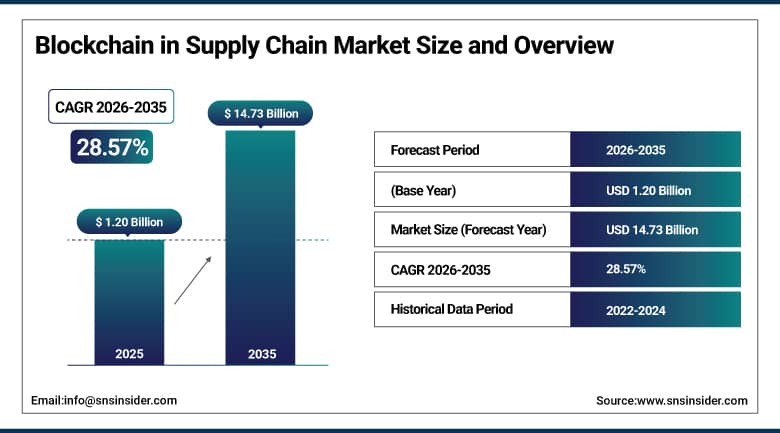
The Blockchain in Supply Chain Market was valued at USD 1.20 Billion in 2025 and is expected to reach USD 14.73 Billion by 2035, growing at a CAGR of 28.57% from 2026 to 2035.
The Blockchain in Supply Chain Market is currently growing at a fast pace owing to the rising demand for transparency, traceability, and protection against frauds in logistics around the world. The increasing digitalization of purchasing processes and inventories is making operations efficient by cutting down on paperwork. Rising issues related to counterfeits and product recall and stringent regulations are contributing to increased adoption in the industry. Adoption of IoT and smart sensors is helping in the integration of real-time data into the blockchain system. Also, rising e-commerce, globalization, and secure transaction records are contributing significantly to Blockchain in Supply Chain Market growth.
The U.S. Food and Drug Administration Drug Supply Chain Security Act (DSCSA) mandates full pharmaceutical traceability by 2025, accelerating blockchain adoption for end-to-end drug tracking. Walmart has implemented blockchain-based food traceability systems, reducing product tracking time from days to seconds in pilot supply chains, while IBM has developed blockchain-enabled food safety solutions widely used across North American grocery networks, strengthening transparency, compliance, and supply chain integrity.
Market Size and Forecast
-
Market Size in 2026E: USD 1.54 Billion
-
Market Size by 2035: USD 14.73 Billion
-
CAGR: 28.57% from 2026 to 2035
-
Fastest Growing Region: Asia Pacific
-
Largest Region: North America
Get Customized Report as Per Your Business Requirement - Enquiry Now
Blockchain in Supply Chain Market Trends
-
Rising need for transparency, traceability, and trust in global supply networks is driving the blockchain in supply chain market.
-
Growing adoption across logistics, retail, manufacturing, and food & beverage industries is boosting market growth.
-
Expansion of e-commerce and cross-border trade is fueling demand for real-time supply chain visibility.
-
Increasing focus on fraud prevention, product authentication, and regulatory compliance is shaping adoption trends.
-
Advancements in smart contracts, decentralized ledger technologies, and IoT integration are enhancing supply chain automation and data accuracy.
-
Rising pressure to improve operational efficiency and reduce supply chain disruptions is supporting market expansion.
The U.S. Blockchain in Supply Chain Market Outlook
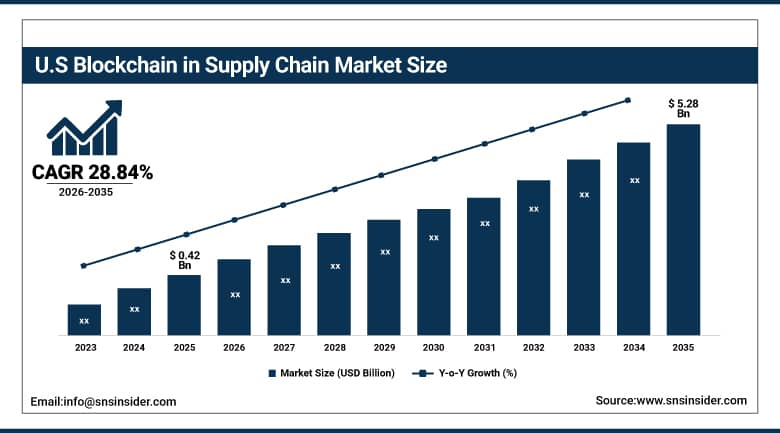
The U.S. Blockchain in Supply Chain Market was valued at approximately USD 0.42 Billion in 2025 and is expected to reach approximately USD 5.28 Billion by 2035, growing at a CAGR of approximately 28.84%.
The United States is the most commercially advanced blockchain in supply chain market globally, driven by the combination of the world's largest enterprise technology adoption base, regulatory mandates including FDA FSMA 204 food traceability requirements and DSCSA pharmaceutical serialisation obligations, and a mature venture capital ecosystem that has funded the blockchain supply chain technology vendors whose enterprise deployments are establishing commercial proof of concept across major industry verticals.
Blockchain in Supply Chain Market Segment Analysis
-
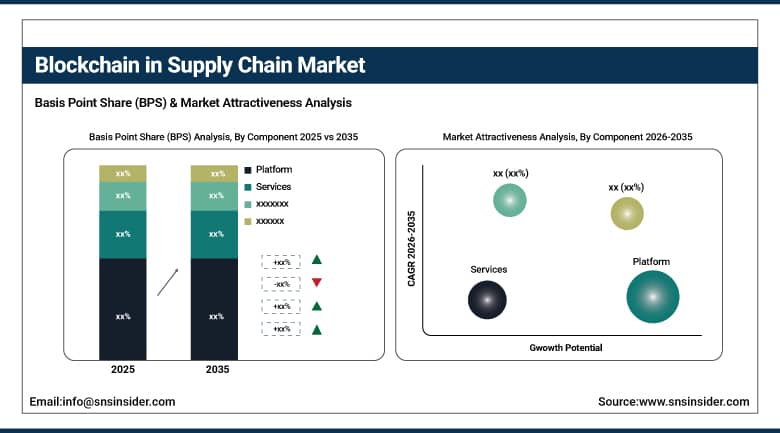
By Component, Platform segment dominated the Blockchain in Supply Chain Market in 2025 with 61% share; Services segment is the fastest growing segment.
-
By Type, Public segment dominated the market in 2025 with 46% share; Consortium segment is the fastest growing segment.
-
By Product Provenance & Traceability, Inventory & Asset Tracking segment dominated the market in 2025 with 33% share; Smart Contracts segment is the fastest growing segment.
-
By Industry Vertical, Manufacturing segment dominated the market in 2025 with 24% share; Healthcare segment is the fastest growing segment.
-
By Organization Size, Large Enterprises segment dominated the market in 2025 with 67% share; SMEs segment is the fastest growing segment.
-
By Deployment Mode, Cloud-Based segment dominated the market in 2025 with 64% share; Cloud-Based segment is the fastest growing segment.
By Component, platform segment dominated the blockchain in supply chain market, services segment is the fastest growing
The Platform segment dominated the Blockchain in Supply Chain Market in 2025 attributed to the increased demand for blockchain-based platform solutions that facilitate end-to-end tracking, transparency, and traceability across supply chains. Blockchain technology is being adopted in enterprises to record business transactions and monitor products' movements throughout complex global supply chains. Digitalization trends in logistics, higher demand for real-time information exchange, and increasing demand for tamper-proof transaction records have been major factors behind the high dominance.
The Services segment is the fastest growing due to increased demand for consulting, implementation, integration, and managed services related to blockchain deployment in supply chain management. Organizations require assistance in building blockchain ecosystems and seamless integration with existing legacy systems. Increasingly complex supply chains and fast adoption of decentralized technology have been major drivers behind the increased demand for blockchain services. Moreover, increasing focus on digital transformation initiatives and shortage of internal blockchain expertise have been further fueling market growth.
By Type, public segment dominated the blockchain in supply chain market, consortium segment is the fastest growing
The Public segment dominated the Blockchain in Supply Chain Market in 2025 owing to its transparency, openness, and decentralization characteristics that help achieve safe and traceable transactions among several parties. The use of public blockchain technology helps enhance data accessibility, fraud protection, and supply chain transaction verification in real time. Growing adoption among industries that require high levels of transparency, including logistics and retail, has been fueling the segment demand. Besides, the rising popularity of trustless and secure cross-border supply chain transactions has contributed immensely towards the leadership of the segment.
The Consortium segment is the fastest growing because of growing cooperation among several organizations that want to exercise joint control over blockchain networks in the supply chain ecosystem. Consortium blockchain technologies have a combination of all the three essential factors, i.e., transparency, privacy, and governance, thus making it an ideal choice for industry collaborations. Moreover, growing adoption among industries such as logistics, manufacturing, and healthcare has been driving the segment's growth.
By Application, inventory & asset tracking segment dominated the blockchain in supply chain market, smart contracts segment is the fastest growing
The Inventory & Asset Tracking segment dominated the Blockchain in Supply Chain Market in 2025 owing to the increase in demand for real-time monitoring of goods in complicated supply chains. The blockchain technology helps track the movement of goods, eliminates the risk of counterfeit goods, and increases the effectiveness of the supply chain. With time, the demand for blockchain technology for effective tracking of supply chains will only rise. In addition, the rise in e-commerce activities and expansion of international trade fueled segment domination.
The Smart Contracts segment is the fastest growing due to increasing adoption of blockchain technology for automating supply chain processes using digital agreements called smart contracts. These contracts eliminate the need for intermediaries and minimize transaction time. In addition, an increase in demand for efficient execution of contracts without any errors led to accelerated growth of the segment.
By Industry Vertical, manufacturing segment dominated the blockchain in supply chain market, healthcare segment is the fastest growing
The Manufacturing segment dominated the Blockchain in Supply Chain Market in 2025 owing to the complicated manufacturing process, extended supply chain network, and increased demands for the traceability of the raw material and end product. The adoption of the blockchain technology among manufacturers increased with the rising emphasis on quality assurance and regulatory compliance, and just-in-time inventory management. Moreover, the adoption of blockchain technology by manufacturers was driven by the rising adoption of industrial automation and Industry 4.0.
The Healthcare segment is the fastest growing due to rising demand for secure monitoring of drugs, medical equipment, and sensitive health information along with increased regulatory scrutiny. The blockchain technology helps in traceable drug tracking and reduces the risk of counterfeit drugs. The rising trend towards digitalization, increasing drug distribution, and increasing safety concerns regarding the patients drive the segment.
Regional Analysis
|
Region |
Major Country |
Share within Region, 2025 (%) |
|---|---|---|
|
North America |
United States |
82.47% |
|
Europe |
Germany |
26.84% |
|
Asia Pacific |
China |
38.47% |
|
Middle East & Africa |
UAE |
32.46% |
|
Latin America |
Brazil |
44.28% |
North America Blockchain in Supply Chain Market Insights
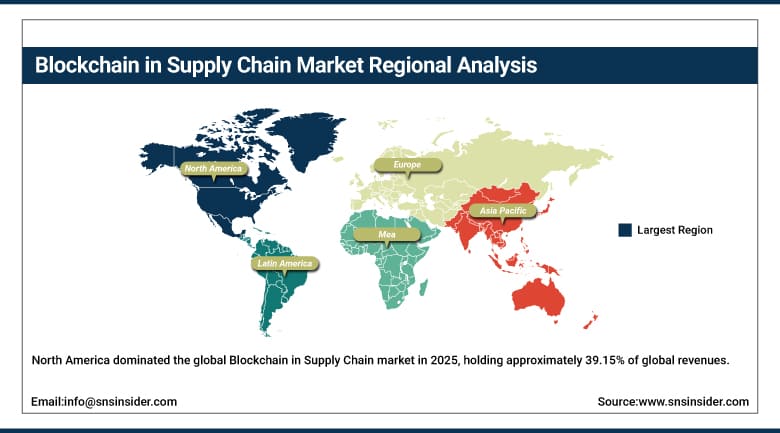
North America dominated the global Blockchain in Supply Chain market in 2025, holding approximately 39.15% of global revenues. The United States accounts for approximately 82.47% of regional revenue through its combination of regulatory compliance mandates driving adoption, the headquarters presence of the world's leading blockchain platform vendors, and the commercial scale of its retail, pharmaceutical, and food processing industries whose supply chain complexity and risk exposure create compelling ROI cases for blockchain-based transparency solutions.
According to the U.S. Census Bureau, U.S. e-commerce sales reached approximately $1.19 trillion in 2024, intensifying demand for logistics transparency and fraud prevention solutions. The U.S. Customs and Border Protection reports counterfeit goods seizures exceeding $2.8 billion annually, reinforcing the need for blockchain-based product authentication and secure global supply chain tracking systems.
Get Customized Report as Per Your Business Requirement - Enquiry Now
Europe Blockchain in Supply Chain Market Insights
Europe held approximately 24.73% of global Blockchain in Supply Chain revenues in 2025. The European Union's digital product passport regulation, which will require verifiable supply chain data for batteries, electronics, and textiles by 2027 and 2030 respectively, is creating a structurally certain and large-scale blockchain adoption mandate across European manufacturing sectors. The EU Falsified Medicines Directive's pharmaceutical serialisation requirements and the Farm to Fork Strategy's food traceability objectives reinforce the policy-driven blockchain adoption environment.
The European Commission reports digital economy adoption has reached over 75% of EU enterprises, accelerating blockchain-based supply chain digitisation for traceability and compliance. EU Anti-Counterfeiting and Traceability programmes estimate counterfeit goods at around 5% of EU imports, driving demand for immutable tracking in pharmaceuticals, food, and luxury supply chains globally.
Asia Pacific Blockchain in Supply Chain Market Insights
Asia Pacific is the fastest-growing regional market for Blockchain in Supply Chain, projected to expand at a CAGR of approximately 30.47% through 2035. China accounts for approximately 38.47% of Asia Pacific revenues through government-mandated blockchain development programmes, substantial enterprise blockchain adoption across its manufacturing and logistics sectors, and the commercial scale of its export supply chains whose international buyers increasingly require digital traceability documentation. Singapore, Japan, South Korea, and India each host commercially active blockchain supply chain ecosystems supported by government innovation programmes, technology vendor presence, and the enterprise blockchain adoption of their respective global manufacturing and logistics company bases.
According to the World Trade Organization, Asia accounts for around 39% of global merchandise exports, increasing demand for supply chain transparency. China’s General Administration of Customs reports trade exceeding $5 trillion annually, accelerating digital customs systems. India’s DGFT notes $770 billion exports with rapid adoption of digital trade documentation and blockchain integration.
MEA & Latin America Blockchain in Supply Chain Market Insights
The UAE leads MEA revenues at approximately 32.46% of the regional total through Dubai's position as a global logistics hub whose government blockchain trade facilitation programmes, including the Dubai Customs blockchain platform and TradeLens participation, have demonstrated blockchain's practical supply chain documentation efficiency gains. Saudi Arabia's supply chain digitalisation investments under Vision 2030 are creating enterprise blockchain adoption in its petrochemical, consumer goods, and healthcare distribution sectors.
Brazil leads Latin American revenues at approximately 44.28% of the regional total through its large agricultural commodity export supply chains, pharmaceutical distribution traceability requirements under ANVISA regulation, and growing enterprise technology adoption among its major food processing and consumer goods companies.
Market Dynamics
Growth Drivers: Rising demand for supply chain transparency, traceability, and fraud prevention across global logistics ecosystems
The need for transparency and traceability within global supply chains by consumers and companies has pushed the implementation of blockchain technology. Companies have been relying on blockchain technology in order to create a chain of events of where products travel from until the point when they reach their end-user customers. This has been used in order to minimize the risk of counterfeiting. Blockchain technology provides a system where information is immutable, thus making it easy for tracking purposes and secure data sharing among various stakeholders. The increase in product recall cases and counterfeits in the pharmaceutical industry has led to more and more organizations adopting blockchain technology. The IoT devices combined with blockchain provide real-time data, which makes better decisions and enhances efficiency.
Restraints: High implementation complexity and lack of standardized interoperability across multi-party blockchain supply chain ecosystems
Blockchain integration into the supply chain network is affected by several technical and operational difficulties, including those that are brought about by having to integrate many different parties using various systems. The lack of a uniform protocol across different blockchain networks makes data sharing difficult. Most of the supply chains have fragmented legacy systems that make the integration process complicated and expensive. Besides, reaching consensus among various participants in the consortium takes time and reduces scalability. Issues regarding data governance and responsibility for the shared data add on the list. SMEs are particularly disadvantaged because they lack adequate technical skills and the capital to start the process.
Opportunities: Expansion of digital product passports and regulatory-driven traceability frameworks enabling blockchain-based supply chain transformation
New regulatory initiatives such as digital product passports and mandatory traceability regimes have resulted in huge growth potential in blockchain supply chain management solutions. Regulatory bodies and governments are demanding more stringent lifecycle information on products for sustainability, recycling, and reporting purposes. Blockchain allows for the secure, tamper-proof, and transparent tracking of information about the product, starting from the origin of the raw materials until their disposal at the end of the lifecycle. There is therefore considerable potential for blockchain adoption in several sectors including manufacturing, automotive, electronics, and consumer products among others. Enterprises are using blockchain for ESG reporting and circular business practices. In addition, regulations surrounding international trade are fostering the use of standardized document management systems.
Recent Developments:
-
2025: IBM Food Trust expanded its blockchain-based food traceability network to over 300 participating organisations globally, including major retailers, food processors, and agricultural producers, demonstrating its commercial scale and enabling documented improvement in food safety incident response time from days to hours across participating supply chain networks.
-
2024: Walmart Canada completed full commercial deployment of its DLT Labs blockchain freight management system, reducing invoice dispute rates from approximately 70% to under 1% across its 400-plus carrier network and establishing a commercially validated ROI case for blockchain-based logistics payment automation in major retail supply chain operations.
-
2024: SAP extended its supply chain blockchain integration capabilities within SAP Business Network, enabling enterprise customers to embed blockchain-based traceability and smart contract functionality directly within existing SAP ERP and supply chain management workflows without requiring separate blockchain platform implementations.
Blockchain in Supply Chain Market Key Players are:
-
IBM Corporation
-
Microsoft Corporation
-
SAP SE
-
Oracle Corporation
-
Amazon Web Services, Inc. (AWS)
-
Huawei Technologies Co., Ltd.
-
Accenture PLC
-
Infosys Limited
-
TIBCO Software Inc.
-
VeChain Foundation
-
Guardtime Inc.
-
Bitfury Group Limited
-
Chainvine Limited
-
Digital Treasury Corporation
-
Everledger Ltd.
-
Auxesis Group
-
Modum.io AG
-
OriginTrail
-
Blockverify Limited
-
CargoX
Blockchain in Supply Chain Market Report Scope:
| Report Attributes | Details |
|---|---|
| Market Size in 2025 | USD 1.20 Billion |
| Market Size by 2035 | USD 14.73 Billion |
| CAGR | CAGR of 28.57% From 2026 to 2035 |
| Base Year | 2025 |
| Forecast Period | 2026-2035 |
| Historical Data | 2022-2024 |
| Report Scope & Coverage | Market Size, Segments Analysis, Competitive Landscape, Regional Analysis, DROC & SWOT Analysis, Forecast Outlook |
| Key Segments | • By Component (Platform, Services) • By Type (Public Blockchain, Private Blockchain, Consortium Blockchain) • By Application (Product Provenance & Traceability, Payment & Settlement, Smart Contracts, Inventory & Asset Tracking, Compliance Management, Others) • By Industry Vertical (Retail & Consumer Goods, Manufacturing, Healthcare, Logistics & Transportation, Food & Beverages, Oil & Gas, Others) • By Organization Size (Small & Medium Enterprises (SMEs), Large Enterprises) • By Deployment Mode (On-Premises, Cloud-Based) |
| Regional Analysis/Coverage | North America (US, Canada), Europe (Germany, UK, France, Italy, Spain, Russia, Poland, Rest of Europe), Asia Pacific (China, India, Japan, South Korea, Australia, ASEAN Countries, Rest of Asia Pacific), Middle East & Africa (UAE, Saudi Arabia, Qatar, South Africa, Rest of Middle East & Africa), Latin America (Brazil, Argentina, Mexico, Colombia, Rest of Latin America). |
| Company Profiles | IBM Corporation, Microsoft Corporation, SAP SE, Oracle Corporation, Huawei Technologies Co., Ltd., Amazon Web Services, Inc., Tencent Holdings Ltd., VeChain Foundation, Accenture Plc, Infosys Limited, Capgemini SE, Wipro Limited, IBM Blockchain Services, Blockchain Foundry Inc., Provenance Inc., Guardtime, Bitfury Group Limited, Chronicled Inc., BTL Group Ltd., Modum AG. |
Frequently Asked Questions
North America dominated the Blockchain in Supply Chain Market in 2025.
The product traceability & provenance segment dominated the Blockchain in Supply Chain Market with 37.55% share in 2025.
The primary growth factors are regulatory traceability mandates, supply chain opacity costs, and blockchain IoT AI convergence enabling visibility ROI.
The Blockchain in Supply Chain Market was valued at USD 1.20 Billion in 2025.
The Blockchain in Supply Chain Market is expected to grow at a CAGR of 28.57% from 2026 to 2035.
