
Botanical Extracts Market Report Scope & Overview:
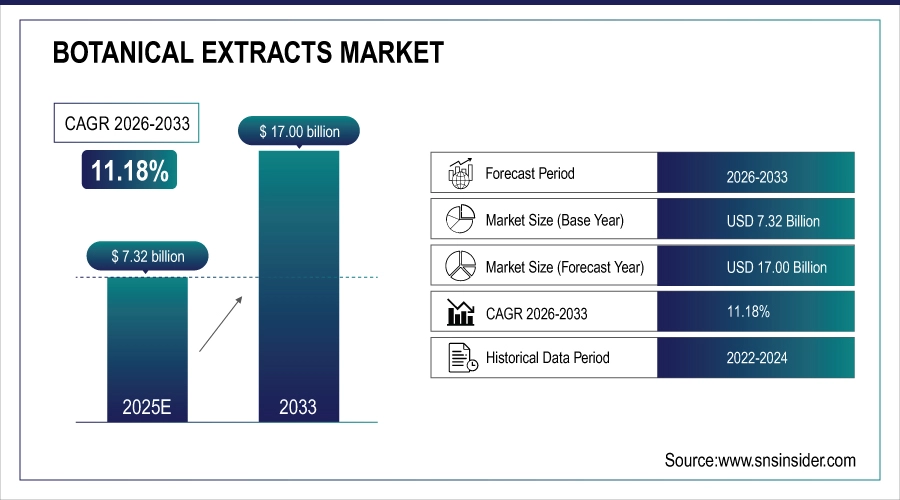
The Botanical Extracts Market was valued at USD 7.32 billion in 2025 and is expected to reach USD 17.00 billion by 2033, growing at a CAGR of 11.18% from 2026-2033.
The Botanical Extracts Market is expanding due to increasing consumer preference for natural and plant-based products across food, beverage, nutraceutical, and cosmetic industries. Rising awareness of health and wellness, coupled with demand for clean-label, organic, and functional ingredients, is driving adoption. Technological advancements in extraction methods, along with growth in research and development of bioactive compounds, are further enhancing product efficacy. Additionally, expanding global applications and sustainability trends are contributing to overall market growth.
In 2024, over 70% of new food, beverage, and cosmetic products featured botanical ingredients; clean-label demand rose by 25%, and R&D investment in sustainable extraction technologies grew by 20% globally.
Botanical Extracts Market Size and Forecast
-
Market Size in 2025: USD 7.32 Billion
-
Market Size by 2033: USD 17.00 Billion
-
CAGR: 11.18% from 2026 to 2033
-
Base Year: 2025E
-
Forecast Period: 2026–2033
-
Historical Data: 2022–2024
To Get more information on Botanical Extracts Market - Request Free Sample Report
Botanical Extracts Market Trends
-
Rising consumer preference for natural and plant-based ingredients drives global botanical extracts demand significantly
-
Growing applications in nutraceuticals, functional foods, and beverages fuel market expansion across diverse industries
-
Increasing demand for clean-label, organic, and sustainable extracts promotes innovation in production and formulation processes
-
Technological advancements in extraction methods enhance yield, purity, and bioavailability of botanical compounds effectively
-
Expanding use in cosmetics, personal care, and pharmaceuticals boosts market growth and product diversification globally
-
Rising focus on regulatory compliance and quality standards ensures safety, efficacy, and consumer trust consistently
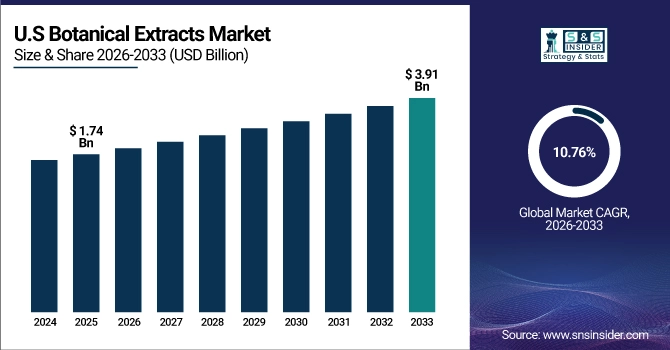
U.S. Botanical Extracts Market was valued at USD 1.74 billion in 2025E and is expected to reach USD 3.91 billion by 2033, growing at a CAGR of 10.76 % from 2026-2033.
Growth in the U.S. Botanical Extracts Market is driven by rising consumer demand for natural, plant-based ingredients in food, beverages, supplements, and cosmetics. Increasing health awareness, preference for clean-label and organic products, and advancements in extraction technologies are further boosting adoption and market expansion.
Botanical Extracts Market Growth Drivers:
-
Rising consumer preference for natural and plant-based products is driving demand for botanical extracts across food, cosmetics, and pharmaceutical industries
Consumers are increasingly shifting toward natural, clean-label, and plant-based products due to growing health consciousness and environmental awareness. This trend is fueling demand for botanical extracts in diverse applications, including functional foods, beverages, dietary supplements, skincare, and pharmaceuticals. Manufacturers are leveraging botanical ingredients to replace synthetic additives, enhance product appeal, and meet consumer expectations for sustainability. The rising preference for herbal remedies, natural flavors, and plant-derived active compounds is significantly driving market growth across multiple sectors globally.
In 2024, 72% of new cosmetic launches featured plant-based claims, while 58% of consumers globally actively sought natural ingredients, driving a 9% annual increase in botanical extract demand across food, beauty, and pharma sectors.
-
Growing awareness of health and wellness benefits, including antioxidants, immunity support, and anti-inflammatory properties, boosts botanical extract consumption globally
Increasing consumer awareness about preventive healthcare, immunity enhancement, and overall wellness is driving the adoption of botanical extracts. Ingredients rich in antioxidants, polyphenols, and bioactive compounds are widely used in nutraceuticals, functional foods, and beverages to support health benefits. The rising prevalence of lifestyle diseases and focus on natural remedies further accelerates consumption. Additionally, healthcare professionals and wellness influencers are promoting the use of botanical extracts, contributing to growing global demand for herbal supplements and plant-based solutions.
In 2024, over 75% of global consumers actively sought botanical extracts for wellness, with antioxidant benefits cited by 70% as a primary reason for regular use.
Botanical Extracts Market Restraints:
-
High production and extraction costs limit profitability, making it challenging for small manufacturers to compete with established global players
The production of botanical extracts involves expensive raw materials, advanced extraction technologies, and specialized equipment, which significantly increase operational costs. Small and medium-sized manufacturers often struggle to invest in high-quality extraction processes, purification systems, and quality control measures. These cost pressures make it difficult to compete with larger, established companies that benefit from economies of scale. Additionally, maintaining consistent product quality and complying with international standards further adds to expenses, restricting market entry and limiting profitability for smaller players in the botanical extracts industry.
Small manufacturers face production costs 25–40% higher than global leaders due to economies of scale; over 60% struggle to achieve breakeven, limiting competitiveness in capital-intensive markets.
-
Seasonal availability and inconsistent quality of raw botanical materials hinder large-scale production and affect supply chain reliability
Many botanical extracts rely on plants and herbs that are subject to seasonal growth cycles, climate conditions, and agricultural variability. This leads to fluctuations in raw material availability, which can disrupt continuous production. Inconsistent quality of harvested plants can also affect the potency, purity, and efficacy of extracts. Manufacturers must invest in quality testing, sourcing multiple suppliers, or using preservation techniques to maintain supply chain reliability. These challenges make large-scale production difficult, increase operational complexity, and can limit timely delivery to end-users across global markets.
Over 60% of botanical ingredient suppliers report seasonal shortages, and 45% of manufacturers face batch inconsistencies disrupting 30% of production schedules and increasing supply chain volatility globally.
Botanical Extracts Market Opportunities:
-
Growth in the pharmaceutical and healthcare sectors presents opportunities to develop plant-based therapeutics and herbal medicines using botanical extracts
The pharmaceutical and healthcare industries are increasingly exploring plant-based solutions due to rising demand for natural, safe, and effective alternatives. Botanical extracts offer bioactive compounds with therapeutic potential for treating various ailments, supporting immune health, and preventing chronic diseases. Companies can leverage these opportunities to develop herbal medicines, supplements, and functional therapies. Rising consumer awareness, regulatory support for herbal products, and ongoing research in pharmacognosy further strengthen the potential for botanical extracts to play a significant role in healthcare innovation and drug development.
Global demand for botanical extracts in healthcare formulations grew by 10.2% in 2024, with over 40% of new herbal medicine approvals incorporating standardized plant extracts, a trend accelerating into 2025.
-
Increasing use of botanical extracts in cosmetics and personal care products offers potential for new formulations and innovative skincare solutions
Botanical extracts are gaining popularity in cosmetics due to their natural, anti-aging, antioxidant, and skin-soothing properties. Brands are incorporating plant-derived ingredients into creams, serums, lotions, and hair care products to meet consumer demand for clean and sustainable formulations. Innovations in extraction techniques and formulation science allow higher potency and better bioavailability of these extracts. Growing interest in eco-friendly and cruelty-free products provides further growth potential, enabling manufacturers to create differentiated, high-value offerings in skincare, haircare, and personal care markets globally.
Over 60% of cosmetic brands reported increased R&D investment in plant-based actives in 2024, with botanical extract use in skincare formulations rising by 27% since 2022 due to advances in green extraction and consumer preference for clean beauty.
Botanical Extracts Market Segment Highlights
-
By Source: In 2025, Herbs led the market with 29% share, while Flowers is the fastest-growing segment with the highest CAGR (2026–2033)
-
By Technology: In 2025, Steam Distillation led the market with 35% share, while CO₂ Extraction is the fastest-growing segment with the highest CAGR (2026–2033)
-
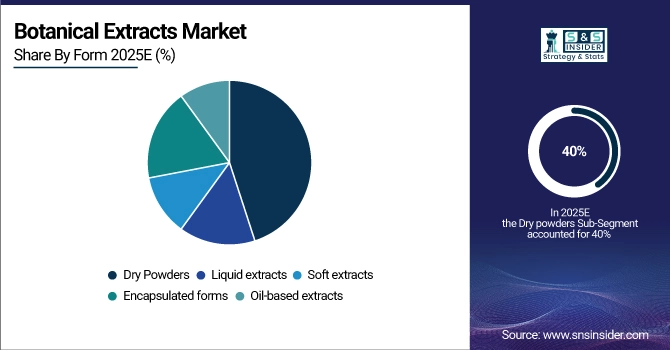
By Form: In 2025, Dry Powders led the market with 40% share, while Oil-based Extracts is the fastest-growing segment with the highest CAGR (2026–2033)
-
By End Use Industry: In 2025, Nutraceuticals & Dietary Supplements led the market with 35% share, while the same segment is also the fastest-growing with the highest CAGR (2026–2033)
Botanical Extracts Market Segment Analysis
By Form: Dry Powders segment led in 2025; Oil-based Extracts segment expected fastest growth 2026–2033
Dry Powders segment dominated the Botanical Extracts Market with the highest revenue share of about 40% in 2025 owing to their long shelf life, ease of storage, and versatility in applications across food, beverages, and supplements.
Oil-based Extracts segment is expected to grow at the fastest CAGR from 2026-2033, driven by increasing demand for essential oils and concentrated plant compounds in nutraceuticals, aromatherapy, and cosmetics, along with technological advancements in extraction and formulation enhancing bioavailability and stability.
By Source: Herbs segment led in 2025; Flowers segment expected fastest growth 2026–2033
Herbs segment dominated the Botanical Extracts Market with the highest revenue share of about 29% in 2025 due to their widespread use in traditional medicine, nutraceuticals, and dietary supplements. High consumer preference for natural remedies and increased awareness about health benefits have driven steady demand, making herbs the most preferred source of botanical extracts.
Flowers segment is expected to grow at the fastest CAGR from 2026-2033, fueled by rising applications in cosmetics, fragrances, and premium health products, alongside increasing demand for plant-based and aromatic ingredients across personal care and wellness industries.
By Technology: Steam Distillation segment led in 2025; CO₂ Extraction segment expected fastest growth 2026–2033
Steam Distillation segment dominated the Botanical Extracts Market with the highest revenue share of about 35% in 2025 due to its cost-effectiveness, scalability, and ability to preserve the natural aroma and bioactive compounds of plants.
CO₂ Extraction segment is expected to grow at the fastest CAGR from 2026-2033 as it offers superior purity, solvent-free extracts, and higher yield of sensitive bioactive compounds, meeting growing demand for high-quality, clean-label botanical extracts in food, cosmetics, and pharmaceutical applications.
By End Use Industry: Nutraceuticals & Dietary Supplements segment led in 2025; same segment expected fastest growth 2026–2033
Nutraceuticals & Dietary Supplements segment dominated the Botanical Extracts Market with the highest revenue share of about 35% in 2025 due to rising consumer preference for natural health products, increasing health awareness, and the growing prevalence of lifestyle-related diseases. The segment is also expected to grow at the fastest CAGR from 2026-2033, driven by continuous product innovation, expanding functional food applications, and rising global demand for immune-boosting and preventive health solutions, which has positioned nutraceuticals as the most lucrative end-use for botanical extracts.
Botanical Extracts Market Regional Analysis
North America Botanical Extracts Market Insights
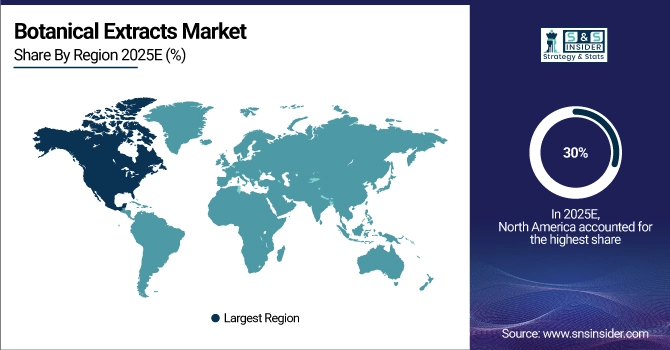
North America dominated the Botanical Extracts Market with a 30% share in 2025 due to its well-established nutraceutical and pharmaceutical industries, high consumer awareness of herbal and natural products, and strong R&D capabilities. Growing demand for functional foods, dietary supplements, and cosmetic applications further reinforced the region’s leadership in botanical extract consumption.
Get Customized Report as per Your Business Requirement - Enquiry Now
Asia Pacific Botanical Extracts Market Insights
Asia Pacific is expected to grow at the fastest CAGR of about 12.88% from 2026–2033, driven by rising health consciousness, increasing disposable incomes, and expanding herbal and natural product markets. Rapid urbanization, growing food and beverage industries, and government support for plant-based products accelerate regional adoption of botanical extracts across nutraceutical, cosmetic, and pharmaceutical applications.
Europe Botanical Extracts Market Insights
Europe held a significant share in the Botanical Extracts Market in 2025, supported by high consumer awareness of natural and organic products, stringent quality standards, and well-established nutraceutical and cosmetic industries. Increasing demand for herbal supplements, functional foods, and plant-based ingredients, along with strong R&D and regulatory frameworks, strengthened Europe’s market position.
Middle East & Africa and Latin America Botanical Extracts Market Insights
The Middle East & Africa and Latin America together showed steady growth in the Botanical Extracts Market in 2025, driven by rising health awareness, increasing demand for natural and herbal products, and expanding nutraceutical, pharmaceutical, and cosmetic industries. Improving distribution networks, growing urban populations, and government support for plant-based products further strengthened market adoption in these regions.
Botanical Extracts Market Competitive Landscape:
International Flavors & Fragrances Inc. (IFF)
International Flavors & Fragrances Inc. (IFF) is a leading U.S.-based company specializing in flavors, fragrances, and natural ingredients for the food, beverage, personal care, and pharmaceutical industries. The company focuses on innovative botanical extracts, essential oils, and plant-derived compounds to create sustainable, high-quality formulations. With global operations, strong R&D capabilities, and strategic acquisitions, IFF plays a major role in developing natural solutions for health, wellness, and sensory experiences worldwide.
-
June 2024, IFF launched new natural ingredients at the World Perfumery Congress: Ylanganate fragrance molecule and Grapefruit & Persian Lime oils from LMR Naturals
Givaudan S.A.
Givaudan S.A., headquartered in Switzerland, is a global leader in flavors, fragrances, and active cosmetic ingredients. The company develops plant-based extracts and natural solutions for food, beverages, and personal care industries. With a focus on innovation, sustainability, and biotechnology, Givaudan combines advanced extraction methods and green chemistry to provide high-quality botanical ingredients. Its global presence and research capabilities enable it to meet evolving consumer demands for natural and functional products.
-
2024, Givaudan Active Beauty introduced its [N.A.S.] Vibrant Collection, a line of five 100% natural-origin powder botanical extracts for hybrid make‑up
Indena S.p.A.
Indena S.p.A., headquartered in Milan, Italy, is a leading company in plant-based active ingredients and botanical extracts for nutraceuticals, pharmaceuticals, and functional foods. The company specializes in standardized extracts, innovative formulations, and research-driven solutions for health and wellness. With over a century of experience, advanced extraction technologies, and global distribution, Indena ensures high-quality, safe, and effective botanical products. Its focus on scientific validation supports global innovation in herbal and natural remedies.
-
2024, Indena revealed four new standardized cognitive‑health extracts: Virtiva Plus, Enovita, Mirtoselect, and Relissa (lemon balm) for brain health, mood, and sleep.
Martin Bauer Group
Martin Bauer Group, based in Germany, is a global leader in herbal and botanical ingredients for food, beverages, supplements, and pharmaceuticals. The company produces high-quality extracts, teas, and plant-based active compounds using sustainable sourcing and advanced extraction technologies. With extensive research, product innovation, and global operations, Martin Bauer delivers scientifically validated, safe, and effective botanical solutions. The company emphasizes sustainability, quality, and natural wellness, serving customers worldwide across multiple industries.
-
2025, Martin Bauer launched a new line of prebiotic botanical solutions tailored for the food and beverage industry, focusing on gut health and natural wellness
Botanical Extracts Market Key Players
-
International Flavors & Fragrances Inc.
-
Indena S.p.A.
-
Martin Bauer Group
-
Synthite Industries Ltd.
-
Kalsec, Inc.
-
Arjuna Natural Extracts Ltd.
-
Bio-Botanica, Inc.
-
Nexira (Cargill, Inc.)
-
Döhler GmbH
-
Sensient Technologies Corporation
-
Symrise AG
-
Archer Daniels Midland Company (ADM)
-
Blue Sky Botanics Ltd.
-
Organic Herb Inc.
-
Ransom Naturals Ltd.
-
Golden Harvest Bio
-
Natural Remedies Ltd.
-
Huagao Biology
| Report Attributes | Details |
|---|---|
| Market Size in 2025 | USD 7.32 Billion |
| Market Size by 2033 | USD 17.00 Billion |
| CAGR | CAGR of 11.18% From 2026 to 2033 |
| Base Year | 2025 |
| Forecast Period | 2026-2033 |
| Historical Data | 2022-2024 |
| Report Scope & Coverage | Market Size, Segments Analysis, Competitive Landscape, Regional Analysis, DROC & SWOT Analysis, Forecast Outlook |
| Key Segments | • By Source (Spices, Herbs, Flowers, Leaves, Others) • By Technology (CO2 Extraction, Solvent Extraction, Steam Distillation, Enfleurage, Others) • By Form (Dry powders, Liquid extracts, Soft extracts, Encapsulated forms, Oil-based extracts) • By End Use Industry (Nutraceuticals & Dietary Supplement, Functional Foods & Beverages, Pharmaceuticals & Herbal Medicine, Cosmetics & Personal Care, Food Processing & Preservation, Animal Feed & Pet Nutrition, Industrial Applications, Others) |
| Regional Analysis/Coverage | North America (US, Canada), Europe (Germany, UK, France, Italy, Spain, Russia, Poland, Rest of Europe), Asia Pacific (China, India, Japan, South Korea, Australia, ASEAN Countries, Rest of Asia Pacific), Middle East & Africa (UAE, Saudi Arabia, Qatar, South Africa, Rest of Middle East & Africa), Latin America (Brazil, Argentina, Mexico, Colombia, Rest of Latin America). |
| Company Profiles | International Flavors & Fragrances Inc., Givaudan S.A., Indena S.p.A., Martin Bauer Group, Synthite Industries Ltd., Kalsec, Inc., Arjuna Natural Extracts Ltd., Sabinsa Corporation, Bio-Botanica, Inc., Nexira (Cargill, Inc.), Döhler GmbH, Sensient Technologies Corporation, Symrise AG, Archer Daniels Midland Company (ADM), Blue Sky Botanics Ltd., Organic Herb Inc., Ransom Naturals Ltd., Golden Harvest Bio, Natural Remedies Ltd., Huagao Biology |
Frequently Asked Questions
North America dominated the market in 2025 with a 30% share due to strong nutraceutical, pharmaceutical industries, and high consumer herbal product awareness.
In 2025, Herbs, Steam Distillation, Dry Powders, and Nutraceuticals & Dietary Supplements segments led the market and will grow fastest through 2033.
Rising consumer preference for natural, plant-based, clean-label products and growing applications across nutraceuticals, functional foods, cosmetics, and pharmaceuticals drive market growth.
The Botanical Extracts Market was valued at USD 7.32 billion in 2025, supported by increasing adoption of plant-based ingredients across industries.
The Botanical Extracts Market is expected to grow at a CAGR of 11.18% from 2026 to 2033, driven by rising natural product demand.
