
Hypochlorous Acid Market Report Scope & Overview:
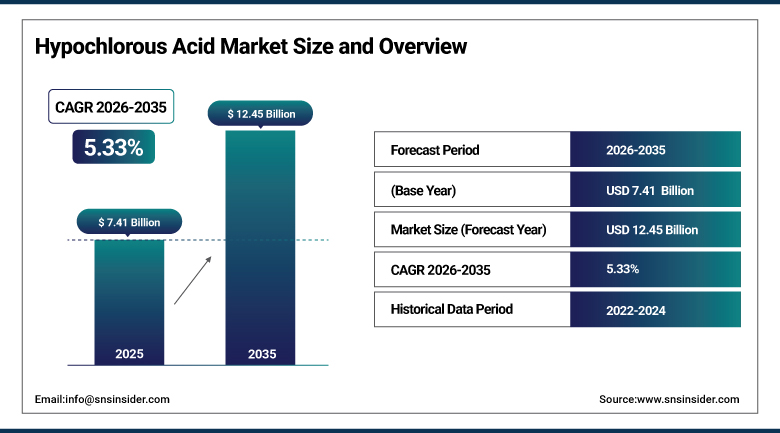
The Hypochlorous Acid Market was valued at USD 7.41 Billion in 2025 and is expected to reach USD 12.45 Billion by 2035, growing at a CAGR of 5.33% from 2026-2035.
The Hypochlorous Acid Market is witnessing an upsurge owing to the increasing need for better disinfectants, higher hygiene consciousness, and applications in the healthcare industry. The use of hypochlorous acid is widespread in surface disinfection, wound care, sanitation, and odor control owing to its antimicrobial efficacy and safe profile when used properly. Hypochlorous acid products are being utilized by hospitals, clinics, food processing plants, and businesses to improve their hygiene procedures. Moreover, the growing need for eco-friendly cleaning products is also driving its application in households, personal care, and veterinary uses. With the help of advancements in the technology of on-site generation and formulation, the ease of use of the products has been improved. Furthermore, focus on food safety and water treatment solutions will aid in market growth.
⮞In October 2024, the Sudanese National Academy of Sciences submitted an application to the World Health Organization asking that hypochlorous acid join the core Essential Medicines List, citing 13 randomized controlled trials. The submission is an applicant request and not a WHO decision, yet it places the clinical record of the compound before global procurement bodies and supports wound care demand.
To Get more information Hypochlorous Acid Market - Request Free Sample Report
Hypochlorous Acid Market Trends
-
On-site and on-demand generation is replacing shipped bottled disinfectant in kitchens, hospitals and plants.
-
Hypochlorous acid sprays and hydrogels are crossing from clinics into mass retail skincare shelves.
-
Stabilization and buffered pH engineering are extending shelf life for bottled hypochlorous acid.
-
Regulatory clearances for wound care are building clinical credibility for the chemistry.
-
Biocide rules are being formalized while private label and contract manufacturing consolidate supply.
U.S. Hypochlorous Acid Market Outlook
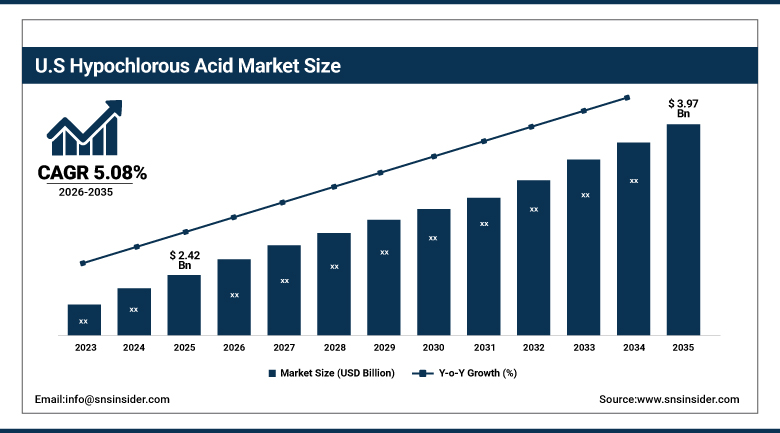
The U.S. Hypochlorous Acid Market was valued at USD 2.42 Billion in 2025 and is expected to reach USD 3.97 Billion by 2035, growing at a CAGR of 5.08% from 2026-2035.
The U.S. Hypochlorous Acid Market is the largest in North America. Hospitals buy cleared wound irrigation solutions. Food processors and restaurant chains install generators that make disinfectant at the point of use. Pool operators and water utilities continue to buy sodium and calcium hypochlorite in bulk. Pharmacy chains now stock hypochlorous acid sprays beside acne and eyelid care items. Antimicrobial claims are registered with the Environmental Protection Agency while medical uses are cleared by the Food and Drug Administration. This dual pathway rewards suppliers with documented efficacy and traceable manufacturing. Competition between bleach makers and newer generator brands keeps pricing sharp.
⮞In June 2026, Sonoma Pharmaceuticals received a new 510(k) clearance from the U.S. Food and Drug Administration for its Microdacyn Wound Irrigation Solution, which brought the company to 23 FDA 510(k) clearances. The clearance widens cleared indications for a hypochlorous acid product and reinforces hospital and clinic demand for regulated wound care.
Hypochlorous Acid Market Segment Analysis
-
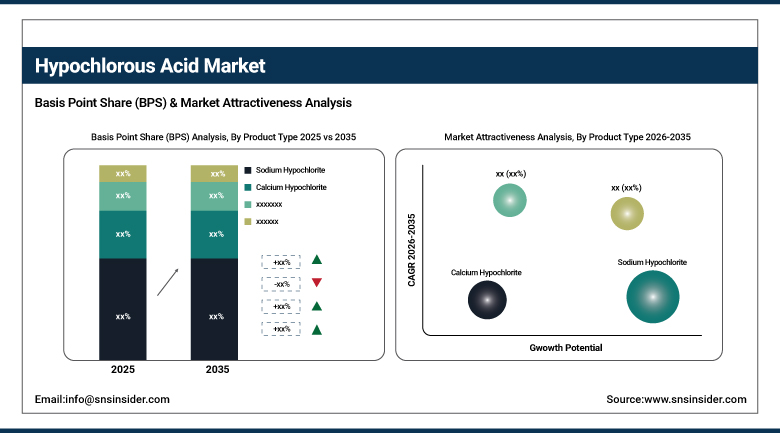
By Product Type, the Sodium Hypochlorite segment dominated the Hypochlorous Acid Market with approximately 54.67% share in 2025, while the Calcium Hypochlorite segment is the fastest growing with a CAGR of approximately 6.44%.
-
By Application, the Disinfecting Agent segment dominated the Hypochlorous Acid Market with approximately 44.06% share in 2025 and is also the fastest growing with a CAGR of approximately 7.92%.
-
By End-Use, the Water Treatment segment dominated the Hypochlorous Acid Market with approximately 40.28% share in 2025, while the Healthcare segment is the fastest growing with a CAGR of approximately 7.53%.
-
By Distribution Channel, the Direct Sales segment dominated the Hypochlorous Acid Market with approximately 34.80% share in 2025, while the Online Retail segment is the fastest growing with a CAGR of approximately 7.83%.
By Product Type, Sodium Hypochlorite Dominates the Hypochlorous Acid Market and Calcium Hypochlorite Grows Fastest
Sodium hypochlorite dominated the Hypochlorous Acid Market with an estimated 54.67% share in 2025, owing to its wide application in disinfection, sanitation, and water treatment. Sodium hypochlorite is preferred due to its established supply chain, cost-effectiveness, and efficacy against a wide array of microorganisms. Sodium hypochlorite and hypochlorous acid are different chemical compounds of chlorine-based products. Their usage varies depending on their formulations, concentration levels, and operating conditions.
Calcium hypochlorite is projected to register the fastest growth, with a CAGR of approximately 6.44%, due to the growing demand for concentrated chlorine-based disinfectants in swimming pools, water treatment, and sanitation applications. Calcium hypochlorite has relatively higher available chlorine content and can be stored in solid form which makes it more suitable for use in places where there is difficulty in handling or transporting liquids. The growth of calcium hypochlorite will depend on the handling requirements of the product, its safety during storage, cost-effectiveness, and availability of other disinfectants.
⮞In March 2023, Anolytech of Sweden stated that its AnoDes system produces pH-optimized hypochlorous acid using only water, salt and electricity, and the product was to be integrated into aquaculture technology. The development shows electrolyzed hypochlorous acid moving beyond hospitals into water-based food production systems.
By Application, Disinfecting Agent Dominates the Hypochlorous Acid Market and Also Grows Fastest
The disinfecting agent segment dominated the Hypochlorous Acid Market with an estimated 44.06% share in 2025, due to the growing need for antimicrobial solutions in health care, food processing, commercial buildings, and households. The inactivation of various microbes by hypochlorous acid is possible if proper concentrations and conditions are applied. The possibility of using the product on selected surfaces and in special hygiene formulas increases its applicability. The increasing focus on infection control, workplace hygiene, and food safety boosts the demand for disinfectants. The stability of the product, its effectiveness, and compliance with regulations in particular application are the main factors that influence the purchase decision.
The disinfecting agent segment is also projected to record the fastest growth, owing to the importance that institutions give to hygiene management and practices. There are efforts by hospitals, clinics, food manufacturing facilities, hospitality industries, and homes toward identifying formulations for their respective cleaning needs. There are formulations with hypochlorous acid that have been found appealing due to its antimicrobial characteristics.
⮞Berkshire stated in September 2025 that its VersaHOCl disinfectant is cleared by the FDA and USDA as a high-level disinfectant for organic production and handling operations. That status gives organic food handlers a compliant hypochlorous acid option and broadens the disinfecting use case.
By End-Use, Water Treatment Dominates the Hypochlorous Acid Market and Healthcare Grows Fastest
Water treatment dominated the Hypochlorous Acid Market with an estimated 40.28% share in 2025, based on the necessity to control microbial contamination of drinking water, wastewater, industries, and recreational water bodies. Chlorine-based disinfectants have been commonly employed as a means of dealing with microorganisms present in water. Water treatment requires continued expenditure on chemical treatments and equipment, fueled by the increasing need for sanitation, growing urbanization, and water re-use at industry level.
Healthcare is projected to register the fastest growth, with a CAGR of approximately 7.53%. Hospitals and other clinical establishments adopt more robust measures to prevent infections and take care of wounds and skin conditions. Some products containing hypochlorous acid have uses in certain types of wound and skin cleansers and for the disinfection of surfaces under specific approval of those products. Increased activity in healthcare sector, infection prevention, and availability of appropriate antimicrobials may drive the use further.
⮞Dermatology Times reported in May 2026 that at least eight branded aqueous hypochlorous acid formulations have received FDA 510(k) clearance for topical wound management. The count underlines the depth of regulated healthcare supply behind the fastest growing end-use.
By Distribution Channel, Direct Sales Dominates the Hypochlorous Acid Market and Online Retail Grows Fastest
Direct sales dominated the Hypochlorous Acid Market with an estimated 34.80% share in 2025 due to the fact that institutional and industrial clients require bulk quantities and reliable delivery arrangements. Water treatment plants, hospitals and other health care organizations, manufacturing companies, and commercial cleaning businesses can buy their products directly from the manufacturers in order to receive technical support and enter into long-term supply agreements.
Online retail is projected to grow at a CAGR of approximately 7.83%, supported by increasing access to online retailers and consumer demand for hygiene and cleaning products. Online retail makes it possible for consumers to compare formulations, container volumes, price, and information about the products. Direct-to-consumer websites and digital marketplaces could allow small brands to enter households and niche markets without wide physical distribution channels. Growth in home-care and personal-care product sales could contribute to its growth.
⮞In April 2026, Magic Science announced that its Magic Molecule hypochlorous acid spray is available at 6,000 CVS Pharmacy locations throughout the U.S. and on CVS.com. The rollout shows pharmacy chains pairing physical shelves with online ordering for hypochlorous acid skincare.
Regional Insights
|
Region |
Major Country |
Share within Region, 2025 (%) |
|---|---|---|
|
North America |
United States |
82.00 |
|
Europe |
Germany |
23.50 |
|
Asia Pacific |
China |
44.00 |
|
Latin America |
Brazil |
48.00 |
|
Middle East and Africa |
Saudi Arabia |
26.00 |
North America Hypochlorous Acid Market Insights
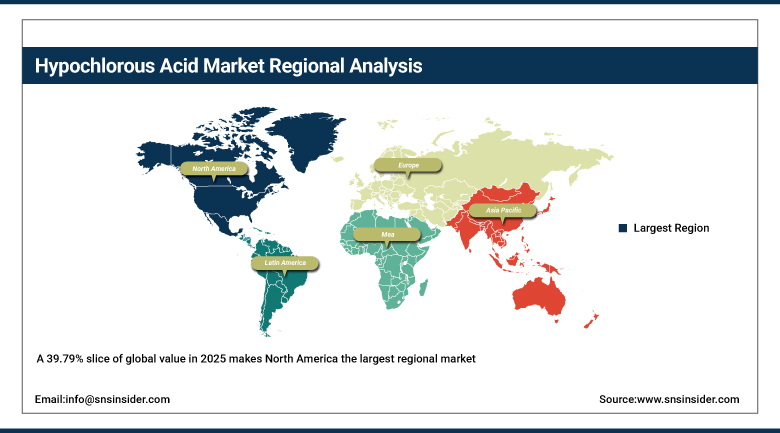
A 39.79% slice of global value in 2025 makes North America the largest regional market. Demand rests on hospitals, long-term care homes, food processors and municipal utilities that already run structured disinfection programs. The United States and Canada both maintain formal pathways for disinfectant registration and wound care clearance, which favors suppliers with solid documentation. Strong retail penetration of consumer hypochlorous acid products adds a second layer of volume and keeps brand competition active.
Hospitality and food service operators are installing generators that produce disinfectant from salt and water at the point of use, which cuts freight, storage and labeling burdens. Hospital groups negotiate private label wound care solutions with manufacturers. Veterinary clinics and pet care retailers add further volume. Quaternary ammonium compounds and hydrogen peroxide remain entrenched alternatives, so suppliers must prove efficacy with data and show total cost savings to win institutional tenders.
⮞A fact sheet posted to the Department of Defense environmental portal in April 2026 describes portable on-demand hypochlorous acid cleaners claimed to cost up to 80% less per ounce than conventional products. Demonstration sites include the Pentagon Athletic Center and NSA Bethesda, which shows institutional buyers testing generator-based supply.
Get Customized Report as per Your Business Requirement - Enquiry Now
Europe Hypochlorous Acid Market Insights
Biocide authorization and medical device conformity rules set the pace in Europe, so suppliers invest heavily in dossiers before they reach shelves. Germany anchors regional demand through rigorous hospital hygiene programs, a large food and beverage sector and a deep chemicals base. Water utilities across the region use hypochlorite for network disinfection and swimming pool operators rely on it for compliance with health codes. Buyers favor documented safety and sustainability credentials in tenders. Rising attention to chemical hazard labeling also steers hospitals toward milder disinfectants.
Pharmacy-led skincare retail gives hypochlorous acid sprays and gels a distribution route that differs from the United States. Electrolysis equipment makers in Northern and Eastern Europe sell generators for healthcare, aquaculture and food processing. Environmental policies that discourage hazardous chemical transport support on-site production. The United Kingdom operates a separate registration regime after Brexit, so suppliers often plan dual market entry and adapt labeling and claims accordingly.
⮞In April 2025, a U.S. hypochlorous acid manufacturer announced registration of its acne products with the Medicines and Healthcare products Regulatory Agency (MHRA) and launched them across more than 1,200 stores in the United Kingdom under a pharmacy chain brand. The registration shows how regulatory approval opens European retail shelves.
Asia Pacific Hypochlorous Acid Market Insights
Expansion at 7.56% a year through 2035 places Asia Pacific ahead of every other region. China contributes the largest national pool through its chemical manufacturing capacity, large water treatment build-out and rising hygiene awareness. India adds demand from public health programs and a growing hospital sector. Japan and South Korea use electrolyzed water in food service and medical settings, which supports equipment sales. Urbanization and piped water coverage broaden the base of municipal buyers.
Local skincare brands in East Asia are experimenting with hypochlorous acid mists and wipes, and e-commerce platforms carry them to a large young consumer base. Food safety reforms push processors toward validated sanitation chemistry. Local manufacturers produce generators at lower prices than imported units, which opens smaller clinics and farms to the technology. Aquaculture in Southeast Asia is another growth pocket for water disinfection, since shrimp and fish farms need constant pathogen control.
⮞In April 2024, India's CSIR-AMPRI launched HealthChlor, a 6-liter hypochlorite generator developed with HES Water Engineers that makes disinfectant solution on site. Compact generators of this type extend disinfectant access to clinics and rural water points across the region.
Middle East and Africa and Latin America Hypochlorous Acid Market Insights
Brazil anchors demand in Latin America through its large agribusiness, food processing and municipal water sectors. Sodium hypochlorite dominates volume, while consumer interest in hypochlorous acid skincare and wound care is only starting to build through pharmacies. Mexico adds a manufacturing base tied to North American supply chains. Currency swings and uneven enforcement of biocide rules slow premium product adoption, yet pool maintenance and dairy hygiene provide steady baseline consumption.
Saudi Arabia leads the Middle East and Africa through desalination, healthcare investment and hospitality, all of which rely on hypochlorite for disinfection. Gulf buyers specify imported systems for hospitals and hotels. South Africa has a local hypochlorous acid wound care industry with national medical device registration. Limited cold chain and storage infrastructure favor on-site generation and concentrated products across the wider region. Government healthcare spending programs and rising hotel construction add procurement demand for validated disinfectants. Import dependence leaves buyers sensitive to freight and currency movements.
Market Dynamics
Growth Drivers: Infection prevention priorities and consumer skincare adoption are raising demand for hypochlorous acid across institutional and retail channels.
Hospitals face constant pressure to reduce healthcare-associated infections, and published clinical studies in catheter care and surgical wound management support hypochlorous acid as an alternative to povidone-iodine and saline. Regulators are also pushing food and water operators toward lower-residue chemistry. Each clearance and registration strengthens the case for procurement committees that need documented evidence before switching chemistries. National antimicrobial resistance plans reinforce demand for non-antibiotic wound and surface solutions. Clinicians increasingly cite tissue tolerance as a reason to prefer it for repeated daily irrigation.
Since around 2022 sprays and hydrogels sold for acne, eyelid care and pet care have moved onto mass retail shelves and social media feeds, creating consumer pull that runs alongside hospital demand. Larger consumer health brands are extending product lines, which raises awareness and normalizes the ingredient among shoppers who never met it in clinics. That visibility feeds back into institutional buying as nurses and facility managers recognize the name. Influencer education has also shortened the learning curve for first-time buyers. Online reviews and dermatologist commentary now guide purchases that once depended on a clinician recommendation alone.
⮞In August 2026, WellSpring Consumer Healthcare launched seven hypochlorous acid products across its established over-the-counter brands. The range is stocked at major online and store-based retailers, which brings the chemistry to household names in first aid and skin care.
Restraints: Short shelf life, volatile power and chlorine costs and weak brand scale are holding back smaller hypochlorous acid suppliers.
Hypochlorous acid degrades quickly unless pH, concentration and packaging are tightly controlled, so unstabilized products can lose potency within days. Stabilized formulations last months or longer but require costlier processes and barrier packaging. Distributors dislike long transit times and storage risk, which limits the geographic reach of local producers and pushes the sector toward on-site generation rather than shipped bottles. Quality complaints from degraded stock can also damage the reputation of the whole category and slow institutional approval of new brands.
Electricity, salt and chlorine price swings squeeze margins for electrolysis operators, and generators demand upfront capital that small sites hesitate to commit. Quaternary ammonium compounds, hydrogen peroxide, alcohol and bleach remain cheaper per liter and sit on entrenched procurement lists. Regulatory fragmentation across jurisdictions forces separate dossiers and raises compliance spending for smaller brands that lack scale. Lengthy review cycles for medical clearances delay launches and strain the cash reserves of young companies, which often depend on a single flagship product and a narrow customer base.
⮞In January 2025, NovaBay Pharmaceuticals sold substantially all of its revenue generating and operating assets, including the Avenova hypochlorous acid eyelid cleanser, to PRN. The transaction shows that small branded hypochlorous acid companies can struggle to reach the scale needed for independent operations.
Opportunities: On-site generation is opening new demand in food plants, kitchens and hospitals that want to cut shipped chemicals and storage risk.
Equipment that turns water, salt and electricity into disinfectant removes freight, storage and shelf-life risk, the main weaknesses of bottled products. Food plants and hospitals can run it close to the point of use. Manufacturers can bundle hardware and consumables with service contracts, which creates recurring revenue and customer lock-in. Larger batch sizes are lowering the cost per ounce, and that improves the payback case for mid-size buyers. Remote sites without reliable chemical delivery see an especially strong benefit. Operators also gain tight control of concentration and pH.
Adjacent pools of demand are forming in veterinary care, livestock hygiene, aquaculture, organic produce handling and municipal water polishing. Wound care access in emerging economies is another open field because cleared products remain scarce and clinics need stable supply. Retail expansion into pharmacies and mass merchants lets suppliers reach consumers directly. Private label manufacturing offers contract producers a path to scale without building consumer brands.
⮞Force of Nature announced in May 2025 that its Pro On-Demand generator makes up to 20 gallons of disinfectant cleaner per batch, with nationwide shipping to start in November 2025. The product targets commercial kitchens and facilities that want to produce cleaner on site.
Recent Developments
-
April 2025, Hoshizaki Corporation acquired a large-scale electrolyzed sodium hypochlorite solution generator business with a maximum daily output of 200 tons. The deal extends the Japanese equipment maker from small commercial units for slightly acidic electrolyzed water into municipal and industrial scale disinfection.
-
May 2025, Health Canada brought the Biocides Regulations into force with a four-year transition period for disinfectants and six years for food-premises surface sanitizers. The phased timetable gives hypochlorous acid suppliers until 2029 and 2031 to complete registration in a major North American market.
-
September 2025, Aquaox Pure Solutions announced its first European agricultural contract, covering hypochlorous acid for livestock umbilical cord care in Spain. The announcement is company-reported but signals entry into European animal health, where on-farm hygiene products are in demand.
-
November 2025, EcoloxTech detailed that its HOCl-AS200 on-site generator carries EPA Reg. No. 101112-1 and that hypochlorous acid appears on EPA Lists N and K. Clear registration status helps facility buyers qualify generator-made disinfectant for healthcare and food service use.
Hypochlorous Acid Companies are:
-
Sonoma Pharmaceuticals
-
Magic Science
-
Force of Nature
-
EcoloxTech
-
Aqualution Systems
-
Envirolyte
-
Innovacyn
-
CleanSmart
-
Aquaox Pure Solutions
-
Hoshizaki
-
Oxy'Pharm
Hypochlorous Acid Market Report Scope:
| Report Attributes | Details |
|---|---|
| Market Size in 2025 | USD 7.41 Billion |
| Market Size by 2035 | USD 12.45 Billion |
| CAGR | CAGR of 5.33% From 2026 to 2035 |
| Base Year | 2025 |
| Forecast Period | 2026-2035 |
| Historical Data | 2022-2024 |
| Report Scope & Coverage | Market Size, Segments Analysis, Competitive Landscape, Regional Analysis, DROC & SWOT Analysis, Forecast Outlook |
| Key Segments | • By Product Type (Sodium Hypochlorite, Calcium Hypochlorite, and Others) • By Application (Disinfecting Agent, Sanitizing Agent, Oxidizing Agent, and Others) • By End-Use (Water Treatment, Healthcare, Agriculture and Horticulture, Food and Beverage, Personal Care, and Others) • By Distribution Channel (Direct Sales, Pharmacies, Supermarkets, Specialty Stores, and Online Retail) |
| Regional Analysis/Coverage | North America (US, Canada), Europe (Germany, UK, France, Italy, Spain, Russia, Poland, Rest of Europe), Asia Pacific (China, India, Japan, South Korea, Australia, ASEAN Countries, Rest of Asia Pacific), Middle East & Africa (UAE, Saudi Arabia, Qatar, South Africa, Rest of Middle East & Africa), Latin America (Brazil, Argentina, Mexico, Colombia, Rest of Latin America). |
| Company Profiles | Sonoma Pharmaceuticals, Magic Science, Force of Nature, EcoloxTech, Briotech Inc., Aqualution Systems, Envirolyte, Innovacyn, CleanSmart, BluLyte, Aquaox Pure Solutions, Hoshizaki, Oxy'Pharm |

Frequently Asked Questions
Key players in the Hypochlorous Acid Market include Sonoma Pharmaceuticals, Force of Nature, EcoloxTech, Envirolyte and Innovacyn among others.
On-site generation for food plants, kitchens and hospitals is the leading opportunity. Veterinary care, aquaculture, organic production and retail skincare add further room for growth.
Rising focus on infection prevention in healthcare, food and water settings is the major growth factor. Consumer adoption of hypochlorous acid skincare adds momentum.
The Sodium Hypochlorite segment dominated the market with approximately 54.67% share in 2025 because of its low production cost and wide use in water treatment.
North America dominated the market with approximately 39.79% share in 2025, supported by structured disinfection programs, clear regulatory pathways and strong retail penetration.
