
Chloromethanes Market Report Scope & Overview:
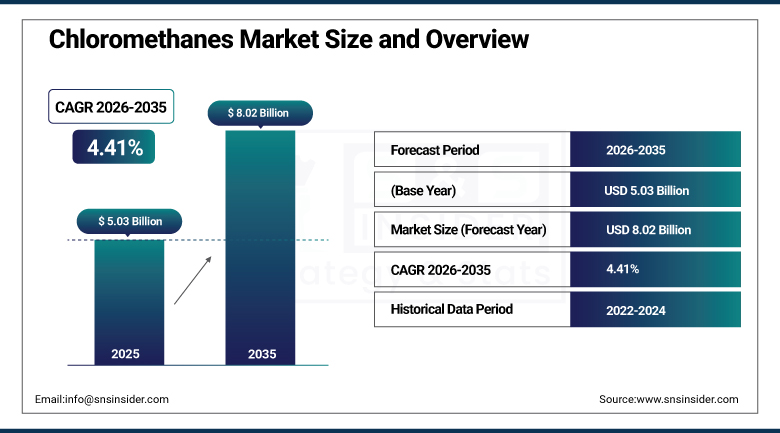
The Chloromethanes Market was valued at USD 5.03 Billion in 2025 and is expected to reach USD 8.02 Billion by 2035, growing at a CAGR of 4.41% from 2026–2035.
The global chloromethanes market is growing at a steady pace. Chloromethanes are a family of halogenated methane compounds including methyl chloride (CH₃Cl), methylene chloride (CH₂Cl₂), chloroform (CHCl₃), and carbon tetrachloride (CCl₄). The market is driven by rising demand for silicones in automotive and construction applications, which represents the primary market driver, creating above-average methyl chloride procurement for dimethyldichlorosilane synthesis whose downstream silicone fluid, resin, and elastomer production creates structured long-term feedstock demand. The report provides comprehensive analysis of production capacity, feedstock availability, regulatory impact, environmental metrics, and end-use sector demand trends across silicones, pharmaceuticals, and agrochemicals.
In 2024, Shin-Etsu Chemical expanded its chloromethane production capacity at its Niigata facility in Japan, targeting growing methyl chloride demand from its integrated silicone manufacturing operations. The expansion reflects the commercial reality that silicone polymer growth in automotive lightweighting, EV battery sealing, and construction sealant applications is creating above-average methyl chloride demand whose supply constraint risk motivates backward integration investment by silicone producers with captive chloromethane production capability.
To Get more information On Chloromethanes Market- Request Free Sample Report
Chloromethanes Market Trends:
-
Silicone demand in EV batteries, 5G sealing, and construction drives strong methyl chloride consumption growth globally.
-
Pharmaceutical applications of methylene chloride in API production and extraction significantly increase solvent demand in healthcare industry.
-
Environmental regulations on chloroform and carbon tetrachloride under Montreal Protocol restrict supply and support higher compliant pricing levels.
-
Green chemistry trends encourage development of safer substitutes, gradually reducing long-term dependence on chloromethanes in industrial processes.
-
Process efficiency improvements in chloromethane production reduce costs through energy recovery, recycling, and catalytic yield optimization technologies.
U.S. Chloromethanes Market Outlook:
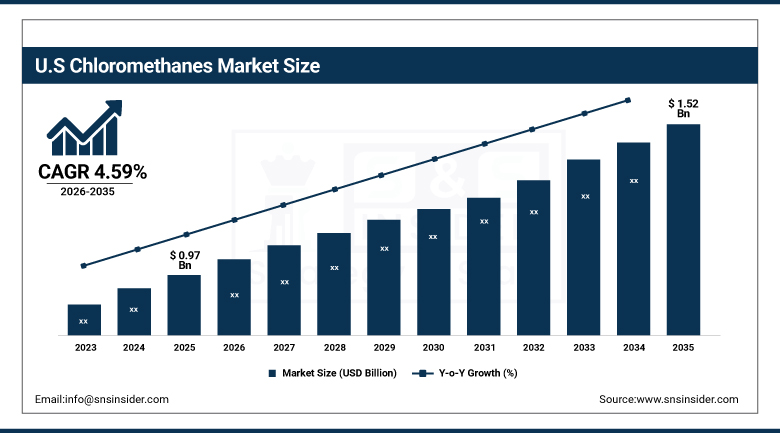
The U.S. Chloromethanes Market was valued at approximately USD 0.97 Billion in 2025 and is expected to reach approximately USD 1.52 Billion by 2035, growing at a CAGR of approximately 4.59%.
The U.S. is the most commercially significant chloromethanes market within the fastest-growing North American region. Occidental Chemical (OxyChem), Dow Chemical, and INEOS’ U.S. operations collectively serve the domestic chloromethanes market. The U.S. Gulf Coast’s integrated chlor-alkali and chloromethane production infrastructure creates commercially competitive domestic supply for pharmaceutical, silicone, and industrial solvent applications. EPA’s regulatory framework under the Toxic Substances Control Act creates compliance investment that sustains premium domestic producer relationships over import alternatives whose regulatory compliance documentation creates procurement preference for domestic supply in regulated industry applications.
Occidental Chemical expanded its methylene chloride production capacity at its Battleground, Texas facility in 2024, targeting growing U.S. pharmaceutical sector demand for high-purity DCM as a process solvent in API manufacturing whose IRA-incentivized domestic pharmaceutical production investment is creating above-average domestic methylene chloride procurement. The capacity expansion reflects the commercial opportunity created by domestic pharmaceutical production incentive whose near-shoring motivation creates structured procurement growth for domestically produced specialty chemical intermediates.
Chloromethanes Market Segment Analysis:
-
By Product Type, the methyl chloride segment dominated the chloromethanes market with approximately 55% share in 2025, while the methylene chloride segment is the fastest growing.
-
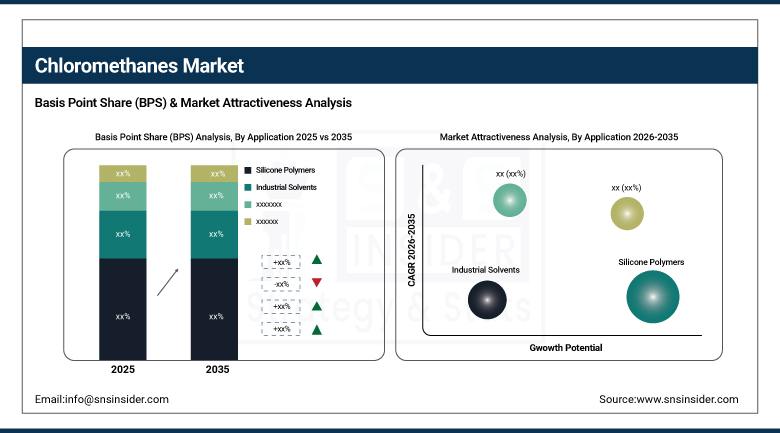
By Application, the silicone polymers segment dominated the chloromethanes market with approximately 48% share in 2025, while the pharmaceuticals segment is the fastest growing.
-
By End Use, the silicone manufacturing segment dominated the chloromethanes market with approximately 46% share in 2025, while the agrochemical industry segment is the fastest growing.
By Product Type, methyl chloride dominates, methylene chloride grows fastest
Methyl chloride retained the dominant product type position with approximately 55% of the chloromethanes market in 2025. Methyl chloride’s commercial primacy reflects its role as the principal feedstock for methylchlorosilane synthesis whose downstream silicone polymer production creates the most commercially established and structurally growing chloromethane demand category. Each ton of polydimethylsiloxane fluid, silicone sealant, and silicone elastomer manufactured requires methyl chloride as the methyl group donor in the Rochow direct synthesis whose aggregate across global silicone production creates above-average annual methyl chloride procurement. Dow Silicones, Wacker Chemie, Shin-Etsu, and Elkem’s silicone manufacturing operations collectively define the methyl chloride demand landscape whose captive or contracted supply relationships create commercial stability.
Methylene chloride (dichloromethane, DCM) is the fastest-growing product type because pharmaceutical industry’s expanding API manufacturing, the growing polyurethane foam industry’s blowing agent application, and specialty chemical extraction’s process solvent demand create multiple simultaneous above-average growth vectors. The pharmaceutical sector’s methylene chloride use in API recrystallisation, membrane extraction, and chromatography creates premium pharmaceutical-grade DCM procurement whose purity specification creates commercial differentiation from industrial-grade alternatives.
By Application, silicone polymers dominate, pharmaceuticals grow fastest
Silicone polymers retained the dominant application position with approximately 48% of the chloromethanes market in 2025. The silicone industry’s extraordinary growth momentum, driven by EV battery thermal interface material, 5G antenna encapsulation, sustainable construction sealant, and medical device biocompatibility applications, creates structural demand growth for methyl chloride whose correlation with silicone production volume sustains the application’s commercial leadership. Each new silicone polymer application category that emerges from materials innovation creates incremental methyl chloride demand whose aggregate across the silicone industry’s expanding application portfolio sustains above-market methyl chloride procurement growth.
Pharmaceuticals is the fastest-growing application because the global pharmaceutical industry’s extraordinary expansion, driven by aging population’s growing drug demand and emerging market healthcare access improvement, creates above-average process solvent procurement whose chloromethane component sustains above-market growth. Methylene chloride’s extraction efficiency, chloroform’s NMR solvent application, and carbon tetrachloride’s reagent role collectively create pharmaceutical procurement that compounds with active pharmaceutical ingredient production volume growth. The near-shoring of pharmaceutical manufacturing to domestic facilities in the U.S. and Europe creates new regional chloromethane demand that adds to existing Asian pharmaceutical production procurement.
By End Use, silicone manufacturing dominates, agrochemicals grow fastest
Silicone manufacturing retained the dominant end-use position with approximately 46% of the chloromethanes market in 2025. The silicone industry’s integrated production model, whose methyl chloride consumption is captively managed through backward integration at major producers including Dow, Wacker, Shin-Etsu, and Elkem, creates commercial procurement relationships whose structural stability reflects long-term production capacity investment. Each silicone manufacturing facility’s methyl chloride consumption, calculated in tens of thousands of tons annually at major integrated sites, creates procurement scale that defines the chloromethane market’s commercial character.
Agrochemicals is the fastest-growing end use because global crop protection demand’s expansion, driven by food security investment and precision agriculture’s per-hectare chemical application value improvement, creates above-average chloromethane intermediate procurement. Each new herbicide and insecticide active ingredient that employs chloromethane chemistry in synthesis creates structured procurement that compounds with crop protection market volume growth. Emerging market agricultural intensification, whose expanding pesticide market creates growing API synthesis demand, creates above-average procurement growth in Asia Pacific and Latin American agrochemical manufacturing.
Regional Analysis:
|
Region |
Major Country |
Share within Region, 2025 (%) |
|---|---|---|
|
North America |
United States |
87.4% |
|
Europe |
Germany |
22.3% |
|
Asia Pacific |
China |
54.6% |
|
Middle East & Africa |
Saudi Arabia |
31.2% |
|
Latin America |
Brazil |
44.2% |
North America Chloromethanes Market Insights
North America is the fastest-growing regional chloromethanes market, driven by IRA-incentivized domestic pharmaceutical manufacturing, the silicone industry’s above-average procurement, and the construction sector’s growing silicone sealant demand. The United States accounts for approximately 87.4% of North American revenues through OxyChem, Dow, and INEOS’ domestic production infrastructure, the pharmaceutical sector’s growing domestic methylene chloride procurement, and the silicone industry’s methyl chloride consumption.
Canada contributes approximately 12.6% of North American revenues through its chemical industry’s chloromethane consumption, the pharmaceutical sector’s process solvent procurement, and the construction industry’s silicone sealant demand creating methyl chloride procurement.
Europe Chloromethanes Market Insights
Europe is a technically sophisticated chloromethanes market where REACH regulation’s worker exposure limits for methylene chloride, Wacker Chemie’s German silicone manufacturing, and the pharmaceutical industry’s process solvent procurement create structured institutional demand. Germany accounts for approximately 22.3% of European revenues through Wacker Chemie’s integrated silicone and chloromethane operations, the pharmaceutical sector’s methylene chloride procurement, and the chemical industry’s chloromethane intermediate consumption.
France, the Netherlands, and Belgium are significant secondary markets where the pharmaceutical and specialty chemical industries create consistent chloromethane procurement whose quality and regulatory compliance requirements sustain premium domestic European producer relationships.
Asia Pacific Chloromethanes Market Insights
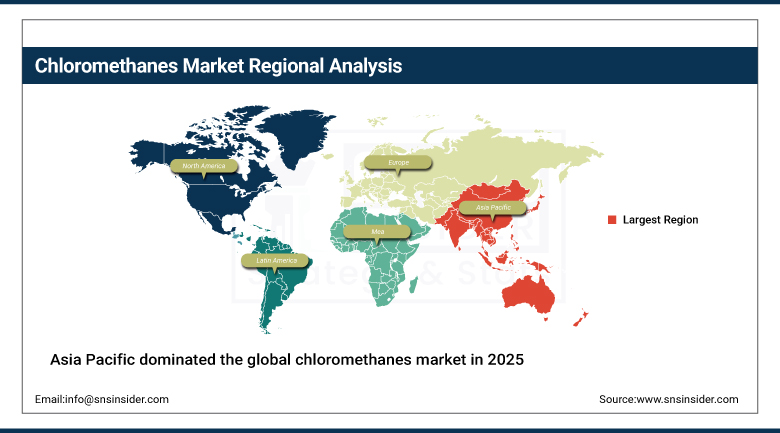
Asia Pacific dominated the global chloromethanes market in 2025 with the highest revenue share as confirmed by SNS Insider. China accounts for approximately 54.6% of Asia Pacific revenues through its position as the world’s largest chloromethane producer and consumer, whose integrated chlor-alkali, chloromethane, and silicone manufacturing complex creates the most commercially concentrated chloromethane demand globally. China’s extraordinary silicone industry expansion, pharmaceutical API manufacturing growth, and agrochemical production create multiple simultaneous demand drivers that sustain Asia Pacific’s commercial leadership.
Japan and South Korea represent technically sophisticated secondary markets where Shin-Etsu Chemical’s, Dow Toray’s, and Wacker’s integrated silicone manufacturing creates captive methyl chloride procurement, and the pharmaceutical and electronics sectors create consistent chloromethane intermediate demand.
Get Customized Report as per Your Business Requirement - Enquiry Now
MEA & Latin America Chloromethanes Market Insights
Saudi Arabia leads MEA revenues at approximately 31.2% through SABIC’s chemical complex integration, the petrochemical industry’s chloromethane production capability, and the growing silicone and pharmaceutical sectors’ domestic procurement. Brazil leads Latin American revenues at approximately 44.2% through its agrochemical industry’s chloromethane intermediate demand, the pharmaceutical sector’s process solvent procurement, and the construction industry’s silicone sealant application.
UAE’s specialty chemical sector and South Africa’s chemical manufacturing create significant MEA secondary markets whose chloromethane procurement reflects the respective national chemical industry development programmes.
Market Dynamics:
Growth Drivers: Silicone demand in automotive and construction and pharmaceutical API synthesis creating structural chloromethane procurement
Rising demand for silicones in automotive and construction sectors is the chloromethanes market’s most commercially certain structural growth driver. Each electric vehicle that requires thermal interface material between battery cells and cooling system, each 5G antenna array that requires weather-sealed silicone encapsulation, and each sustainable building that specifies silicone sealant for weathertight glazing creates proportional methyl chloride demand whose aggregate across the silicone industry’s extraordinary growth creates structured long-term procurement motivation. The silicone industry’s growth correlation with decarbonization technology’s deployment, EV batteries, solar panel encapsulation, and wind turbine blade bonding, creates a structural demand driver whose commercial momentum compound with clean energy investment scale.
Pharmaceutical API manufacturing’s extraordinary global expansion is creating above-average methylene chloride demand whose pharmaceutical-grade specification creates premium commercial relationships that sustain producer investment. Each new generic API manufacturing facility in India, China, or the U.S. that specifies methylene chloride as process solvent creates procurement relationships whose duration reflects the facility’s multi-decade operational life. The specialty API’s extraction and purification process requirements create methylene chloride consumption whose volume compounds with pharmaceutical industry production growth.
Restraints: Environmental regulation constraining chloroform and carbon tetrachloride and occupational health restriction on methylene chloride
Montreal Protocol’s regulation of chloroform as a controlled ozone-depleting substance precursor creates production and trade restriction whose compliance requirement limits the addressable market for chloroform applications beyond essential use exemptions. Each regulatory tightening that reduces permitted chloroform production creates supply constraint whose commercial impact creates substitution investment in alternative synthesis routes that progressively erode chloroform’s application base.
REACH regulation’s methylene chloride occupational exposure limit of 100 ppm and the EU REACH restriction on industrial DCM use in paint stripping and certain consumer applications creates reformulation investment that moderates European methylene chloride demand growth. Each new DCM application restriction creates substitution incentive whose aggregate across multiple simultaneous regulatory actions creates structural demand moderation in regulated geographies.
Opportunities: Pharmaceutical-grade methylene chloride supply chain localization and green process chemistry development
Pharmaceutical-grade methylene chloride supply chain localization represents the most commercially significant near-term opportunity whose IRA domestic manufacturing incentive in the U.S. and EU pharmaceutical resilience programme in Europe create structured procurement motivation for domestically produced pharmaceutical-grade DCM. Each pharmaceutical manufacturer that transitions from Asian import supply to domestic procurement creates commercial relationships whose volume and duration sustain producer investment in pharmaceutical-grade DCM capacity expansion.
Green process chemistry development opportunities exist in bio-based chloromethane production and in alternative synthesis routes that reduce chloromethane consumption through process intensification. Each new green chemistry patent that enables equivalent API synthesis with reduced DCM consumption creates commercial adoption motivation whose aggregate creates progressive demand moderation that sustains innovation investment.
Recent Developments:
-
2026: Dow Inc. strengthened integration of chloromethane value chain into silicone and specialty materials production.
-
2026: Occidental Chemical expanded chlor-alkali capacity utilization to support stable chloromethane feedstock supply.
-
2025: Shin-Etsu Chemical Co., Ltd. expanded silicone production capacity in Japan and Asia, indirectly increasing methyl chloride demand.
Chloromethanes Market Key Players are:
-
Occidental Chemical Corporation (OxyChem)
-
Dow Inc.
-
INEOS Group
-
Shin-Etsu Chemical Co., Ltd.
-
Wacker Chemie AG
-
AkzoNobel N.V.
-
AGC Chemicals (Asahi Glass)
-
Gujarat Alkalies and Chemicals Ltd. (GACL)
-
SRF Limited
-
Tokuyama Corporation
-
Ercros S.A.
-
Jinling Group
-
Juhua Group Corporation
-
Luxi Chemical Group Co., Ltd.
-
Dongyue Group
-
Jiangsu Meilan Chemical Co., Ltd.
-
Lee & Man Chemical
-
Kureha Corporation
-
Hanwha Solutions
-
KEMONE (Arkema)
Chloromethanes Market Report Scope:
| Report Attributes | Details |
|---|---|
| Market Size in 2025 | USD 5.03 Billion |
| Market Size by 2035 | USD 8.02 Billion |
| CAGR | CAGR of 4.41% From 2026 to 2035 |
| Base Year | 2025 |
| Forecast Period | 2026-2035 |
| Historical Data | 2022-2024 |
| Report Scope & Coverage | Market Size, Segments Analysis, Competitive Landscape, Regional Analysis, DROC & SWOT Analysis, Forecast Outlook |
| Key Segments | • By Product Type (Methyl Chloride / Chloromethane, Methylene Chloride / Dichloromethane, Chloroform / Trichloromethane, Carbon Tetrachloride) • By Application (Silicone Polymers, Industrial Solvents, Pharmaceuticals, Agrochemicals / Herbicides, Refrigerants / Blowing Agents, Adhesives & Sealants, Others) • By End Use (Silicone Manufacturing, Pharmaceutical Industry, Agrochemical Industry, Automotive & Construction, Paints & Coatings, Personal Care & Cosmetics, Others) |
| Regional Analysis/Coverage | North America (US, Canada), Europe (Germany, UK, France, Italy, Spain, Russia, Poland, Rest of Europe), Asia Pacific (China, India, Japan, South Korea, Australia, ASEAN Countries, Rest of Asia Pacific), Middle East & Africa (UAE, Saudi Arabia, Qatar, South Africa, Rest of Middle East & Africa), Latin America (Brazil, Argentina, Mexico, Colombia, Rest of Latin America). |
| Company Profiles | Occidental Chemical Corporation (OxyChem), Dow Inc., INEOS Group, Shin-Etsu Chemical Co., Ltd., Wacker Chemie AG, AkzoNobel N.V., AGC Chemicals (Asahi Glass), Gujarat Alkalies and Chemicals Ltd. (GACL), SRF Limited, Tokuyama Corporation, Ercros S.A., Jinling Group, Juhua Group Corporation, Luxi Chemical Group Co., Ltd., Dongyue Group, Jiangsu Meilan Chemical Co., Ltd., Lee & Man Chemical, Kureha Corporation, Hanwha Solutions, KEMONE (Arkema) |
Frequently Asked Questions
The Chloromethanes Market is expected to grow at a CAGR of 4.41% from 2026 to 2035.
The Chloromethanes Market was valued at USD 5.03 Billion in 2025.
Rising demand for silicones in automotive and construction drives market growth through methyl chloride’s essential role in methyl chlorosilane synthesis.
Methylene chloride is the fastest growing segment in the Chloromethanes Market.
Asia Pacific dominated the Chloromethanes Market in 2025 with the highest revenue share.
