
Brain Training Apps Market Report Scope & Overview:
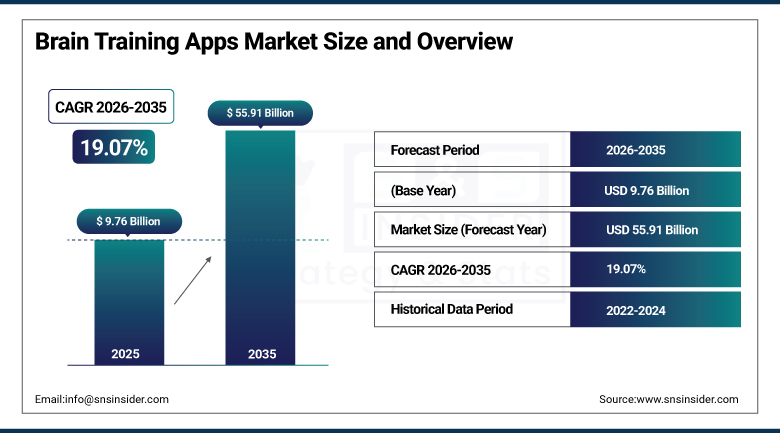
The Brain Training Apps Market was valued at USD 9.76 Billion in 2025 and is expected to reach USD 55.91 Billion by 2035, growing at a CAGR of 19.07% from 2026 to 2035.
The Brain Training Apps Market is driven by an increased emphasis on cognitive fitness and mental wellness across various age groups. The growing number of individuals who are concerned about memory problems, concentration disorders, and the cognitive decline associated with aging has resulted in an increasing number of individuals seeking out digital methods for personalizing brain exercises. Further, the growing use of smartphones and tablets and improved internet connectivity are boosting the adoption of these apps. Cognitive exercise associated with gaming and the availability of artificial intelligence-driven personalized training modules, which help integrate such exercises in one’s daily routine, are fueling the engagement rate and widening the applications of brain training apps to a wider user base comprising children, working individuals, and seniors.
In September 2025, Lumosity released version 10.19.42 of its app, adding new and improved games alongside updates integrating the latest cognitive research and new tools for tracking progress, aimed at keeping workouts fresh and users engaged over the long term.
To Get more information On Brain Training Apps Market - Request Free Sample Report
Brain Training Apps Market Trends
-
Corporate wellness programs are increasingly incorporating brain training tools to reduce workplace stress and enhance cognitive performance across employee populations.
-
Rising healthcare awareness is nudging individuals toward preventive cognitive care before problems escalate into diagnosable conditions.
-
Schools are adopting brain training programs to help students strengthen processing speed, language fluency, and multitasking skills.
-
More apps are working closely with neuroscientists and psychological researchers to ensure transparency and measurable progress for users.
-
Personalized exercises using AI, gamified cognitive challenges, and interactive learning tools continue drawing millions of new users globally.
U.S. Brain Training Apps Market Outlook
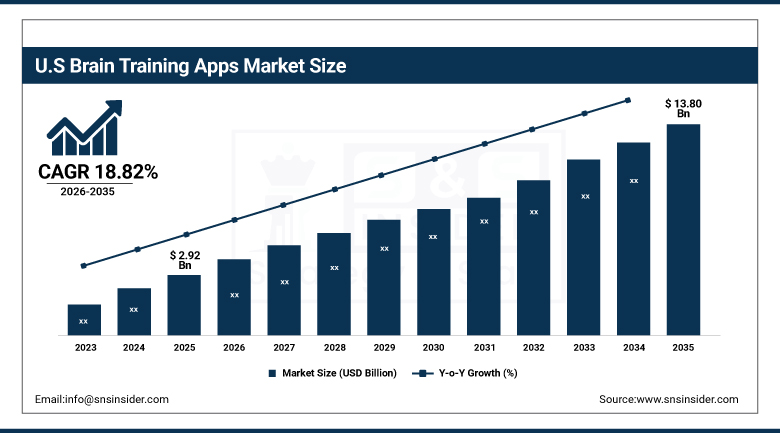
The U.S. Brain Training Apps Market was valued at approximately USD 2.92 Billion in 2026 and is expected to reach approximately USD 13.80 Billion by 2035, growing at a CAGR of approximately 18.82%.
The factors behind the development of the U.S. market include heightened awareness of cognitive wellness, penetration of smartphones, and incorporation of brain games into wellness programs. Among the main factors contributing to the growth of the market, one can highlight increased awareness on the part of consumers about cognitive wellness and mental fitness and protection from age-associated memory loss. Both children and senior citizens care about the improvement of memory and cognitive skills and mental fitness through the use of brain training applications; corporates and educational organizations incorporate such apps in wellness and learning programs.
In July 2025, BrainHQ, a cognitive training platform, launched its Freeze Frame assessment, a computerized tool designed to measure executive function in older adults by assessing inhibitory control in rapidly changing environments.
Brain Training Apps Market Segment Analysis
-
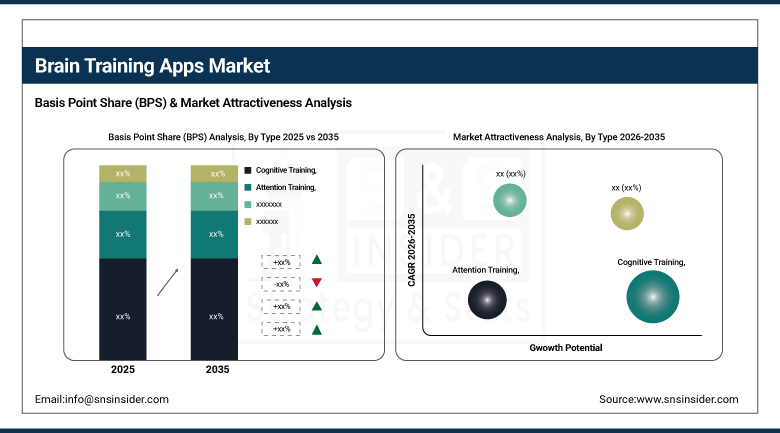
By Type, Cognitive Training segment dominated the Brain Training Apps Market in 2025 with 46% share; Attention Training segment is the fastest-growing segment.
-
By Subscription Model, Freemium segment dominated the market in 2025 with 57% share; Paid segment is the fastest-growing segment.
-
By Platform, Android segment dominated the market in 2025 with 61% share; iOS segment is the fastest-growing segment.
-
By End-User, Adults segment dominated the market in 2025 with 58% share; Elderly segment is the fastest-growing segment.
By Type, Cognitive Training Dominates the Brain Training Apps Market While Attention Training Emerges as the Fastest-Growing Segment
The Cognitive Training segment dominated the Brain Training Apps Market in 2025 with a 46% share because of growing consumer preference for training in cognitive skills such as memory, problem-solving, and mental agility through digital exercises. There is an increasing preference among the student community, professionals, and aged individuals for brain training apps that help them develop their cognitive abilities on a regular basis. With continued developments in areas like personalized learning algorithms, tracking of progress, and gamified experience, cognitive training is the most commonly used category of all brain training apps.
The Attention Training segment is the fastest-growing category owing to increasing digital distractions and increasing consciousness regarding attention issues. There is an increasing inclination toward attention training apps that help improve attention and reaction times among other things. Improvements in the area of personalization through AI, performance feedback, and neuroscience training are contributing to improved effectiveness of brain training apps for attention.
By Subscription Model, Freemium Dominates the Brain Training Apps Market While Paid Subscription Records the Fastest Growth
The Freemium segment dominated the Brain Training Apps Market in 2025 with a 57% owing to its provision to allow users to enjoy all features of brain training applications at no cost, thus prompting them to upgrade to premium versions. This business model appeals to a wider pool of users since there are no upfront costs, making brain training applications more downloadable. The developers will earn subscription fees due to the use of advanced features, personalized training, and lack of ads.
The Paid segment is the fastest-growing as consumers willingness to purchase brain training applications that offer premium cognitive wellness experiences thanks to science-driven programs and training makes it the fastest growing market segment. In addition, users are ready to pay to enjoy such advanced services as analytics, personalized training, exclusive exercises, and ad-free use. Increased confidence in digital health apps, as well as constant improvements of their features, make this market segment faster growing.
By Platform, Android Dominates the Brain Training Apps Market While iOS Witnesses the Fastest Growth
The Android segment dominated the Brain Training Apps Market in 2025 with a 61% share owing to the large number of smartphones available around the world at different price points. The availability of a large number of smartphone users in developed and developing countries has widened the scope for brain training apps. Due to the flexible nature of the apps ecosystem, easy availability on various devices and low costs, it has become possible to reach millions of users and establish leadership in the form of Android.
The iOS segment is the fastest-growing because of increased adoption by users looking for better digital health & wellness services. Increased expenditure on app subscriptions, high engagement rates, and increased use of wearables contribute to the growth in the need for advanced brain training apps. Improved performance, seamless synchronization between Apple devices, and growing interest in personalized cognitive wellness solutions are some of the factors behind the fast growth of this segment.
By End-User, Adults Dominate the Brain Training Apps Market While the Elderly Segment Registers the Fastest Growth
The Adults segment dominated the Brain Training Apps Market in 2025 with a 58% share due to the increasing use of cognitive training by professionals, students, and lifelong learners in order to enhance their memory, concentration, productivity, and decision-making skills. The competitive pressure at the workplace and continuous learning are responsible for the increasing utilization of brain training apps. Personalized learning programs and mobile accessibility also contribute to consistent engagement, making adults the most prominent user segment globally.
The Elderly segment is the fastest-growing as the increasing adoption of digital cognitive training among aging population to retain their memory, stimulate their brain, and ensure their brain health is driving their growth. The increasing awareness regarding healthy aging, increasing penetration of smartphones among the elderly, and advice of healthcare professionals are motivating the elderly to engage in brain training.
Regional Insights
|
Region |
Major Country |
Share within Region, 2025 (%) |
|---|---|---|
|
North America |
United States |
78.85% |
|
Europe |
United Kingdom |
24.60% |
|
Asia Pacific |
China |
29.85% |
|
Middle East & Africa |
UAE |
27.15% |
|
Latin America |
Brazil |
36.20% |
North America Brain Training Apps Market Insights
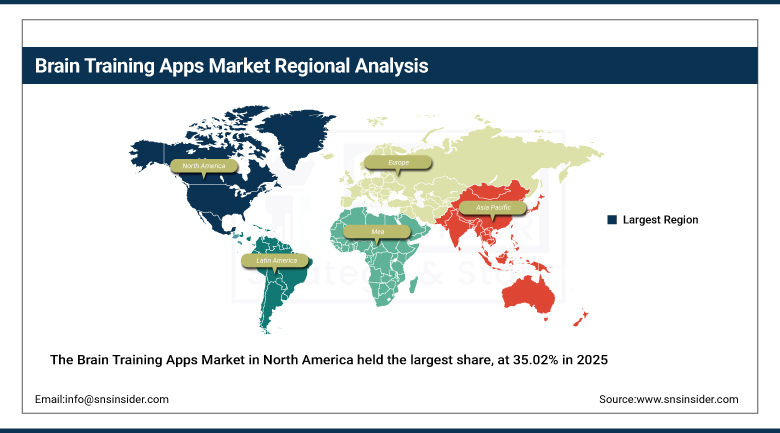
The Brain Training Apps Market in North America held the largest share, at 35.02% in 2025, driven by high cognitive health awareness and mental wellness pursuit, along with preventive care adoption across the region's tech-savvy population. Consumer spending power, digital literacy, and uptake of preventive mental wellness solutions have all kept North America the market's clear regional leader.
The United States accounts for roughly 78.85% of regional revenue, driven by increasing awareness of cognitive health, widespread smartphone adoption, and integration of brain training tools into wellness programs. Canada adds further regional demand through its own growing health-tech adoption, and that combined regional strength should keep North America the largest addressable market for brain training app vendors through the forecast period.
Get Customized Report as per Your Business Requirement - Enquiry Now
Europe Brain Training Apps Market Insights
Europe holds a meaningful share of the global brain training apps market, supported by strong healthcare infrastructure and an aging population that keeps driving demand for cognitive wellness solutions across the region's major economies. Strict data privacy regulation, including GDPR, has shaped how vendors design and market their apps to European consumers.
The United Kingdom leads regional demand at roughly 24.60% of European revenue, supported by strong digital health adoption and consumer awareness of cognitive wellness. Germany and France contribute substantial additional demand, and continued European emphasis on preventive healthcare should keep regional demand for brain training apps climbing steadily through the forecast period.
Asia Pacific Brain Training Apps Market Insights
Asia Pacific is the fastest-growing region in the Brain Training Apps Market, projected to expand at a CAGR of approximately 20.58%, due to rising smartphone penetration, internet penetration, and awareness about cognitive health and mental wellness. Market growth is fueled by widespread uptake of mobile solutions by children, adults, and the older generation, while inexpensive subscription-based models of service and localized content contribute to broader access.
China leads the region, accounting for roughly 29.85% of regional revenue, supported by intense competition among domestic developers and aggressive marketing of brain training apps to aging populations. India and Japan contribute meaningful additional demand, and rising initiatives around education and corporate wellness plans keep expanding the addressable market across the region.
MEA & Latin America Brain Training Apps Market Insights
The Middle East & Africa as well as Latin America show consistent growth of usage of brain training apps, as a result of increasing smartphone usage in the regions, greater recognition of importance of brain wellness and governmental digital health programs in both regions. As these regions develop digital infrastructure, brain training apps gain great popularity with young and connected generations.
The UAE takes lead in demand in the Middle East & Africa market with about 27.15% of regional revenues due to advanced digital infrastructure and digital health programs supported by the government. Saudi Arabia and South Africa make additional demand due to their digital health programs. In Latin America, Brazil makes about 36.20% of regional revenue due to increasing smartphone penetration.
Growth Drivers: Rising awareness of cognitive health and mental wellness
One of the key factors fueling the growth of the Brain Training Apps Market is the growing consciousness of individuals regarding cognitive health and mental agility, along with prevention of age-related memory decline. Everyone from kids to older adults cares increasingly about improving memory, attention, and problem-solving by keeping their minds mentally fit, and corporates and educational institutions are including these apps in wellness and learning programs, adding further traction to the technology.
Increasing adoption of smartphones and tablets, along with better internet connectivity, is reinforcing this driver further, and cognitive exercise tagged with gamification alongside accessibility of AI-powered customized training programs keeps increasing user engagement. More than 30% of users are influenced by digital awareness campaigns highlighting the value of brain training, and that combination of genuine health concern and easy digital access is exactly what's kept demand climbing so quickly across every user demographic.
Restraints: Limited scientific validation and intense competition
Despite rapid adoption, scientific validation remains a major consideration for potential users deciding on premium subscriptions, as many brain training apps face genuine scrutiny over whether their cognitive benefits generalize meaningfully beyond the specific game-based tasks they train. Many apps now work closely with neuroscientists and psychological researchers to ensure transparency and measurable progress, but that validation gap continues to give some potential subscribers pause.
Intense competition from a large number of established and new market players is adding a further restraint, driving up user acquisition costs considerably across the category. With dozens of apps competing for the same health-conscious consumer base, vendors face genuine pressure on both customer acquisition economics and subscriber retention, which can compress margins even as overall market demand keeps growing.
Opportunities: AI-driven personalization and wearable device integration
The advent of AI-driven personalization presents a very genuine opportunity for brain training application providers because advanced algorithms will enable them to design training applications that will cater to users’ unique strengths and weaknesses, something that general applications could not do before. Providers that will be able to deliver genuine personalized and adaptive training programs will be able to gain a good portion of the market as more users will demand more intelligent apps from them.
The integration of wearables is another huge opportunity for vendors of brain training applications since it will allow them to offer real-time monitoring and personalized training, thus extending brain training beyond the smartphone into the health and wellness sphere. With the growing adoption rate of wearables across the world, vendors will be able to take advantage of this market as well.
Recent Developments
-
July 2025: BrainHQ launched its Freeze Frame assessment, a computerized tool to measure executive function in older adults by assessing inhibitory control in rapidly changing environments.
-
September 2025: NeuroTracker introduced various 3D rendering options, including Anaglyph 3D, Active 3D, and 2D modes, to accommodate different user preferences and hardware capabilities.
-
September 2025: Lumosity released version 10.19.42 of its app, adding new and improved games alongside updated tools for tracking progress and maintaining user motivation.
Brain Training Apps Market Key Players
-
Lumosity
-
CogniFit
-
Peak
-
Rosetta Stone Ltd.
-
HAPPYneuron, Inc.
-
Wise Therapeutics, Inc.
-
Easybrain
-
Happify, Inc.
-
BrainHQ
-
NeuroTracker
-
Mensa Brain Training
-
Memorado (GEIST)
-
MindPal
-
Brainy
-
Impulse
-
Mental Math
-
Fit Brains
-
Brainwell
Brain Training Apps Market Report Scope :
| Report Attributes | Details |
|---|---|
| Market Size in 2025 | USD 9.76 Billion |
| Market Size by 2035 | USD 55.91 Billion |
| CAGR | CAGR of 19.07% From 2026 to 2035 |
| Base Year | 2025 |
| Forecast Period | 2026-2035 |
| Historical Data | 2022-2024 |
| Report Scope & Coverage | Market Size, Segments Analysis, Competitive Landscape, Regional Analysis, DROC & SWOT Analysis, Forecast Outlook |
| Key Segments | • By Type (Memory Training, Attention Training, Cognitive Training, Others) • By Subscription Model (Free, Freemium, Paid) • By Platform (iOS, Android, Web-Based , Others) • By End-User (Children, Adults, Elderly) |
| Regional Analysis/Coverage | North America (US, Canada), Europe (Germany, UK, France, Italy, Spain, Russia, Poland, Rest of Europe), Asia Pacific (China, India, Japan, South Korea, Australia, ASEAN Countries, Rest of Asia Pacific), Middle East & Africa (UAE, Saudi Arabia, Qatar, South Africa, Rest of Middle East & Africa), Latin America (Brazil, Argentina, Mexico, Colombia, Rest of Latin America). |
| Company Profiles | Lumosity, CogniFit, Elevate, Peak, Rosetta Stone Ltd., HAPPYneuron, Inc., Wise Therapeutics, Inc., Easybrain, Happify, Inc., BrainHQ, NeuroTracker, Mensa Brain Training, Memorado (GEIST), MindPal, NeuroNation, Brainy, Impulse, Mental Math, Fit Brains, Brainwell. |
Frequently Asked Questions
The Brain Training Apps Market is expected to grow at a CAGR of 19.07% from 2026 to 2035.
The Brain Training Apps Market was valued at USD 9.76 Billion in 2025.
The major growth factor is increasing awareness of cognitive health and mental wellness across all age groups.
The Cognitive Training segment dominated the Brain Training Apps Market in 2025.
North America dominated the Brain Training Apps Market in 2025 with a 35.02% share of total global market revenue.
