
Building Maintenance Unit (BMU) Market Report Scope & Overview:
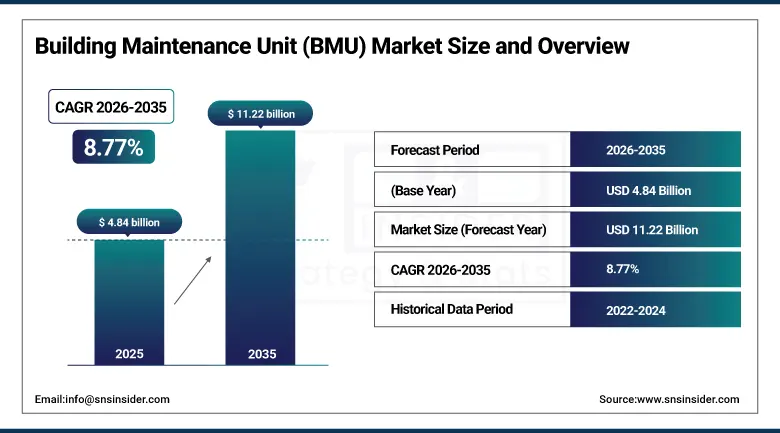
The Building Maintenance Unit (BMU) Market was valued at USD 4.84 billion in 2025 and is expected to reach USD 11.22 billion by 2035, growing at a CAGR of 8.77% from 2026-2035.
Building Maintenance Unit (BMU) Market is growing due to the rising construction of high-rise and complex architectural structures that require advanced façade access solutions. Increasing emphasis on worker safety, stricter regulatory standards, and the demand for automated, efficient maintenance systems are driving adoption. Additionally, rapid urbanization, renovation of aging building infrastructure, and technological advancements such as IoT-enabled BMUs and predictive maintenance features are boosting market expansion.
In 2024, 60% of urban construction projects adopted IoT-enabled BMUs. By 2025, over 75% of building retrofits integrated predictive maintenance systems, enhancing efficiency and safety in high-rise operations.
Building Maintenance Unit (BMU) Market Size and Forecast
-
Market Size in 2025: USD 4.84 Billion
-
Market Size by 2035: USD 11.22 Billion
-
CAGR: 8.77% from 2026 to 2035
-
Base Year: 2025
-
Forecast Period: 2026–2035
-
Historical Data: 2022–2024
To Get More Information On Building Maintenance Unit (BMU) Market - Request Free Sample Report
Building Maintenance Unit (BMU) Market Trends
-
Increasing demand for advanced façade access systems as high-rise construction accelerates across global urban centers
-
Growing adoption of automated and motorized BMUs to improve worker safety and operational efficiency significantly
-
Rising integration of IoT and remote monitoring technologies enabling predictive maintenance and reduced downtime for BMUs
-
Shift toward lightweight, modular, and energy-efficient BMU designs to meet evolving architectural and sustainability requirements
-
Expanding use of customized BMU solutions tailored for complex, curved, and irregular building façade structures worldwide
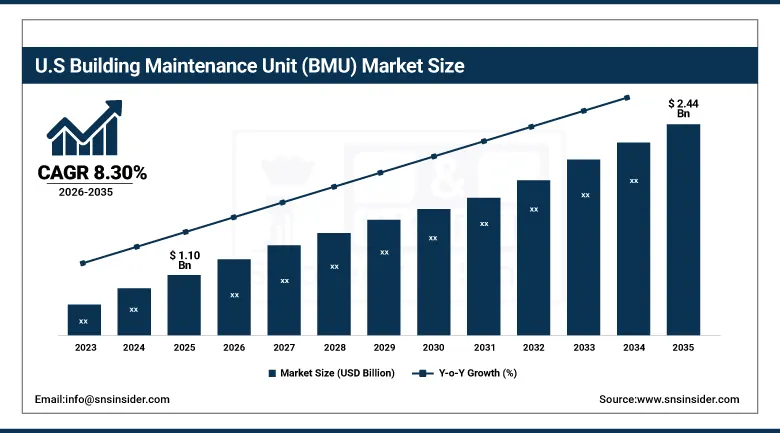
The U.S. Building Maintenance Unit (BMU) Market was valued at USD 1.10 billion in 2025 and is expected to reach USD 2.44 billion by 2035, growing at a CAGR of 8.30% from 2026-2035.
Growth in the U.S. BMU Market is driven by expanding high-rise construction, stricter safety regulations, and increasing investments in modern façade maintenance systems. Rising adoption of automated and energy-efficient BMUs, along with ongoing upgrades to aging commercial infrastructure, is further supporting market demand.
Building Maintenance Unit (BMU) Market Growth Drivers:
-
Rising Global High-Rise Construction Activities Increasing Demand for Advanced BMU Systems to Support Efficient Exterior Maintenance and Window Cleaning Operations
The rapid increase in high-rise and supertall building construction worldwide is significantly boosting the demand for advanced Building Maintenance Units. As modern structures feature complex facades, curved surfaces, and extensive glass exteriors, efficient and reliable maintenance systems are essential for cleaning, inspection, and repair. BMUs enable safe and effective exterior access while minimizing operational downtime. With growing urbanization and development of commercial, residential, and mixed-use towers, developers increasingly rely on technologically advanced BMU systems to support long-term building upkeep and ensure high structural aesthetic standards.
in 2024, global high-rise construction rose by 18%, driving demand for automated BMUs. By 2025, over 85% of new supertall buildings incorporated integrated BMU systems for safer, faster exterior maintenance.
-
Growing Emphasis on Worker Safety and Compliance with Stringent Building Maintenance Regulations Driving Adoption of Automated and Secure BMU Solutions
Increasing global focus on worker safety, combined with stringent building maintenance and safety regulations, is accelerating the adoption of modern, automated BMU systems. Governments and regulatory bodies now require safer access solutions for facade maintenance, reinforcing the need for compliant, secured, and certified equipment. Advanced BMUs equipped with sensors, automated controls, and enhanced fall-protection mechanisms reduce the risk of accidents and improve operational reliability. As building owners prioritize safe working environments and regulatory adherence, demand for high-quality BMU solutions continues to rise across commercial and residential sectors.
In 2024, 65% of new BMU installations included safety automation to meet updated regulations. By 2025, nearly all high-rise projects mandated integrated compliance monitoring and secure access controls for worker protection.
Building Maintenance Unit (BMU) Market Restraints:
-
Complex Structural Requirements and Design Constraints Restrict BMU Integration in Older Buildings and Architecturally Challenging High-Rise Structures
Integrating Building Maintenance Units into older structures or uniquely designed high-rise buildings presents significant challenges due to structural limitations and complex architectural layouts. Many existing buildings lack adequate load-bearing capacity, façade access points, or rooftop space required for BMU installation. Additionally, modern buildings with irregular shapes, curved surfaces, or mixed façade materials demand highly customized BMU solutions, increasing engineering complexity and cost. These structural and design constraints often lead developers to opt for alternative access methods, limiting BMU adoption and slowing market growth.
In 2024, nearly 60% of retrofit BMU projects faced delays due to structural incompatibility. By 2025, design constraints in 45% of high-rise buildings limited seamless integration, especially in heritage zones.
-
Limited Skilled Workforce for BMU Operation and Maintenance Creates Safety Risks and Slows Market Expansion in Emerging Regions
The Building Maintenance Unit market faces considerable restraints due to a shortage of trained professionals capable of safely operating, inspecting, and maintaining BMU systems. In many emerging economies, technicians often lack specialized knowledge of advanced BMU technologies, leading to operational inefficiencies and elevated safety risks. Improper usage or inadequate maintenance can result in system failures, accidents, and regulatory non-compliance, discouraging widespread adoption. This talent gap also increases training costs for building owners and contractors, further hindering market expansion and delaying modernization of façade access solutions.
In 2024, nearly 60% of BMU incidents stemmed from untrained operators; by 2025, over half of emerging economies still lacked certified technicians, delaying adoption and increasing safety violations.
Building Maintenance Unit (BMU) Market Opportunities:
-
Smart City Development and Urban Infrastructure Expansion Boost Requirement for Innovative, Efficient, and Sustainable BMU Solutions
The rapid growth of smart cities and large-scale urban infrastructure projects is significantly increasing demand for modern Building Maintenance Units (BMUs). As cities adopt advanced architectural designs, high-rise structures, and sustainable building practices, the need for efficient façade maintenance solutions becomes more critical. Innovative BMU systems that offer improved safety, energy efficiency, and operational precision are gaining strong traction. Governments and developers are investing in cutting-edge maintenance technologies to support long-term asset management, driving substantial opportunities for BMU manufacturers and solution providers.
In 2024, over 1,200 smart city projects globally adopted advanced BMUs; 2025 sees a 25% rise in high-rise façade maintenance investments, driven by sustainability mandates and safety innovations.
-
Integration of IoT, Sensors, and Predictive Maintenance Technologies Creates New Opportunities for Next-Generation BMU Systems
The adoption of IoT-enabled features, advanced sensors, and predictive maintenance technologies is transforming BMU performance and reliability. These digital enhancements allow real-time monitoring, early fault detection, and data-driven maintenance scheduling, reducing downtime and improving operational safety. Smart BMU systems can track usage patterns, optimize energy consumption, and enhance equipment lifespan. As building owners prioritize automation and intelligent facility management, demand for technologically advanced BMUs continues to grow, creating significant opportunities for manufacturers to develop next-generation systems equipped with connected and self-diagnostic capabilities.
In 2024, over 70% of new BMU deployments integrated IoT sensors for real-time data. By 2025, predictive analytics became standard, cutting maintenance delays by nearly 40% and boosting system reliability.
Building Maintenance Unit (BMU) Market Segment Highlights
-
By Product In 2025, Cradle led the market with 42% share while Telescopic is the fastest-growing segment (2026–2035)
-
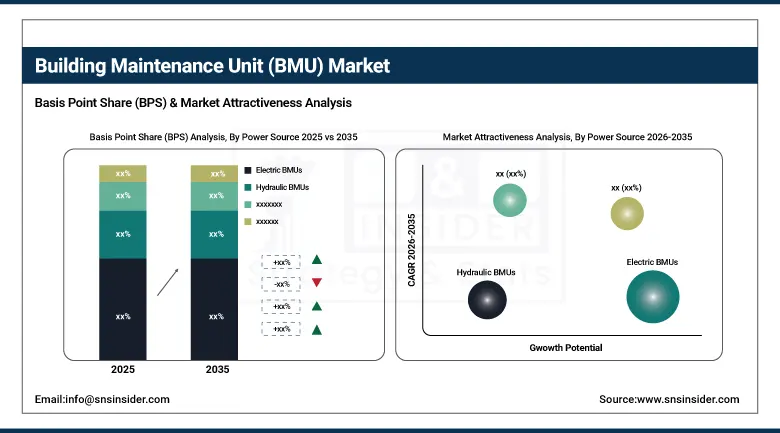
By Power Source In 2025, Electric BMUs led the market with 55% share while Hybrid BMUs is the fastest-growing segment (2026–2035)
-
By Mode of Control In 2025, Full-automatic led the market with 48% share and is also the fastest-growing segment (2026–2035)
-
By End Users In 2025, Commercial & Residential Property led the market with 48% share and is also the fastest-growing segment (2026–2035)
Building Maintenance Unit (BMU) Market Segment Analysis
By Power Source, Electric BMUs segment led in 2025; Hybrid BMUs segment expected fastest growth 2026–2035
Electric BMUs dominated the Building Maintenance Unit Market in 2025 because they offer reliable operation, lower maintenance needs, and improved energy efficiency. Their smooth control systems, reduced noise levels, and suitability for a wide range of building heights make them the preferred choice for modern facade maintenance across commercial and high-rise projects.
Hybrid BMUs are expected to grow fastest from 2026–2035 due to increasing demand for flexible, energy-efficient systems that combine electric and hydraulic advantages. Their ability to handle complex architectural structures, improve load management, and reduce operational costs makes them highly attractive for next-generation building maintenance requirements.
By Product, Cradle segment led in 2025; Telescopic segment expected fastest growth 2026–2035
The Cradle segment dominated the Building Maintenance Unit Market in 2025 because it remains the most widely used access solution for facade cleaning and inspection. Its versatility, ease of deployment, compatibility with various building designs, and cost-efficient operation support strong adoption across large commercial and residential structures.
The Telescopic segment is expected to grow fastest from 2026–2035 due to rising demand for BMUs that can extend reach for complex, irregular, or high-elevation facades. Their ability to operate in constrained spaces and provide enhanced maneuverability makes them ideal for modern architectural designs with challenging geometries.
By Mode of Control, Full-automatic segment led in 2025; Full-automatic segment expected fastest growth 2026–2035
The Full-automatic segment dominated the Building Maintenance Unit Market in 2025 and is expected to grow fastest from 2026–2035 because automation improves safety, operational precision, and efficiency in facade maintenance. Advanced control systems, remote monitoring, and reduced dependency on manual labor make full-automatic BMUs attractive for high-rise buildings. Increasing adoption of digital building management and smart facade maintenance further accelerates demand for fully automated solutions.
By End Users, Commercial & Residential Property segment led in 2025; Commercial & Residential Property segment expected fastest growth 2026–2035
Commercial & Residential Property dominated the Building Maintenance Unit Market in 2025 and is expected to grow fastest from 2026–2035 due to continuous expansion of urban infrastructure and high-rise developments. Demand for regular facade cleaning, safety upgrades, and compliance with building maintenance standards drives strong adoption. Growing investments in premium residential towers and commercial complexes further support sustained growth, while emerging smart building technologies enhance long-term demand for efficient BMU systems.
Building Maintenance Unit (BMU) Market Regional Analysis
North America Building Maintenance Unit (BMU) Market Insights
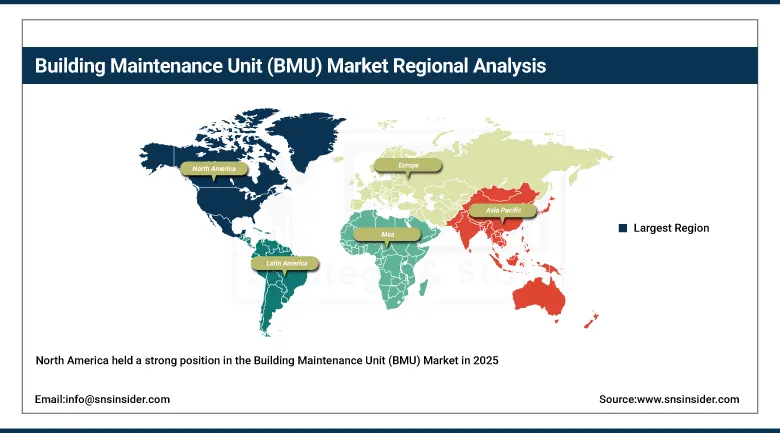
North America held a strong position in the Building Maintenance Unit (BMU) Market in 2025, supported by the presence of advanced infrastructure, high adoption of safety-compliant façade maintenance systems, and steady investments in commercial real estate. The region’s focus on modernization, building refurbishment, and stringent safety regulations further contributed to consistent demand for reliable and technologically advanced BMU solutions.
Get Customized Report as Per Your Business Requirement - Enquiry Now
Asia Pacific Building Maintenance Unit (BMU) Market Insights
Asia Pacific dominated the Building Maintenance Unit (BMU) Market with a 35% share in 2025 due to rapid growth in high-rise commercial and residential infrastructure, strong construction activity, and increasing urbanization, supported by significant investments in building safety systems and advanced façade maintenance technologies. The region is also projected to grow at the fastest CAGR of about 10.00% from 2026–2035, driven by expanding skyscraper development, stricter building safety regulations, rising demand for automated façade access solutions, and accelerating smart city initiatives coupled with continuous technological advancements.
Europe Building Maintenance Unit (BMU) Market Insights
Europe held a strong position in the Building Maintenance Unit (BMU) Market in 2025, supported by its mature construction sector, strict building safety regulations, and widespread adoption of advanced façade maintenance technologies. The region’s focus on energy-efficient buildings, renovation of aging infrastructure, and high standards for operational safety further reinforced its substantial market presence.
Middle East & Africa and Latin America Building Maintenance Unit (BMU) Market Insights
The Middle East & Africa and Latin America together showed steady growth in the Building Maintenance Unit (BMU) Market in 2025, supported by increasing construction activities, rising development of commercial towers, and growing investments in urban infrastructure. Expanding real estate projects, improving safety regulations, and gradual adoption of modern façade maintenance technologies contributed to the regions’ strengthening presence in the market.
Building Maintenance Unit (BMU) Market Competitive Landscape:
Alimak Group AB
Alimak Group AB is a global leader in vertical access and façade access solutions, operating renowned brands such as CoxGomyl and Manntech in the BMU sector. The company delivers advanced building maintenance units, permanent façade access systems, and construction hoists used in high-rise and complex architectural structures. With a strong global footprint, Alimak focuses on safety, engineering innovation, customization, and lifecycle support to meet demanding façade maintenance requirements across commercial, residential, and infrastructure projects.
-
July 8, 2025: Alimak Group announced the acquisition of an industrial elevator business in the U.S., likely strengthening its global vertical-access and BMU capacity.
Sky Climber LLC
Sky Climber LLC is a global provider of suspended access equipment, specializing in modular hoists, platforms, and building maintenance units used for high-rise façade work and industrial applications. With decades of engineering expertise, the company focuses on safety, durability, and efficiency in vertical access solutions. Its systems are widely adopted in construction, maintenance, and energy sectors, supported by strong training programs, service networks, and compliance with international safety standards.
-
September 20, 2025: Sky Climber enters a strategic partnership with Pilosio to bring the “FlyDeck” horizontal suspended platform to North America — expanding its access solution portfolio
Shanghai Shuangbao Machinery (ZLP)
Shanghai Shuangbao Machinery, known for its ZLP series suspended platforms, is a leading Chinese manufacturer of façade access and temporary suspended solutions. The company provides electrically driven platforms, safety components, and customized vertical access systems for construction, glazing, and building maintenance. Its ZLP gondolas are widely exported and recognized for affordability, reliability, and adherence to quality regulations. Shuangbao emphasizes product standardization, large-scale production, and competitive supply capabilities across global markets.
-
June 27, 2024: ShuangBao Machinery is planning to expand its ZLP series suspended platforms across Dhaka and Chittagong, Bangladesh, aiming to strengthen market presence and meet growing demand for advanced access solutions.
Geda GmbH
Geda GmbH is a prominent German manufacturer of vertical access and hoist solutions, offering material hoists, personnel lifts, temporary suspended platforms, and façade access equipment for construction and industrial environments. Known for precision engineering and robust build quality, Geda products support safe and efficient elevation across a variety of heights and load requirements. The company maintains a strong global presence, emphasizing durability, innovation, and compliance with European safety standards, making it a trusted partner in access technology.
-
June 17, 2025: GEDA deployed two elevator/hoist systems (GEDA 300 Z and 500 Z/ZP) to support bridge renovation in Slovenia, contributing to infrastructure maintenance projects.
Building Maintenance Unit (BMU) Market Key Players
-
So Alimak Group AB
-
XSPlatforms
-
Tractel Group
-
Gondola Engineering Ltd
-
Sky Climber LLC
-
Shanghai Shuangbao Machinery (ZLP)
-
Tectron Group (TEC International)
-
Geda GmbH
-
Riwal Safelift
-
Manntech
-
Büro für Fassadentechnik (BFT)
-
Pfeifer DRAKO
-
BMU Technologies FZC
-
Saeclimber
-
Platform Basket Srl
-
ABS Facade
-
SkyReach Lifts
-
RAXTAR Construction
| Report Attributes | Details |
|---|---|
| Market Size in 2025 | USD 4.84 Billion |
| Market Size by 2035 | USD 11.22 Billion |
| CAGR | CAGR of 8.77% From 2026 to 2035 |
| Base Year | 2025 |
| Forecast Period | 2026-2035 |
| Historical Data | 2022-2024 |
| Report Scope & Coverage | Market Size, Segments Analysis, Competitive Landscape, Regional Analysis, DROC & SWOT Analysis, Forecast Outlook |
| Key Segments | • By Product (Cradle, Monorail, Swing Stage, Telescopic) • By Power Source (Electric BMUs, Hydraulic BMUs, Hybrid BMUs) • By Mode of Control (Full-Automatic, Manual, Semi-Automatic) • By End-Use (Commercial & Residential Property, Manufacturing, Educational Institutions, Healthcare, Government, Construction, Others) |
| Regional Analysis/Coverage | North America (US, Canada), Europe (Germany, UK, France, Italy, Spain, Russia, Poland, Rest of Europe), Asia Pacific (China, India, Japan, South Korea, Australia, ASEAN Countries, Rest of Asia Pacific), Middle East & Africa (UAE, Saudi Arabia, Qatar, South Africa, Rest of Middle East & Africa), Latin America (Brazil, Argentina, Mexico, Colombia, Rest of Latin America). |
| Company Profiles | Alimak Group AB (CoxGomyl & Manntech), XSPlatforms, Tractel Group, FBA Gomyl, Gondola Engineering Ltd. (Gondolas Hong Kong), Sky Climber LLC, Shanghai Shuangbao Machinery (ZLP), Tectron Group (TEC International), Geda GmbH, Riwal (Safelift), Manntech, Büro für Fassadentechnik (BFT), Pfeifer DRAKO, Alba Enterprises, BMU Technologies FZC, Saeclimber, Platform Basket Srl, ABS Facade, SkyReach Lifts, RAXTAR |
Frequently Asked Questions
Asia Pacific dominated with a 35% share, driven by accelerated high-rise development, urbanization, and strong investments in advanced building maintenance technologies.
The Cradle product segment dominated due to its versatility, cost-efficiency, and widespread usage for façade cleaning across commercial and residential buildings.
Rapid high-rise construction, stricter global safety regulations, and increasing adoption of automated and IoT-enabled BMU systems are driving strong market expansion.
The Building Maintenance Unit Market size in 2025 was USD 4.84 billion, supported by strong adoption of automated, safety-focused façade access solutions.
The market is expected to grow at a CAGR of 8.77% driven by rising high-rise construction and increasing demand for advanced façade maintenance systems.
