
CBD Nutraceuticals Market Report Scope & Overview:
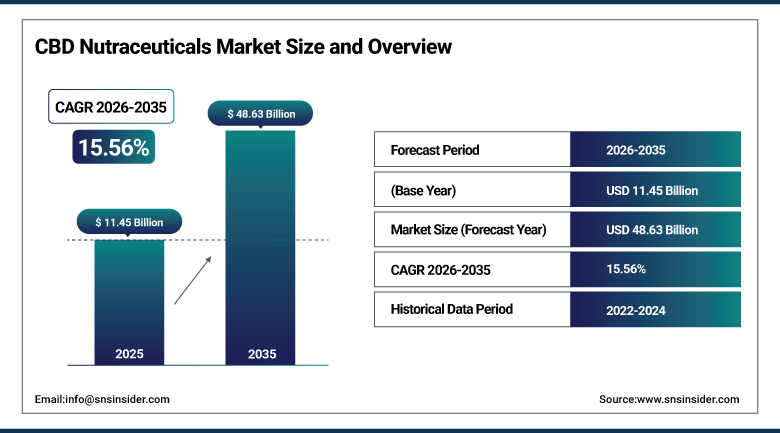
The CBD Nutraceuticals Market was valued at USD 11.45 Billion in 2025 and is expected to reach USD 48.63 Billion by 2035, growing at a CAGR of 15.56% from 2026-2035.
The CBD Nutraceuticals Market covers dietary supplements, functional foods, and wellness products formulated with cannabidiol, a non-intoxicating compound extracted mainly from hemp. Consumers use these products to support relaxation, sleep, recovery, and everyday comfort, and manufacturers deliver the ingredient as oils, gummies, capsules, beverages, and topicals. Demand is shaped by rising wellness spending, wider retail availability, and growing interest in plant-based alternatives to conventional remedies. Regulation remains the defining variable, since agencies in several regions are still clarifying how CBD may be sold as a food or supplement. Water-soluble formulations, third-party testing, and full-spectrum extracts are now central to brand positioning.
⮞A survey of 47,100 adults published in Drug and Alcohol Dependence Reports in October 2024 found that 20.6% of U.S. adults reported past-year CBD use in 2022. Participation at that scale shows how mainstream the category has become.
To Get more information CBD Nutraceuticals Market - Request Free Sample Report
CBD Nutraceuticals Market Trends
- Shift toward water-soluble and fast-acting nanoemulsion formulations
- Rising use of third-party certificates of analysis to build consumer trust
- Growth of functional gummies and beverages that combine CBD with sleep and calm ingredients
- Expansion of pharmacy and mainstream retail shelf space for hemp-derived supplements
- Movement toward minor cannabinoid blends and full-spectrum extracts
U.S. CBD Nutraceuticals Market Outlook
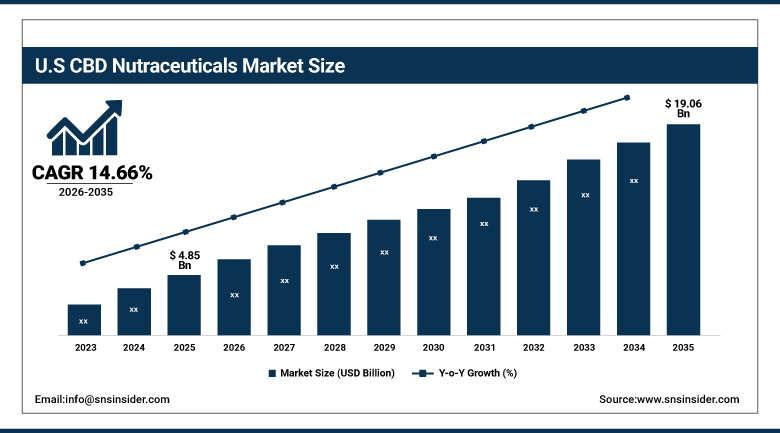
The U.S. CBD Nutraceuticals Market was valued at USD 4.85 Billion in 2025 and is expected to reach USD 19.06 Billion by 2035, growing at a CAGR of 14.66% from 2026-2035.
The U.S. CBD Nutraceuticals Market is the largest national market, supported by high consumer awareness, a deep base of established brands, and extensive online and retail distribution. The Agriculture Improvement Act of 2018 legalized hemp with no more than 0.3% delta-9 THC, which opened large-scale cultivation and extraction. The Food and Drug Administration, however, treats CBD as excluded from the dietary supplement definition, so products operate in a gray zone without a clear federal pathway. Brands rely on voluntary testing, state rules, and quality seals to compete, while the pending hemp-THC restrictions add uncertainty for the entire product class.
⮞In September 2026, law firm Foley Hoag reported that President Trump signed H.R. 6500 on 2 September 2026, moving federal hemp-derived THC restrictions from 12 November 2026 to 11 December 2026. The delay gives Congress extra time to draft a regulatory framework.
CBD Nutraceuticals Market Segment Analysis
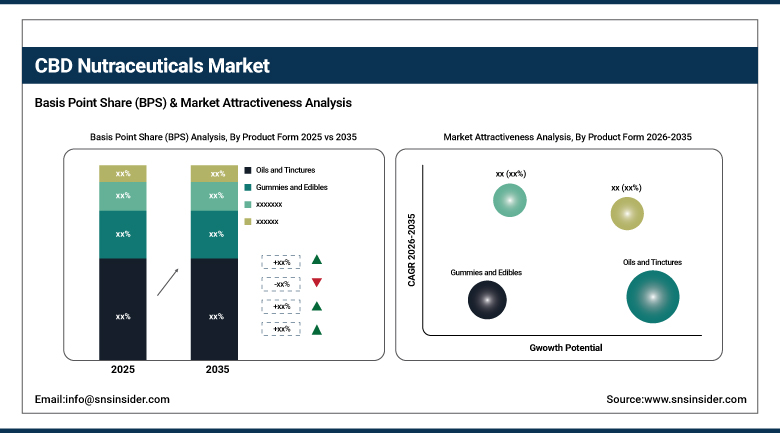
- By Product Form, the Oils and Tinctures segment dominated the CBD Nutraceuticals Market with approximately 38.62% share in 2025, while the Gummies and Edibles segment is the fastest growing with a CAGR of approximately 17.84%.
- By Application, the Pain Management segment dominated the CBD Nutraceuticals Market with approximately 34.18% share in 2025, while the Anxiety and Stress segment is the fastest growing with a CAGR of approximately 17.41%.
- By Distribution Channel, the Online Retail segment dominated the CBD Nutraceuticals Market with approximately 41.27% share in 2025, while the Pharmacies and Drugstores segment is the fastest growing with a CAGR of approximately 17.93%.
- By Source, the Hemp-Derived segment dominated the CBD Nutraceuticals Market with approximately 81.00% share in 2025, while the Marijuana-Derived segment is the fastest growing with a CAGR of approximately 16.92%.
By Product Form, Oils and Tinctures Dominate CBD Nutraceuticals Market; Gummies and Edibles to Register Fastest Growth.
Oil and tincture products are the top-selling categories due to the flexibility in dosing, fast sublingual absorption, and simple formulation process of these products, using either full-spectrum or isolate extracts. Experienced users find them useful due to the ability to measure accurately the number of milligrams per serving, while the brands consider them as the key line, forming the portfolio. Moreover, simple ingredients of such products appeal to the customers, and bulk packages provide cheaper cost per dosage compared to all other forms. Also, the easy access of oils and tinctures in various stores strengthens their positions.
Edibles and gummy-type products are the fastest-growing categories, removing the taste barrier and blending naturally with daily activities. New users are attracted by pre-dosed chews with similar form to vitamins. The brands blend CBD with melatonin or botanics for specific effects, while retailers have no problems providing shelves for gummy-type products, increasing the trial rate among regular customers who will never buy any dropper bottle.
⮞A study in Frontiers in Public Health, published in February 2026, found that among U.S. adults who had ever used CBD, 26.0% most often used topicals and 25.2% used edibles such as gummies, while 14.6% used tinctures or oils.
By Application, Pain Management Dominates CBD Nutraceuticals Market; Anxiety and Stress to Register Fastest Growth.
Pain management takes top place, since discomfort from working out, sore joints due to aging, and other problems associated with chronic illnesses are the primary reasons why people decide to start using CBD. Consumers seek pain-relieving but non-addictive supplements to accompany their over-the-counter treatments, and both ingestibles and topical treatments are being promoted based on improving mobility and recovery. Moreover, athletes and physically active users increase the demand, since purified CBD is legal in sports and is not banned in competition.
Anxiety and stress become a fast-growing application of CBD products, driven by the trend towards wellness and self-care, as more people try to alleviate their stress naturally without prescription medicines. CBD is often paired with such ingredients as adaptogens, L-theanine, and magnesium to promote relaxation and reduce anxiety. Social networks also play an important role in raising awareness about these health benefits. The need for sleep and insomnia solutions also keeps growing as a related area. Younger adults are the primary demand group in this case.
⮞A Gallup poll released in August 2019 found that among Americans who use CBD products, 40% cited pain, 20% anxiety, and 11% sleep or insomnia as their main reason for use.
By Distribution Channel, Online Retail Dominates CBD Nutraceuticals Market; Pharmacies and Drugstores to Register Fastest Growth.
Online retail is the leading channel as there have been restrictions from the payment processors, ad networks, and mass merchants with respect to CBD, forcing companies to go directly to consumer websites. The subscription model, lab reports, and educational content will create customer loyalty as well as giving the manufacturer the ability to have control over the price and customer data. In addition, marketplaces and the brand website will help reach the consumer in those markets where there are restrictions on the physical availability. This will be true for both mature and new brands.
The pharmacies and drugstores are seeing rapid growth due to the framework being created by the regulatory bodies and retailers for supervised distribution channels. The role of the pharmacist in guiding the consumer in getting a safe dosing will create consumer confidence. In addition, it provides national coverage and has wide geographic reach. Some of the countries already permit pharmacist dispensation of low-dose products, hence creating legitimacy for the channel. The specialty store, dispensary, and health food retailer will continue to be relevant.
⮞Australia's Therapeutic Goods Administration allows pharmacists to supply low-dose cannabidiol to adults without a prescription at a maximum of 150 mg per day, limited to approved products.
By Source, Hemp-Derived Dominates CBD Nutraceuticals Market; Marijuana-Derived to Register Fastest Growth.
Hemp-derived CBD dominates because hemp is federally legal in the United States under the 2018 Farm Bill and accepted in most European and Asian markets when THC remains below prescribed limits. Farmers can grow it widely, extractors can scale production, and brands can ship across state lines. Lower THC content also fits the non-intoxicating wellness positioning that mainstream retailers and consumers expect from supplements. Supply chains for seed, biomass, and processing equipment are more mature than those for alternatives.
CBD derived from marijuana is expanding faster from a relatively lower base due to growth in both medical and recreational use programs, as well as licensed producers coming up with strains of high-CBD content. These products are being distributed through licensed dispensaries and make their way to consumers that require controlled access, in many cases in more potent forms. Tightened regulations on intoxicating cannabinoids derived from hemp may shift consumer and investments’ attention to licensed markets, enabling above average growth in this sector.
⮞The U.S. Department of Agriculture's National Hemp Report, released in April 2026, showed that floral hemp harvested area reached 16,880 acres in 2025, up 43%, producing 33.2 million pounds, up 60%.
Regional Analysis
|
Region |
Major Country |
Share within Region, 2025 (%) |
|---|---|---|
|
North America |
United States |
87.46% |
|
Europe |
United Kingdom |
29.41% |
|
Asia Pacific |
Japan |
27.94% |
|
Latin America |
Brazil |
46.12% |
|
Middle East & Africa |
South Africa |
28.57% |
North America CBD Nutraceuticals Market Insights
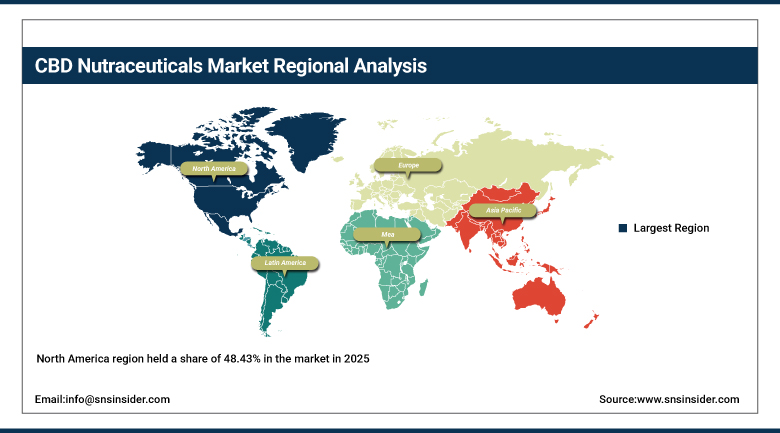
The North America region held a share of 48.43% in the market in 2025 owing to the early availability of cannabinoid-based wellness products in the US along with rising interest in Canada. Established brands have an advantage with their widespread distribution, excellent e-commerce presence, and awareness among consumers about CBD products. Most of the demand comes from the United States, but the regulators in Canada are studying the creation of a separate channel through which CBD health products can be excluded from the cannabis licensing program.
Federal uncertainty is the main force shaping regional strategy. Without a defined route for CBD in foods and supplements, companies invest in quality assurance, state-level compliance, and engagement with lawmakers. Pending legislation on hemp-derived THC limits, minimum purchase ages, and serving caps may either consolidate the market around compliant operators or reduce product variety. Mexico is counted within Latin America in this report, so regional figures here cover the United States and Canada only. Large retailers, meanwhile, wait for clearer rules before widening assortments.
⮞In January 2026, Health Canada published its What We Heard report, noting that 135 submissions were received on a pathway for CBD health products and that most respondents opposed requiring a Cannabis Drug Licence for CBD natural health products.
Get Customized Report as per Your Business Requirement - Enquiry Now
Europe CBD Nutraceuticals Market Insights
Europe with the United Kingdom, Germany, Switzerland, France, and the Netherlands being home to some of the most vibrant consumer markets. CBD is recognized as novel foods, and products must obtain authorizations before being sold as supplements; this has somewhat hindered the process of market development. Producers can still distribute their brands through the available listings, and there are efforts to conduct safety assessments that will determine appropriate dosages and types of products to be offered within member countries. Consumer demand for organically grown hemp plants creates an opportunity for producers to source locally and position premium products.
The current regulatory development creates a bright future opportunity for companies that comply with regulations. European regulators have already set provisional safety levels and are currently evaluating applications for CBD products, while Switzerland has its own procedures of authorization. Companies that have sufficient toxicological data and isolates that are highly purified are better placed to compete in the market. There are well-established pharmacy and health food routes, and consumers have a preference for organically cultivated, traceable, and testable products with labels.
⮞In February 2026, the European Food Safety Authority set a provisional safe level of 0.0275 mg per kilogram of body weight per day for CBD, roughly 2 mg per day for a 70 kg adult.
Asia Pacific CBD Nutraceuticals Market Insights
Asia Pacific region is the fastest-growing region at a CAGR of 18.16% during 2026 to 2035, driven by countries like Japan, Australia, Thailand, South Korea, and China. Increased wellness expenditure, increasing middle-class population, and loosening regulations are expanding the addressable consumer base. However, since there are huge variations in country-specific regulations, companies follow market-by-market strategies and often enter into partnerships with local distributors who understand the requirements of licensing, testing, and labeling. The increased presence of e-commerce will also help with cross-border sales of imported wellness products, wherever allowed.
CBD-containing products extracted from hemp stalks and seeds without any presence of THC are allowed in Japan, while Australia permits the sale of low-dose products through pharmacists only. In China, CBD-containing products for cosmetic use and consumer supplements are not allowed, but it is still an important destination for industrial hemp product processing. Extract regulation in Thailand has become stringent after being liberalized. Such different stances ensure uneven growth with the highest growth in those destinations where there are clear pharmacy or retail routes.
⮞A Thai Ministerial Regulation published in the Royal Gazette on 26 March 2026 took effect on 26 April 2026, keeping extracts with more than 0.2% THC by weight classified as narcotics.
MEA & Latin America CBD Nutraceuticals Market Insights
Latin America is developing as Brazil, Colombia, and Mexico build regulatory structures for cannabis-derived products. Mexico is counted within this region in market estimates and has authorized supplements, foods, and cosmetics containing low levels of THC. Brazil allows CBD sales through compounding pharmacies, and Colombia regulates industrial use of non-psychoactive plant components in foods, beverages, and supplements. Local cultivation and favorable climates support future export-oriented supply. Growing urban middle classes and a strong tradition of herbal remedies also create receptive consumers for plant-based wellness products across the region.
⮞In February 2022, the Colombian Ministry of Health issued Resolution 227, regulating Decree 811 of 2021 on the industrial use of the non-psychoactive component of the cannabis plant in food, beverages, and dietary supplements.
The Middle East and Africa region is at an earlier stage. South Africa has created an exemption for low-dose CBD complementary medicines, offering a defined legal route, while Gulf states take stricter positions and prohibit cannabis ingredients in many food and supplement categories. Israel has begun normalizing low-THC CBD under health ministry supervision. Medical tourism, premium wellness retail, and rising consumer awareness could expand opportunities where rules become clearer. Retail pharmacies and online platforms are the most likely early channels for authorized products in the region.
⮞South Africa's health regulator issued Government Notice 586 on 22 May 2020, listing CBD in Schedule 4 with an exception for complementary medicines containing up to 600 mg CBD per pack and a maximum daily dose of 20 mg.
Market Dynamics
Growth Drivers: Rising Wellness Spending and Mainstream Consumer Adoption Drive Growth in the CBD Nutraceuticals Market
Adoption has shifted from curiosity to regular consumption. Many millions of people are already using CBD to help with relaxation, sleep, and recovery, and repeated purchases are enabled through subscription services and loyalty rewards programs. Acceptance among mature consumers and even athletes ensures that the target group extends far beyond just early adopters. Collaboration with retailers and pharmacies, along with better consumer education, helps to drive down reticence and trial usage of new formats to enable sustained growth at a double-digit rate per annum. The process is accelerated further through word-of-mouth, influencer education, and the willingness of physicians to discuss supplements, leading to repeated purchase behavior over the next decade.
Product innovation remains another key driver in the industry. The development of water dispersible nano-emulsions, quick action gummies, functional beverages, or formulas with melatonin and adaptogens improves the efficacy of the products in tackling certain health problems. As the volume of agricultural goods increases, the problem of raw materials becomes less severe because farmers produce more floral hemp. Better extraction techniques and greater ability to analyze make it easier for brands to build trust and create a brand new category of products and go global within the forecasted period. The interest in dosages and absorption in the course of clinical studies forces brands to generate research results, thus increasing their credibility and allowing premium pricing.
⮞A national survey published in JAMA Network Open in December 2023 reported that 21.1% of U.S. adults used CBD in the past year.
Restraints: Regulatory Uncertainty and Product Quality Concerns Restrain Growth in the CBD Nutraceuticals Market
The biggest constraint is regulatory uncertainty. As per the Food and Drug Administration, CBD is not allowed to be added to foods in interstate commerce or sold as a dietary supplement. Moreover, the pending regulations by the federal government on THC from hemp have imposed a limit of up to 0.4 mg of THC per container. This means that a lot of intoxicating products will get off the shelves. In addition, banks, media, and retailers are cautious about their involvement, thus limiting the sales and increasing costs of compliance. Payment processing and shipping constraints also present additional hurdles for businesses that operate across the nation.
The issue of quality is an aspect that makes the consumer lose confidence. Independent tests have proven that some products have either too much or too little of the substance, while some have been tested to have traces of THC that cause health problems to athletes and people who drive cars. The smaller companies do not have the means to carry out proper testing, and counterfeit products are harming the image of the category. Due to the inconsistent regulations, compliance with the regulations is costly for compliant operators, while the informal competition is not subject to any form of regulation.
⮞A study in the Journal of the American Medical Association in November 2017 found that of 84 CBD products bought online, only 30.95% were accurately labeled and THC was detected in 21.43%.
Opportunities: Regulatory Clarity and Pharmacy Channel Expansion Create Opportunities in the CBD Nutraceuticals Market
Regulatory certainty will open up many possibilities. The regulatory frameworks in the UK, EU, and Canada are gravitating towards dosage, product type, and purity criteria that are advantageous for firms with strong safety profiles. Authorized products will have the ability to reach the mass market without being perceived as being part of the gray market segment. Early investments in toxicological tests, production certification, and clear supply chain will put such firms at a competitive advantage going forward. In addition, early authorization offers data protection for the firm, which encourages investment in safety tests and prevents imitation by firms joining the market later on.
More avenues through the pharmacy and healthcare routes may be explored. The dispensation of products by pharmacists, procurement through group buying, and piloting in managed care may help reach CBD to older consumers who are guided by experts. Emerging regions in Asia and Latin America will provide an opportunity to formulate locally, form partnerships, and have contract manufacturing done. Other applications in pet wellness, sports nutrition, and sleep aid are areas where formulation differentiation may create product positioning at premium pricing levels and repeat business. Co-marketing ventures with clinicians and wellness specialists may further help in building trust, particularly where certification, proper dosing instructions, and use information is provided.
⮞A UK Food Standards Agency paper updated on 19 October 2026 recommended authorizing three CBD novel food applications, covering about 3,000 products on the CBD Public List, with a provisional acceptable daily intake of 10 mg per day for adults.
Recent Developments:
- In January 2026, cbdMD closed the acquisition of substantially all assets of Bluebird Botanicals, a hemp extract and CBD maker founded in 2012. The asset purchase was paid through an initial issuance of shares plus earnout shares, consolidating two established hemp brands. The deal adds a loyal customer base and a long-established tincture and gummy portfolio.
- In August 2026, Charlotte's Web launched Route CBD, a pop-up truck advocacy and sales tour along the California-Nevada border from Las Vegas to Stateline. The tour supports customers who depend on full-spectrum hemp CBD products amid federal restrictions. The campaign highlights the importance of consumer education during regulatory change.
- In August 2026, CV Sciences expanded its PlusHLTH portfolio and launched the PlusHLTH.com e-commerce site, reporting 52 new products introduced since 1 January 2023. The company has also introduced formulas combining plant protein with creatine for active consumers.
- In March 2026, Cornbread Hemp was named exclusive hemp supplier to Alliant Purchasing, a group purchasing organization serving 68,000 provider locations. The program allows accountable care organizations to offer eligible Medicare beneficiaries hemp products, with independent third-party testing required.
CBD Nutraceuticals Market Key Players are:
- cbdMD
- Charlotte's Web
- CV Sciences
- Cornbread Hemp
- Medterra
- Green Roads
- Lazarus Naturals
- Joy Organics
- CBDistillery
- Extract Labs
CBD Nutraceuticals Market Report Scope:
| Report Attributes | Details |
|---|---|
| Market Size in 2025 | USD 11.45 Billion |
| Market Size by 2035 | USD 48.63 Billion |
| CAGR | CAGR of 15.56% From 2026 to 2035 |
| Base Year | 2025 |
| Forecast Period | 2026-2035 |
| Historical Data | 2022-2024 |
| Report Scope & Coverage | Market Size, Segments Analysis, Competitive Landscape, Regional Analysis, DROC & SWOT Analysis, Forecast Outlook |
| Key Segments | • By Product Form (Oils and Tinctures, Gummies and Edibles, Capsules and Softgels, and Others) • By Application (Pain Management, Anxiety and Stress, Sleep and Insomnia, and General Wellness) • By Distribution Channel (Online Retail, Pharmacies and Drugstores, and Specialty Stores) • By Source (Hemp-Derived and Marijuana-Derived) |
| Regional Analysis/Coverage | North America (US, Canada), Europe (Germany, UK, France, Italy, Spain, Russia, Poland, Rest of Europe), Asia Pacific (China, India, Japan, South Korea, Australia, ASEAN Countries, Rest of Asia Pacific), Middle East & Africa (UAE, Saudi Arabia, Qatar, South Africa, Rest of Middle East & Africa), Latin America (Brazil, Argentina, Mexico, Colombia, Rest of Latin America). |
| Company Profiles | cbdMD, Charlotte's Web, CV Sciences, Cornbread Hemp, Medterra, Green Roads, Lazarus Naturals, Joy Organics, CBDistillery, Extract Labs |

Frequently Asked Questions
Key players in the market include cbdMD, Charlotte's Web, CV Sciences, Cornbread Hemp, Medterra, and Green Roads, among others.
Key opportunities include regulatory clarity in the United Kingdom, the European Union, and Canada, and expansion through pharmacy and healthcare channels.
Rising wellness spending and mainstream consumer adoption are the major growth factors, supported by product innovation in gummies, beverages, and water-soluble formats.
The Oils and Tinctures segment dominated the market in 2025 with approximately 38.62% share, because they allow flexible dosing and quick sublingual absorption.
North America dominated the market in 2025 with approximately 48.43% share, reflecting early commercialization of hemp-derived wellness products in the United States.
