
Healthcare Contract Research Organization Market Report Scope & Overview:
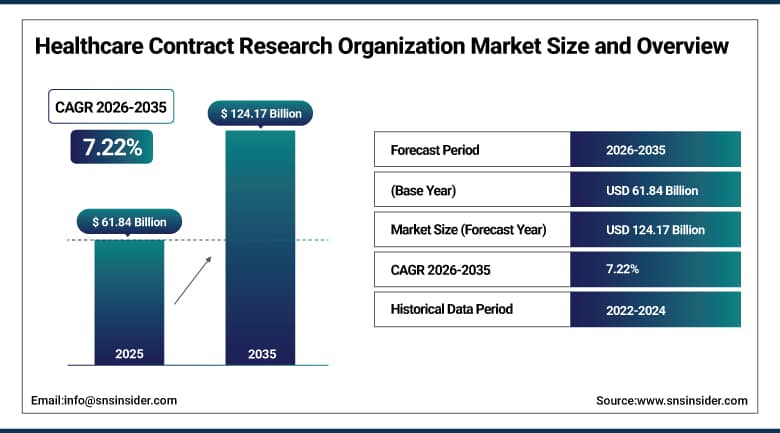
The Healthcare Contract Research Organization Market was valued at USD 61.84 Billion in 2025 and is expected to reach USD 124.17 Billion by 2035, growing at a CAGR of 7.22% from 2026-2035.
The Healthcare Contract Research Organization Market is expanding as drug and device sponsors shift more of their research spending to specialist partners. Rising protocol complexity, cell and gene therapy pipelines and global recruitment needs make outsourcing the default route for most biotech companies. Large providers now sell integrated services that span discovery, preclinical safety, clinical trials and regulatory support. Artificial intelligence is changing site selection, feasibility and data review. Regulators in the United States, Europe and Asia are streamlining trial approvals. Funding cycles in biotechnology still influence demand, and consolidation continues. Asia Pacific is adding site capacity at a fast pace. The market is expected to grow as pipelines widen and sponsors seek faster, cheaper development.
⮞In November 2025, the World Health Organization reported through its Global Observatory on Health R&D that cumulative clinical trial registrations had reached 197,090 for the United States. The scale of registered research shows the large base of studies that sponsors place with contract research providers.
To Get More Information On Healthcare Contract Research Organization Market - Request Free Sample Report
Healthcare Contract Research Organization Market Trends:
-
Wider use of artificial intelligence for site selection, protocol design and data review
-
Growth of decentralized and hybrid trial models supported by remote data capture
-
Rising demand for early-phase, translational and new approach methodology services
-
Consolidation among mid-sized providers and acquisitions of specialty laboratories
-
Expansion of trial capacity in Asia Pacific, Latin America and the Middle East
U.S. Healthcare Contract Research Organization Market Outlook:
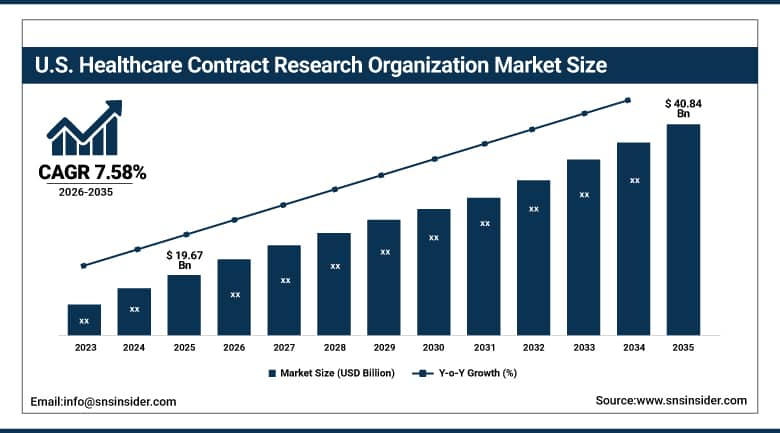
The U.S. Healthcare Contract Research Organization Market was valued at USD 19.67 Billion in 2025 and is expected to reach USD 40.84 Billion by 2035, growing at a CAGR of 7.58% from 2026-2035.
The U.S. Healthcare Contract Research Organization Market is the largest national market, anchored by the headquarters of the biggest providers and by a deep pool of biotech sponsors. Most global pharmaceutical companies run their largest trial programs through U.S. sites. The Food and Drug Administration is modernizing early development rules and promoting new approach methodologies. Venture funding and public biotech financing shape demand for small sponsors. Academic medical centers and community oncology networks supply patients. Specialty laboratories and bioanalytical facilities add capacity for biologics. Security rules on foreign biotechnology suppliers are prompting sponsors to review vendors. Demand is expected to rise with advanced therapy trials and wider use of real-world data.
⮞In September 2026, the U.S. Food and Drug Administration launched an Expedited IND Pilot Program, accepting applications until 30 October 2026. The program signals faster early-stage review, which supports earlier start of trials run by contract research providers.
Healthcare Contract Research Organization Market Segment Analysis:
-
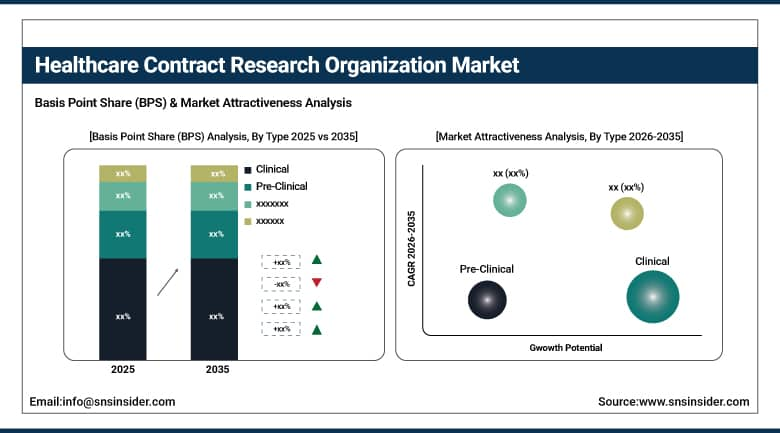
By Type, the Clinical segment dominated the Healthcare Contract Research Organization Market with approximately 64.88% share in 2025, while the Pre-Clinical segment is the fastest growing with a CAGR of approximately 8.94%.
-
By Service, the Clinical Monitoring segment dominated the Healthcare Contract Research Organization Market with approximately 18.83% share in 2025, while the Regulatory and Medical Affairs segment is the fastest growing with a CAGR of approximately 8.46%.
-
By Therapeutic Area, the Oncology segment dominated the Healthcare Contract Research Organization Market with approximately 27.58% share in 2025, while the Infectious Diseases segment is the fastest growing with a CAGR of approximately 9.69%.
-
By End User, the Pharmaceutical and Biopharmaceutical Companies segment dominated the Healthcare Contract Research Organization Market with approximately 59.66% share in 2025, while the Medical Device Companies segment is the fastest growing with a CAGR of approximately 8.52%.
By Type, Clinical Dominates the Healthcare Contract Research Organization Market and Pre-Clinical Grows Fastest
Clinical research remains the largest type because most sponsor spending falls in Phase II and Phase III studies, which need many sites, patients and monitors. Large providers hold master service agreements with global pharmaceutical companies and can open sites across dozens of countries within weeks. Oncology, cardiovascular and metabolic programs generate multi-year trials with heavy data management and safety reporting. Sponsors also prefer a single partner for monitoring, biostatistics and regulatory submission, which keeps clinical revenue concentrated in a few global firms. Rising protocol complexity and longer trials increase the hours billed per study, which supports value even when trial counts are flat.
Pre-clinical services are growing fastest because biotech sponsors need toxicology, pharmacology and bioanalytical packages before they can file an investigational new drug application. The shift toward new approach methodologies, such as organoids, human-cell assays and computational models, is creating demand for specialized laboratories that can replace or reduce animal studies. Cell and gene therapy developers need custom safety and biodistribution work, and antibody-drug conjugate programs require complex bioanalysis. Providers with GLP-compliant labs and imaging capabilities are adding capacity, while Asian laboratories win work on cost and speed.
⮞In January 2026, Inotiv announced it would add LifeNet Health's TruVivo hepatic platform, which pairs primary human hepatocytes with feeder cells, to its discovery and translational sciences offering. The addition shows how preclinical providers are building new approach methodology capabilities.
By Service, Clinical Monitoring Dominates the Healthcare Contract Research Organization Market and Regulatory and Medical Affairs Grows Fastest
Clinical monitoring leads service demand because every interventional trial requires site visits, source data review and compliance checks. Large global studies may involve hundreds of sites, and sponsors outsource monitoring to control cost and keep staffing flexible. Risk-based monitoring has changed the work toward centralized review and targeted visits, yet monitoring still accounts for the largest block of billable hours in most contracts. Site networks and dedicated research nurses are gaining importance, since recruitment speed often determines study timelines. Providers invest in remote monitoring platforms to lower travel cost and give sponsors earlier visibility into protocol deviations.
Regulatory and medical affairs services are growing fastest because sponsors face a heavier and faster-changing rulebook. The revised ICH GCP guideline, the European Clinical Trials Regulation, new device rules and country-level reforms require specialist knowledge for submissions and inspections. Small and mid-sized biotechs rarely hold this expertise in-house, so they buy dossier preparation, agency meetings and post-approval support from providers. Rare disease and advanced therapy programs add demand for early scientific advice and accelerated pathways, and strategy consulting sold alongside clinical operations lifts the average contract value.
⮞In February 2026, ICON added the Brian Moran Cancer Institute to its Accellacare network, which now has more than 50 sites. The expansion shows how providers are building owned site networks to speed enrollment.
By Therapeutic Area, Oncology Dominates the Healthcare Contract Research Organization Market and Infectious Diseases Grows Fastest
Oncology is the largest therapeutic area because cancer holds the biggest share of the global drug pipeline and its trials are long, data-heavy and biomarker-driven. Sponsors need access to specialist centers, central pathology and molecular testing, which favors providers with dedicated oncology teams. Immuno-oncology, antibody-drug conjugates and cell therapies have raised study complexity and the number of arms per program. Adaptive and basket designs require sophisticated statistics and data management. Providers that combine site networks, imaging and real-world evidence can run entire oncology programs, and large sponsors increasingly award multi-trial portfolios to a small set of partners.
Infectious diseases are growing fastest as vaccine, antiviral and antimicrobial resistance programs gain public funding and regulatory priority. Pandemic preparedness investments, new RSV, influenza and combination vaccines, and urgent need for novel antibiotics create steady trial demand. Human challenge studies and rapid-enrollment designs rely on specialist units and laboratories. Trials often run in several climate zones and regions, which suits providers with established sites in Asia, Africa and Latin America. Government and philanthropic funders also contract providers directly, widening the customer base beyond commercial sponsors.
⮞In May 2026, Parexel reported that over the past five years it had supported more than 560 oncology studies across over 104,000 patients. The record shows the depth of CRO experience in cancer trials.
By End User, Pharmaceutical and Biopharmaceutical Companies Dominates the Healthcare Contract Research Organization Market and Medical Device Companies Grows Fastest
Pharmaceutical and biopharmaceutical companies account for the largest share of demand because they run the most and the largest trials. Big pharma uses strategic partnerships with a few providers to cover capacity, while emerging biotech firms outsource nearly all development because they lack infrastructure. Sponsors seek flexible staffing through functional service models, which allows them to scale resources without hiring. Pressure to shorten timelines and reduce fixed cost leads sponsors to hand over larger parts of the development process. Providers meet this need with integrated offerings, data platforms and AI tools that cut study start-up time.
Medical device companies are growing fastest as regulators demand stronger clinical evidence under new rules in Europe and tighter expectations in the United States. Device makers often lack large clinical teams, so they engage providers for pivotal trials, post-market studies and registries. Digital therapeutics, wearable sensors and robotic surgery systems create trials with unusual endpoints and software validation needs. Providers with device specialists, ethics committee access and real-world data sets can win these projects, and the shorter timelines of device studies suit smaller contracts that recur frequently.
⮞In March 2026, IQVIA launched IQVIA.ai, an agentic platform built with NVIDIA, and said 19 of the top 20 pharmaceutical companies had begun incorporating its agents. The launch shows rising adoption of AI tools by sponsors.
Regional Analysis:
|
Region |
Major Country |
Share within Region, 2025 (%) |
|---|---|---|
|
North America |
U.S. |
78.74 |
|
Europe |
Germany |
24.37 |
|
Asia Pacific |
China |
29.26 |
|
Latin America |
Brazil |
47.83 |
|
Middle East & Africa |
Saudi Arabia |
31.58 |
North America Healthcare Contract Research Organization Market Insights
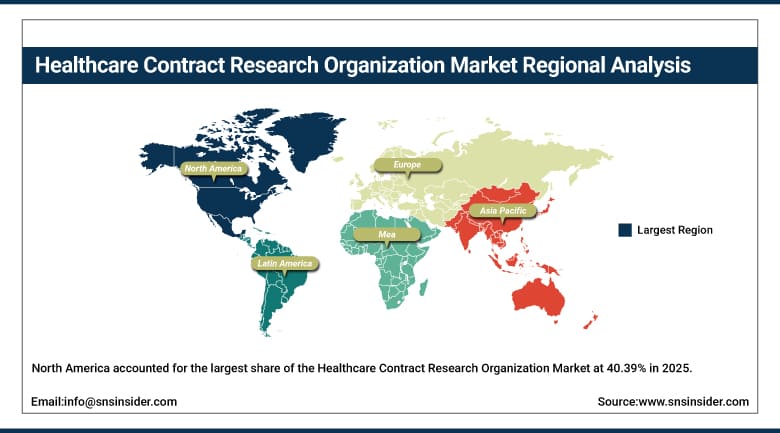
North America accounted for the largest share of the Healthcare Contract Research Organization Market at 40.39% in 2025, led by the United States and supported by Canada. The region hosts the headquarters of the largest providers and most biotech sponsors, and it offers deep investigator and patient pools, advanced laboratories and strong venture funding. Most global pivotal programs include U.S. sites, which gives providers a steady base of work. Hospital systems and community oncology networks are joining site networks to speed enrollment, and sponsors favor partners with established research nurse teams.
Policy is changing the cost and speed of research. The Food and Drug Administration is encouraging new approach methodologies and expedited early development, while Canada is aligning with the revised ICH good clinical practice guideline. Security legislation on foreign biotechnology suppliers is pushing some sponsors to diversify vendors, which may benefit North American laboratories. Biotech funding swings still determine demand from small sponsors, and consolidation among providers continues as buyers seek scale. Cell and gene therapy hubs in Massachusetts, California and North Carolina draw specialized trial work.
⮞In October 2025, Health Canada announced that it would implement the ICH E6(R3) good clinical practice guideline effective 1 April 2026, after a six-month preparatory period. The change aligns Canadian trial oversight with international standards.
Get Customized Report as Per Your Business Requirement - Enquiry Now
Europe Healthcare Contract Research Organization Market Insights
Europe is the second largest region, led by Germany, the United Kingdom, France, Spain and Italy. The region offers diverse patient populations, strong academic centers and a dense network of hospital research units. Many large providers run European hubs in Ireland, the Netherlands and Poland for regulatory and data management work. The Clinical Trials Regulation and the CTIS submission portal have created a single route to approval across member states, although sponsors still report uneven timelines. Medical device makers need new clinical evidence under the Medical Device Regulation, which supports demand for device-focused providers.
Public policy now targets competitiveness. The European Union has set goals to add multinational trials and shorten recruitment times, and the United Kingdom has overhauled its clinical trial regulations to speed approvals. Eastern European countries attract sponsors with fast enrollment and lower cost, while Nordic registries support real-world evidence work. Rising wage costs and the shortage of experienced monitors remain constraints, so providers are investing in centralized monitoring and regional training programs. Brexit-era differences between UK and EU rules add some duplication for sponsors running studies in both markets.
⮞In May 2026, the European Medicines Agency, together with the European Commission and national agencies, published the first quarterly ACT EU progress report, showing that 40.5% of trials recruited within 200 days against a target of 66%. The report quantifies the speed gap that European policy aims to close.
Asia Pacific Healthcare Contract Research Organization Market Insights
Asia Pacific is a large and fast-expanding region, led by China, Japan, India, South Korea and Australia. Sponsors move studies to the region for lower cost, large treatment-naive populations and quick recruitment, particularly in oncology and infectious disease. Chinese providers are among the largest in the world and serve both domestic biotechs and global sponsors, while Australia attracts early-phase work with its tax incentive and fast ethics review. Japan has a mature but costly market with strict data standards, and South Korea is known for hospital-based oncology research.
Asia Pacific is also projected to be the fastest growing region, with a CAGR of 8.84% during 2026-2035. India is expanding capacity under revised clinical trial rules and offers a large pool of English-speaking investigators. China is shortening investigational drug review times and has become a leading source of novel molecules licensed to Western companies. Geopolitical tension and data export rules create uncertainty for cross-border studies, so global providers are building local entities and data centers to serve both domestic and international sponsors.
⮞In January 2026, India's Central Drugs Standard Control Organization notified amendments to the New Drugs and Clinical Trials Rules that cut the statutory processing time for the remaining test licenses from 90 to 45 days. The change reduces start-up time for studies in India.
MEA & Latin America Healthcare Contract Research Organization Market Insights
In Latin America, Brazil is the largest market, followed by Mexico, Argentina and Colombia. The region offers large and diverse patient populations, quick recruitment in oncology, vaccines and metabolic disease, and growing investigator experience. Brazil has launched measures to shorten approval queues and accept international data, and Mexico is increasing public support for clinical research. Currency swings, import permit delays and ethics review times still affect timelines, so providers rely on local offices and experienced regulatory teams. Argentina and Colombia attract vaccine and rare disease studies with experienced hospital groups.
⮞In May 2026, PSI CRO opened a Mexico City office, citing Mexico as the second largest trial market in Latin America. The move shows global providers building local presence to win regional studies.
In the Middle East and Africa, Saudi Arabia, the United Arab Emirates, Qatar, Egypt and South Africa lead demand. Gulf governments are investing in genomics, life sciences zones and reliance-based regulatory pathways that speed approval. South Africa has a long history of vaccine and infectious disease trials, and North African countries are building research infrastructure. Limited numbers of experienced investigators and uneven laboratory standards restrain growth, but government programs and partnerships with global providers are widening capacity. Medical tourism and new university hospitals in the Gulf also support early-phase research units.
⮞In January 2026, the Saudi Food and Drug Authority reported that clinical trial applications for advanced therapies and biotechnology products rose 83% in 2025 compared with 2024. The increase shows the kingdom's growing role in advanced therapy research.
Market Dynamics:
Growth Drivers: Pipeline Expansion and Outsourcing Preference Drive Growth in the Healthcare Contract Research Organization Market
The drug and device pipeline continues to expand, and most new programs come from small and mid-sized biotechs with limited internal infrastructure. These sponsors outsource nearly every step of development, from toxicology to regulatory submission. Cell and gene therapy, antibody-drug conjugates and obesity treatments create complex studies that need specialized laboratories and experienced teams. Large pharmaceutical companies also hand more work to preferred providers through multi-year agreements, which converts fixed cost into variable cost and shortens start-up time. Sponsors also value providers with global safety databases and pharmacovigilance teams, since these functions are costly to build in-house.
Technology and regulation add momentum. Artificial intelligence tools help select sites, predict enrollment and review data faster, and providers sell these tools as part of integrated packages. Regulators in the United States, Europe, India and China are modernizing trial rules, which shortens approvals and encourages global studies. Growth in clinical research capacity across Asia, Latin America and the Middle East gives sponsors faster recruitment and lower cost. Rising chronic disease and an ageing population in major markets keep the pipeline of new treatments full. Public funding for vaccine, oncology and rare disease research adds further volume, particularly from government agencies and foundations that contract providers directly.
⮞In July 2026, China's National Medical Products Administration said 38 innovative drugs had been approved in the first half of the year. The figure points to a strong pipeline of novel molecules that need clinical development support.
Restraints: Funding Volatility, Data Rules and Talent Shortages Restrain Growth in the Healthcare Contract Research Organization Market
Demand from small sponsors depends on capital markets, and funding slowdowns lead to canceled or delayed studies. Backlogs may remain large while new awards slow, which pressures utilization and pricing. Sponsors also negotiate hard on unit prices and push providers toward fixed-fee or outcome-linked contracts. Consolidation among large pharmaceutical customers can reduce the number of independent buyers, and in-house development units at some sponsors compete for the same work. Margin pressure is strongest in large functional service contracts, where buyers compare hourly rates across several providers.
Regulation and talent add friction. Data privacy and localization rules in Europe, China and India complicate cross-border data transfers and raise compliance cost. Security legislation targeting certain foreign biotechnology suppliers has created uncertainty for sponsors that rely on laboratories in some countries. Providers also compete for a limited pool of monitors, data managers and statisticians, which lifts wages. Patient recruitment for rare and pediatric diseases remains slow, and trial delays can erode margins on fixed-price contracts. Cybersecurity requirements and audit demands from sponsors also raise overhead, particularly for smaller providers without dedicated compliance teams.
⮞In December 2025, the U.S. Congress enacted the BIOSECURE Act as part of the fiscal 2026 defense authorization law, restricting federal contracting with certain biotechnology companies of concern. The law adds supply chain risk for sponsors and providers with exposure to those suppliers.
Opportunities: Real-World Data, AI Platforms and Advanced Therapies Create Opportunities in the Healthcare Contract Research Organization Market
Real-world data and artificial intelligence open higher-margin services. Access to large claims and electronic record datasets lets providers support feasibility, external control arms and post-approval studies. AI-based site selection, protocol optimization and enrollment prediction can shorten timelines by months, and sponsors are willing to pay for faster readouts. Providers that own proprietary data assets or partner with data owners can offer differentiated analytics and win more complex programs. Providers with proprietary data partnerships can price these services on value delivered and not on hours worked.
Advanced therapies and rare disease programs create specialized demand. Gene editing, cell therapies and radioligand treatments need custom assays, manufacturing-linked testing and small, tightly managed trials. New approach methodologies are another opportunity, since regulators are encouraging alternatives to animal testing and laboratories that master organoids and in silico models can win new work. Emerging markets with growing investigator capacity give providers additional sites, and device and diagnostics companies seek evidence partners for new regulatory frameworks. Digital biomarkers and wearable sensor data are also creating new endpoints, which needs validated data pipelines and statistical expertise that providers can sell.
⮞In April 2026, Thermo Fisher Scientific's PPD clinical research business announced a collaboration with HealthVerity that gives it access to a claims dataset covering more than 270 million de-identified U.S. patient lives. The agreement supports real-world evidence, feasibility and site selection.
Recent Developments:
-
In February 2026, Worldwide Clinical Trials completed its acquisition of Catalyst Clinical Research, an oncology contract research organization and functional service provider. The combination expands the company's oncology capabilities and flexible resourcing offering for sponsors.
-
In April 2026, Veristat agreed to acquire the regulatory and medical writing business of Certara, with closing expected in the second quarter of 2026. The deal adds regulatory strategy and writing capacity focused on rare disease and oncology programs.
-
In September 2026, Novotech agreed to acquire Agilex Biolabs, an Adelaide-based bioanalytical laboratory, subject to regulatory clearances. The acquisition adds laboratory capability that supports early-phase studies across Asia Pacific.
-
In March 2026, Frontage Laboratories completed its acquisition of Teddy Clinical Research Laboratory, a central laboratory in Shanghai. The deal strengthens Frontage's central laboratory services for global clinical trials in China.
Healthcare Contract Research Organization Market Key Players
-
IQVIA Holdings Inc.
-
Thermo Fisher Scientific Inc. (PPD)
-
Labcorp Holdings Inc.
-
Fortrea Holdings Inc.
-
Syneos Health, Inc.
-
ICON plc
-
Parexel International Corporation
-
Medpace Holdings, Inc.
-
Charles River Laboratories International, Inc.
-
WuXi AppTec Co., Ltd.
-
Pharmaron Beijing Co., Ltd.
-
Hangzhou Tigermed Consulting Co., Ltd.
-
Worldwide Clinical Trials
-
Premier Research International LLC
-
Precision Medicine Group, LLC
-
Novotech
-
Allucent
-
Alimentiv Inc.
-
Linical Co., Ltd.
-
Syngene International Limited
Healthcare Contract Research Organization Market Report Scope:
| Report Attributes | Details |
|---|---|
| Market Size in 2025 | USD 61.84 Billion |
| Market Size by 2035 | USD 124.17 Billion |
| CAGR | CAGR of 7.22% From 2026 to 2035 |
| Base Year | 2025 |
| Forecast Period | 2026-2035 |
| Historical Data | 2022-2024 |
| Report Scope & Coverage | Market Size, Segments Analysis, Competitive Landscape, Regional Analysis, DROC & SWOT Analysis, Forecast Outlook |
| Key Segments | • By Type (Clinical, Pre-Clinical, Drug Discovery, and Others) • By Service (Clinical Monitoring, Project Management, Data Management and Biostatistics, Medical Writing, Regulatory and Medical Affairs, Quality Management, and Others) • By Therapeutic Area (Oncology, CNS Disorders, Infectious Diseases, Immunological Disorders, Cardiovascular Diseases, and Others) • By End User (Pharmaceutical and Biopharmaceutical Companies, Medical Device Companies, Academic and Research Institutes, and Others) |
| Regional Analysis/Coverage | North America (US, Canada), Europe (Germany, UK, France, Italy, Spain, Russia, Poland, Rest of Europe), Asia Pacific (China, India, Japan, South Korea, Australia, ASEAN Countries, Rest of Asia Pacific), Middle East & Africa (UAE, Saudi Arabia, Qatar, South Africa, Rest of Middle East & Africa), Latin America (Brazil, Argentina, Mexico, Colombia, Rest of Latin America). |
| Company Profiles | IQVIA Holdings Inc., Thermo Fisher Scientific Inc. (PPD), Labcorp Holdings Inc., Fortrea Holdings Inc., Syneos Health, Inc., ICON plc, Parexel International Corporation, Medpace Holdings, Inc., Charles River Laboratories International, Inc., WuXi AppTec Co., Ltd., Pharmaron Beijing Co., Ltd., Hangzhou Tigermed Consulting Co., Ltd., Worldwide Clinical Trials, Premier Research International LLC, Precision Medicine Group, LLC, Novotech, Allucent, Alimentiv Inc., Linical Co., Ltd., Syngene International Limited |

Frequently Asked Questions
Key players include IQVIA, Thermo Fisher Scientific (PPD), Labcorp, Fortrea, Syneos Health, ICON, Parexel, Medpace, Charles River Laboratories, WuXi AppTec, Pharmaron, Tigermed, Worldwide Clinical Trials, Premier Research, Precision Medicine Group, Novotech, Allucent, Alimentiv, Linical and Syngene.
Key opportunities include real-world data services, AI-enabled trial design and site selection, new approach methodologies for preclinical work, advanced therapy and rare disease programs, and expanding trial capacity in emerging regions.
Growing pipelines at small and mid-sized biotechs, rising study complexity and the shift to outsourcing are the main growth factors, supported by regulatory modernization and wider use of AI tools.
By Type, the Clinical segment dominated the market in 2025 with an estimated 64.88% share, supported by large multi-site Phase II and Phase III programs that require monitoring, data management and regulatory support.
North America dominated the market with a share of 40.39% in 2025, driven by the headquarters of leading providers, strong biotech funding and large patient and investigator pools.
