
Crab Market Report Scope & Overview:
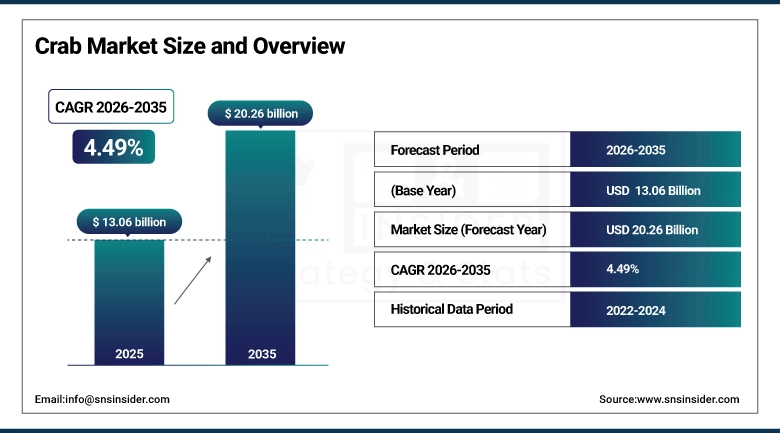
The Crab Market was estimated at USD 13.06 Billion in 2025 and is expected to reach USD 20.26 Billion by 2035 and grow at a CAGR of 4.49% over the forecast period of 2026-2035.
The Crab Market analysis report offers a detailed overview of industry dynamics, highlighting species diversity, product forms, and growing demand in seafood consumption. Increasing preference for fresh and processed crab, culinary innovations, and expanding foodservice and retail channels are expected to drive market growth.
Crab consumption reached 2.8 million metric tons in 2025, driven by rising seafood demand and culinary applications.
Market Size and Forecast:
-
Market Size in 2025: USD 13.06 Billion
-
Market Size by 2035: USD 20.26 Billion
-
CAGR: 4.49% from 2026 to 2035
-
Base Year: 2025
-
Forecast Period: 2026–2035
-
Historical Data: 2022–2024
Crab Market Trends:
-
Growing consumer preference for protein-rich and nutritious seafood is driving demand for fresh and premium crab products.
-
Expansion of crab usage in ready-to-eat meals, gourmet dishes, soups, and processed seafood is broadening its application scope.
-
Rising awareness of omega-3s, vitamins, and other health benefits is boosting consumption among health-conscious consumers.
-
Wider distribution through supermarkets, online seafood platforms, and specialty stores is enhancing market reach.
-
Urban lifestyles and increasing seafood delivery services are promoting convenient formats such as pre-cooked, frozen, and canned crab.
-
Sustainable fishing practices and eco-friendly sourcing are gaining importance, aligning with trends among environmentally conscious consumers.
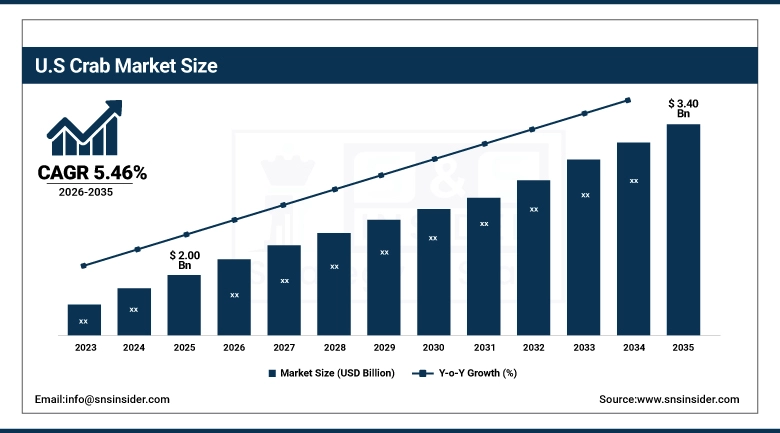
The U.S. Crab Market is projected to grow from USD 2.00 Billion in 2025 to USD 3.40 Billion by 2035, at a CAGR of 5.46%. Market growth is driven by rising health-conscious consumers, increasing demand for fresh, frozen, and ready-to-eat crab products, and expanding adoption in restaurants, processed seafood, and premium retail channels.
Crab Market Growth Drivers:
-
Increasing seafood consumption and preference for high-protein, premium shellfish are strongly driving crab market growth.
Increasing seafood consumption and preference for high-protein, premium shellfish are key drivers of Crab Market growth. Crabs are increasingly valued for their lean protein, omega-3 fatty acids, and mineral content, appealing to health-conscious consumers. Expanding use of crab in gourmet cuisine, ready-to-eat meals, and processed seafood products is accelerating demand. Additionally, growing dining-out culture, seafood delivery platforms, and premium restaurant offerings are reshaping consumer preferences and strengthening market penetration across both developed and emerging economies.
Crab demand increased by 4.2% in 2025, driven by rising seafood consumption and growing preference for high-protein, premium shellfish across foodservice and retail channels.
Crab Market Restraints:
-
Seasonal harvest limitations, overfishing concerns, and price volatility are restricting consistent crab market growth.
Seasonal harvest limitations, overfishing concerns, and price volatility present significant restraints for the Crab Market. Crab supply is highly dependent on fishing seasons, weather conditions, and regulatory quotas, which restrict consistent availability. Sustainability regulations and catch limits, while essential for marine conservation, reduce harvesting volumes and increase operational costs. Additionally, fluctuations in fuel prices, labor expenses, and cold-chain logistics elevate market prices, limiting affordability. These supply-side challenges create sourcing risks for processors and foodservice operators, constraining large-scale expansion and stable market growth.
Crab Market Opportunities:
-
Rising demand for sustainably sourced, value-added and ready-to-eat seafood products is creating strong growth opportunities in the crab market.
Rising demand for sustainably sourced, value-added, and ready-to-eat seafood presents a major opportunity for the Crab Market. Consumers increasingly seek convenient, nutritious, and responsibly harvested seafood options. This is encouraging innovation in pre-cooked, frozen, canned, and flavored crab products tailored for retail and foodservice. Adoption of eco-labels, traceability, and sustainable fishing practices enhances brand credibility. These trends enable product differentiation, expansion into premium segments, and increased penetration across supermarkets, online platforms, and health-focused dining channels.
Value-added and ready-to-eat crab products accounted for 29% of new seafood product launches in 2025, driven by demand for convenient, sustainably sourced protein options.
Crab Market Segmentation Analysis:
-
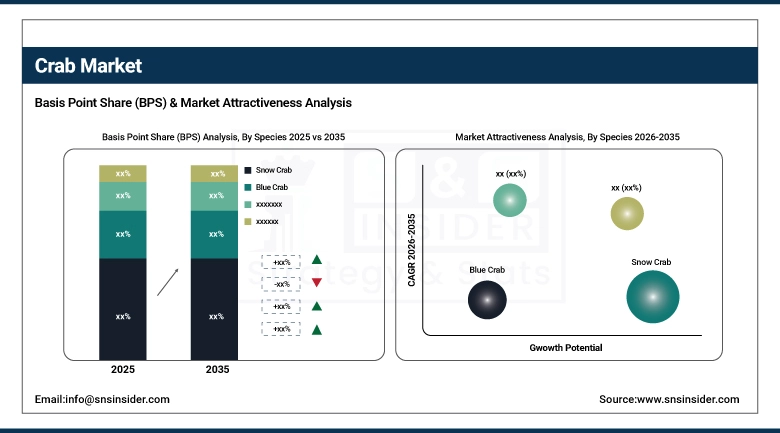
By Species, Snow Crab held the largest market share of 32.45% in 2025, while King Crab is expected to grow at the fastest CAGR of 6.23% during 2026–2035.
-
By Form, Fresh crab accounted for the highest market share of 41.12% in 2025, while Frozen crab is projected to expand at the fastest CAGR of 5.98% during the forecast period.
-
By Application, Seafood Dishes dominated with a 38.67% share in 2025, while Snacks are anticipated to record the fastest CAGR of 6.47% through 2026–2035.
-
By Distribution Channel, Supermarkets/Hypermarkets held the largest share of 35.04% in 2025, while Online Retail is expected to grow at the fastest CAGR of 6.55% during 2026–2035.
-
By End-Use, Household accounted for the largest share of 44.31% in 2025, while Restaurants & Hotels are forecasted to register the fastest CAGR of 5.89% during 2026–2035.
By Species, Snow Crab Dominates While King Crab Expands Rapidly:
Snow Crab segment dominated the market due to its wide availability, balanced pricing, and strong demand across retail and foodservice sectors. Its mild flavor, tender meat, and suitability for seafood dishes, soups, and frozen formats make it a preferred choice among consumers and processors. In 2025, Snow Crab consumption exceeded 910,000 metric tons.
King Crab is the fastest-growing segment, driven by premium dining trends and rising demand in luxury restaurants. In 2025, King Crab demand reached 420,000 metric tons, supported by high-value exports and gourmet consumption. Increasing tourism, chef-driven menus, and luxury seafood branding further accelerate market adoption.
By Form, Fresh Crab Leads While Frozen Crab Gains Momentum:
Fresh segment dominated the market due to strong consumer preference for high-quality, natural, and minimally processed seafood. Restaurants, hotels, and seafood markets heavily rely on fresh crab for premium dishes and live seafood offerings. In 2025, fresh crab consumption surpassed 1.15 million metric tons, driven by coastal demand and traditional culinary practices.
Frozen is the fastest-growing segment, supported by extended shelf life, improved cold-chain logistics, and trade expansion. In 2025, frozen crab volumes crossed 760,000 metric tons, fueled by retail and online seafood platforms. Rising urbanization and demand for convenient, year-round seafood access further accelerate adoption.
By Application, Seafood Dishes Dominate While Snacks Grow Rapidly:
Seafood Dishes segment dominated the market as crab remains a staple ingredient in cuisines such as Asian, North American, and European seafood preparations. Its use in main courses, soups, and restaurant menus sustains strong demand. In 2025, crab used in seafood dishes exceeded 1.02 million metric tons.
Snacks is the fastest-growing segment, driven by innovation in crab chips, spreads, and protein-rich ready-to-eat formats. In 2025, crab-based snack consumption reached 310,000 metric tons, supported by urban lifestyles and convenience food demand. Product premiumization and bold flavor innovations are further accelerating growth.
By Distribution Channel, Supermarkets Dominate While Online Retail Accelerates:
Supermarkets and Hypermarkets segment dominated the market due to their strong cold-storage infrastructure, broad product assortment, and consumer trust. These channels support both fresh and packaged crab sales. In 2025, supermarket-based crab sales exceeded 980,000 metric tons.
Online retail is the fastest-growing segment, driven by digital seafood platforms, doorstep delivery, and rising consumer comfort with purchasing frozen and pre-cooked seafood online. In 2025, online crab sales crossed 520,000 metric tons, supported by urbanization and e-commerce penetration.
By End-Use, Household Consumption Leads While Restaurants Expand Fastest:
Household segment dominated the market as home cooking, festive meals, and health-driven protein intake continue to rise. Easy availability of fresh and frozen crab supports this segment. In 2025, household crab consumption surpassed 1.18 million metric tons.
Restaurants and Hotels are the fastest-growing segment, driven by premium dining, seafood tourism, and menu innovation. In 2025, crab usage across restaurants and hotels reached 740,000 metric tons, fueled by luxury dining and seafood cuisine trends.
Regional Insights:
Asia-Pacific Crab Market Insights:
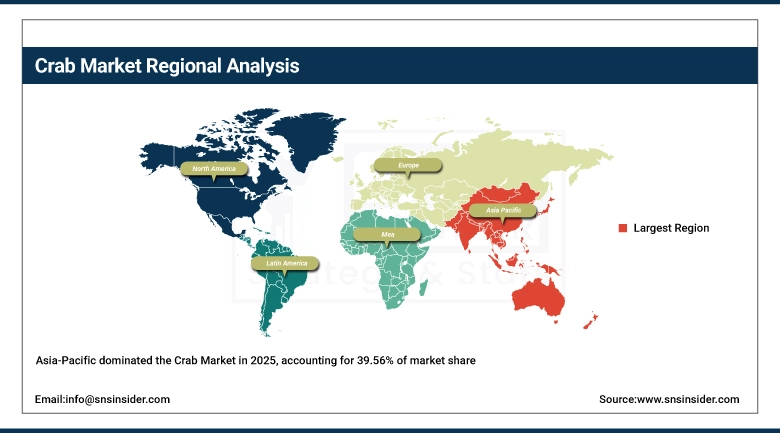
The Asia-Pacific Crab Market dominated with a market share of 39.56% in 2025. Growth is driven by high seafood consumption, strong preference for fresh and premium crab, and rising demand in restaurants, hotels, and processed seafood products across China, Japan, South Korea, and India. Expanding urbanization, adoption of convenient ready-to-eat formats, and growing awareness of protein-rich, healthy diets are fueling market expansion. The region remains the largest and most influential market for crab.
Get Customized Report as per Your Business Requirement - Enquiry Now
China Market Insights:
China’s Crab Market is driven by rising seafood consumption, growing demand for fresh and premium crab, and expanding restaurant and processed seafood sectors. Increasing preference for protein-rich, ready-to-eat formats and high-quality domestic and imported crab products positions China as a key growth contributor in the Asia-Pacific crab market.
North America Crab Market Insights:
North America is the fastest-growing Crab Market, projected to expand at a CAGR of 5.68% during 2026–2035. Rising health-conscious consumers, increasing preference for high-protein seafood, and demand for ready-to-eat and value-added crab products are driving growth. Expanding online seafood retail, restaurant innovations, and premium dining trends further support market development. This combination of convenience, quality, and health-focused consumption positions North America as a leading region for new product launches, seafood innovation, and market expansion.
U.S. Market Insights:
The U.S. Crab Market is driven by rising health awareness, high-protein seafood demand, and growing preference for fresh, frozen, and ready-to-eat products. Expansion in restaurants, processed crab innovations, sustainable sourcing, eco-labels, and e-commerce platforms further fuels growth, positioning the U.S. as a key contributor to the North American crab market.
Europe Crab Market Insights:
The Europe Crab Market is growing due to rising seafood consumption, increasing demand for fresh, frozen, and value-added crab products, and shifting preferences toward high-protein, healthy diets. Germany, the UK, France, and Italy are key contributors, supported by strong restaurant culture, premium dining trends, and expanding retail and seafood infrastructure. Growing adoption in ready-to-eat meals, processed seafood, and gourmet dishes further reinforces Europe’s position as a significant and expanding market for crab.
Germany Market Insights:
Germany is a key Crab Market, driven by strong seafood consumption, rising health-consciousness, and demand for fresh, premium crab. Expanding restaurant offerings, ready-to-eat products, and processed seafood, combined with sustainable sourcing practices and growing retail availability, further strengthen Germany’s position as a leading contributor to the European crab market.
Latin America Crab Market Insights:
The Latin America Crab Market is expected to grow, driven by rising seafood consumption, increasing demand for fresh and processed crab, and expanding restaurant and retail channels in Brazil, Mexico, and Argentina. Growing adoption of ready-to-eat products, premium offerings, and sustainable sourcing practices will further accelerate regional market expansion.
Middle East and Africa Crab Market Insights:
The Middle East & Africa Crab Market is expanding due to rising seafood consumption, increasing demand for fresh, frozen, and value-added crab, and growing restaurant and retail sectors. High-end, sustainably sourced products and strong demand from Saudi Arabia, UAE, and South Africa are key factors driving regional market growth.
Competitive Landscape:
Thai Union Group, headquartered in Bangkok, Thailand, is a leader in seafood production, including crab. The company dominates the market through a fully integrated supply chain, encompassing sustainable sourcing, processing, and distribution. Thai Union offers a diverse portfolio, including fresh, frozen, and ready-to-eat crab products catering to retail, foodservice, and industrial clients. Strong R&D, strategic acquisitions, and commitment to sustainability and quality have enabled Thai Union to maintain a leading position in the crab market.
-
In August 2025, Thai Union Group introduced Crabish plant-based seafood products, expanding sustainable and alternative crab offerings. This launch targeted retail and foodservice channels, emphasizing innovation, sustainability, and consumer demand for protein-rich, environmentally friendly seafood alternatives.
Phillips Foods, Inc., based in Maryland, USA, is a prominent player in the seafood industry, specializing in crab and other shellfish. The company leads the market through premium, high-quality products, including fresh, frozen, and value-added crab offerings. Phillips Foods emphasizes innovation, sustainability, and stringent quality control, ensuring consistent supply to both retail and foodservice sectors. Its strong brand recognition, export capabilities, and focus on health-conscious, protein-rich products have solidified its dominance in the North American and crab markets.
-
In May 2025, Phillips Foods, Inc. launched Crab & Sweet Corn Empanadas and Crab & Mozzarella Arancini, expanding its value-added crab portfolio. These innovative appetizers targeted retail and foodservice channels, enhancing brand presence and responding to growing consumer demand for convenient, high-quality crab products.
Pacific Seafood Group, headquartered in Oregon, USA, is a key leader in the seafood industry with a strong foothold in the crab market. It dominates through vertically integrated operations, including fishing, processing, and distribution, ensuring premium product quality and traceability. The company offers a wide range of fresh, frozen, and processed crab products for retail, foodservice, and industrial clients. Pacific Seafood Group leverages sustainable fishing practices, innovation in ready-to-eat and value-added products, and extensive market reach, establishing itself as a major crab supplier.
-
In March 2025, Pacific Seafood Group unveiled a brand refresh and modernized packaging at Seafood Expo North America. Hundreds of seafood products, including crab offerings, received updated designs, boosting retail appeal, aligning with consumer trends, and strengthening the company’s market presence across North America.
Crab Market Key Players:
-
Thai Union Group
-
Phillips Foods, Inc.
-
Pacific Seafood Group
-
High Liner Foods
-
Trident Seafoods Corporation
-
Clearwater Seafoods
-
Maruha Nichiro Corporation
-
Nippon Suisan Kaisha (Nissui)
-
Supreme Crab & Seafood Inc.
-
Bumble Bee Foods LLC
-
Admiralty Island Fisheries Inc.
-
Maine Lobster Now LLC
-
Mazzetta Co. LLC
-
The J.M. Clayton Company
-
SEA DELIGHT LLC
-
Seaview Crab Co.
-
Pacific Cove
-
Sogelco International Inc.
-
Blue Star Foods Corp.
-
KEYPORT LLC
| Report Attributes | Details |
|---|---|
| Market Size in 2025 | USD 13.06 Billion |
| Market Size by 2035 | USD 20.26 Billion |
| CAGR | CAGR of 4.49% From 2026 to 2035 |
| Base Year | 2025 |
| Forecast Period | 2026-2035 |
| Historical Data | 2022-2024 |
| Report Scope & Coverage | Market Size, Segments Analysis, Competitive Landscape, Regional Analysis, DROC & SWOT Analysis, Forecast Outlook |
| Key Segments | • By Species (Blue Crab, King Crab, Snow Crab, Dungeness Crab, Others) • By Form (Fresh, Frozen, Canned, Processed, Others) • By Application (Seafood Dishes, Soups & Sauces, Snacks, Nutraceuticals, Others) • By Distribution Channel (Supermarkets/Hypermarkets, Seafood Markets, Online Retail, Restaurants, Others) • By End-Use (Household, Restaurants & Hotels, Food Processing Industry, Catering Services, Others) |
| Regional Analysis/Coverage | North America (US, Canada), Europe (Germany, UK, France, Italy, Spain, Russia, Poland, Rest of Europe), Asia Pacific (China, India, Japan, South Korea, Australia, ASEAN Countries, Rest of Asia Pacific), Middle East & Africa (UAE, Saudi Arabia, Qatar, South Africa, Rest of Middle East & Africa), Latin America (Brazil, Argentina, Mexico, Colombia, Rest of Latin America). |
| Company Profiles | Thai Union Group, Phillips Foods, Inc., Pacific Seafood Group, High Liner Foods, Trident Seafoods Corporation, Clearwater Seafoods, Maruha Nichiro Corporation, Nippon Suisan Kaisha (Nissui), Supreme Crab & Seafood Inc., Bumble Bee Foods LLC, Admiralty Island Fisheries Inc., Maine Lobster Now LLC, Mazzetta Co. LLC, The J.M. Clayton Company, SEA DELIGHT LLC, Seaview Crab Co., Pacific Cove, Sogelco International Inc., Blue Star Foods Corp., KEYPORT LLC |
Frequently Asked Questions
Asia-Pacific dominated the market with a 39.56% share in 2025, while North America is the fastest-growing region with a CAGR of 5.68% during 2026–2035.
Snow Crab dominated with a 32.45% share in 2025, while King Crab is projected to grow at the fastest CAGR of 6.23% during 2026–2035.
Growth is driven by rising seafood consumption, demand for premium, high-protein crab, and expanding use in ready-to-eat and gourmet dishes.
The market is valued at USD 13.06 Billion in 2025 and is projected to reach USD 20.26 Billion by 2035.
The Crab Market is expected to grow at a CAGR of 4.49% during the forecast period 2026–2035.
