
Cryptocurrency Exchange Market Report Scope & Overview:
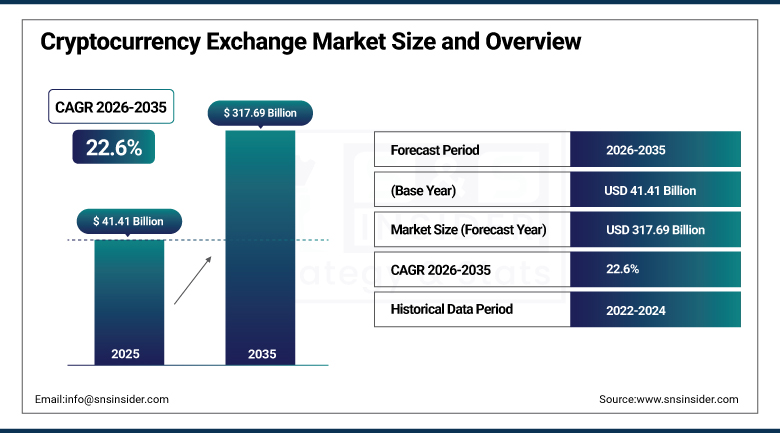
The Cryptocurrency Exchange Market was valued at USD 41.41 Billion in 2025 and is expected to reach USD 317.69 Billion by 2035, growing at a CAGR of 22.6% from 2026 to 2035.
The Cryptocurrency Exchange Market is expected due to rising adoption of cryptocurrency and rising demand for a safe trading environment for long-term investments. Retail and institutional investors generally prefer investing in cryptocurrency exchange market due to which there is convenience in buying, selling, and trading in different cryptocurrencies. Decentralized cryptocurrency exchanges control the level of transparency and control, which increases user confidence, whereas the growth in number of payment systems related to cryptocurrencies, rising demand for a safe trading environment, and technological developments in blockchain technology and cybersecurity are some of the major factors driving growth in this market segment.
In 2025, Binance launched new perpetual futures contracts and Bybit launched an AI-driven risk management system, as the use of cryptocurrency derivatives increased by 11% amid rising trader demand for hedging and leveraged trading strategies.
To Get more information On Cryptocurrency Exchange Market - Request Free Sample Report
Cryptocurrency Exchange Market Trends
-
67% of global crypto trades are conducted via mobile apps, while 43% of major exchanges now integrate DeFi or NFT functionalities.
-
Institutional adoption is one of the strongest drivers of market growth, as banks, asset managers, and hedge funds increasingly offer digital asset exposure to clients.
-
The launch of Bitcoin ETFs in the U.S. has boosted liquidity and confidence, drawing meaningfully more institutional capital into crypto markets.
-
Decentralized exchanges continue expanding through Layer-2 scalability improvements, driven by rising demand for privacy, autonomy, and smart contract-based trading.
-
Hybrid exchanges combining CEX convenience with DEX autonomy are seeing rising adoption as they address liquidity, security, and user-control challenges simultaneously.
U.S. Cryptocurrency Exchange Market Outlook
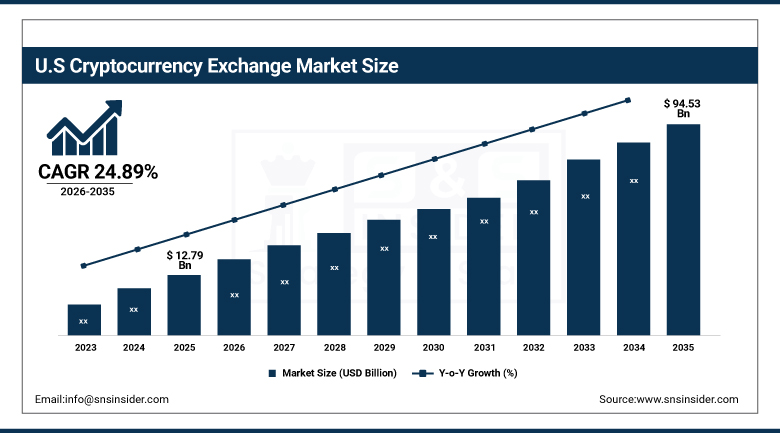
The U.S. Cryptocurrency Exchange Market was valued at approximately USD 12.79 Billion in 2026 and is expected to reach approximately USD 94.53 Billion by 2035, growing at a CAGR of approximately 24.89%.
The United States drives market influenced by the presence of well-developed financial infrastructure, widespread usage of digital currencies and the presence of exchanges such as Coinbase, Kraken, and Binance.US. The combination of regulatory support and significant involvement of institutions has enabled additional growth and trust in the market all across the nation. Increase in the number of payments that use cryptocurrencies, increase in demand for safe and transparent environment and development of blockchain technologies and cybersecurity are some of the key drivers of this market.
Coinbase supported Euro-backed stablecoins in 2025, and Binance implemented instant conversion for stablecoin pairs, advancements that provide meaningful liquidity and usability improvements for U.S. traders moving between fiat and stablecoin holdings.
Cryptocurrency Exchange Market Segment Analysis
-
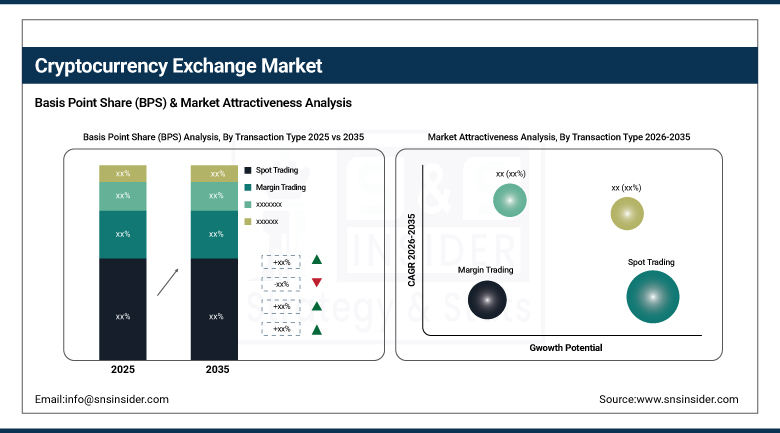
By Transaction Type, Spot Trading segment dominated the Cryptocurrency Exchange Market in 2025 with 56% share; Derivatives Trading segment is the fastest-growing segment.
-
By Coin Type, Bitcoin Exchange segment dominated the market in 2025 with 43% share; Stablecoin Exchange segment is the fastest-growing segment.
-
By Platform Type, Centralized Exchange (CEX) segment dominated the market in 2025 with 72% share; Hybrid Exchange segment is the fastest-growing segment.
-
By Additional Features, Staking segment dominated the market in 2025 with 31% share; Token Swapping segment is the fastest-growing segment.
-
By Security Measures, Know-Your-Customer (KYC) Verification segment dominated the market in 2025 with 34% share; Multi-Factor Authentication (MFA) segment is the fastest-growing segment.
By Transaction Type, Spot Trading Dominates the Cryptocurrency Exchange Market While Derivatives Trading Emerges as the Fastest-Growing Segment
The Spot Trading segment dominated the Cryptocurrency Exchange Market in 2025 with a 56% share owing to its simplicity, prompt ownership, and widespread usage by retail and institutional investors alike. The Spot Trading allows trading cryptocurrencies at current market rates without any complications related to using derivative instruments. High liquidity, wide selection of cryptocurrencies, and influx of new investors have made spot trading the largest trading type on all global cryptocurrency exchanges.
The Derivatives Trading segment is the fastest-growing due to growing needs of institutions and seasoned investors in risk mitigation and profiting techniques. Futures, options, and perpetual contracts help manage risks in volatile markets and engage in leveraging. Higher number of institutions, more regulatory transparency in some markets, and better trading capabilities contribute to the growing popularity of cryptocurrency derivatives globally.
By Coin Type, Bitcoin Exchange Dominates the Cryptocurrency Exchange Market While Stablecoin Exchange Registers the Fastest Growth
The Bitcoin Exchange segment dominated the Cryptocurrency Exchange Market in 2025 with a 43% share owing to the status of Bitcoin as the best-known and most extensively traded digital asset. The continuous adoption by institutions, high liquidity, and large number of exchanges offering it have contributed to steady trading volumes. The acceptance of Bitcoin as an effective store of value, together with increased availability through regulated investment vehicles and payment services, will continue to consolidate its market dominance.
The Stablecoin Exchange segment is the fastest-growing owing to the rising need for digital assets with reduced volatility that help in effective trading and settlement as well as international money transfer processes. Stable coins offer a secure environment to the traders where they can hold their value during market fluctuation along with fast transition from one cryptocurrency to another.
By Platform Type, Centralized Exchange (CEX) Dominates the Cryptocurrency Exchange Market While Hybrid Exchange Witnesses the Fastest Growth
The Centralized Exchange (CEX) segment dominated the Cryptocurrency Exchange Market in 2025 with a 72% share owing to the features such as high liquidity, user interface, quick transaction process, and customer service offered by them. The Centralized Exchange platforms provide the investors with access to multiple cryptocurrencies, trading functionalities and even fiat currencies in their portfolio. Moreover, stringent compliance and regulatory initiatives along with security measures contribute towards the dominance of the Centralized Exchange platforms.
The Hybrid Exchange segment is the fastest-growing because it brings together the benefits of centralized exchanges and decentralized exchanges. In other words, investors tend to like hybrid exchanges due to higher security and low dependence on centralized custody. Constant technological progress along with the development of interoperability and increased demand for convenient trading platforms contribute to the popularity of hybrid cryptocurrency exchanges.
By Additional Features, Staking Dominates the Cryptocurrency Exchange Market While Token Swapping Records the Fastest Growth
The Staking segment dominated the Cryptocurrency Exchange Market in 2025 with a 31% share owing to the increasing preference among investors to earn passive income through their cryptocurrency investments. Cryptocurrency exchanges have started incorporating staking services to ease the process of participating in proof-of-stake blockchains and earning lucrative returns. The rising adoption of staking enabled cryptos along with the ease of use and automatic distribution of rewards has contributed towards increased adoption of staking facilities.
The Token Swapping segment is the fastest-growing because there is an increasing requirement to switch from one cryptocurrency to another without using trading pairs. The adoption of token swapping services improves efficiency and convenience in transactions. The growing adoption of decentralized finance, interoperability of blockchain technology, and increased requirement for instant conversions between digital assets is contributing to the growth of the segment.
By Security Measures, Know-Your-Customer (KYC) Verification Dominates the Market While Multi-Factor Authentication (MFA) Experiences the Fastest Growth
The Know-Your-Customer (KYC) Verification segment dominated the Cryptocurrency Exchange Market in 2025 with a 34% share owing to need for higher levels of regulatory compliance and anti-fraud activities in addition to the growing efforts towards reducing money laundering and financial crime has made exchanges adapt to KYC processes for verification and building credibility according to global financial regulations. Institutional participation in cryptocurrency transactions has made the role of a reliable identification system crucial.
The Multi-Factor Authentication (MFA) segment is the fastest-growing due to the necessity for increased protection against various cyber attacks, such as phishing and credentials theft. Adding another level of identity verification improves the level of security and boosts confidence. Higher cybercrime rate, larger ownership of digital assets, and better understanding of cybersecurity principles fuel the growth of this segment.
Regional Insights
|
Region |
Major Country |
Share within Region, 2025 (%) |
|---|---|---|
|
North America |
United States |
82.75% |
|
Europe |
Germany |
26.10% |
|
Asia Pacific |
China |
29.40% |
|
Middle East & Africa |
UAE |
28.60% |
|
Latin America |
Brazil |
36.55% |
North America Cryptocurrency Exchange Market Insights
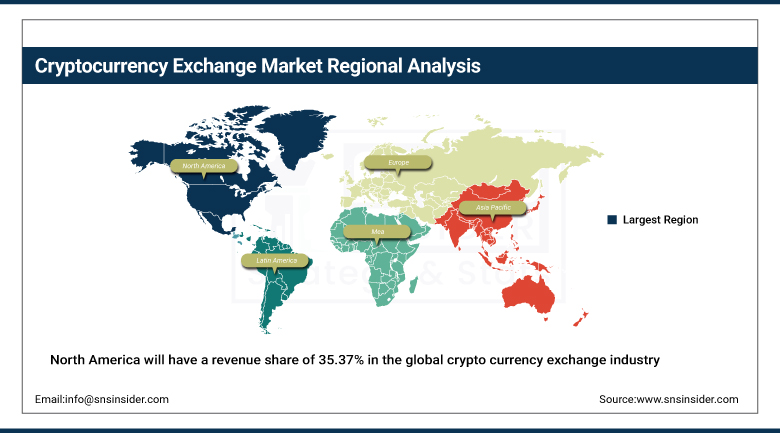
North America will have a revenue share of 35.37% in the global crypto currency exchange industry owing to blockchain adoption, digital infrastructure, and large volume of trades. The industry is dominated by North America where the United States constitutes the major portion because of its well-developed infrastructure and players such as Coinbase and Kraken, whereas Mexico and Canada’s regulation for the sector is promoting growth too.
The United States holds around 82.75% share of revenue within the region due to its advanced financial system, high use of digital currencies, and the presence of exchanges such as Coinbase, Kraken, and Binance.US. Canada’s regulation will also promote demand from the region, thus, making North America the largest addressable market for cryptocurrency exchange operators in the forecast period.
Get Customized Report as per Your Business Requirement - Enquiry Now
Europe Cryptocurrency Exchange Market Insights
Cryptocurrency exchanges in Europe have experienced remarkable expansion due to progressive regulatory framework and fintech developments within the major economies of the region. Germany stands out with progressive crypto regulations and traditional banks providing cryptocurrency services, whereas the United Kingdom and France are striving for higher acceptance of retail digital asset trades.
Germany dominates demand at around 26.10% of European revenue owing to its progressive regulations as well as involvement of traditional banks in cryptocurrency services. The United Kingdom and France provide notable demand contribution, and future European regulatory development regarding digital assets will likely result in further rising demand for cryptocurrency exchange services in the region.
Asia Pacific Cryptocurrency Exchange Market Insights
The Asia Pacific region is projected to grow at a strong CAGR of approximately 27.35%, making it the fastest-expanding market globally. Massive smartphone penetration, a young tech-savvy population, and government-backed blockchain initiatives are key drivers of adoption across the region's largest economies.
China leads the region, accounting for roughly 29.40% of regional revenue, supported by substantial domestic blockchain infrastructure investment despite regulatory restrictions on certain crypto activities. India and Japan contribute meaningful additional demand, and that broadening base of young, mobile-first crypto adopters is what's keeping Asia Pacific's growth outlook well ahead of every other region tracked in this report.
MEA & Latin America Cryptocurrency Exchange Market Insights
Cryptocurrency exchange is experiencing a consistent increase in adoption rates within Middle East & Africa and Latin America due to increasing financial inclusion, government support for blockchain infrastructure, and an increasing need for alternative stores of value in volatile currencies within these regions. Cryptocurrency exchanges have shown themselves to be truly useful tools for communities that mainstream banking systems have failed to serve.
The United Arab Emirates has the highest demand in Middle East & Africa with almost 28.60% of regional revenues due to the country's aggressive plan of developing blockchain and digital asset infrastructure. Demand from Saudi Arabia and South Africa within the region is being fueled by the two countries' efforts at modernizing their digital finance ecosystems. Brazil holds almost 36.55% of regional revenues in Latin America due to its increasing adoption of cryptocurrencies.
Growth Drivers: Rising institutional adoption and regulatory maturity
Rising Institutional Adoption and Regulatory Maturity Drive Widespread Expansion Across Cryptocurrency Trading Platforms. Institutional adoption is one of the strongest drivers of market growth, as banks, asset managers, and hedge funds are increasingly offering digital asset exposure to clients, boosting liquidity and confidence across the broader market. The launch of Bitcoin ETFs in the U.S. has meaningfully accelerated this trend, giving traditional investors a regulated, familiar pathway into crypto exposure without needing to directly manage a wallet themselves.
Growth in the number of payment systems involving cryptocurrencies, an uptick in demand for transparent and secure trading environments, along with technological advancements in blockchain and cybersecurity, are reinforcing this driver further. As 67% of global crypto trades are now conducted via mobile apps and 43% of major exchanges integrate DeFi or NFT functionalities, that convergence of mainstream finance with Web3 technology is exactly what's kept cryptocurrency exchange demand climbing so rapidly.
Restraints: Regulatory uncertainty and cybersecurity risk
Regulatory uncertainty across different jurisdictions remains a genuine restraint on faster market growth, as exchanges operating internationally must navigate genuinely inconsistent and sometimes rapidly changing regulatory frameworks around digital asset trading, custody, and taxation. That fragmented regulatory landscape adds real compliance cost and operational complexity for exchanges trying to serve a genuinely global user base.
Cybersecurity risk adds a further restraint, since cryptocurrency exchanges remain high-value targets for sophisticated attackers given the genuine liquidity and value of assets held on these platforms. Despite widespread 2FA adoption and growing MFA implementation, security breaches and hacking incidents continue to periodically undermine user trust, which helps explain why exchanges keep investing so heavily in ever-more-sophisticated security infrastructure.
Opportunities: DeFi integration and stablecoin expansion
Growing DeFi and NFT integration represents a genuinely significant opportunity for exchange operators, as 43% of major exchanges already integrate these functionalities and that share keeps expanding. Vendors that can seamlessly bridge centralized exchange convenience with decentralized finance capability stand to capture meaningful share as traders increasingly want access to both worlds from a single platform.
Expanding stablecoin adoption offers a second substantial opportunity, as the segment's fast growth rate reflects genuine demand for price-stable, cross-border payment and value-preservation capability that pure cryptocurrency trading doesn't always deliver. As exchanges keep easing fiat-to-stablecoin and stablecoin-to-crypto conversions, vendors with mature stablecoin infrastructure stand to capture meaningful share of this rapidly expanding bridge between traditional finance and crypto markets.
Recent Developments:
-
2025: Binance launched new perpetual futures contracts and implemented instant conversion for stablecoin pairs, strengthening its derivatives and stablecoin trading capabilities.
-
2025: Bybit launched an AI-driven risk management system, enhancing automated monitoring and protection for traders using leveraged and derivatives products.
-
2025: Coinbase added support for Euro-backed stablecoins, expanding liquidity and usability for European users converting between fiat and stablecoin holdings.
Cryptocurrency Exchange Market Key Players
-
Binance
-
Coinbase
-
KuCoin
-
OKX (OKEx)
-
Bitfinex
-
Huobi (HTX)
-
Bybit
-
Bitstamp
-
Gemini
-
Crypto.com Exchange
-
Gate.io
-
Upbit
-
Bitget
-
eToro Crypto Trading Platform
-
Deribit
-
Robinhood Crypto
-
Uniswap
-
dYdX
Cryptocurrency Exchange Market Report Scope:
| Report Attributes | Details |
|---|---|
| Market Size in 2025 | USD 41.41 Billion |
| Market Size by 2035 | USD 317.69 Billion |
| CAGR | CAGR of 22.6% From 2026 to 2035 |
| Base Year | 2025 |
| Forecast Period | 2026-2035 |
| Historical Data | 2022-2024 |
| Report Scope & Coverage | Market Size, Segments Analysis, Competitive Landscape, Regional Analysis, DROC & SWOT Analysis, Forecast Outlook |
| Key Segments | • By Transaction Type (Spot Trading, Margin Trading, Derivatives Trading, and Over-the-Counter (OTC) Trading) • By Coin Type (Bitcoin Exchange, Ethereum Exchange, Altcoin Exchange, Stablecoin Exchange) • By Platform Type (Centralized Exchange, Decentralized Exchange, Hybrid Exchange) • By Additional Features (Staking, Lending, Yield Farming, Token Swapping, Fiat Gateway, NFT Marketplace) • By Security Measures (Two-Factor Authentication, Multi-Factor Authentication, Cold Storage, Know-Your-Customer Verification, Anti-Money Laundering Compliance) |
| Regional Analysis/Coverage | North America (US, Canada), Europe (Germany, UK, France, Italy, Spain, Russia, Poland, Rest of Europe), Asia Pacific (China, India, Japan, South Korea, Australia, ASEAN Countries, Rest of Asia Pacific), Middle East & Africa (UAE, Saudi Arabia, Qatar, South Africa, Rest of Middle East & Africa), Latin America (Brazil, Argentina, Mexico, Colombia, Rest of Latin America). |
| Company Profiles | Binance, Coinbase, Kraken, KuCoin, OKX (OKEx), Bitfinex, Huobi (HTX), Bybit, Bitstamp, Gemini, Crypto.com Exchange, Gate.io, Bittrex Global, Upbit, Bitget, eToro Crypto Trading Platform, Deribit, Robinhood Crypto, Uniswap, and dYdX |
Frequently Asked Questions
North America dominated with a revenue share of 35.37%, led by the U.S. due to strong infrastructure and major exchanges like Coinbase and Kraken.
The Spot Trading segment dominated with a 49.07% revenue share in 2025, driven by instant transactions and wide adoption by retail and institutional users.
Rising institutional adoption and regulatory maturity, along with demand for secure, transparent trading platforms, are the major growth factors driving the market.
The Cryptocurrency Exchange Market size was valued at USD 41.41 billion in 2025.
