
Digital Camera Market Report Scope & Overview:
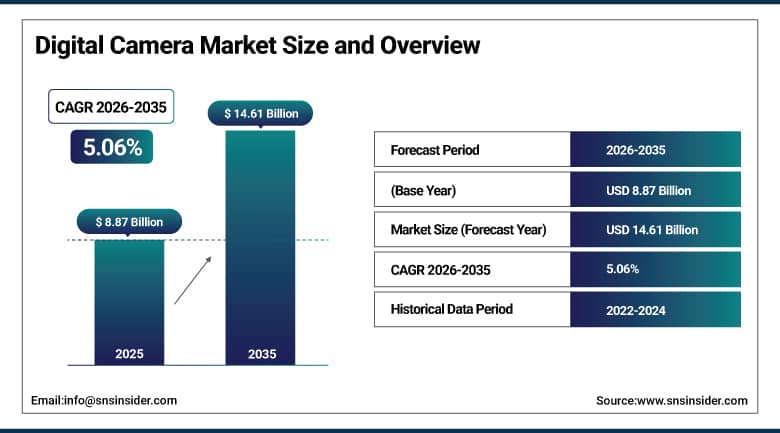
Digital Camera Market was valued at USD 8.87 billion in 2025 and is expected to reach USD 14.61 billion by 2035, growing at a CAGR of 5.06% from 2026-2035.
The digital camera market is growing due to rising demand for high-quality imaging in professional photography, content creation, and social media platforms. Advancements in mirrorless and DSLR technologies, improved autofocus, and 4K/8K video capabilities are driving adoption. Growth of vlogging, travel photography, and influencer culture further boosts demand. Additionally, integration with wireless connectivity, AI-based image processing, and increasing use in surveillance and industrial applications are supporting steady market expansion.
To Get More Information On Digital Camera Market - Request Free Sample Report
Digital Camera Market Trends
-
Rising demand for high-resolution imaging in professional photography, content creation, and social media is driving the digital camera market.
-
Growing adoption among vloggers, influencers, and filmmakers is boosting market growth.
-
Expansion of mirrorless camera systems and advanced sensor technologies is fueling product innovation.
-
Increasing focus on superior image quality, portability, and interchangeable lens systems is shaping adoption trends.
-
Advancements in autofocus systems, image stabilization, and AI-powered photography features are enhancing performance.
-
Rising demand for hybrid shooting capabilities (photo + video) is supporting market expansion.
-
Collaborations between camera manufacturers, lens producers, and software developers are accelerating innovation and global adoption.
U.S. Digital Camera Market Outlook:
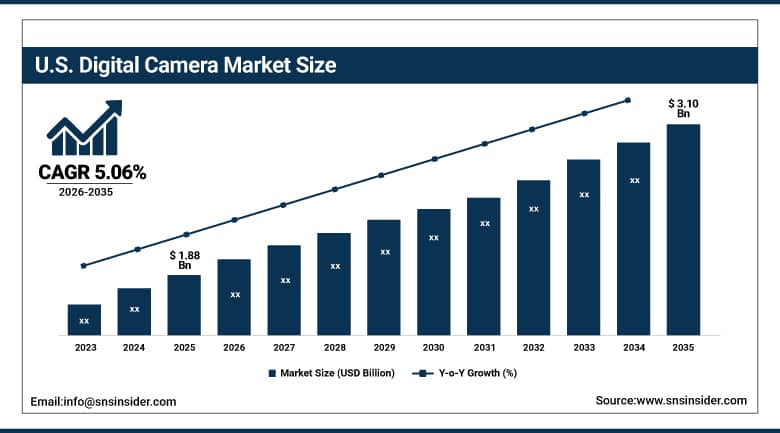
U.S. Digital Camera Market was valued at USD 1.88 billion in 2025 and is expected to reach USD 3.10 billion by 2035, growing at a CAGR of 5.06% from 2026-2035.
The U.S. digital camera market is growing due to rising demand for professional photography, content creation, and vlogging. Technological advancements in mirrorless systems, AI-based imaging, and 4K/8K video capabilities, along with increasing social media influence, are driving sustained market expansion.
The U.S. Bureau of Labor Statistics identifies photographers as a growing occupational category with over 170,000 employed professionals. The FTC's influencer marketing disclosure guidelines have formalized content creation as a regulated commercial activity, reflecting the scale of the U.S. creator economy and its equipment purchasing power.
Digital Camera Market Segment Analysis
-
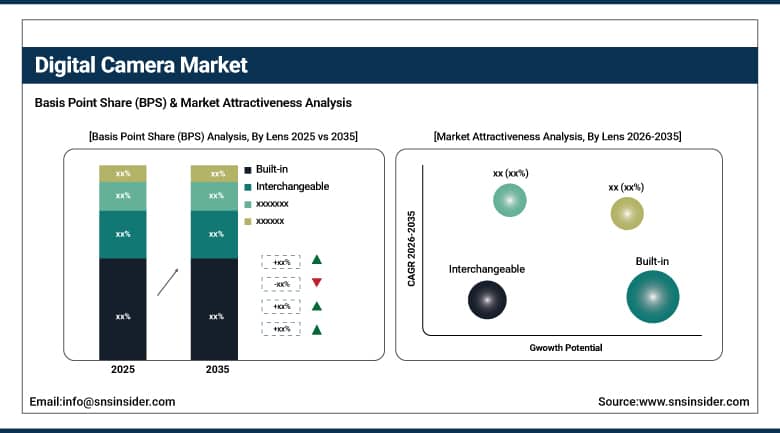
By Lens, the Built-in segment dominated the Digital Camera Market with approximately 65.38% share in 2025, while the Interchangeable segment is the fastest growing with a CAGR of approximately 6.10%.
-
By Product, the Mirrorless segment dominated the Digital Camera Market with approximately 55.42% share in 2025, while the Compact Digital Camera segment is the fastest growing with a CAGR of approximately 7.15%.
-
By End Use, the Pro Photographers segment dominated the Digital Camera Market with approximately 47.36% share in 2025, while the Hobbyists segment is the fastest growing with a CAGR of approximately 6.58%.
By Lens, Built-in segment dominates the Digital Camera Market, Interchangeable segment expected to grow fastest
Built-in lens cameras led the Digital Camera Market with around 65.38% revenue share in 2025. Cameras built into smartphones, compact point-and-shoot models, and action cameras serve the majority of casual photography occasions without any setup, selection process, or additional equipment. The sheer accessibility of built-in camera products affordable, pocketable, immediately operational sustains their volume dominance even as average selling prices in the category remain relatively modest. Action cameras like GoPro's HERO series and smartphone cameras from Apple, Samsung, and Google together constitute a massive volume base that keeps the built-in segment at the top of the revenue table.
Interchangeable lens cameras DSLRs and mirrorless systems are growing at approximately 6.10% CAGR and represent where the market's premium value is concentrated. The ability to swap lenses for different shooting scenarios is precisely what separates serious photographers from casual ones, and the growing number of people who take their craft seriously enough to make that investment is driving the segment's above-market growth. Canon's RF mount, Sony's E-mount, and Nikon's Z-mount ecosystems now offer dozens of native lens options spanning everything from ultra-wide architectural lenses to 600mm wildlife telephoto, creating long customer relationships anchored by lens library investment that effectively ties buyers to a specific camera brand.
By Product, Mirrorless segment dominates the Digital Camera Market, Compact Digital Camera segment expected to grow fastest
Mirrorless cameras dominated with roughly 55.42% revenue share in 2025, and that position looks durable. The mechanical simplicity of eliminating the mirror box allows manufacturers to build smaller, lighter bodies without sacrificing image sensor size which is the primary determinant of image quality. Sony's Alpha 7 series, Canon's EOS R system, and Nikon's Z-series have collectively convinced professional photographers and serious enthusiasts that mirrorless is not a compromise but a genuine upgrade from DSLR technology. The video capabilities of modern mirrorless cameras particularly their ability to record cinema-quality footage internally have made them the default choice for video-first content creators who want one device for both still photography and professional video production.
Compact digital cameras represent the fastest growing category of products with growth in this category expected at around 7.15% CAGR driven by needs of high quality imaging in a compact form factor. Compact digital cameras come with features such as large image sensors, premium lenses, advanced auto focus, and state-of-the-art image processing. They still attract photographers involved in street photography, travel photography, and documentary photography. As smartphones become more capable in terms of imaging, makers are distinguishing compact cameras by offering better optics and photography skills.
By End Use, Pro Photographers segment dominates the Digital Camera Market, Hobbyists segment expected to grow fastest
Professional photographers held approximately 47.36% of the Digital Camera Market in 2025. This makes sense: a professional photographer is not buying one camera every five years as a hobbyist might. They maintain backup bodies, multiple lens sets, specialized lighting gear, and regularly update equipment as technology advances affect their competitive output quality. Wedding photographers, commercial advertising shooters, photojournalists, and scientific imaging specialists each represent distinct professional buyer segments with specific equipment needs and reliable purchasing cycles. Their purchasing decisions are commercial investments rather than personal spending, which means quality requirements override price sensitivity in ways that directly support premium product sales.
Hobbyists are growing the fastest at around 6.58% CAGR, and the social media effect is the real driver here. People who discover photography through their phones often reach a point where they want more control, better low-light performance, or the creative possibilities that interchangeable lenses open up. The hobbyist segment is particularly interesting for manufacturers because it represents the pipeline into the prosumer and professional segments the person who buys an entry-level mirrorless kit today is the one investing in professional prime lenses in four years. Affordable entry-level mirrorless systems from Canon (R50, R100), Nikon (Z30), and Sony (ZV-E10) are all explicitly targeting this conversion opportunity.
Regional Analysis
|
Region |
Major Country |
Share within Region (%) |
|---|---|---|
|
Asia Pacific |
Japan |
42% |
|
North America |
United States |
82% |
|
Europe |
Germany |
25% |
|
Middle East & Africa |
UAE |
35% |
|
Latin America |
Brazil |
45% |
Asia Pacific Digital Camera Market Insights
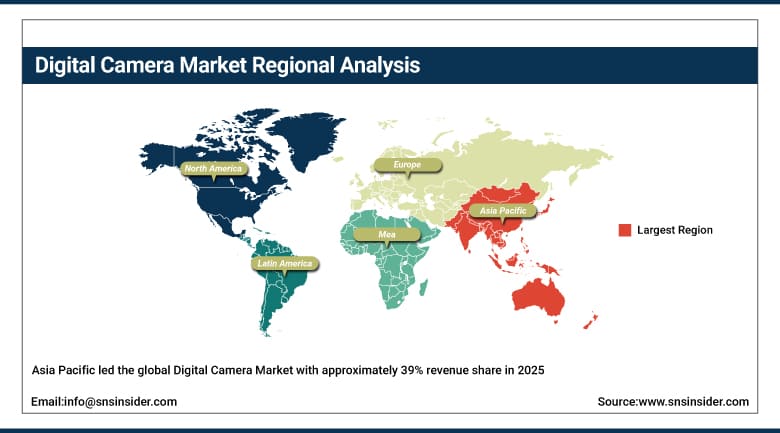
Asia Pacific led the global Digital Camera Market with approximately 39% revenue share in 2025, and the reasons are pretty straightforward. Japan is home to Canon, Sony, Nikon, Fujifilm, Olympus, and Panasonic the manufacturers that collectively define what digital cameras are. That home market concentration generates both strong domestic consumption and export revenue that flows through the region's trade statistics. China and South Korea have large and increasingly sophisticated consumer electronics markets where photography culture, travel photography, and social media content creation are all growing. The region also has the highest concentration of digital camera manufacturing expertise, meaning that production cost advantages reinforce commercial competitiveness globally.
Japan's Camera and Imaging Products Association (CIPA) reported that interchangeable lens camera shipments from Japan exceeded 6.5 million units in 2023, with mirrorless models constituting over 80% of units. South Korea's strong YouTube creator culture and China's rapidly growing travel photography market are identified by CIPA as primary APAC growth drivers.
Get Customized Report as Per Your Business Requirement - Enquiry Now
North America Digital Camera Market Insights
North America represents a premium-weighted camera market where average selling prices run higher than the global average across all product categories. The U.S. creator economy, professional photography service industry, and strong consumer disposable income combine to create a market environment where manufacturers can successfully launch and sustain high-price-point products. The growing popularity of photography education through YouTube tutorials, photography schools, and online courses is continuously expanding the pipeline of informed camera buyers who know what to look for and are willing to spend accordingly. Canada's outdoor and wildlife photography culture is a notable contributor to telephoto lens and weather-sealed camera system demand within the regional market.
Europe Digital Camera Market Insights
Europe is expected to be the fastest-growing regional market at approximately 6.78% CAGR through 2035. Travel photography culture is deep across Germany, France, the UK, and Scandinavia, and the growing professional content creator economy in European markets is generating real demand for advanced camera systems. European consumers tend to favor quality over price in consumer electronics, which means the region punches above its population weight in premium camera segment revenue. The growth of the creator economy YouTube channels, Instagram photographers, travel vloggers is particularly visible in the UK, France, and Germany, where brand investment in camera equipment is being driven by commercial content creation ambitions.
The European Audiovisual Observatory reports that video content creation in Europe grew by 34% between 2021 and 2024, with independent creator output accounting for a growing share of total video production. Germany's PhotoKina trade fair (now merged into Photopia) historically served as the global stage for camera product launches, reflecting Europe's commercial importance to the camera industry.
Middle East & Africa and Latin America Digital Camera Market Insights
These regions are less developed in terms of digital cameras, but the market is developing steadily due to an increase in the number of the middle class, rising interest in tourism and traveling, and growing social networking activity that creates motivation for camera purchases. The UAE and Saudi Arabia are countries with growing interest in traveling photography, where consumers have disposable income sufficient for buying high-end cameras. In Latin America, the leading countries in terms of adoption of digital cameras are Brazil and Mexico.
Market Dynamics
Growth Drivers: Rising content creator economy and AI imaging innovation fueling sustained global digital camera demand
Progress in the field of image sensing technologies is enhancing the functionality of digital cameras and drawing an ever-larger market segment. Artificial intelligence-driven auto focus, automatic scene detection, enhanced low-light cameras, and computational photography are making top-of-the-line image sensing accessible to enthusiasts and content creators. At the same time, the expansion of the creator economy is changing the role of cameras from optional purchases to money-making equipment. YouTube influencers, social media creators, and professional video makers are considering their camera purchases in terms of investments.
Japan's CIPA 2024 export data shows digital camera average selling prices increased 22% over three years as product mix shifts toward premium mirrorless systems. The global influencer marketing industry exceeded USD 21 billion in 2023 according to the Influencer Marketing Hub, creating a large commercial customer base with specific professional camera equipment needs.
Restraints: Premium camera pricing and improving smartphone cameras limiting entry-level digital camera market growth
The high cost of ownership continues to pose a major problem when it comes to the adoption of digital cameras, especially by hobbyists and beginners. The cost of buying the mirrorless body, good lenses, memory cards, bags, and other accessories required by digital cameras is higher than that of upgrading one’s smartphone. The technology in smartphones is getting better day by day, and as such, ordinary users find no need to buy any digital cameras. Professionals will always need good cameras, but sustaining demand is becoming difficult.
Opportunities: Social media content demand and mirrorless technology adoption creating strong commercial growth avenues globally
Digital camera industry presents good prospects for growth due to the increasing importance of high quality visuals in commercial terms and availability of mirrorless technologies. Social networks, professional photographers and branded content increasingly need high quality visuals which cannot always be provided by smartphones. With the emergence of professional attitude towards content creation, the expenses on dedicated photographic hardware are growing. In addition, development of mirrorless systems, low priced entry-level cameras and mid-range systems are attracting new customers.
Recent Developments:
-
2026: Sony launched the Alpha 1 II with a redesigned AI processor capable of tracking subjects across frames using scene context rather than just visual patterns, achieving autofocus acquisition speeds reported at 30% faster than the original Alpha 1 while retaining its 50-megapixel full-frame sensor and 30fps burst shooting capability.
-
2025: Canon released the EOS R1 mirrorless flagship specifically targeting professional sports and news photographers, featuring a 24.2-megapixel stacked CMOS sensor with 40fps electronic shutter shooting, built-in image authentication for news agencies, and enhanced weather sealing rated for sustained professional field use.
-
2025: Fujifilm introduced the GFX 100RF a medium format camera in a compact body format combining a 102-megapixel sensor with an integrated wide-angle lens, targeting commercial photographers and high-end enthusiasts who previously required separate large-format camera and lens systems to achieve equivalent image quality.
Digital Camera Market Key Players
-
Canon Inc.
-
Eastman Kodak Company
-
FUJIFILM Holdings Corporation
-
Leica Camera AG
-
Nikon Corporation
-
Olympus Corporation
-
OM Digital Solutions Corporation
-
Panasonic Corporation
-
Ricoh Imaging Company, Ltd.
-
SIGMA Corporation
-
Sony Corporation
-
Hasselblad
-
GoPro, Inc.
-
Panasonic Corporation
-
Samsung Electronics
-
Vizio Inc.
-
Leica Microsystems
-
Benq Corporation
-
Casio Computer Co., Ltd.
-
Polaroid Corporation
-
Kodak Alaris
| Report Attributes | Details |
|---|---|
| Market Size in 2025 | USD 8.87 Billion |
| Market Size by 2035 | USD 14.61 Billion |
| CAGR | CAGR of 5.06% From 2026 to 2035 |
| Base Year | 2025 |
| Forecast Period | 2026-2035 |
| Historical Data | 2022-2024 |
| Report Scope & Coverage | Market Size, Segments Analysis, Competitive Landscape, Regional Analysis, DROC & SWOT Analysis, Forecast Outlook |
| Key Segments | • By Lens (Built-in, Interchangeable) • By Product (Compact Digital Camera, DSLR, Mirrorless) • By End Use (Pro Photographers, Prosumers, Hobbyists) |
| Regional Analysis/Coverage | North America (US, Canada), Europe (Germany, UK, France, Italy, Spain, Russia, Poland, Rest of Europe), Asia Pacific (China, India, Japan, South Korea, Australia, ASEAN Countries, Rest of Asia Pacific), Middle East & Africa (UAE, Saudi Arabia, Qatar, South Africa, Rest of Middle East & Africa), Latin America (Brazil, Argentina, Mexico, Colombia, Rest of Latin America). |
| Company Profiles | Canon Inc., Eastman Kodak Company, FUJIFILM Holdings Corporation, Leica Camera AG, Nikon Corporation, Olympus Corporation, OM Digital Solutions Corporation, Panasonic Corporation, Ricoh Imaging Company, Ltd., SIGMA Corporation, Sony Corporation, Hasselblad, GoPro, Inc., Samsung Electronics., Vizio Inc., Leica Microsystems, Benq Corporation, Casio Computer Co., Ltd., Polaroid Corporation, Kodak Alaris. |

Frequently Asked Questions
Key players include Canon, Sony, Nikon, Fujifilm, Panasonic, and OM Digital Solutions.
Key opportunities include mirrorless cameras, creator economy growth, professional video, and AI-enabled imaging.
Market growth is driven by content creation, mirrorless adoption, imaging innovation, and professional photography.
Built-in lens cameras dominated the market due to portability, affordability, and ease of use.
Asia Pacific dominated in 2025, supported by major manufacturers and strong consumer electronics demand.
