
Digital Mining Market Report Scope & Overview:
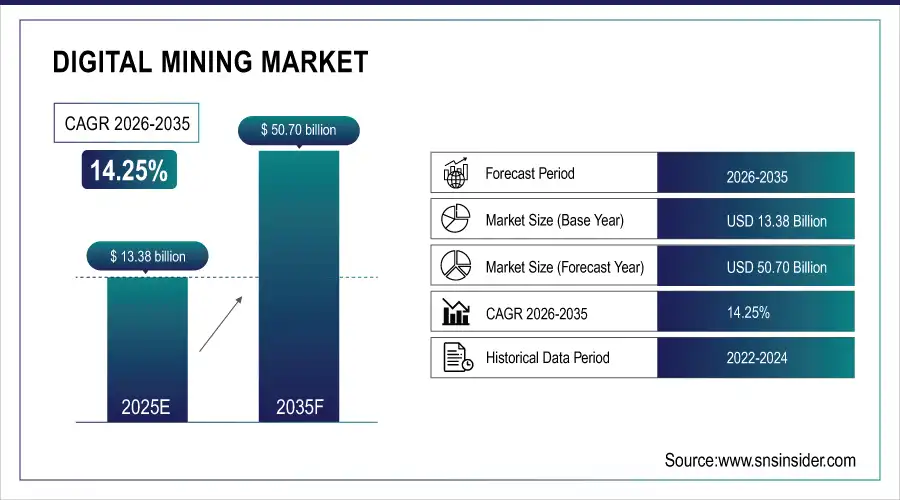
Digital Mining Market is valued at USD 13.38 billion in 2025 and is expected to reach USD 50.70 billion by 2035, growing at a CAGR of 14.25 % from 2026-2035.
The Digital Mining Market is expanding with the rising utilization of latest technologies, such as the IoT, cloud computing, AI and automation, in mining industry. Such technologies improve the efficiency of operation, real-time monitoring, predictive maintenance and utilization of resources. Growing requirement from minerals and metals particularly coal, iron ore & bauxite; increase in concern for cost efficiency and safety are demand sided drivers of digital mining market. Furthermore, smart mining projects and environmental-friendly initiatives are also boosting the global market.
In 2025, global digital mining adoption rose by 26%, as 75% of mining firms leveraged cloud-based AI and automation to enhance real-time decision making reducing downtime by 28% and supporting ESG compliance through smarter energy and water management.
To Get more information On Digital Mining Market - Request Free Sample Report
Digital Mining Market Trends
-
Rising adoption of automation and robotics to improve mining efficiency, safety, and operational cost optimization
-
Increasing integration of IoT sensors for real-time monitoring of equipment, environment, and mineral extraction processes
-
Growing use of AI and machine learning to enhance predictive maintenance and optimize resource allocation
-
Expansion of data analytics and visualization platforms to enable informed decision-making and operational transparency
-
Cloud computing adoption accelerates collaboration, scalability, and storage of large-scale mining data across operations
Digital Mining Market Trends
-
Rising adoption of automation and robotics to improve mining efficiency, safety, and operational cost optimization
-
Increasing integration of IoT sensors for real-time monitoring of equipment, environment, and mineral extraction processes
-
Growing use of AI and machine learning to enhance predictive maintenance and optimize resource allocation
-
Expansion of data analytics and visualization platforms to enable informed decision-making and operational transparency
-
Cloud computing adoption accelerates collaboration, scalability, and storage of large-scale mining data across operations
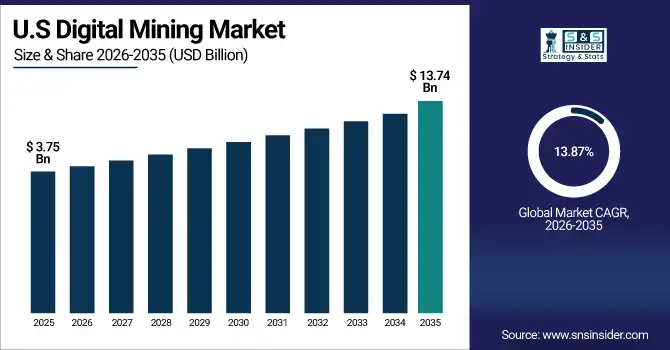
U.S. Digital Mining Market is valued at USD 3.75 billion in 2025 and is expected to reach USD 13.74 billion by 2035, growing at a CAGR of 13.87% from 2026-2035.
Growth in the U.S. Digital Mining Market is driven by increasing adoption of IoT, AI, and automation technologies to improve operational efficiency, safety, and predictive maintenance. Rising demand for minerals and metals, coupled with investments in smart mining solutions, is further accelerating market expansion
Digital Mining Market Growth Drivers:
-
Increasing adoption of automation, IoT, and AI technologies in mining operations is driving efficiency, safety, and real-time data analytics across the digital mining sector globally
Automation, Internet of Things and artificial intelligence are being leveraged by the mining industry to improve production and safety. By automating operations the worker is removed from a hazardous environment and by incorporating internet of things (IoT) enabled sensors and equipment, real time information can be obtained on machinery output & quality, ore type and environmental data. AI-powered analytics support predictive maintenance, process optimization and resource management, resulting in lower operational expenses and downtime. These tools also foster better decision making and productivity. Be it profitability, efficiency or safety — mining companies have never had to deal with more than they do today and that is where digitalization comes into play.
In 2024, 68% of global mining operations integrated automation, IoT, and AI, improving operational efficiency by 28%, reducing safety incidents by 35%, and enabling real-time analytics for predictive maintenance and resource optimization.
-
Growing demand for minerals and metals in industries such as automotive, electronics, and construction is boosting investment in advanced digital mining solutions to optimize production
The rising need for critical minerals and base metals globally on the back of automotive electrification, electronics manufacturing, and infrastructure upgrade projects is motivating mining companies to deploy digital solutions. Digital mining solutions create the conditions for more effective dig, higher yield and fewer operating challenges. With advanced monitoring, data analytics and automation work together in sync hence mining operations can be carried out with more predictability on production forecasts and better control on costs. Thus, the increasing demand from various industries is also encouraging companies to deploy smart mining technologies in order to provide a stable and good-quality supply of critical minerals and improve operational efficiency.
In 2024, surging demand for critical minerals driven by EV, electronics, and infrastructure sectors spurred a 22% increase in digital mining investments, with companies deploying AI and automation to boost production efficiency by up to 30%.
Digital Mining Market Restraints:
-
High implementation costs and significant upfront investment for digital mining technologies limit adoption, especially among small and medium-sized mining companies in emerging regions
It isexpensive to deploy these digital mining solutions, such as automated equipment, artificial intelligence based various analytics platforms and Internet of Things (IoT) sensors. Small and budding companies faced with significant first costs (installation, integration and employee training for example) just can’t afford it. Furthermore, regular maintenance and software updates contribute to operational cost, making it difficult for smaller players to justify a digital spend. Challenging financing and infrastructure also hinder penetration in developing regions. Accordingly, although digital mining does offer some attractive advantages for strategic development of the overall market in the world, high expenses and financial thresholds have become striking hindrances for expanding to a wider market.
In 2024, 70% of small and medium-sized mining firms in emerging regions deferred digital transformation due to upfront costs exceeding USD2 million, with ROI uncertainty and limited financing further restricting adoption of advanced mining technologies.
-
Lack of skilled workforce, cybersecurity concerns, and integration challenges hinder seamless deployment of digital mining solutions, affecting operational efficiency and overall market growth
Digital mining demands a workforce with the skills to run AI systems, IoT networks and advanced analytics. An implementation can be slowed down and operate less efficiently due to a lack of experienced professionals. Furthermore, miners also face growing cyber risk as they increasingly rely on digital technologies; mines can become vulnerable to hackers who can attack data systems or result in equipment failure. A further technical challenge is the integration with legacy equipment and existing operation processes. All of these factors conspire to slow the digital roll-out, erode productivity gains, and drive low adoption rates – especially by smaller or less tech-enabled mining houses – across the market as a whole.
In 2024, 65% of mining operators reported deployment delays due to a shortage of digital-skilled personnel, while 60% cited cybersecurity risks and legacy system integration issues as key barriers, reducing operational efficiency gains by up to 30%.
Digital Mining Market Opportunities:
-
Rising focus on sustainable and environmentally responsible mining practices offers opportunities for digital solutions that optimize energy usage, reduce emissions, and improve compliance
The mining industry is focused on environmental sustainability and adoption of digital solutions that reduce the impact on the environment. The implementation of technologies, such as energy-saving automation, emissions monitoring in real time and predictive control of resources enhance the efficiencies leading to reduced energy consumption, greenhouse gas (GHG) emissions and waste generation. Being SOx compliant The use of digital tools can also help keeping your head above the water in situations where it is challenging to meet stringent environmental regulations and reporting needs Digitization is key. By adopting sustainable practices along with efficient operations, mining companies can enhance their image, save money and create longevity. This increasing emphasis on responsible mining creates exciting opportunities for suppliers of advanced digital solutions.
In 2024, 55% of mining companies deployed digital sustainability solutions, cutting energy consumption by 18% and lowering emissions by 22% while enhancing regulatory compliance through AI-driven resource optimization and real-time environmental monitoring.
-
Expansion of remote monitoring, predictive maintenance, and cloud-based analytics presents growth opportunities for companies to enhance safety, efficiency, and decision-making in mining operations
Mining operations are on the verge of taking a leap from traditional to digital mining. Continuous remote monitoring allows operators to have quarry equipment and production monitored around the clock, increasing both overall safety as well operational efficiency. Performance benefits of predictive maintenance include prevention of downtime, extension of equipment life and reduction in repair costs. Cloud analytics aggregates tons of operational data for improved forecasting, planning, and decision making. These are technologies that help mine more efficiently with less operational risk and increased profitability. Increasing penetration of digital solutions such as these has set the tone for growth within this market worldwide.
In 2024, 60% of mining operators adopted remote monitoring and cloud-based analytics, reducing equipment downtime by 25% and improving safety incident response times by 30% through predictive maintenance and real-time data insights.
Digital Mining Market Segment Highlights
-
By Technology: Automation & Robotics led with 27.5% share, while AI & Machine Learning is the fastest-growing segment with CAGR of 17.8%.
-
By Application: Fleet & Equipment Management led with 24.8% share, while Predictive Maintenance is the fastest-growing segment with CAGR of 16.9%.
-
By Mining Type: Surface Mining led with 31.2% share, while Solution Mining is the fastest-growing segment with CAGR of 17.4%.
-
By End-User: Metals & Minerals Mining Companies led with 28.6% share, while Industrial & Construction Material Mining Companies is the fastest-growing segment with CAGR of 16.5%.
Digital Mining Market Segment Analysis
By Technology: Automation & Robotics led, while AI & Machine Learning is the fastest-growing segment
The technology segment is dominated by Automation & Robotics mining equipment that boosts the operational efficiency, minimizes human error, reduces workplace accidents and enables optimal extraction of earth’s resources. Their use in drilling and excavation operations can be leveraged to improve processes, reduce costs and maintain productivity. Robots Large mining operations make use of complex robot systems for dangerous and monotonous jobs. The advanced sensors, remote monitoring and integration with control systems are another testament to how automation and robotics remain at the forefront of the digital mining environment.
AI & Machine Learning is the fastest growing segment of technology to predict outcomes, detect anomalies, and make decisions. Tools like these help mining firms predict equipment failure and optimize resource allocation and production. Increasing investment on smart mining solutions, cloud integration and real-time data analytics lead to adoption. AI-enabled solutions also facilitate energy saving, sustainability, and cost reduction; hence, AI is the fastest growing market amongst digital mining technologies.
By Application: Mine safety led, while Predictive Maintenance is the fastest-growing segment
The application segment, too, of Fleet & Equipment Management is dominating since it allows mining companies to efficiently monitor, maintain and manage heavy equipment. Summary Monitoring, scheduling and alerts provide a way to monitor Service-ware and automatically schedule maintenance, if needed - preventing downtime and reducing operational costs. Through integration with IoT sensors and on a single software platform, the platform enables optimal resource use, safety standards compliance and continuous operation at minimum costs. Fleet management is the most common application in digital mining because it's key to improve productivity, optimise logistics and keep equipment availability high.
The most rapidly growing application is that of Predictive Maintenance, as mining companies are finding ways to avoid machine failures, minimize unplanned downtime and increase profitability. AI, IoT and sensor-based analytics allow you to foresee wear and performance-related issues so that action can be taken when required. By embracing predictive maintenance, you can extend the lifecycle of your assets, minimize repair expenses and improve safety. This rapidly expanding growth of predictive maintenance solutions is enabled by increased awareness about the benefits and cost savings associated with it, as well as digitization of mining operations.
By Mining Type: Surface Mining led, while Solution Mining is the fastest-growing segment.
Surface mining prevails because of its volume production, significantly larger resource abundance and broader implementation of automated systems. Automation, fleet management and vehicle monitoring systems are in use both in open-pit mines and quarries to enhance safety and productivity. Metal, mineral and coal companies are increasingly exploring their site-based surface mining options because of the scale-ability and cost effectiveness. Digital technologies are integrated to improve control functions, reduce labor and render real-time analytics, which in turn ensures the maintenance of surface mining as the leading segment.
Fastest Growing Type is Solution Mining Solution mining is a type of surface mining The market for the solution mining type segment is expected to witness high growth in countries such as China, Australia, and Indonesia. Including digital tools for monitoring and control, real-time feedback allows exact volume injection, recovery and processing to reduce waste and operational uncertainty. This technique is environmentally friendly and has low environmental impact, sustainable practice, and high yield of extraction. Escalating demand of minerals and implementation of cutting edge digital monitoring in solution mining are boosting the growth rate, rendering it fastest growing mine type.

By End-User: Metals & Minerals Mining Companies led, while Industrial & Construction Material Mining Companies is the fastest-growing segment.
Metals & Minerals Mining Companies are the front-runners in terms of operations, vast resource extraction and implementation of digital technologies. They have invested in automation, AI, fleet management and analytics to maximize production efficiencies, lower costs and provide a safer workplace. The fact that the industry is extremely capital-intensive, combined with a strong reliance on system efficiency, offers ample scope for the upscaling of digital mining operations. Advanced monitoring, predictive maintenance and performance trend additionally cement their leadership in digital mining market.
Industrial & Construction Material Mining Companies represent the fastest-growing end-user market as they are increasingly utilizing digital mining to manage operations and recover faster by boosting extraction efficiency, increasing productivity, safety, and reducing operational risks. By implementing AI, IoT and cloud-based monitoring tools, more effective use of equipment including resource management and power consumption can be achieved. Growing demand for digitalization of mining operations, increasing focus on cost reduction and revenue growth are propelling rapid uptake of digital technologies in the mining sector being the fastest growing end-user segment worldwide.
Digital Mining Market Regional Analysis
North America Digital Mining Market Insights:
North America dominated the Digital Mining Market with a 33.00% share in 2025 due to its advanced mining infrastructure, high adoption of digital technologies, and presence of leading mining companies investing in automation, IoT, and AI solutions. Strong regulatory support, focus on operational efficiency, and early technology adoption further reinforced regional leadership.

Get Customized Report as per Your Business Requirement - Enquiry Now
Asia Pacific Digital Mining Market Insights
Asia Pacific is expected to grow at the fastest CAGR of about 15.99% from 2026–2035, driven by rapid industrialization, increasing mining activities, and rising investments in digital mining solutions. Growing demand for minerals and metals, adoption of advanced analytics, and government initiatives supporting smart mining technologies are accelerating market growth across the region.
Europe Digital Mining Market Insights
Europe is projected to be a major market for Digital Mining during the forecast period owing to the regularized mining activity, rising digitalization in the mining activities and stringent government regulations promoting efficient mining practices. In the area of digitization, automation and predictive maintenance investments in energy-efficient digital technologies helped to reinforce Europe’s position further within the global digital mining market
Middle East & Africa and Latin America Digital Mining Market Insights
Middle East & Africa and Latin America combined accounted for a huge growth in the Digital Mining Market for the forecast period 2025, on account of rising mining activities, rising demand for minerals coupled with growing digital technology adoption. Automation, Internet of Things (IoT) solutions and smart mining infrastructure investments as well as government programs to boost up-to-date mine development allowed for regional growth on the market.
Digital Mining Market Competitive Landscape:
Caterpillar
Caterpillar is the world’s leader in the heavy equipment and mining industries, providing digital solutions including autonomous haulage systems, fleet management and intelligent mining. Its integrated offerings deliver improved operating efficiencies, greater safety and increased productivity to the mining sector. IoT, along with data analytics and automation, helps Caterpillar to maximise the performance of equipment, drive down operating costs and promote responsible mining. SCANTECH is a global company whose goal is to provide the highest value for its products and services through competitive pricing, superior performance and innovative solutions for modern day mining.
-
2024, Caterpillar launched autonomous haulage under its Cat MineStar Auto platform, enabling driverless operation of 794 AC electric drive haul trucks in mixed fleet environments .
Sandvik AB
Sandvik AB is a Swedish multinational company that is engaged in mining and rock excavation equipment, including digital mining services. The firm offers automation, monitoring and data‐driven software to enhance mine productivity, safety and operational efficiency. Sandvik, for one, is concentrating on smart mining technologies that will be sensor and IoT-activated and analysed by machinery to achieve efficient fleet operations with effective resource management. Its solutions are used in both surface and underground mines worldwide to enable mining companies to achieve fantastic productivity, sustainability and cost-effective mine production.
-
2025, Sandvik Developed its AutoMine autonomous system to support fully electric underground mining equipment, including the SANDVIK LH518B battery-electric loader and TH565B truck.
Komatsu Mining Corp.
Komatsu Mining Corp delivers innovative mining technology, automation and digital solutions to the market providing for a safer, more efficient and cost effective process. Its intelligent mining system improves operational efficiency, equipment utilization and safety at mines. Komatsu leverages IoT, AI and sensor-based data technologies to track and optimize machine performance which enables both cost savings and productivity gains. The company serves the world's mines with innovative, safe and reliable systems for longwall mining, room and pillar mining and underground development, and it provides added value to mine operations through high-tech products, software applications and engineering excellence.
-
2023, Komatsu Mining launched SmartLift, an AI-powered autonomous hoisting system for deep mine shafts, designed to optimize cage movement, energy use, and personnel/material transport.
Digital Mining Market Key Players
Some of the Digital Mining Market Companies are:
-
Caterpillar
-
Sandvik AB
-
Komatsu Mining Corp.
-
Epiroc AB
-
Siemens AG
-
ABB Ltd.
-
Schneider Electric
-
Hitachi Construction Machinery Co., Ltd.
-
Hexagon AB
-
Rockwell Automation
-
Cisco Systems
-
FLSmidth & Co. A/S
-
Metso Outotec
-
ThyssenKrupp
-
Liebherr Group
-
Atlas Copco AB
-
Emerson Electric Co.
-
Honeywell International Inc.
-
Mitsubishi Electric Corporation
-
Yokogawa Electric Corporation
| Report Attributes | Details |
|---|---|
| Market Size in 2025 | USD 13.38 Billion |
| Market Size by 2035 | USD 50.70 Billion |
| CAGR | CAGR of 14.25% From 2026 to 2035 |
| Base Year | 2025 |
| Forecast Period | 2026-2035 |
| Historical Data | 2022-2024 |
| Report Scope & Coverage | Market Size, Segments Analysis, Competitive Landscape, Regional Analysis, DROC & SWOT Analysis, Forecast Outlook |
| Key Segments | • By Technology (Automation & Robotics, IoT & Sensors, AI & Machine Learning, Data Analytics & Visualization, Cloud Computing) • By Application (Mine Safety & Monitoring, Fleet & Equipment Management, Predictive Maintenance, Resource & Asset Management, Energy & Environmental Management) • By Mining Type (Surface Mining, Underground Mining, Placer Mining, Solution Mining) • By End-User (Metals & Minerals Mining Companies, Coal Mining Companies, Industrial & Construction Material Mining Companies, Oil & Gas Mining Companies, Government & Research Organizations) |
| Regional Analysis/Coverage | North America (US, Canada), Europe (Germany, UK, France, Italy, Spain, Russia, Poland, Rest of Europe), Asia Pacific (China, India, Japan, South Korea, Australia, ASEAN Countries, Rest of Asia Pacific), Middle East & Africa (UAE, Saudi Arabia, Qatar, South Africa, Rest of Middle East & Africa), Latin America (Brazil, Argentina, Mexico, Colombia, Rest of Latin America). |
| Company Profiles | Caterpillar, Sandvik AB, Komatsu Mining Corp., Epiroc AB, Siemens AG, ABB Ltd., Schneider Electric, Hitachi Construction Machinery Co., Ltd., Hexagon AB, Rockwell Automation, Cisco Systems, FLSmidth & Co. A/S, Metso Outotec, ThyssenKrupp, Liebherr Group, Atlas Copco AB, Emerson Electric Co., Honeywell International Inc., Mitsubishi Electric Corporation, Yokogawa Electric Corporation HORIBA Scientific, Jeol Ltd., Analytik Jena AG |
Frequently Asked Questions
North America dominated with 33% share in 2025, due to advanced mining infrastructure, early technology adoption, and investments in AI, IoT, and automation solutions.
Automation & Robotics led the technology segment, improving operational efficiency, safety, and productivity across large-scale surface and underground mining operations globally.
