
Door Control Modules Market Report Scope & Overview:
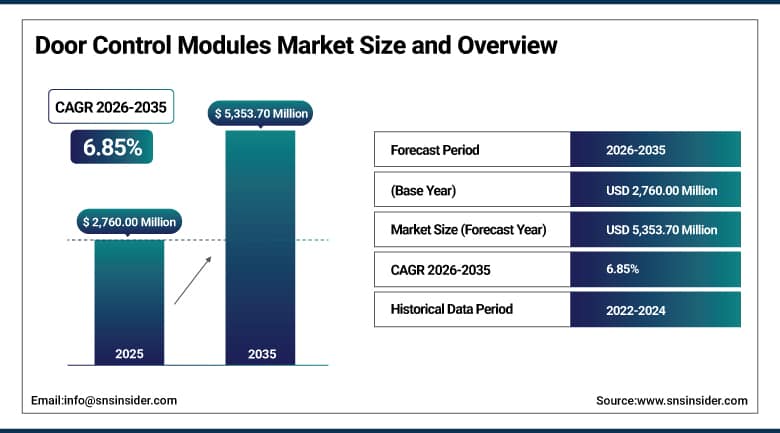
The Door Control Modules Market was valued at USD 2,760.00 Million in 2025 and is expected to reach USD 5,353.70 Million by 2035, growing at a CAGR of 6.85% from 2026-2035.
The Door Control Modules Market covers the electronic units, actuators, sensors, wiring and switches that operate a vehicle's door locks, mirrors, windows and interior lighting functions, whether built as one centralized module or distributed across smaller decentralized units. Automakers are consolidating what used to be several separate door-area controllers into fewer, more capable modules as zonal electrical architectures replace the point-to-point wiring of prior vehicle generations. Suppliers are widening sensor and actuator portfolios to support pinch-protection, keyless entry and electrochromic-mirror features buyers now expect on mainstream trim levels. Passenger-car demand remains the primary volume driver, while commercial-vehicle fleets adopt comparable electronics at a slower, steady pace across most producing regions.
⮞AUMOVIO previewed its Automotive Remote Control Network architecture ahead of CES 2026, in a press release dated December 9, 2025, built around a high-performance computer, zone control units, sensors and actuators with standardized communication protocols connecting them. An architecture shift of that kind, decoupling vehicle applications from hardware-dependent firmware, is the same consolidation trend now reshaping how door control modules are designed and sourced across the wider supplier base.
To Get More Information On Door Control Modules Market - Request Free Sample Report
Door Control Modules Market Trends:
-
Automakers are consolidating door-area electronics into fewer zonal control units as server-based electrical architectures replace legacy distributed wiring layouts.
-
Suppliers are expanding sensor-equipped pinch-protection and anti-trap features on power windows and liftgates to meet tightening regional safety expectations.
-
Regulators in several markets are tightening mechanical-backup requirements for electronic door handles and locks following well-publicized entrapment incidents.
-
Keyless and smartphone-based entry systems are extending from premium trims into mainstream passenger vehicles as component costs continue to fall.
-
Aftermarket demand for replacement actuators and control modules is growing fastest in markets with aging vehicle fleets and limited OEM parts availability.
U.S. Door Control Modules Market Outlook:
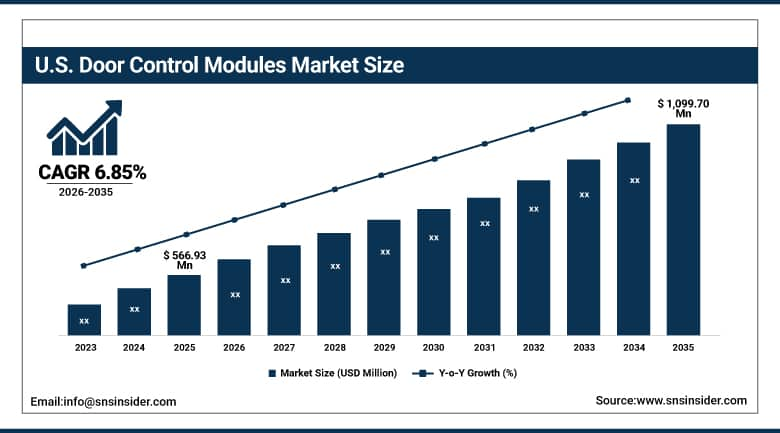
The U.S. Door Control Modules Market was valued at USD 566.93 Million in 2025 and is expected to reach USD 1,099.70 Million by 2035, growing at a CAGR of 6.85% from 2026-2035.
The U.S. Door Control Modules Market is the largest within North America. U.S. and foreign automakers assembling vehicles across the country are standardizing on zonal door-electronics architectures for new platforms, pulling module suppliers toward fewer, higher-content designs per vehicle. Regulatory attention to door-latch integrity and power-window pinch protection continues to shape component specifications more directly than in most other regions. Aftermarket demand for replacement actuators and switches remains meaningful given the country's older average vehicle age, supporting a parts channel that OEM-focused suppliers increasingly also serve. Fleet and commercial-vehicle buyers are adopting comparable electronics more gradually than passenger-car programs nationwide.
⮞DENSO's smart mobility brand MobiQ exhibited its keyless access solution at the NAFA Institute & Expo in Cleveland, Ohio, held April 13-15, 2026, built on Bluetooth Low Energy, NFC and RFID-badge technology aimed at government and large fleet operators. Fleet-focused keyless access of that kind illustrates how U.S. buyers outside the traditional retail channel are now adopting the same door-access electronics increasingly standard on passenger vehicles.
Door Control Modules Market Segment Analysis:
-
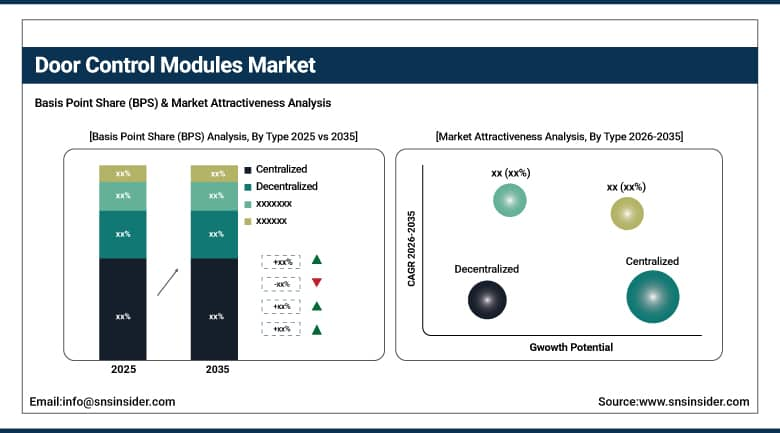
By Type, the Centralized segment dominated the Door Control Modules Market with approximately 60.80% share in 2025, while the Decentralized segment is the fastest growing with a CAGR of approximately 8.65%.
-
By Application, the Door Lock segment dominated the Door Control Modules Market with approximately 42.70% share in 2025, while the Mirror Adjustment segment is the fastest growing with a CAGR of approximately 11.25%.
-
By Component, the Actuators segment dominated the Door Control Modules Market with approximately 45.80% share in 2025, while the Sensors segment is the fastest growing with a CAGR of approximately 8.50%.
-
By Sales Channel, the Original Equipment Manufacturer segment dominated the Door Control Modules Market with approximately 82.60% share in 2025, while the Aftermarket segment is the fastest growing with a CAGR of approximately 7.20%.
-
By Vehicle Type, the Passenger Cars segment dominated the Door Control Modules Market with approximately 71.40% share in 2025, while the Light Commercial Vehicles segment is the fastest growing with a CAGR of approximately 8.10%.
By Type, Centralized Dominates the Door Control Modules Market and Decentralized Grows Fastest
Centralized door control modules hold the largest type share because consolidating lock, window, mirror and lighting functions into one module per door still offers the simplest wiring and lowest integration cost for most mainstream vehicle platforms built today around the world. Established tooling and decades of supplier experience with this architecture keep per-unit costs predictable for automakers running high production volumes across multiple vehicle lines simultaneously. Legacy platforms still in production rely heavily on this proven approach, reinforcing centralized architecture's volume lead even as newer platforms begin shifting toward alternative designs across several producing regions worldwide.
Decentralized modules are growing fastest as automakers adopt zonal electrical architectures that distribute smaller, purpose-built controllers closer to the sensors and actuators they operate, cutting wiring harness length and weight substantially across most new vehicle programs. Software-defined vehicle programs favor this approach specifically because it separates hardware from application software, letting features be updated over the air without redesigning the underlying module each time a platform is refreshed. Premium and electric-vehicle platforms are adopting decentralized designs earlier than mainstream combustion programs, pulling this category's growth rate well above the centralized segment's more gradual expansion across most major vehicle markets today.
By Application, Door Lock Dominates the Door Control Modules Market and Mirror Adjustment Grows Fastest
Door lock modules hold the largest application share because central and child-lock functions remain the single most safety-critical electronic system housed within the door, fitted on essentially every vehicle sold worldwide regardless of trim level or price point. Regulatory scrutiny of door-latch integrity following publicized entrapment incidents has pushed automakers to specify redundant mechanical backups alongside the electronic lock actuator, adding content value to this application without reducing its overall unit volume. Keyless and remote locking features layered onto the base lock function continue to reinforce this application's lead across nearly every vehicle segment and producing region worldwide.
Mirror adjustment controllers are growing fastest as automakers extend electrochromic auto-dimming glass from premium trims into mainstream models, pairing it with blind-spot indicators and memory positioning that require dedicated control electronics on nearly every new platform. Falling sensor and chip costs are letting suppliers offer electrochromic control at price points that were previously limited to luxury vehicles only, widening the addressable buyer base by a meaningful margin each year across most regional markets. That mainstream adoption curve is pulling this application's growth rate well ahead of the far larger but more slowly growing door-lock base it is increasingly layered alongside on the same door module.
By Component, Actuators Dominate the Door Control Modules Market and Sensors Grow Fastest
Actuators hold the largest component share because every powered door function, from locks to window lifts to mirror folding, ultimately depends on a motor or solenoid to perform the physical movement, making actuators the one component no door-electronics bill of materials can omit. Decades of established motor and solenoid manufacturing give actuator suppliers a cost and reliability advantage that newer component categories have not yet matched at comparable production volume. Electrified door functions expanding from premium trims into mainstream vehicles continue to add actuator content per vehicle, reinforcing this component's volume lead across nearly every vehicle segment produced across the industry today.
Sensors are growing fastest as pinch-protection, obstacle-detection and capacitive-touch features move from optional extras into expected standard equipment on power windows, liftgates and keyless entry systems across most vehicle segments worldwide. Regulatory pressure around child safety and entrapment risk is accelerating sensor adoption specifically, since a sensor-based automatic reversal system is the primary engineering response to those documented hazards in multiple major markets. That safety-driven adoption curve is pulling sensor demand growth meaningfully ahead of the actuator category it increasingly works alongside inside the same consolidated door module, and suppliers are investing accordingly to keep pace with that faster-growing demand profile.
By Sales Channel, Original Equipment Manufacturer Dominates the Door Control Modules Market and Aftermarket Grows Fastest
OEM sales dominate the channel split because door control modules are almost always specified and fitted during vehicle assembly rather than retrofitted afterward, tying the overwhelming majority of unit volume directly to new-vehicle production schedules worldwide. Long-term supply agreements between automakers and established electronics suppliers reinforce this channel's lead, since qualifying a new module for a vehicle platform requires extensive validation that few aftermarket-only suppliers can economically replicate at comparable scale. Rising electronic content per door continues to add OEM channel value even as overall vehicle production growth remains comparatively modest across most mature vehicle markets today.
The aftermarket is growing fastest as aging vehicle fleets in several mature markets generate steady demand for replacement actuators, switches and lock modules once factory warranties expire and original components begin failing over time on higher-mileage vehicles. Independent repair shops and parts distributors are expanding their electronic-component offerings specifically to capture this replacement demand, which OEM-focused suppliers have historically underserved relative to its real volume potential. That underserved replacement-parts opportunity is pulling aftermarket growth ahead of the OEM channel's more production-tied expansion pace across most mature regional markets worldwide.
⮞Standard Motor Products expanded its Door Lock Actuator Program on December 19, 2025, adding power door lock actuators covering roughly 8.8 million late-model vehicles, including fitments for the 2017-2023 Toyota Tacoma, 2020-2025 Nissan Sentra and 2015-2020 Ford Transit, alongside new hood latch assemblies for the 2022-2024 Jeep Grand Cherokee and tailgate latch assemblies for about 1.4 million Ford SUVs. An aftermarket expansion of that breadth, spanning actuators and latch hardware across multiple vehicle platforms, reflects the replacement-parts opportunity independent suppliers are capturing as factory warranties expire on higher-mileage vehicles.
By Vehicle Type, Passenger Cars Dominates the Door Control Modules Market and Light Commercial Vehicles Grows Fastest
Passenger cars hold the largest vehicle-type share because door control modules are specified as standard content on nearly every new passenger model sold worldwide, tying the bulk of unit volume directly to global light-vehicle production rather than to commercial fleet replacement cycles. Consumer demand for keyless entry, pinch-protection sensing and power-window convenience features continues to expand electronic content per door on mainstream passenger trims, reinforcing this vehicle type's volume lead as automakers standardize zonal door-electronics architectures across widening model lineups. That broad-based passenger-vehicle adoption keeps the segment's unit base substantially larger than commercial-vehicle programs, which specify comparable electronics more selectively by trim and market.
Light commercial vehicles are the fastest-growing vehicle type as delivery and last-mile fleet operators electrify door access and cargo-area controls to support higher-frequency loading and unloading cycles than passenger-vehicle duty profiles require. Fleet operators are specifying keyless and remote-locking door modules to speed driver access during multi-stop routes, a feature set that commercial-vehicle programs adopted later than passenger cars but are now scaling quickly from a comparatively small installed base. Heavy commercial vehicles are adopting the same electronics more gradually, reflecting their lower production volumes and longer vehicle replacement cycles across most fleet operators worldwide.
Regional Analysis:
|
Region |
Major Country |
Share within Region, 2025 (%) |
|---|---|---|
|
North America |
United States |
83.50 |
|
Europe |
Germany |
26.80 |
|
Asia Pacific |
China |
54.60 |
|
Middle East and Africa |
Saudi Arabia |
38.90 |
|
Latin America |
Brazil |
47.20 |
Asia Pacific Door Control Modules Market Insights
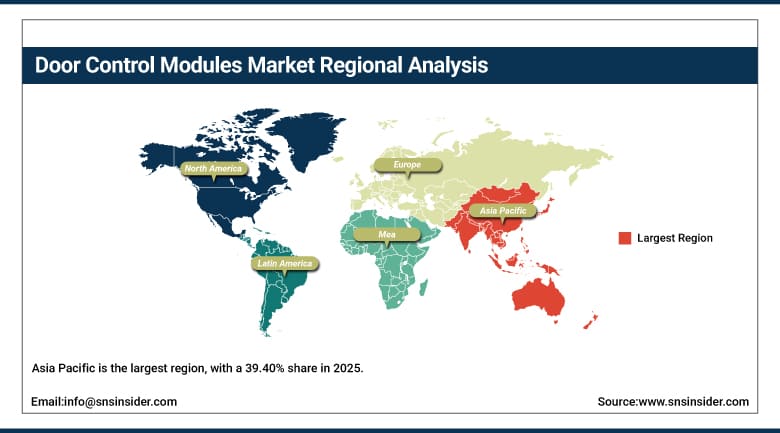
Asia Pacific is the largest region, with a 39.40% share in 2025. China anchors regional demand through its vast passenger-vehicle production base and a fast-growing local electric-vehicle industry that is adopting zonal door-electronics architectures earlier than most legacy combustion programs elsewhere in the region. India and Japan add further volume, with India's production base expanding steadily and Japan's established supplier ecosystem continuing to export modules and components to vehicle programs across the wider region. Regional component and chip suppliers are scaling output to serve both local automakers and the export-oriented contract manufacturing that increasingly runs through the region's main hubs today.
South Korea and Southeast Asian markets are expanding assembly capacity that draws on the same regional component supply base, reinforcing Asia Pacific's role as both the largest consuming region and an increasingly significant net exporter of door-control hardware to other producing regions worldwide. India is also growing its share of door-system component production: Inteva Products opened a second Pune manufacturing plant on November 10, 2025, backed by an investment of over Rs. 50 crore, to produce frameless window regulators, E-Latch systems and power folding actuators for Indian automakers.
Get Customized Report as Per Your Business Requirement - Enquiry Now
North America Door Control Modules Market Insights
North America is the second-largest region, anchored by the United States, with Canada and Mexico forming an integrated production base under USMCA regional-content rules that keep door-module sourcing concentrated close to final vehicle assembly across all three countries. Mexico has become an established door-module manufacturing hub, hosting dedicated plants such as Daedong Door's Zacatecas facility, opened in 2023 to supply plastic and steel door modules to Kia and Hyundai assembly lines in the country. Canada's smaller parts base is increasingly oriented toward electric-vehicle platforms, where automakers are specifying higher-content zonal door-electronics modules than on comparable combustion-engine programs built in the region.
Aftermarket demand for replacement door-control components remains meaningful across the region given a comparatively older average vehicle fleet, supporting independent parts distributors alongside OEM-focused suppliers in both the United States and Canada. Regulatory recall activity tied to door-latch and lock defects continues to surface periodically, keeping safety compliance a persistent engineering priority for suppliers serving the region's automakers across both passenger and light commercial lines. Fleet and commercial-vehicle buyers are adopting the same zonal door-electronics architectures more gradually than passenger-car programs, extending the replacement cycle for older centralized designs that remain in active service across much of the region's existing fleet.
⮞Nissan North America filed recall campaign 26V023000 with federal safety regulators on January 20, 2026, covering 26,432 vehicles across the 2025 Altima, 2025-2026 Frontier, 2026 Kicks and 2025 Sentra over door strikers that may have been improperly welded and could break during vehicle operation. A door-latch recall of that specificity and scale illustrates the continued regulatory and engineering scrutiny directed at door-closure hardware across the region's vehicle fleet.
Europe Door Control Modules Market Insights
Europe is a mature, technically demanding region, with Germany, France and the United Kingdom anchoring both production volume and premium-feature adoption across the continent as a whole. Germany's established automotive supplier base gives the region deep expertise in zonal electrical architectures and software-defined vehicle platforms, which several of the world's largest door-electronics suppliers develop and manufacture close to home across multiple plants. France and the United Kingdom add further production volume, while Central and Eastern European manufacturing sites increasingly supply components back into Western European vehicle assembly on a cost-competitive basis that benefits automakers across the bloc as a whole.
European regulators and vehicle-type-approval authorities maintain some of the world's most detailed door-closure and pinch-protection requirements, pushing suppliers toward sensor-equipped designs earlier than markets with lighter regulatory frameworks elsewhere around the world. Software-defined vehicle programs launched by regional automakers are accelerating the shift from centralized to zonal door-electronics architectures, with several premium manufacturers already running production vehicles on the newer design today across multiple model lines. That early-mover position keeps European suppliers at the technical forefront of the broader global architecture transition now underway across the industry.
⮞Bosch presented its zone-based electrical architecture and related software-defined vehicle technologies at IAA Mobility 2025 in Munich, in a presentation dated September 2, 2025, describing high-performance computers paired with zone-based designs intended to reduce the number of conventional control units per vehicle. A technology showcase of that breadth at one of the industry's largest suppliers reflects the depth of architectural change now reshaping door and body electronics across the region.
MEA & Latin America Door Control Modules Market Insights
The Middle East and Africa is a smaller but steadily growing region, with demand concentrated in Saudi Arabia, the United Arab Emirates and South Africa. Saudi Arabia and the United Arab Emirates lead regional demand through growing vehicle assembly and import volumes tied to rising consumer purchasing power and expanding road infrastructure investment. South Africa contributes a smaller, longer-established vehicle production base that continues to rely mainly on imported door-control components given limited local electronics manufacturing capacity across the country. Limited local chip and module production across the wider region means nearly all door-control hardware sold arrives through established import channels rather than local fabrication lines.
Latin America is the fastest-growing region, expanding at a projected CAGR of approximately 8.95% from 2026 to 2035, led by Brazil's large vehicle assembly base serving both local consumers and regional export markets across South America. Mexico and Argentina contribute additional assembly volume tied to their own growing automotive sectors, drawing on a mix of local and imported door-control components depending on the vehicle platform involved. Currency volatility across several countries continues to make landed component pricing less predictable than automakers and suppliers in the region would prefer, even as underlying vehicle production keeps expanding steadily across most of the region's major manufacturing hubs.
⮞Stellantis issued a recall covering Peugeot, Citroën and Opel vehicles worldwide, reported June 16, 2026, after a Vehicle Supervision Module software fault left interior door handles able to deactivate randomly and unexpectedly across 142,708 cars globally. A software-driven door-control defect of that scale and reach, affecting vehicles built for both European and export markets including Latin America and Africa, underscores how deeply software now governs door-access reliability across the group's global model lineup.
Market Dynamics:
Growth Drivers: Zonal architecture consolidation is reshaping how automakers specify door electronics
The strongest driver is the industry-wide shift from distributed, point-to-point door wiring toward zonal electrical architectures that consolidate lock, window, mirror and lighting control into fewer, more capable modules per vehicle area across nearly every new platform program. Automakers pursuing software-defined vehicle platforms favor this consolidation specifically because it separates hardware from application software, letting door features be updated or added without redesigning the underlying wiring harness each model year. That architectural shift is pulling module content value upward even where overall vehicle production growth remains comparatively modest across major manufacturing regions worldwide.
A second driver is the steady expansion of keyless entry, pinch-protection sensing and electrochromic mirror features from premium trims into mainstream vehicles, adding electronic content per door that a basic mechanical system never required in earlier vehicle generations. Falling sensor and microcontroller costs are making this expansion economically viable across a far wider range of vehicle price points than was possible even a few years ago across most major markets worldwide. Suppliers able to package these features into a single consolidated module are capturing disproportionate share of this expanding content opportunity relative to competitors still offering only discrete, single-function components today.
⮞Volkswagen Group China delivered its China Electronic Architecture on schedule, announced January 30, 2026, reducing electronic control units by about 30 percent compared with previous generations while supporting full-vehicle over-the-air updates across multiple platforms and powertrain types. A platform-wide electronics consolidation of that magnitude at one of the world's largest automakers by volume is direct evidence of the zonal-architecture driver now reshaping door and body electronics industry-wide.
Restraints: Regulatory compliance costs and recall exposure are weighing on supplier margins
A persistent restraint is the rising cost of regulatory compliance as authorities in multiple major markets tighten mechanical-backup and pinch-protection requirements for electronic door handles and locks, forcing suppliers to redesign components that had previously met looser standards for years. Meeting a new compliance deadline often requires re-validating an entire module rather than a single component, since mechanical and electronic subsystems within a door module are tightly integrated by design. That redesign burden falls hardest on smaller suppliers lacking the engineering capacity that larger, better-capitalized competitors can deploy more readily across multiple affected product lines simultaneously and across several regions at once.
A second restraint is the recurring risk of door-latch and lock-related recalls, which periodically force costly remediation campaigns and tighten automaker qualification requirements across the supplier base worldwide. Automakers have grown more cautious about supplier vetting following a string of recent recalls tied to door-closure hardware, adding testing and documentation costs that smaller producers absorb less easily than established Tier 1 suppliers with deeper balance sheets and broader engineering teams. That heightened scrutiny is slowing the pace at which newer or smaller door-electronics suppliers can win qualification with major automaker accounts across multiple regions and vehicle segments alike going forward.
⮞China's Ministry of Industry and Information Technology issued a draft Automotive Door Handle Safety Requirements standard on December 16, 2025, mandating mechanical emergency opening functions on interior and exterior door handles for vehicles under 3.5 tons, with the requirement taking effect January 1, 2027. A mandatory redesign timeline of that scope, covering one of the world's largest vehicle markets, illustrates the compliance-cost pressure now facing door-handle and lock-module suppliers across the industry.
Opportunities: Supplier consolidation and new design wins are opening fresh revenue paths
A major opportunity lies in capturing design wins tied to the industry-wide shift toward zonal architectures, since suppliers that qualify early with a major automaker on a next-generation platform typically retain that business for the platform's full production life. Switching module suppliers after initial qualification carries real requalification cost and risk for automakers, so suppliers investing early in zonal-compatible module designs stand to lock in multi-year revenue streams that later entrants will find difficult to displace once production begins. That first-mover advantage is becoming more valuable as more automakers commit to zonal architecture roadmaps across their next several vehicle generations worldwide.
A second opportunity lies in supplier consolidation and new capital investment, as established door-electronics and access-systems suppliers attract fresh ownership and financing to accelerate growth plans that organic reinvestment alone could not fund as quickly across every target market worldwide. Suppliers securing new strategic investment are using the proceeds to expand engineering capacity and pursue design wins across a wider customer base than their prior capital structure permitted them to serve. That capital-driven expansion is reshaping the competitive landscape faster than product innovation alone would achieve, and smaller rivals are responding with partnerships of their own across several regions and customer segments.
⮞Brose reported on October 9, 2026 that it is localizing production of its electric tailgate actuation module in Brazil, already supplying two automakers with plans concluded for two more in 2027, alongside an already-consolidated door automation module integrating window-lift, remote door-locking, anti-pinch sensing and control electronics built at its São José dos Pinhais, Jarinu and Goiana plants. A localization push of that scope at a major door-systems supplier signals the kind of production and design-win opportunity now available to suppliers positioned for the industry's broader architecture transition.
Recent Developments:
-
In November 2026, Aptiv won an Automotive News PACE Award for its Emergency Power Module, which supplies independent backup power and control to unlock vehicle doors and release handles after a collision even where the vehicle's main power and control systems have failed.
-
In April 2026, Marelli showcased an MCU-Free Door Module and MCU-Free Seat Module at Auto China 2026, removing the local microcontroller unit so that window, mirror, seat and anti-pinch safety functions are instead managed directly by a zone control unit over a low-latency remote control protocol.
-
In September 2025, Bosch presented an expanded zone-based electrical architecture and high-performance computer platform at IAA Mobility 2025, designed to consolidate conventional control units per vehicle area, the same consolidation approach increasingly applied to door-area electronics and module design.
Door Control Modules Market Key Players:
-
AUMOVIO SE
-
Robert Bosch GmbH
-
Denso Corporation
-
Valeo SA
-
Aisin Corporation
-
FORVIA HELLA GmbH & Co. KGaA
-
Aptiv PLC
-
Marelli Holdings Co., Ltd.
-
Brose Fahrzeugteile SE & Co. KG
-
Lear Corporation
-
Kiekert AG
-
Inteva Products
Door Control Modules Market Report Scope:
| Report Attributes | Details |
|---|---|
| Market Size in 2025 | USD 2,760.00 Million |
| Market Size by 2035 | USD 5,353.70 Million |
| CAGR | CAGR of 6.85% From 2026 to 2035 |
| Base Year | 2025 |
| Forecast Period | 2026-2035 |
| Historical Data | 2022-2024 |
| Report Scope & Coverage | Market Size, Segments Analysis, Competitive Landscape, Regional Analysis, DROC & SWOT Analysis, Forecast Outlook |
| Key Segments | • By Type (Centralized, Decentralized) • By Application (Door Lock, Mirror Adjustment, Window Lift, Illumination) • By Component (Actuators, Sensors, Wires, Switches) • By Sales Channel (Original Equipment Manufacturer, Aftermarket) • By Vehicle Type (Passenger Cars, Light Commercial Vehicles, Heavy Commercial Vehicles) |
| Regional Analysis/Coverage | North America (US, Canada), Europe (Germany, UK, France, Italy, Spain, Russia, Poland, Rest of Europe), Asia Pacific (China, India, Japan, South Korea, Australia, ASEAN Countries, Rest of Asia Pacific), Middle East & Africa (UAE, Saudi Arabia, Qatar, South Africa, Rest of Middle East & Africa), Latin America (Brazil, Argentina, Mexico, Colombia, Rest of Latin America). |
| Company Profiles | AUMOVIO SE, Robert Bosch GmbH, Denso Corporation, Valeo SA, Aisin Corporation, FORVIA HELLA GmbH & Co. KGaA, Aptiv PLC, Marelli Holdings Co., Ltd., Brose Fahrzeugteile SE & Co. KG, Lear Corporation, Kiekert AG, Inteva Products |

Frequently Asked Questions
The market includes AUMOVIO SE, Robert Bosch, Denso Corporation, Valeo, Aisin Corporation, FORVIA HELLA, Aptiv, Marelli, Brose, Lear Corporation, Kiekert and Inteva Products, among others.
The main opportunities lie in capturing early design wins tied to the industry-wide shift toward zonal electrical architectures, and in supplier consolidation and new capital investment accelerating engineering capacity and design-win activity.
The key growth factor is the industry-wide shift from distributed, point-to-point door wiring toward zonal electrical architectures that consolidate lock, window, mirror and lighting control into fewer, more capable modules per vehicle.
By application, the Door Lock segment dominated the market with approximately 42.70% share in 2025, since central and child-lock functions remain the most safety-critical electronic system housed within the door.
Asia Pacific dominated the market with approximately 39.40% share in 2025, led by China. Latin America is the fastest-growing region with a projected CAGR of approximately 8.95% from 2026 to 2035.
