
Rail Freight Market Report Scope & Overview:
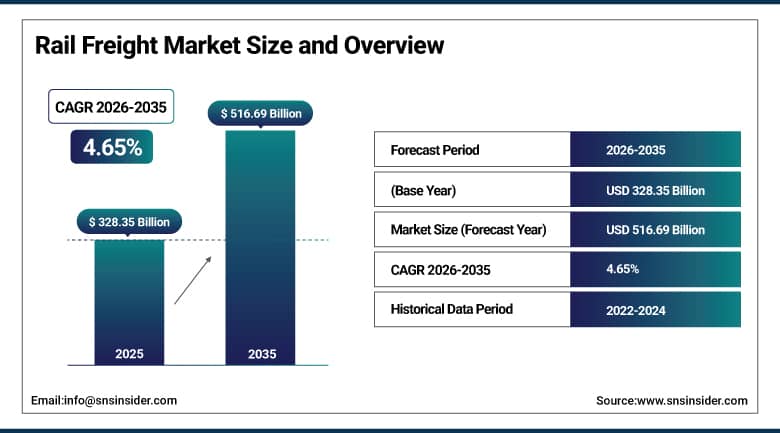
The Rail Freight Market was valued at USD 328.35 billion in 2025 and is expected to reach USD 516.69 billion by 2035, growing at a CAGR of 4.65% from 2026-2035.
The Rail Freight Market is influenced by the growing demand for cost-effective, energy-efficient, and reliable transportation of bulk commodities and manufactured goods across domestic and international markets. Governments and railway operators are concentrating on creating intermodal transport networks, developing freight corridors, and modernizing railway infrastructure to boost freight capacity, operational efficiency and connectivity. Trade, industrial production and cross-border trade are growing and this supports demand for rail freight services. Rail transportation is less carbon intensive than road freight which is further driving the market, making logistics providers look for more sustainable solutions for transportation.
⮞In 2024, Indian Railways continued expanding its dedicated freight corridor infrastructure and freight transportation capacity, supporting faster cargo movement, improved logistics efficiency, and greater integration of rail-based freight services across major industrial and commercial regions.
To Get More Information On Rail Freight Market - Request Free Sample Report
Rail Freight Market Trends:
-
Growing demand for rail freight transportation for cost-effective and fuel-efficient movement of goods over long distances.
-
Rising adoption of intermodal and containerized rail freight services to improve logistics efficiency and supply chain connectivity.
-
Continued modernization of railway infrastructure, freight corridors, and digital signaling systems to enhance transportation capacity and operational performance.
-
Increasing government investment in railway networks to support cross-border trade, industrial development, and sustainable freight transportation.
-
Expanding adoption of digital technologies, including artificial intelligence, Internet of Things, and predictive analytics, to improve freight tracking, asset utilization, and operational reliability.
U.S. Rail Freight Market Outlook:
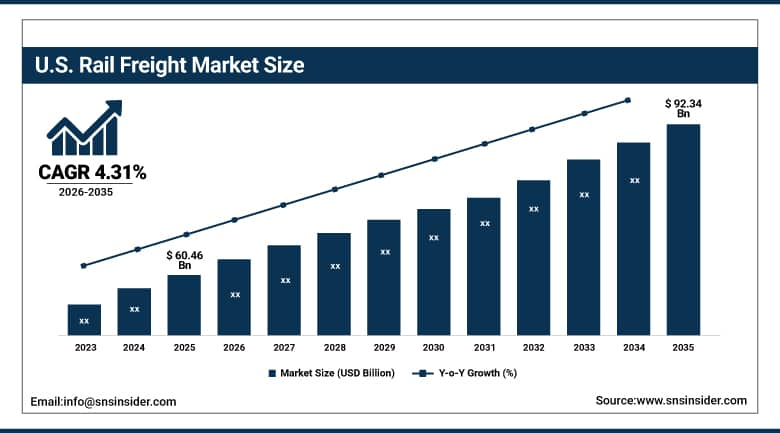
The U.S. Rail Freight Market was valued at USD 60.46 Billion in 2025 and is expected to reach USD 92.34 Billion by 2035, growing at a CAGR of 4.31% from 2026-2035.
U.S. growth of Rail Freight Market will remain supported by continued investments in rail infrastructure modernization, increasing demand for cost-effective and fuel-efficient freight transportation, and the expansion of intermodal logistics networks. The U.S. Rail Freight Market is expected to grow due to continuous investments in rail infrastructure modernization, increasing demand for economical and fuel-efficient freight transportation, and the expansion of intermodal logistics networks. Actions by governments to improve rail safety, strengthen supply chains, upgrade tracks and bridges, and improve port rail connections will continue to undergird freight transport efficiency. Demand from the mining, agriculture, chemicals, energy, manufacturing and automotive industries will spur domestic freight, while intermodal and containerized rail freight will benefit from growing integration of multimodal logistics and cross-border trade.
⮞In October 2024, the U.S. Federal Railroad Administration announced over $2.4 billion for 122 rail improvement projects across 41 states and Washington, D.C., supporting infrastructure modernization, freight connectivity, rail safety, and operational efficiency.
Rail Freight Market Segment Analysis:
-
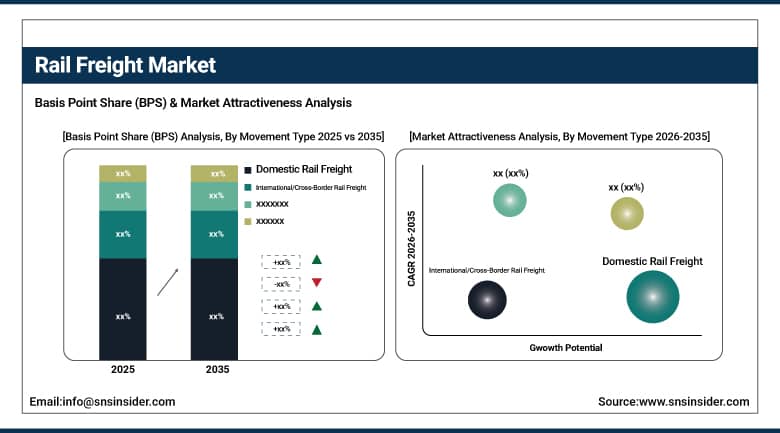
By Movement Type, the Domestic Rail Freight segment dominated the Rail Freight Market with approximately 72.63% share in 2025, while the International/Cross-Border Rail Freight segment is the fastest growing with a CAGR of approximately 5.10%.
-
By Haul Distance, the Short-Haul – Up to 500 km segment dominated the Rail Freight Market with approximately 42.37% share in 2025, while the Long-Haul – Above 1,500 km segment is the fastest growing with a CAGR of approximately 4.92%.
-
By Freight/Handling Type, the Bulk & Conventional Carload Freight segment dominated the Rail Freight Market with approximately 51.37% share in 2025, while the Intermodal & Containerized Rail Freight segment is the fastest growing with a CAGR of approximately 5.10%.
-
By End-Use Industry, the Mining & Metals segment dominated the Rail Freight Market with approximately 24.37% share in 2025, while the Retail & Consumer Goods segment is the fastest growing with a CAGR of approximately 5.07%.
By Movement Type, Domestic Rail Freight dominates and International/Cross-Border Rail Freight grows fastest
Domestic Rail Freight dominating segment of the Rail Freight Market, owing to the widespread domestic freight transportation networks, strong demand for transportation of bulk commodities, agricultural products, manufactured goods and industrial materials, and the well-established railway infrastructure across major economies. The cost effectiveness of rail over long distances, and the growth of domestic trade and industrial activity, is reinforcing the importance of the sector.
International/Cross-Border Rail Freight is the fastest growing segment in the Rail Freight Market, owing to the growth in international trade, cross-border cargo movement and investments in railway corridors linking major industrial and commercial areas. Increased cross-border rail connectivity is driven by the growing demand for efficient multimodal logistics, improved customs coordination, and infrastructure modernization as companies seek cost-effective and reliable solutions for international freight transportation.
By Haul Distance, Short-Haul – Up to 500 km dominates and Long-Haul – Above 1,500 km grows fastest
Short-Haul – Up to 500 km is the largest segment of the Rail Freight Market owing to high demand for regional freight transport, industrial distribution and movement of raw materials and finished goods between nearby production centers, warehouses and consumption markets. The section is underpinned by the dominance of existing rail networks, the frequent movement of freight and the cost effectiveness of rail for the movement of bulk commodities over regional routes.
Long-Haul – over 1,500 km is the fastest growing segment of the Rail Freight Market. The growth is driven by expanding interregional trade, increasing cross-border freight movement, and growing demand for cost-effective transportation over long distances. Investments are being made in dedicated freight corridors, modernization of railway infrastructure and creation of multi-modal logistics networks to improve long-distance connectivity and operational efficiency, encouraging businesses to opt for rail freight to move bulk commodities, industrial materials and containerized cargo across distant markets.
By Freight/Handling Type, Bulk & Conventional Carload Freight dominates and Intermodal & Containerized Rail Freight grows fastest
Bulk & Conventional Carload Freight segment has dominated the Rail Freight Market due to large transportation of coal, minerals, agricultural commodities, chemicals and other industrial raw materials. The segment's dominance is strengthened by robust demand from mining, energy, agriculture, and manufacturing industries coupled with the cost efficiency of railways in transporting heavy and high-volume goods.
Intermodal & Containerized Rail Freight is the fastest growing segment of the Rail Freight Market driven by rising demand for integrated logistics solutions, growing international trade and the increasing adoption of container-based transportation. Investments in intermodal terminals, rail infrastructure and links between ports, road networks and distribution centers improve the efficiency and connectivity of freight handling, prompting companies to switch to rail-based container transportation to ensure reliable and affordable freight movement.
⮞In April 2025, India’s Ministry of Railways highlighted the transportation of bulk commodities, including coal, iron ore, cement, food grains, fertilizers, and petroleum products, underscoring rail freight’s importance for industrial, energy, and agricultural supply chains.
By End-Use Industry, Mining & Metals dominates and Retail & Consumer Goods grows fastest
Mining & Metals segment is expected dominate the Rail Freight Market during the forecast period. The growth of this segment is driven by the large transportation demands for coal, iron ore, steel and other mineral commodities. The high volume and weight of these materials, together with the cost effectiveness of rail freight over long distances and in bulk shipment, underpin demand from mining and metal processing industries. The segment dominance is further supported by continued industrial activity and demand for raw materials.
Retail & Consumer Goods is the fastest growing segment of the Rail Freight Market due to the expansion of retail distribution networks, rising consumer demand and increased movement of packaged goods across regional and international markets. The rise of e-commerce, need for effective supply chains and the use of intermodal transportation solution are motivating retailers and logistics providers to use rail freight for long distance cargo transit, supporting better distribution efficiency and cost management.
Regional Analysis:
|
Region |
Major Country |
Share within Region, 2025 (%) |
|---|---|---|
|
North America |
United States |
78.63% |
|
Asia Pacific |
China |
45.67% |
|
Europe |
United Kingdom |
24.83% |
|
Latin America |
Brazil |
38.72% |
|
Middle East & Africa |
Israel |
21.54% |
Asia Pacific Rail Freight Market Insights
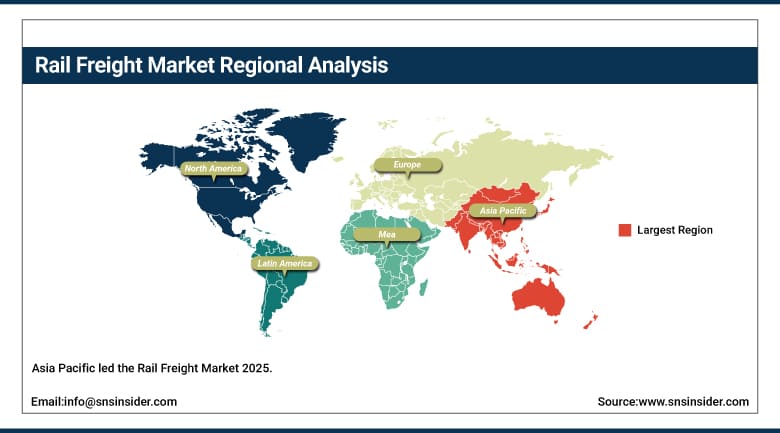
Asia Pacific is anticipated to witness the highest CAGR of approximately 5.26% among all regional segments of the Rail Freight Market throughout the forecast period from 2026 to 2035 on account of increasing cross-border trade, expanding railway infrastructure, rising industrial production, and growing demand for efficient freight transportation. The largest contributor among all countries within the region will be China owing to its extensive rail freight network, strong manufacturing sector, and significant investments in railway infrastructure.
The contribution from Japan will be in the form of advanced railway systems and efficient freight logistics, while India will have a growing contribution in terms of dedicated freight corridor development, railway infrastructure expansion, and increasing demand for rail-based cargo transportation.
Get Customized Report as Per Your Business Requirement - Enquiry Now
North America Rail Freight Market Insights
North America accounted for approximately 23.42% of the global Rail Freight Market in 2025, driven by an extensive railway network, strong freight transportation demand, and well-established logistics infrastructure. The United States is a significant part of regional demand, with substantial rail transport of bulk commodities, agricultural products, energy resources and manufactured goods.
Canada contributes to regional growth through cross-border freight movements, resource transportation, and expanding trade connectivity. Ongoing investments in rail infrastructure upgrades, intermodal transportation, digital freight management and operational efficiency further bolster North America’s position in the global rail freight market.
Europe Rail Freight Market Insights
Europe offers a large regional market for rail freight and Germany, with its extensive railway network and its position as a major European logistics and freight transport hub, forms the basis. Germany’s share of the European market is a result of the strong industrial base, the existing freight corridors and the position in cross-border rail transport.
France, the United Kingdom, Italy and Poland add further regional demand, supported by mature rail infrastructure, industrial freight movements and growing investment in intermodal transport. Ongoing European Union investment in railway modernization, cross-border connectivity and sustainable freight mobility underpin steady regional demand for rail freight services.
⮞In October 2025, Eurostat reported that Germany led EU rail freight transport in 2024 with 126,320 million tonne-kilometres, followed by Poland with 56,713 million and France with 32,249 million, highlighting Germany’s importance in European freight transportation.
MEA & Latin America Rail Freight Market Insights
The Middle East & Africa rail freight market is gradually developing, supported by investments in railway infrastructure, freight corridor expansion, and logistics connectivity. Saudi Arabia and the UAE are expanding their rail networks to boost cargo transport and reduce reliance on road freight. South Africa and other emerging markets in Africa are the main drivers of regional demand, transporting mining commodities, minerals and bulk goods.
In Latin America, the Rail Freight Market is led by Brazil, which represents a major share of regional demand owing to its extensive transportation of agricultural commodities, iron ore, and other bulk materials. And Mexico and Argentina also contribute to market activity through industrial freight movement and cross-border trade connectivity. The region’s rising rail freight services are supported by increasing demand for affordable logistics, export-oriented commodity transportation and railway infrastructure development.
⮞In July 2025, South Africa’s Transnet reported that freight rail volumes increased by 5.5% to 160.1 million tonnes, supported by the transportation of export coal, iron ore, and general freight, highlighting rail freight’s importance to the country’s commodity exports.
Market Dynamics:
Growth Drivers: Rising Freight Transportation Demand and Expansion of Rail Logistics Infrastructure
Growing demand for cost-effective transportation of bulk commodities, agricultural products, industrial materials, and manufactured goods contributes to the growth of the Rail Freight Market. Railway networks are growing, with dedicated freight corridors and intermodal logistics infrastructure expanding freight capacity and connectivity. Growth in industrial production, domestic trade and cross-border trade underpins the demand for reliable rail transport.
Modernizing railways, digital freight management and enhanced connections between ports, industrial centers and distribution hubs are making operations more efficient. The increasing focus on reducing emissions from transportation also encourages logistics providers to move appropriate freight volumes from the road to the rail, thus supporting the use of energy-efficient and sustainable solutions for freight transportation.
Restraints: High Infrastructure Investment Costs and Operational Efficiency Challenges
High capital expenditure required for railway construction, track upgrades, freight terminals, signaling systems and rolling stock may impede Rail Freight Market growth. The ageing assets of the railway infrastructure require significant long-term investment for renewal and maintenance. Freight movement is being hampered and operating costs are being driven up by network capacity and infrastructure constraints.
Operational challenges, including delays, differences in rail standards across borders, poor last-mile connectivity and the coordination needed between rail and other modes of transport can reduce the reliability of services. Road freight, especially for flexible short distance movements, also competes with rail and puts pressure on rail operators to improve transit times, scheduling and overall logistics efficiency.
Opportunities: Rail Network Expansion and Digital Freight Management Integration
Expansion of dedicated freight corridors, cross-border railway connections, and intermodal terminals creates opportunities for the Rail Freight Market by improving cargo capacity and reducing transit bottlenecks. Investment in port connectivity and industrial rail lines can move bulk commodities, manufactured goods and containerized cargo around the country and the world.
Integration of artificial intelligence, Internet of Things sensors, predictive maintenance, and real-time freight tracking offers further opportunities to improve asset utilization, shipment visibility, and operational reliability. Digital scheduling, automated terminal operations and data-driven logistics all have a role to play in helping rail freight operators to improve service efficiency and meet growing demand for low-cost and sustainable freight transport.
Recent Developments:
-
October 2026: GB Railfreight signed an 11 year agreement with 7 Steel UK to transport scrap steel to its Cardiff facility and distribute finished steel products across the UK, strengthening industrial rail freight logistics.
-
July 2025: Lineas secured operations in zones 3, 4, 5 and 6B at the Port of Antwerp, strengthening its role in port related rail freight logistics.
-
June 2026: Touax Group, Texmaco Rail & Engineering and TrinityRail Global announced a partnership through the TTRL railcar leasing joint venture to expand freight wagon leasing solutions in India.
-
April 2026: GB Railfreight and Maritime Transport agreed a new multiyear rail freight contract to move goods from major UK deep sea ports to inland terminals, strengthening intermodal connectivity and supporting more sustainable supply chains.
-
March 2026: Lineas and Alpha Trains signed a leasing agreement for two Stadler EURO9000 locomotives, supporting the modernisation of freight operations along Europe's North South corridor.
Rail Freight Market Key Players:
-
Union Pacific Corporation
-
BNSF Railway Company
-
Canadian National Railway Company
-
Canadian Pacific Kansas City Limited
-
CSX Corporation
-
Norfolk Southern Railway Company
-
Deutsche Bahn AG (DB Cargo)
-
SNCF Group (Rail Logistics Europe)
-
China State Railway Group Company Limited
-
Indian Railways
-
Russian Railways (RZD)
-
Japan Freight Railway Company (JR Freight)
-
Aurizon Holdings Limited
-
Pacific National Pty Ltd
-
Transnet Freight Rail
-
PKP Cargo S.A.
-
SBB Cargo AG
-
Genesee & Wyoming Inc.
-
Freightliner Group Limited
-
Green Cargo AB
Rail Freight Market Report Scope:
| Report Attributes | Details |
|---|---|
| Market Size in 2025 | USD 328.35 Billion |
| Market Size by 2035 | USD 516.69 Billion |
| CAGR | CAGR of 4.65% From 2026 to 2035 |
| Base Year | 2025 |
| Forecast Period | 2026-2035 |
| Historical Data | 2022-2024 |
| Report Scope & Coverage | Market Size, Segments Analysis, Competitive Landscape, Regional Analysis, DROC & SWOT Analysis, Forecast Outlook |
| Key Segments | • By Movement Type (Domestic Rail Freight, International/Cross-Border Rail Freight) • By Haul Distance (Short-Haul – Up to 500 km, Medium-Haul – Above 500 km to 1,500 km, Long-Haul – Above 1,500 km) • By Freight/Handling Type (Bulk & Conventional Carload Freight, Intermodal & Containerized Rail Freight, Automotive & Specialized Freight) • By End-Use Industry (Mining & Metals, Agriculture, Food & Forestry, Chemicals, Energy & Petrochemicals, Manufacturing & Automotive, Retail & Consumer Goods) |
| Regional Analysis/Coverage | North America (US, Canada), Europe (Germany, UK, France, Italy, Spain, Russia, Poland, Rest of Europe), Asia Pacific (China, India, Japan, South Korea, Australia, ASEAN Countries, Rest of Asia Pacific), Middle East & Africa (UAE, Saudi Arabia, Qatar, South Africa, Rest of Middle East & Africa), Latin America (Brazil, Argentina, Mexico, Colombia, Rest of Latin America). |
| Company Profiles | Union Pacific Corporation, BNSF Railway Company, Canadian National Railway Company, Canadian Pacific Kansas City Limited, CSX Corporation, Norfolk Southern Railway Company, Deutsche Bahn AG (DB Cargo), SNCF Group (Rail Logistics Europe), China State Railway Group Company Limited, Indian Railways, Russian Railways (RZD), Japan Freight Railway Company (JR Freight), Aurizon Holdings Limited, Pacific National Pty Ltd, Transnet Freight Rail, PKP Cargo S.A., SBB Cargo AG, Genesee & Wyoming Inc., Freightliner Group Limited, Green Cargo AB |

Frequently Asked Questions
North America dominated the Rail Freight Market in 2025, accounting for approximately 34.27% share, driven by extensive railway networks, established logistics infrastructure, and strong freight transportation demand.
Leading companies in the Rail Freight Market include Union Pacific Corporation, BNSF Railway Company, Canadian National Railway Company, Canadian Pacific Kansas City Limited, CSX Corporation, among others.
Key opportunities include dedicated freight corridor expansion, cross-border railway connectivity, intermodal terminal development, and digital freight management integration to improve transportation efficiency and shipment visibility.
Rising demand for cost-effective freight transportation, expanding industrial production, increasing cross-border trade, and investments in railway infrastructure modernization are major factors driving market growth.
The Bulk & Conventional Carload Freight segment dominated the Rail Freight Market in 2025, accounting for approximately 51.37% share, supported by strong bulk commodity transportation demand.
