
Edge Application Security Market Report Scope & Overview:
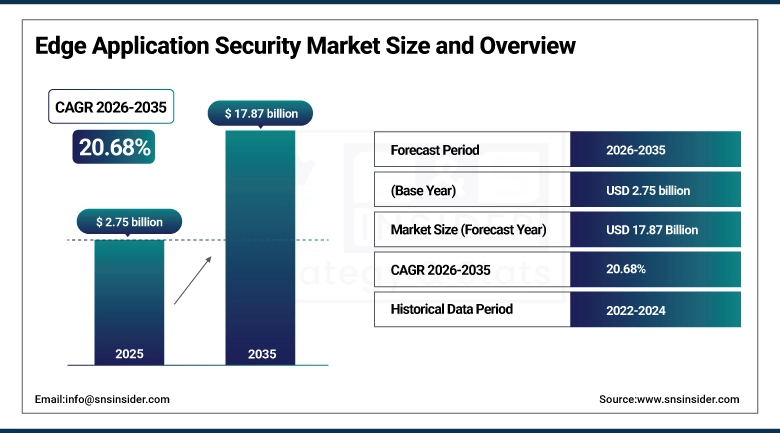
The Edge Application Security Market was valued at USD 2.75 billion in 2025 and is expected to reach USD 17.87 billion by 2035, growing at a CAGR of 20.68% from 2026-2035.
The Edge Application Security Market is experiencing growth owing to the rapid rise of cloud native application development, greater utilization of edge computing, and frequent cyberattacks against API/web-based platforms. Companies are seeking effective security measures to secure their distributed infrastructure and maintain the privacy of sensitive information. The market is gaining impetus from the deployment of 5G, Internet of Things (IoT), digital transformation, and the need for real-time threat detection capabilities.
According to research, edge systems experience nearly 3× higher risk of physical and network-layer attacks compared to centralized cloud systems. Additionally, around 75% of mobile and edge devices lack proper endpoint protection, significantly increasing vulnerability across distributed environments.
In a major cybersecurity incident, Microsoft successfully mitigated one of the largest recorded DDoS attacks at 15.72 Tbps, which was driven by IoT-based botnets, highlighting the rising scale of automated attacks targeting cloud and edge infrastructures.
To Get more information on Edge Application Security Market - Request Free Sample Report
Edge Application Security Market Trends
-
Rising adoption of edge computing and distributed IT environments is driving the edge application security market.
-
Growing need to secure applications, data, and workloads at the network edge is boosting market growth.
-
Expansion of IoT devices, 5G networks, and remote operations is fueling deployment.
-
Increasing focus on real-time threat detection, zero-trust security models, and secure access is shaping adoption trends.
-
Advancements in AI-driven threat intelligence, secure web gateways, and runtime protection are enhancing security capabilities.
-
Rising concerns over data breaches, cyberattacks, and compliance requirements are supporting market expansion.
-
Collaborations between cybersecurity providers, cloud vendors, and enterprises are accelerating innovation and global adoption.
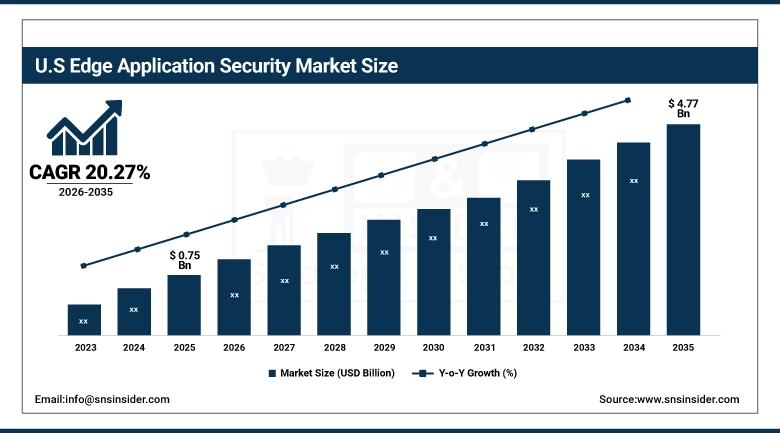
U.S. Edge Application Security Market was valued at USD 0.75 billion in 2025 and is expected to reach USD 4.77 billion by 2035, growing at a CAGR of 20.27% from 2026-2035.
U.S. Edge Application Security Market growth is driven by factors such as fast cloud adoption, cyber-attacks, market presence of major security solution vendors, and high digital infrastructure development. Growth is also fueled by increasing zero-trust security requirements, artificial intelligence (AI)-enabled threat detection, and API and edge application protection needs.
The U.S. federal cybersecurity strategy is actively shifting toward Zero Trust architecture, with key agencies such as the Cybersecurity and Infrastructure Security Agency (CISA) and the U.S. Department of Defense (DoD), along with major cloud providers like AWS, Microsoft, and Google Cloud, formally implementing Zero Trust frameworks.
Additionally, cloud and AI-driven security risks are expanding significantly in the U.S., where over 70% of organizations now use AI-powered cloud services in production environments. Reports indicate that nearly 80% of cloud security incidents are identity-related rather than malware-based, while cloud penetration attacks have increased by approximately 75% year-over-year, highlighting the growing complexity of securing distributed edge and cloud ecosystems.
Edge Application Security Market Growth Drivers:
-
Rapid Expansion of Cloud-Native Applications and Distributed Edge Computing Increasing Demand for Advanced Application Security Solutions Globally
The rapid expansion of cloud-native applications and distributed edge computing infrastructures is greatly enhancing the potential attack surface for companies. Applications are being deployed across numerous edge nodes in an effort to minimize latency and enhance user experience, hence creating new security risks. It is no longer adequate to rely on conventional security strategies due to the complex nature of modern applications. The adoption of cutting-edge security solutions for edge applications is becoming imperative as businesses seek to mitigate new security risks. The increased dependence on digital services and IoT connectivity further fuels the demand for efficient security frameworks.
According to research, over 94% of enterprises now use cloud services, with most adopting multi-cloud or hybrid cloud architectures, further expanding distributed security complexity. Additionally, around 89% of organizations are already using Kubernetes or containerized environments for cloud-native application deployment, significantly increasing the need for container and API-level security.
Major cloud providers are also strengthening their security ecosystems, with AWS (Amazon Web Services) expanding AWS WAF and API Gateway protections, and enhancing edge security capabilities for LambdaEdge and CloudFront workloads.
Edge Application Security Market Restraints:
-
High Implementation Costs and Complex Integration Requirements Limiting Adoption Among Mid-Sized and Resource-Constrained Enterprises
The high cost of implementing edge application security technologies poses an obstacle due to the large capital outlay required to integrate these solutions into the IT environment. Organizations would have to make substantial investments in infrastructure, qualified staff, and monitoring mechanisms. The incorporation of edge application security technologies within legacy IT systems may prove to be difficult and costly. Organizations will encounter difficulties integrating their security solutions with multi-cloud and hybrid IT infrastructures. The budget constraints and uncertainties surrounding the expected ROI deter organizations from adopting these technologies. Cost and integration issues act as major obstacles that impede the adoption of edge application security technologies.
Edge Application Security Market Opportunities:
-
Expansion of 5G Networks and IoT Ecosystems Creating Strong Demand for Scalable and Intelligent Edge Security Platforms
The rollout of 5G infrastructure and IoT ecosystems is paving the way for significant business prospects in the area of edge application security. The rise of connectivity and low latency will mean that more data processing moves towards the edge, thus increasing the scope of security threats. Such an evolution calls for the adoption of cutting-edge security architectures that can deliver real-time threat analysis and automated response across multiple billions of connected devices. Sectors like smart manufacturing, autonomous driving, and smart cities have been among the driving forces behind the growing demand. Edge application security vendors that leverage AI-driven solutions and the cloud are likely to benefit from this trend.
According to Cisco, there are approximately 29–30 billion connected devices globally in the 2023–2025 range, with IoT devices generating a majority of new edge traffic across enterprises.
Additionally, the U.S. National Institute of Standards and Technology (NIST) highlights that edge computing is critical for low-latency processing, distributed AI, and real-time analytics, while also significantly increasing the need for distributed cybersecurity frameworks to secure decentralized environments.
Edge Application Security Market Segment Highlights
-
By Organization Size, Large Enterprises dominated the Edge Application Security Market with ~67% share in 2025; Small and Medium Enterprises fastest growing (CAGR).
-
By Component, Solutions dominated the Edge Application Security Market with ~64% share in 2025; Services fastest growing (CAGR).
-
By End-User, IT & Telecommunications dominated the Edge Application Security Market with ~30% share in 2025; Retail & E-commerce fastest growing (CAGR).
-
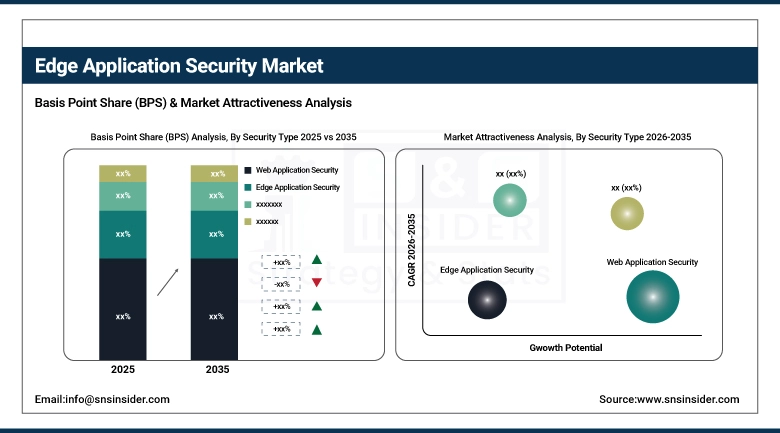
By Security Type, Web Application Security dominated the Edge Application Security Market with ~22% share in 2025; Bot Management fastest growing (CAGR).
-
By Deployment, Cloud dominated the Edge Application Security Market with ~67% share in 2025; Cloud fastest growing (CAGR).
Edge Application Security Market Segment Analysis
By Security Type, Web Application Security segment dominates the Market, Bot Management segment expected to grow fastest.
The Web Application Security Segment held the leading position in the Edge Application Security Market in 2025 because of the increasing reliance of companies on web applications to conduct their businesses and engage customers. The growing threats associated with web applications, API, and cloud services have resulted in a high demand for security solutions.
The Bot Management Segment is anticipated to register the highest growth rate during the forecast period 2026-2035 owing to the increasing number of automated cyberattacks and malicious bot activities against digital platforms. The increasing deployment of AI-enabled bots for credential stuffing and scraping has increased the demand for bot management solutions.
By Organization Size, Large Enterprises segment dominates the Market, Small and Medium Enterprises segment expected to grow fastest.
The Large Enterprises segment captured the largest share of the Edge Application Security Market in 2025 because of several reasons such as high investments made for digital transformation, highly intricate IT infrastructures, and high vulnerability to sophisticated cyberattacks. Their ability to make substantial investments in security platforms, multi-level security solutions, and round-the-clock monitoring systems gives them an edge in the market. They also have more digital and cloud-based applications, adding to their dominance in the market.
The Small and Medium Enterprises segment is anticipated to be the fastest-growing at a CAGR during the forecast period owing to increased awareness about cyber attacks and affordable cloud application security solutions. Their financial strength helps them avail subscription-based models and managed services for easy deployment of solutions. Their growth can be attributed to increasing digitization and growth in e-commerce.
By Component, Solutions segment dominates the Market, Services segment expected to grow fastest.
The Solutions segment led the Edge Application Security Market in 2025 because of high demand for integrated security solutions with features such as real-time threat detection, API protection, and DDoS defense. Firms tend to use comprehensive solutions that enable them to monitor security incidents centrally and respond automatically within their dispersed networks. Complexity and security threats in the edge environment continue to fuel growth in security software solutions around the world.
The Services segment is expected to witness the highest CAGR during the forecast period of 2026-2035 due to increasing demand for managed services, consultancy, and professional services. Companies do not have the necessary knowledge about cybersecurity and therefore, prefer hiring professionals who provide services for constant monitoring of the networks and responses to any security incidents.
By End-User, IT & Telecommunications segment dominates the Market, Retail & E-commerce segment expected to grow fastest.
IT & Telecommunications industry accounted for the largest market share in Edge Application Security market in 2025 because of significant data flow, robust infrastructure, and early implementation of cutting-edge security tools. Telcos need to safeguard their extensive and complex networks from various cyberattacks like DDoS and API hacks. Expansion of 5G and cloud services will continue boosting security spending in this sector.
The Retail & E-commerce industry will experience the highest growth rate during the forecast period (2026-2035) owing to growing online purchases, adoption of digital payment modes, and increasing cybersecurity threats. Companies are focusing on providing enhanced edge security solutions to ensure customer information remains safe and offer secure purchasing experiences. The expansion of e-commerce and omnichannel retailing is fueling this trend.
By Deployment, Cloud segment dominates the Market and is expected to grow fastest.
The cloud segment was leading in the Edge Application Security Market in 2025 owing to the advantages associated with scalability and flexibility that enable its implementation in edge applications for real-time security and auto-updates. Cloud security is more favored by businesses to lower infrastructure cost investments and facilitate easy integration with multi-cloud and hybrid ecosystems. Furthermore, this market segment is anticipated to register the fastest CAGR between 2026 and 2035 driven by accelerating digital transformation, growing remote working practices, cyberattacks, and subscription security solutions adoption.
Edge Application Security Market Regional Analysis
North America Edge Application Security Market Insights
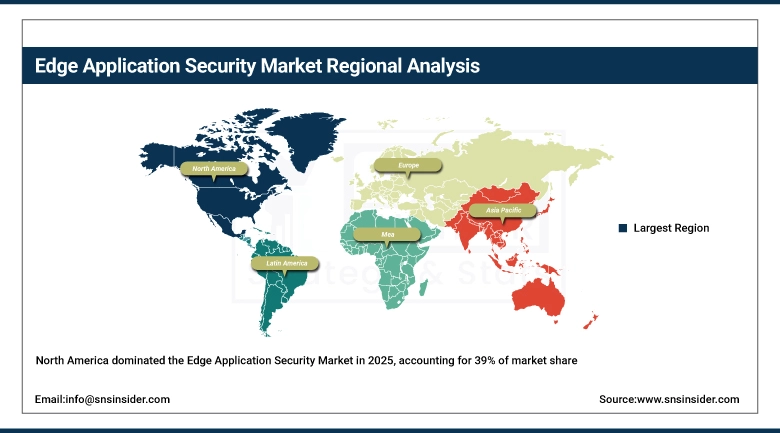
The North American region held the largest Edge Application Security Market share of around 39%, in terms of revenue, in 2025 due to the prevalence of leading cybersecurity providers, superior digital infrastructure, and the presence of edge computing solutions. The high capital expenditure in cloud security, AI-based threat detection, and zero trust models enhances market dominance. Rising instances of cyber attacks among organizations and government agencies increase the need for robust security solutions. Widespread availability of 5G services, rapid IoT growth, and stringent data security laws drive continuous growth.
Get Customized Report as per Your Business Requirement - Enquiry Now
Asia Pacific Edge Application Security Market Insights
The Asia Pacific region is anticipated to have the highest growth rate of around 22.10% CAGR during the forecast period owing to its rapid digitization process, high adoption of cloud services, and increased smartphone and IoT device usage. The rising level of cybersecurity concerns amongst organizations along with increased investment in 5G network infrastructure has led to the increased adoption of edge application security solutions. Growth in e-commerce, fintech, and manufacturing industries has also added to the growing demand.
Europe Edge Application Security Market Insights
The Edge Application Security Market in Europe is witnessing steady growth owing to stringent regulatory environments, including the General Data Protection Regulation (GDPR), heightened privacy concerns, and adoption of cloud and edge computing technology by organizations. Rising cyber-attacks against critical infrastructure, finance, and industries are propelling demand for enhanced security solutions. Digitalization in the BFSI, healthcare, and government sector, alongside spending on zero-trust architectures and artificial intelligence-based cybersecurity measures, is contributing to market growth.
Middle East & Africa and Latin America Edge Application Security Market Insights
The Middle East and Africa region and Latin America represent potential market segments for Edge Application Security owing to their increasing levels of digitalization, growing cloud adoption, and high cybersecurity risk profiles. The increasing levels of investment in smart cities, banking digitization, and telecommunication networks in these regions will fuel the demand for enhanced cyber security measures. Lack of advanced cybersecurity capabilities coupled with high instances of ransomware attacks is fueling the growth of this market in both regions.
Edge Application Security Market Competitive Landscape:
Palo Alto Networks
Palo Alto Networks is a worldwide provider of cybersecurity solutions established back in 2005. The company provides cybersecurity for networks, clouds, and sophisticated threat intelligence services. Palo Alto Networks utilizes a platform approach which combines firewall security services, endpoint security services, and Zero Trust architecture to protect modern businesses. The focus of the company is on protecting cloud native applications and distributed systems through such offerings as Prisma and Cortex.
-
2026 – Palo Alto Networks expanded Prisma SASE and Secure Enterprise Browser capabilities, strengthening edge application security through Zero Trust enforcement, inline AI-driven threat prevention, and real-time application inspection at distributed edge environments.
Cisco Systems Inc.
Cisco Systems Inc., established in 1984, is one of the world's foremost companies for network infrastructure, cybersecurity, and enterprise IT solutions. Its solutions range from routing and switching to cloud network solutions and observability platforms. Through integrated network and security architectures, Cisco provides secure digital transformation services. With Cisco solutions, organizations can manage their hybrid workforces and cloud connectivity, monitor applications' performance, and improve network and edge system visibility, resilience, and secure access.
-
2026 – Cisco enhanced Secure Access and AppDynamics integration to improve edge application visibility, enabling AI-based traffic inspection, secure application delivery, and unified policy enforcement across hybrid cloud and edge environments.
Cloudflare
Formed in 2009, Cloudflare Inc. is one of the prominent providers of internet infrastructure and cybersecurity services. It provides CDN services, DDoS protection, and Zero Trust among other offerings. It has a worldwide edge network that improves website performance and security. Cloudflare ensures that its customers are protected against various cyberattacks to their applications, APIs, and end users while at the same time making sure that there is improved speed and reliability.
-
2026 – Cloudflare advanced its Application Security Suite with expanded WAF, API Shield, and edge-based Zero Trust controls, improving protection for distributed applications against bot attacks, DDoS, and API abuse at the network edge.
Akamai Technologies
Akamai Technologies was founded in 1998 and is currently one of the leading companies in content delivery, cloud security, and cybersecurity. Akamai’s edge platform delivers both security and speed to online experiences through their websites, APIs, and apps. Akamai helps businesses stay secure from cyber threats, bots, and ensures API security for their systems. Through Akamai, companies can enable scalable edge security and performance in their online environment.
-
2026 – Akamai strengthened its App & API Protector platform, integrating enhanced edge security analytics and adaptive bot mitigation to secure high-traffic applications with distributed cloud-edge enforcement and real-time threat detection.
Key Players
Some of the Edge Application Security Market Companies
-
Cisco Systems
-
Palo Alto Networks
-
Fortinet
-
Check Point Software Technologies
-
Trend Micro
-
Akamai Technologies
-
Microsoft Corporation
-
IBM Corporation
-
Amazon Web Services
-
Cloudflare
-
F5 Networks
-
Zscaler
-
Imperva
-
Radware
-
Barracuda Networks
-
Fastly
-
Sophos
-
Juniper Networks
-
Citrix Systems
-
McAfee
| Report Attributes | Details |
|---|---|
| Market Size in 2025 | USD 2.75 Billion |
| Market Size by 2035 | USD 17.87 Billion |
| CAGR | CAGR of 20.68% From 2026 to 2035 |
| Base Year | 2025 |
| Forecast Period | 2026-2035 |
| Historical Data | 2022-2024 |
| Report Scope & Coverage | Market Size, Segments Analysis, Competitive Landscape, Regional Analysis, DROC & SWOT Analysis, Forecast Outlook |
| Key Segments | • By Component (Solutions, Services) • By Security Type (Edge Application Security, Bot Management, DDoS Mitigation, Web Application Security, Data Security & Privacy, Others) • By Deployment (On-Premises, Cloud-based) • By Organization Size (Large Enterprises, Small and Medium Enterprises) • By End-User (IT & Telecommunications, BFSI, Retail & Ecommerce, Healthcare, Manufacturing & Automotive, Government & Defense, Others) |
| Regional Analysis/Coverage | North America (US, Canada), Europe (Germany, UK, France, Italy, Spain, Russia, Poland, Rest of Europe), Asia Pacific (China, India, Japan, South Korea, Australia, ASEAN Countries, Rest of Asia Pacific), Middle East & Africa (UAE, Saudi Arabia, Qatar, South Africa, Rest of Middle East & Africa), Latin America (Brazil, Argentina, Mexico, Colombia, Rest of Latin America). |
| Company Profiles | Cisco Systems, Palo Alto Networks, Fortinet, Check Point Software Technologies, Trend Micro, Akamai Technologies, Microsoft Corporation, IBM Corporation, Amazon Web Services, Cloudflare, F5 Networks, Zscaler, Imperva, Radware, Barracuda Networks, Fastly, Sophos, Juniper Networks, Citrix Systems, McAfee |

Frequently Asked Questions
North America dominated the Edge Application Security Market in 2025.
The Solutions segment dominated the Edge Application Security Market in 2025.
Rapid Expansion of Cloud-Native Applications and Distributed Edge Computing Increasing Demand for Advanced Application Security Solutions Globally.
The Edge Application Security Market was valued at USD 2.75 billion in 2025.
The Edge Application Security Market is expected to grow at a CAGR of 20.68% from 2026 to 2035.
