
Electric Kick Scooter Market Report Scope & Overview:
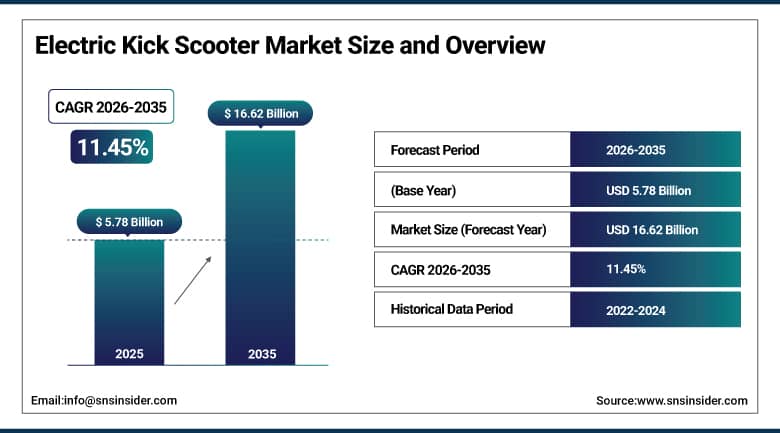
The Electric Kick Scooter Market was valued at USD 5.78 Billion in 2025 and is expected to reach USD 16.62 Billion by 2035, growing at a CAGR of 11.45% from 2026–2035.
Kick scooters powered by electricity have evolved to become viable commuter options in cities around the world. Municipalities are creating cycling and micromobility routes in large urban centers. These measures have made using electric scooters a safer and more reliable experience for new users. The success of scooter operations by fleet owners such as Lime and Bird has proved that electric scooter usage is a viable business venture. There has been an increase in personal ownership along with increased fleet numbers. The decline in battery prices and improved product quality have made purchasing a scooter financially attractive for urban commuters. Major cities like Singapore and Amsterdam have embraced scooters as a viable mode of transportation. Various scooter models include light and portable versions for use in subways to high-performance models designed for longer journeys.
Electric kick scooter sales reached 12.4 million units in 2025. Lime alone logged 200 million rides in 2024, confirming that shared fleet networks have crossed into profitable operations in their strongest city markets.
To Get More Information On Electric Kick Scooter Market - Request Free Sample Report
Electric Kick Scooter Market Trends
-
Urban congestion across major global cities is making electric kick scooters a practical daily choice for millions of short-distance commuters who previously relied on cars or taxis.
-
Battery ranges on commercial scooter models now routinely exceed 40 km per charge, removing range anxiety as a meaningful barrier to daily commuter adoption of personal scooters.
-
Shared fleet operators are reaching sustainable profitability in established markets, with Lime reporting 200 million annual rides in 2024 and positive unit economics across its top city networks.
-
Smart connectivity features including GPS tracking, app-based locking, and ride diagnostics are now standard in premium models, improving safety outcomes and enabling efficient commercial fleet management.
-
U.S. tariffs on Chinese components in 2025 led major manufacturers to open assembly operations in Vietnam and Indonesia, restructuring global production geography in a lasting way.
The U.S. Electric Kick Scooter Market Outlook
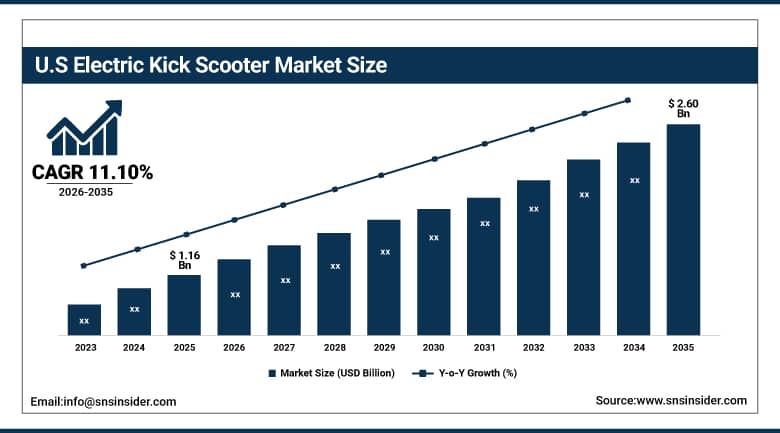
The U.S. Electric Kick Scooter Market was valued at approximately USD 1.16 Billion in 2025 and is expected to reach approximately USD 2.60 Billion by 2035, growing at a CAGR of 11.10%.
The U.S. represents the highest electric kick scooter sales revenue in the world except for China. Ride-sharing fleets can be found in more than 100 cities in the U.S. Lime, Bird, and Spin represent the leading ride-sharing platforms. Regulations in place in most cities have become highly developed and include speed restrictions, lane allocation, and operating hours. Apollo Scooters and Segway-Ninebot have both expanded their U.S. consumer business using brick-and-mortar stores and direct-to-consumer strategies. The number of privately owned electric kick scooters is growing as consumers regard scooters as a real transport alternative. The willingness of U.S. consumers to pay above the worldwide average for better range and quality scooter models has been observed. Premium products in excess of $800 sell well in urban areas located on the coast. The impact of the 2025 tariffs prompted certain brands to take the pressure internally instead of increasing prices.
U.S. tariffs on Chinese electric scooter components announced in 2025 accelerated supply chain restructuring across the industry. Yadea and AOVO both confirmed Vietnamese assembly expansions within months of the policy taking effect.
Electric Kick Scooter Market Segment Analysis
-
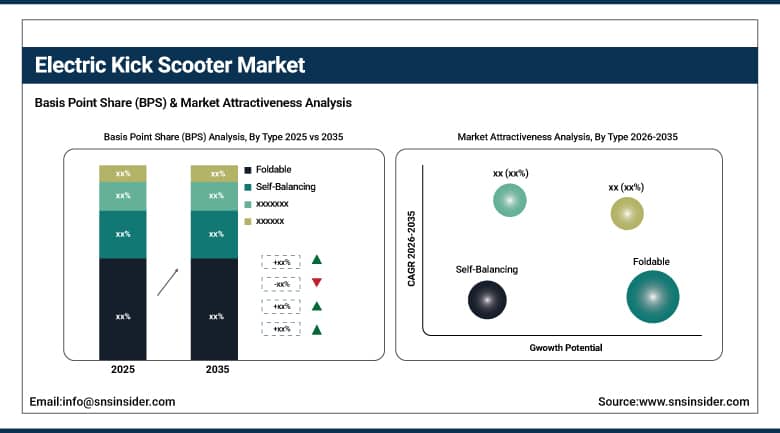
By Type, Foldable Scooters held the largest market share of approximately 38.72% in 2025; Self-Balancing Scooters are the fastest-growing type at a CAGR of 12.84% through 2035, driven by gyroscopic stability features that expand the accessible rider demographic.
-
By Battery Type, Lithium-Ion dominated with approximately 65.19% share in 2025; Nickel-Metal Hydride is the fastest-growing battery type at a CAGR of 13.47% through its cost advantages in price-sensitive commercial fleet segments.
-
By Range per Charge, the 20 to 40 km category held approximately 41.63% share in 2025; the above 40 km range is the fastest-growing segment at a CAGR of 14.12%.
-
By Distribution Channel, offline held approximately 52.28% share in 2025; Online is the fastest-growing channel at a CAGR of 15.03% through direct-to-consumer platforms and expanding e-commerce availability.
By Type, foldable scooters dominate, self-balancing grows fastest
Foldable scooters held approximately 38.72% of the electric kick scooter market in 2025. Portability is their defining commercial advantage. Commuters fold them and take them onto trains, into offices, and onto buses without difficulty. This makes them the natural choice for people who combine scooter riding with public transport. Segway-Ninebot and Apollo have positioned foldable designs at the core of their consumer product lineups. Weight reduction through aluminium frame construction has made modern folding scooters genuinely easy to carry.
Self-balancing scooters are growing at a CAGR of 12.84% through 2035. Gyroscopic stabilization reduces the riding skill required to operate these scooters safely. This opens the market to users who find conventional kick-propulsion models difficult or physically demanding. Hospitality operators, tourism providers, and university campuses are deploying them for staff and visitor mobility. The technology has become more compact and more refined than early commercial versions. Safety certification for self-balancing systems has advanced across the U.S., EU, and Australian markets. These factors together support sustained above-average growth through the forecast period.
By Distribution Channel, offline dominates, online grows fastest
Offline retail accounted for about 52.28% of revenue from distribution channels in 2025. Buyers can experience their scooters firsthand via physical stores, and it is important mainly when buying items worth more than USD 500. It allows for brand showrooms to be used as not only a point of sales but also a place where consumers can discover what to buy. Electronics retail provides geographical reach beyond what scooters' specialty retail can provide. The accessibility of after-sales service also drives buyers toward offline channels.
E-commerce represents the most rapidly growing distribution channel with a CAGR of 15.03% until 2035. Direct-to-consumer channels help brands sell items without retail margins and create consumer relationships. Subscription and installment models have helped make high-end scooters available to wider consumer masses. Online retail helps brands achieve market penetration even in areas where physical presence is limited. Customer reviews have gained considerable importance as purchasing motivation together with advertisement. Apollo and Unagi have created successful business models relying mostly on e-commerce channels.
Regional Analysis
|
Region |
Major Country |
Share within Region, 2025 (%) |
|---|---|---|
|
North America |
United States |
83.4% |
|
Europe |
France |
27.8% |
|
Asia Pacific |
China |
53.7% |
|
Middle East & Africa |
UAE |
28.6% |
|
Latin America |
Brazil |
43.8% |
Asia Pacific Electric Kick Scooter Market Insights
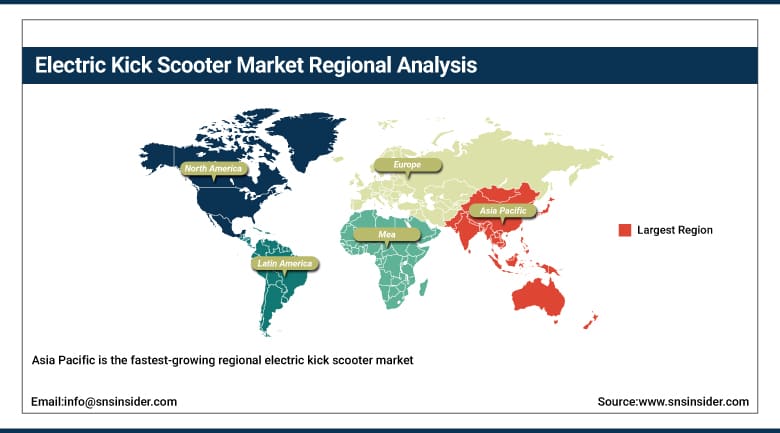
Asia Pacific is the fastest-growing regional electric kick scooter market. China accounts for approximately 53.7% of Asia Pacific revenues. The country is both the world's largest manufacturer and the largest consumer of electric kick scooters. Yadea, Ninebot, and Niu supply global markets from Chinese production bases. India, South Korea, Japan, and Southeast Asia are all recording accelerating adoption. Government electric vehicle incentive programmes across the region make scooter ownership attractive from a cost perspective. Urban density in Asian cities creates strong structural demand for last-mile mobility solutions that cars and public transport alone cannot satisfy.
Get Customized Report as Per Your Business Requirement - Enquiry Now
North America Electric Kick Scooter Market Insights
North America accounted for the biggest regional revenue share at around 36.3% within the global electric kick scooters market in 2025. The United States holds a revenue share of about 83.4% of the total North America revenue. There are currently more than 100 cities in the United States with operating scooter-sharing fleets. The trend toward personal ownership is gaining traction, with better quality products being produced along with lower pricing due to increased competitiveness. Governments in the US have devised regulatory policies that allow for feasible use of such electric kick scooters in most urban areas. Regulations regarding the dedicated lanes and speeds, among others, can now be found in the vast majority of these regions. The shift in tariff policies during 2025 did not curb the market demand; rather, it affected the supply chain. Manufacturers started assembling their scooters in other countries such as Vietnam, Indonesia, and Mexico to reduce costs of components. Retail expansion by Apollo, Segway-Ninebot, and Unagi persisted up until 2025.
Europe Electric Kick Scooter Market Insights
Europe already has a well-established market for electric kick scooters, where there are clear regulations in place concerning shared transportation. The share of revenue from Europe in relation to the continent's market size amounts to around 27.8%. A ban on scooter rentals was imposed in Paris via an official public vote in 2023. Consequently, people became interested in purchasing scooters personally, and the companies' activities moved to other cities in France and nearby markets. Germany, Spain, Italy, and the UK are among the countries that actively develop both personal and shared scooters in their territory. European transport policy is focused on investment into car-free urban transport. Thus, a relatively favorable environment for adopting electric kick scooters can be expected across the majority of EU member states. There have been improvements in regards to safety requirements and speed restrictions within the EU. Retail expansion is being implemented via collaborations between scooter brands and electronics and sports stores.
MEA & Latin America Electric Kick Scooter Market Insights
The Middle East, Africa, and Latin America are growing markets for electric kick scooters. The UAE leads MEA revenues at approximately 28.6% of the regional share. Smart city investment in Dubai and Abu Dhabi has created a supportive environment for micromobility deployment. Tourism and hospitality operators include scooters in guest experience and staff mobility programmes. Brazil leads Latin American revenues at approximately 43.8%. Urban congestion and rising fuel costs in major Brazilian cities have made electric scooters an appealing daily commute option. Several Latin American cities now operate shared scooter programmes at commercial scale.
Market Dynamics
Growth Drivers: Rising urban congestion, government support for low-emission transport, and improving battery technology are driving electric kick scooter market growth.
Traffic congestion continues to worsen in most large cities. Cars become increasingly unsuitable for journeys of moderate to short distances within an urban environment. Electric scooters represent a segment of journeys that lie between walking and the minimum distance required for a taxi or rideshare service to be economically viable. The one-way commute use case has been proven to be commercially viable and is gaining traction. Public funding for cycling and micro-mobility infrastructure improvements has greatly enhanced the safety of electric scooter usage in tens of major urban cities around the world. Such investments continue and are rapidly growing in both Europe and Asia. The cost of batteries has been reduced by more than 70% in the past decade. Thus, it has become commercially viable to manufacture scooters with range exceeding 40 kilometers and sell them at commercially acceptable price levels. Range was the greatest hindrance for such use cases before. It has now been overcome in terms of price points exceeding USD 500.
Restraints: Safety incidents, inconsistent municipal regulations, and supply chain disruption from trade policy changes are restraining electric kick scooter market growth.
Safety still stands as an authentic marketplace problem. Incidents that have led to injuries among users of electric scooters have received significant regulatory attention as well as media coverage across several markets. Restrictions on routes and speeds for scooters have been put in place by several municipalities. In addition, the city of Paris banned electric scooter shared fleets after citizens' votes. Every restriction cuts down the potential commercial addressable market of fleet providers and adds additional risk to brands as they enter new markets. Liability issues for companies have also risen in recent years as personal injury cases arising from scooter-related accidents increase. The policy change in the tariff rates in the U.S. in 2025 for the manufacture of electric scooters affected the cost structure of manufacturers using Chinese components in their products. While some brands passed on increased cost to customers, others bore the margin pressure themselves.
Opportunities: Commercial fleet integration into last-mile logistics and recurring revenue from connected fleet services represent the strongest near-term growth opportunities.
One of the most commercially viable applications of electric kick scooters is last-mile logistics. Delivery firms are considering options other than cargo bicycles and vans for delivering parcels in cities. Electric kick scooters can perform this function well, especially in highly urbanized regions where traffic jams hinder the use of larger modes of transportation. The signing of a single contract by a logistics company would result in an increase in the number of electric scooters in the market greater than many months of retail sales. A commercial fleet purchasing of such electric scooters would result in volumes much higher than the usual volumes of private purchases. Electric kick scooters equipped with IoT features are opening up opportunities for new business models. Fleet management software tracks battery power levels, ride data, and the allocation of maintenance. Such data is useful for sharing with city planners and transport agencies. The subscription model of ride-sharing generates recurring income which is far more commercially attractive than the sale of products to customers.
Recent Developments:
-
2025: Segway-Ninebot launched the Max G2 scooter with a 70 km range and dual suspension, positioning it as a premium commuter product capable of replacing short car trips for urban professionals.
-
2025: Lime reported 200 million annual rides globally, crossing a profitability threshold in its best-performing city markets and confirming the commercial sustainability of the shared fleet model at scale.
-
2025: Yadea and AOVO both confirmed new Vietnamese assembly operations as a direct response to U.S. tariff increases on Chinese manufactured goods, marking a structural shift in production geography.
Electric Kick Scooter Market Key Players are:
-
Segway-Ninebot
-
Xiaomi Corporation
-
Apollo Scooters
-
GOTRAX
-
Yadea Technology Group Co. Ltd.
-
NIU International
-
Bird Rides Inc.
-
Lime (Neutron Holdings Inc.)
-
Razor USA LLC
-
Inokim Inc.
-
Dualtron (Minimotors)
-
Kaabo Electric Scooter
-
Unagi Scooters
-
Joyor
-
Turboant
-
Spin (Ford Motor Company)
-
Voi Technology AB
-
Dott
-
Tier Mobility SE
-
Superpedestrian Inc.
Electric Kick Scooter Market Report Scope
| Report Attributes | Details |
|---|---|
| Market Size in 2025 | USD 5.78 Billion |
| Market Size by 2035 | USD 16.62 Billion |
| CAGR | CAGR of 11.45% From 2026 to 2035 |
| Base Year | 2025 |
| Forecast Period | 2026-2035 |
| Historical Data | 2022-2024 |
| Report Scope & Coverage | Market Size, Segments Analysis, Competitive Landscape, Regional Analysis, DROC & SWOT Analysis, Forecast Outlook |
| Key Segments | • By Type (Foldable, Self-Balancing, Standard) • By Battery Type (Lithium-Ion, Sealed Lead Acid, Nickel-Metal Hydride, Others) • By Range per Charge (Less than 20 km, 20–40 km, more than 40 km) • By Distribution Channel (Online, Offline/Retail) • By End-Use (Personal, Commercial) |
| Regional Analysis/Coverage | North America (US, Canada), Europe (Germany, UK, France, Italy, Spain, Russia, Poland, Rest of Europe), Asia Pacific (China, India, Japan, South Korea, Australia, ASEAN Countries, Rest of Asia Pacific), Middle East & Africa (UAE, Saudi Arabia, Qatar, South Africa, Rest of Middle East & Africa), Latin America (Brazil, Argentina, Mexico, Colombia, Rest of Latin America). |
| Company Profiles | Segway-Ninebot, Xiaomi Corporation, Apollo Scooters, GOTRAX, Yadea Technology Group Co. Ltd., NIU International, Bird Rides Inc., Lime, Razor USA LLC, Inokim Inc., Dualtron, Kaabo Electric Scooter, Unagi Scooters, Joyor, TurboAnt, Spin, Voi Technology AB, Dott, Tier Mobility SE, Superpedestrian Inc |
Frequently Asked Questions
North America dominated the Electric Kick Scooter Market in 2025, holding approximately 36.3% of global revenues.
Foldable Scooters dominated with approximately 38.72% of revenues in 2025.
Rising urban congestion and government support for low-emission transport are driving growth. Improved battery technology and falling product prices are expanding both personal ownership and commercial fleet markets globally.
The Electric Kick Scooter Market was valued at USD 5.78 Billion in 2025.
The Electric Kick Scooter Market is expected to grow at a CAGR of 11.45% from 2026 to 2035.
