
Engine Tuner Market Report Scope & Overview:
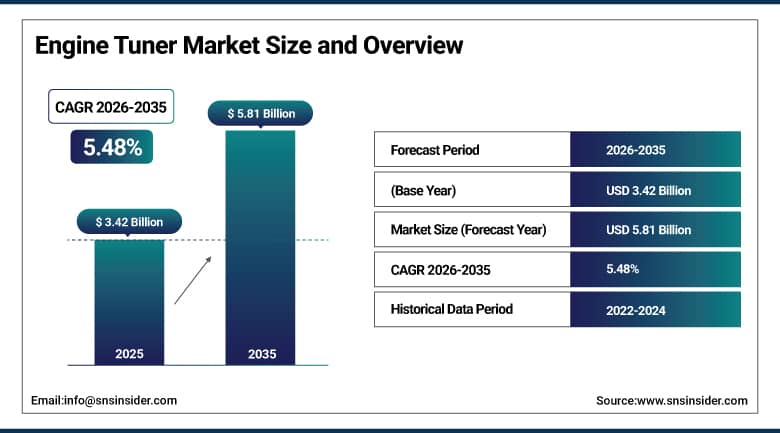
The Engine Tuner Market was valued at USD 3.42 Billion in 2025 and is expected to reach USD 5.81 Billion by 2035, growing at a CAGR of 5.48% from 2026 to 2035.
There will be an increase in demand for the market owing to the increasing demand for improved driving performance, increased fuel efficiency, and personalized tuning services in vehicles. The fast technological changes that have been experienced in the automotive sector in the areas of automotive electronics such as ECU and cloud calibration software can make it possible to improve the engine performance through improved tuning. Another factor that will enhance the growth of the market is the increasing growth of the automotive aftermarket industry in the world.
In the year 2025, firms like Bosch Motorsport and HP Tuners extended the application of their ECU tuning and calibration services to accommodate new models of turbocharged and hybrid vehicles.
To Get More Information On Engine Tuner Market - Request Free Sample Report
Market Trends:
-
Increasing adoption of ECU remapping and software-based engine tuning for performance optimization and fuel efficiency improvements.
-
Rising penetration of turbocharged and direct-injection engines is expanding the scope of aftermarket tuning solutions.
-
Growth of connected vehicles and OTA (over-the-air) tuning updates is enabling real-time engine performance adjustments.
-
Expanding motorsport and performance vehicle culture is driving premium tuning demand in developed markets.
-
Increasing shift toward AI-based engine calibration tools is improving precision and adaptive tuning capabilities.
U.S. Engine Tuner Market Outlook:
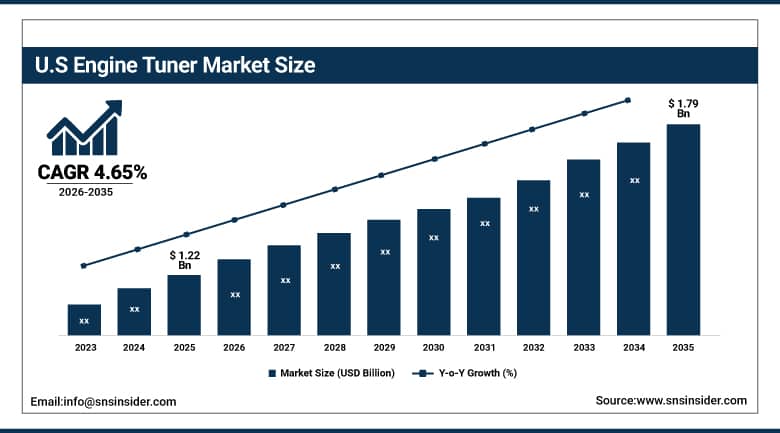
The U.S. Engine Tuner Market was valued at approximately USD 1.22 Billion in 2025 and is expected to reach approximately USD 1.79 Billion by 2035, growing at a CAGR of approximately 4.65% from 2026 to 2035.
The U.S. held the biggest share of the North American engine tuning ecosystem due to a mature motorsport industry, a high penetration of tuning service providers, and growing adoption of connected vehicle technologies that facilitate digital calibration and performance enhancements. The market growth is driven by the growing consumer preference towards the personalization of vehicles, improved engine efficiency and better driving performance in passenger cars, SUVs and light commercial vehicles. Growing use of turbocharged engines and sophisticated ECU systems further drives the demand for software tuning platforms and hardware performance modules. Moreover, the rising availability of cloud-based calibration tools and online tuning services is improving accessibility among professional workshops and individual consumers in the U.S.
In 2025, cloud-enabled ECU tuning platforms from HP Tuners and Cobb Tuning in the U.S. have expanded, enabling remote vehicle calibration, real-time diagnostics and performance optimization for modern turbocharged and hybrid vehicles. In the meantime, the U.S. continues to be the leader in motorsport-related tuning innovation with rising adoption of AI-based engine mapping solutions across performance workshops and aftermarket ecosystems.
Engine Tuner Market Segment Analysis:
-
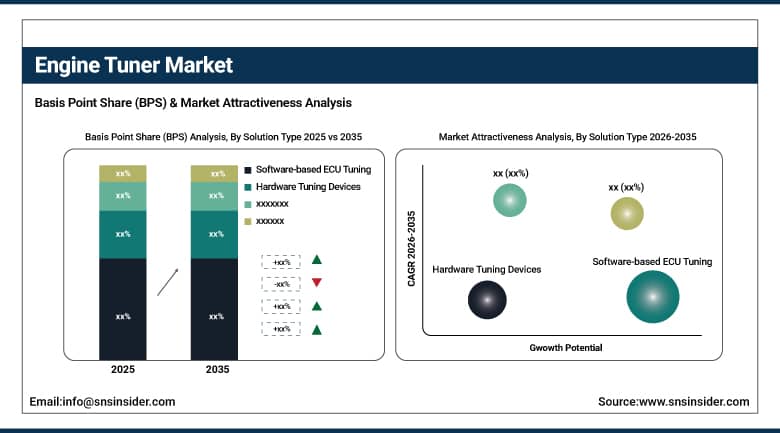
By Solution Type, software-based ECU tuning dominated the Engine Tuner Market with 58.00% share in 2025, while cloud-based tuning platforms are the fastest growing solution segment from 2026 to 2035.
-
By Vehicle Type, passenger cars dominated the Engine Tuner Market with 64.00% share in 2025, while light commercial vehicles are the fastest growing vehicle segment from 2026 to 2035.
-
By Distribution Channel, offline tuning workshops dominated the Engine Tuner Market with 46.00% share in 2025, while online tuning platforms are the fastest growing distribution channel from 2026 to 2035.
-
By End User, individual consumers dominated the Engine Tuner Market with 52.00% share in 2025, while motorsport teams are the fastest growing end-user segment from 2026 to 2035.
By Solution Type, software-based ECU tuning dominates, cloud-based platforms grow fastest
Software-based ECU tuning dominated the Engine Tuner Market in 2025 and held approximately 58% revenue share. The segment is driven by the strong adoption of electronic control unit remapping, fuel optimization, and performance enhancement in the modern turbocharged and direct-injection engines. The increasing demand for affordable aftermarket performance upgrades and compatibility with sophisticated engine electronics further solidified its global dominance.
The cloud-based tuning platform is estimated to record the fastest CAGR owing to the increasing adoption of connected vehicles and digital automotive ecosystems. With the growing use of OTA updates, remote diagnostics and AI based calibration tools in automotive markets globally, a trend towards real-time engine performance optimization solutions is underway.
By Vehicle Type, passenger cars dominate, light commercial vehicles grow fastest
Passenger cars dominated the Engine Tuner Market in 2025 and accounted for approximately 64% revenue share. Increasing consumer demand for personalization, performance enhancement and fuel efficiency optimization of vehicles is fueling strong adoption of tuning solutions in the passenger vehicle segment. The increasing number of turbocharged engines also drives the global demand for ECU tuning.
Light commercial vehicles are estimated to grow at the fastest pace due to increasing need for fleet optimization, expansion of logistics, and growing adoption of fuel-efficient tuning solutions. The increasing focus on the reduction of operational costs and performance improvement in delivery and transportation fleets is leading to an increasing need for sophisticated tuning technologies.
By Distribution Channel, offline workshops dominate, online platforms grow fastest
Offline tuning workshops dominated the Engine Tuner Market in 2025 and held approximately 46% revenue share. Specialized tuning garages, performance service centers and motorsport workshops with a strong global presence still offer hands-on engine calibration services. Established technician know-how and physical diagnostics infrastructure reinforce this channel’s dominance.
Online tuning platforms are expected to witness the fastest growth. Increasing digitalization of automotive services is expected to drive the rapid growth of online tuning platforms, with demand for remote ECU tuning solutions also expected to rise. Software tuning tools and performance upgrades available through subscriptions are gaining popularity, allowing the worldwide distribution of aftermarket parts. The move is also accelerating as the e-commerce automotive ecosystems grow.
By End User, hospitals dominate, biopharmaceutical companies grow fastest
Individual consumers dominated the Engine Tuner Market in 2025 and accounted for approximately 52% revenue share. Car enthusiasts globally are driving robust demand, fueled by a growing preference for vehicle customization, performance enhancement, and aftermarket tuning solutions. The growing availability of plug-and-play tuning tools and software kits is further helping consumer adoption in all passenger vehicle segments.
Motorsport teams are expected to witness the fastest growth in the motorsport as investments are being made in high-performance engine optimization and precision tuning technologies. Adoption is accelerating as a result of increased global motorsport participation and increased need for advanced engine calibration systems. Increasingly teams are turning to AI-based tuning platforms and real-time telemetry systems to improve engine efficiency, power output and consistency of race performance.
Regional Analysis:
|
Region |
Major Country |
Global Market Share (2025 %) |
|---|---|---|
|
North America |
United States |
83.98% |
|
Europe |
Germany |
27.6% |
|
Asia Pacific |
China |
28.9% |
|
Latin America |
Brazil |
5.2% |
|
Middle East & Africa |
UAE |
3.5% |
North America Engine Tuner Market Insights
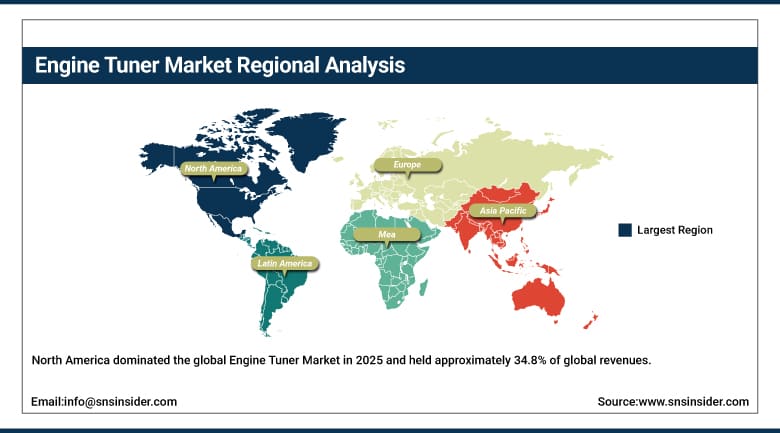
North America dominated the global Engine Tuner Market in 2025 and held approximately 34.8% of global revenues. Strong penetration of performance vehicles, high automotive aftermarket adoption and increasing demand for ECU remapping and software-based tuning solutions continued to make the region lead. The region is led by the US supported by a mature motorsport ecosystem, increasing vehicle customization trends, and the widespread presence of advanced tuning service providers across the region.
The area benefits from a highly developed ecosystem around connected vehicles, with a growing integration of digital tuning platforms, cloud-based calibration tools and AI driven engine optimization solutions. Advanced tuning technologies are still being commercialized by leading aftermarket companies and performance workshops. The U.S. engine tuning aftermarket revenue exceeded USD 1.8 Billion in 2025, propelled by robust demand for passenger cars, SUVs, and high-performance vehicles.
Get Customized Report as Per Your Business Requirement - Enquiry Now
Europe Engine Tuner Market Insights
Europe accounted for approximately 25.79% of global Engine Tuner Market revenues in 2025. Important factors for the growth of the region are a strong automotive engineering base, demand for premium vehicles, and growing adoption of performance tuning solutions in Germany, the UK, France, Italy and Spain. The stringent emission norms have also triggered the development of optimized ECU tuning solutions for fuel efficiency and performance compliance.
The strong presence of OEMs and the well-established motorsport culture in Europe ensure a continuous innovation of the engine calibration technologies. Leading automotive manufacturers and tuning specialists are now increasingly incorporating the use of software based tuning systems into performance vehicles. Germany continues to be the centre of advanced engine engineering, with strong spending on R&D and manufacturing of high-performance vehicles across the region.
Asia Pacific Engine Tuner Market Insights
Asia Pacific accounted for approximately 22.67% of global Engine Tuner Market revenues in 2025. The region is witnessing strong growth due to rising vehicle ownership, growing automotive aftermarket industries and increasing adoption of performance tuning in China, Japan, South Korea and India. The rising disposable income and growing interest for vehicle customization are also driving the market growth.
The region is also witnessing a rapid digitalization of automotive services, including mobile-based tuning platforms and cloud-enabled ECU calibration tools. With its large automotive base and strong tuning ecosystem, China continues to dominate the regional market, while India and South-east Asia are proving themselves as high-growth markets, supported by the growth of the used car markets and aftermarket service penetration.
Middle East & Africa & Latin America Engine Tuner Market Insights
The Middle East & Africa and Latin America collectively accounted for approximately 8.93% of global Engine Tuner Market revenues in 2025. The growth in these regions is driven by increasing automotive enthusiasm, growing imports of used performance vehicles and the gradual expansion of automotive aftermarket services. We are seeing an increased use of tuning solutions in countries like Brazil, Mexico, UAE and Saudi Arabia.
The regions are also witnessing an increase in the availability of digital tuning, thanks to online platforms and mobile ECU tuning tools. Brazil’s large automotive base and robust enthusiast culture make it the largest market in Latin America, while the UAE is the largest in the Middle East thanks to an insatiable appetite for luxury and performance vehicles. The market is growing slowly with the aid of expanding service networks and increasing awareness of performance optimization.
Market Dynamics:
Growth Driver: Rising Demand for Vehicle Performance Optimization and Customization
Another key factor driving the Engine Tuner Market is the increasing demand for vehicle performance enhancement, fuel efficiency optimization, and personalized driving experience. Modern vehicles are allowing more precise tuning due to the increasing penetration of turbocharged engines and advanced ECU systems. The proliferation of the automotive aftermarket culture especially in North America and Europe is further accelerating the adoption of software-based and hardware-based tuning solutions across the globe.
The market growth is further strengthened by the increasing consumer spending on automotive customization and the increasing popularity of motorsport-inspired upgrades. The increasing availability of digital tuning tools, cloud-based ECU calibration and AI-based performance optimization platforms is offering real-time engine tuning capability. This is making tuning services much more accessible and efficient for professional workshops and individual consumers everywhere.
Restraints: Regulatory Restrictions and OEM Software Locking
The Engine Tuner Market is restrained by stringent emission standards globally and increasing regulatory pressure on vehicle modifications. OEMs are increasingly adopting encrypted ECU systems and software locks to restrict access to engine control parameters and cut down on aftermarket tuning versatility. In some regions emissions restrictions and warranty conditions further limit aggressive tuning adoption.
Also, engine durability concerns, insurance and legal restrictions for modified vehicles are affecting market penetration. Regulatory enforcement of emissions compliance in many developed economies is constraining the potential of high-performance tuning modifications, especially for road-legal passenger vehicles. This is shifting demand to managed and compliant tuning options.”
Opportunities: Growth of Digital, AI-Based and Cloud Tuning Ecosystems
With the advent of connected cars and software defined automobile engines, there is strong scope for digital and artificial intelligence-based engine tuning platforms. Cloud-based ECU calibration and remote tuning are becoming more and more popular and are reshaping the current aftermarket industry.
Engine tuning can be supported with machine learning and predictive analytics, to aid the process of adapting the engine performance to driver behavior and environmental factors. In addition, the expanding trend of subscription and mobile app-based tuning systems enables more accessibility. Also, increased electrification and penetration of hybrid vehicles create new market opportunity for powertrain tuning and hybrid performance tuning.
Recent Developments:
-
2026: HP Tuners expanded its cloud-based ECU tuning ecosystem, strengthening remote calibration and real-time diagnostics capabilities for connected and performance vehicles across global aftermarket platforms.
-
2026: Bosch Motorsport enhanced its ECU calibration and performance software systems, supporting advanced engine management solutions for hybrid and high-performance motorsport applications worldwide.
-
2025: Cobb Tuning upgraded its Accessport tuning platform, improving ECU flash tuning, fuel mapping precision, and compatibility with next-generation turbocharged engines globally.
-
2025: Alientech expanded its KESS3 ECU programming system, increasing support for encrypted ECUs and enhancing OBD, bench, and boot mode tuning capabilities for professional tuning workshops worldwide.
Key Players:
-
Bosch Motorsport
-
HP Tuners
-
Cobb Tuning
-
Alientech
-
ECUtek
-
APR LLC
-
Superchips
-
Dynojet Research
-
AEM Electronics
-
MoTeC
-
EFI Live
-
RaceChip
-
Mountune
-
Greddy Performance Products
-
Hondata
-
VF Engineering
-
BR Performance
-
SCT Performance
-
Quantum Tuning
-
Race Dynamics
Engine Tuner Market Report Scope:
| Report Attributes | Details |
|---|---|
| Market Size in 2025 | USD 3.42 Billion |
| Market Size by 2035 | USD 5.81 Billion |
| CAGR | CAGR of 5.48% From 2026 to 2035 |
| Base Year | 2025 |
| Forecast Period | 2026-2035 |
| Historical Data | 2022-2024 |
| Report Scope & Coverage | Market Size, Segments Analysis, Competitive Landscape, Regional Analysis, DROC & SWOT Analysis, Forecast Outlook |
| Key Segments | • By Solution Type (Software-based ECU Tuning, Hardware Tuning Devices, Plug-and-Play Performance Modules, Mobile App-based Tuning Solutions) • By Vehicle Type (Passenger Cars, Light Commercial Vehicles, Heavy Commercial Vehicles, Motorcycles) • By Distribution Channel (Offline Tuning Workshops, Online Platforms, OEM-affiliated Performance Centers, Independent Aftermarket Providers) • By End User (Individual Consumers, Automotive Workshops, Motorsport Teams, Fleet Operators) |
| Regional Analysis/Coverage | North America (US, Canada, Mexico), Europe (Eastern Europe [Poland, Romania, Hungary, Turkey, Rest of Eastern Europe] Western Europe] Germany, France, UK, Italy, Spain, Netherlands, Switzerland, Austria, Rest of Western Europe]), Asia Pacific (China, India, Japan, South Korea, Vietnam, Singapore, Australia, Rest of Asia Pacific), Middle East & Africa (Middle East [UAE, Egypt, Saudi Arabia, Qatar, Rest of Middle East], Africa [Nigeria, South Africa, Rest of Africa], Latin America (Brazil, Argentina, Colombia, Rest of Latin America) |
| Company Profiles | Bosch Motorsport, HP Tuners, Cobb Tuning, Alientech, ECUtek, APR LLC, Superchips, Dynojet Research, AEM Electronics, MoTeC, EFI Live, RaceChip, Mountune, Greddy Performance Products, Hondata, VF Engineering, BR Performance, SCT Performance, Quantum Tuning, Race Dynamics |
Frequently Asked Questions
The Engine Tuner Market is expected to grow at a CAGR of approximately 5.48% during the forecast period.
The Engine Tuner Market was valued at approximately USD 3.42 Billion in 2025.
Rising demand for vehicle performance optimization, ECU remapping, and growing automotive aftermarket customization trends are major factors driving market growth globally.
Software-based ECU tuning dominated the market in 2025 due to high adoption in modern turbocharged and electronically controlled engines.
North America dominated the Engine Tuner Market in 2025 due to strong performance vehicle culture, high aftermarket penetration, and advanced tuning service ecosystems.
