
Explosive Detectors Market Report Scope & Overview:
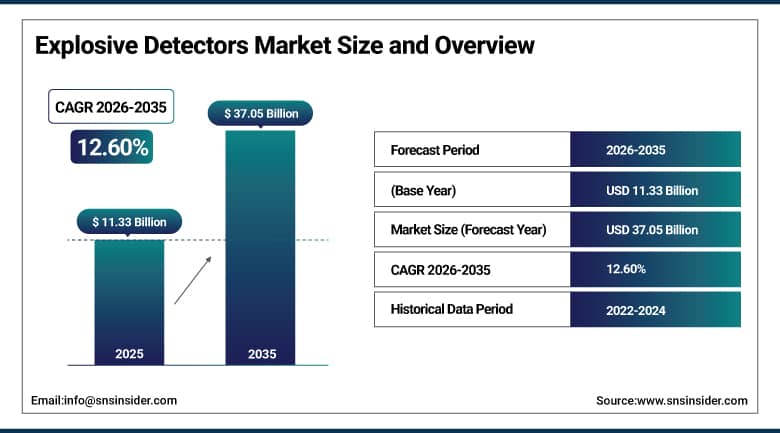
The Explosive Detectors Market was valued at USD 11.33 billion in 2025 and is expected to reach USD 37.05 billion by 2035, growing at a CAGR of 12.60% from 2026–2035.
The explosive detectors market is witnessing strong growth in the global market owing to increasing security threats and rising terrorism concerns. Expanding airport security infrastructure is driving strong adoption of advanced detection systems. Growing deployment of Ion Mobility Spectrometry (IMS) based detectors is improving operational accuracy. Rising investments in border surveillance systems are supporting market expansion. Increasing demand for portable trace detection devices is accelerating technological innovation. Governments are focusing on modernization of defense and public safety systems, further boosting market growth.
According to ICAO Annex 17 aviation security standards, 193 member states require screening of 100% of checked baggage on international flights using explosive detection systems. As per the U.S. Transportation Security Administration, all passengers and 100% of checked baggage are screened at the U.S. commercial airports using advanced explosive detection technologies. European Union aviation security regulations mandate 100% hold baggage screening across member states, indicating near-universal adoption of explosive detection systems.
To Get More Information On Explosive Detectors Market - Request Free Sample Report
Explosive Detectors Market Trends:
-
Increasing global security threats are driving widespread adoption of advanced explosive detection systems across airports, borders, and critical infrastructure worldwide.
-
Rapid expansion of airport infrastructure is boosting demand for high efficiency screening technologies ensuring faster passenger processing and improved safety standards.
-
The increasing use of artificial intelligence and machine learning has led to improved accuracy, automation, and capability to identify threats in real time.
-
The growing use of IMS and X-ray technology has increased operational efficiency and strengthened the current security screening technology.
-
More spending on intelligent security infrastructure has increased the implementation of intelligent detection systems in the government and defense sectors all over the world.
-
The continuous improvement of technology has decreased false alarms and increased performance of explosive detection systems.
U.S. Explosive Detectors Market Outlook:
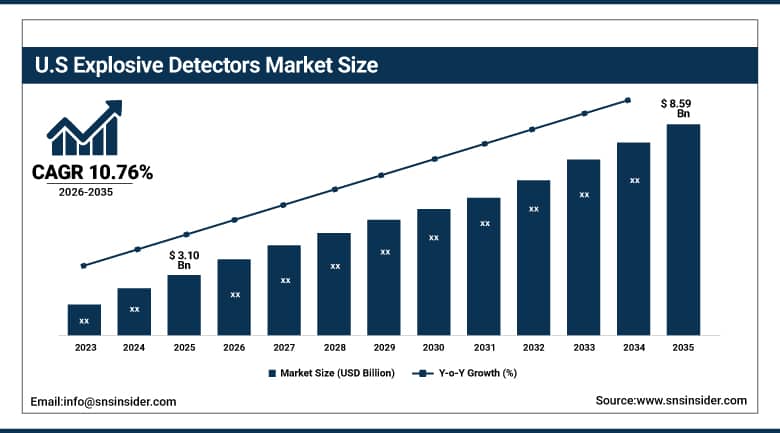
The U.S. Explosive Detectors Market was valued at USD 3.10 billion in 2025 and is expected to reach around USD 8.59 billion by 2035, growing at a CAGR of 10.76% from 2026–2035.
The U.S. explosive detectors market is growing steadily owing to rising homeland security and public safety concerns. Increasing deployment of advanced screening systems is enhancing airport and border protection capabilities. Expansion of defense modernization programs is supporting strong demand for detection systems. Strong adoption of Ion Mobility Spectrometry based technologies is improving operational accuracy. Growing investments in critical infrastructure protection are accelerating market expansion nationwide. Technological advancements in imaging and trace detection solutions are further driving adoption across end users.
According to TSA standards 2025, Advanced Imaging Technology is implemented at more than 99% of passenger checkpoint screening facilities across the country. Similarly, the United States Department of Defense has stated that counter-IED and explosive trace detection technology is incorporated in all the deployed combat and security missions, where explosive trace detection is implemented in over 80% of federal law enforcement screening missions.
Explosive Detectors Market Segment Analysis:
-
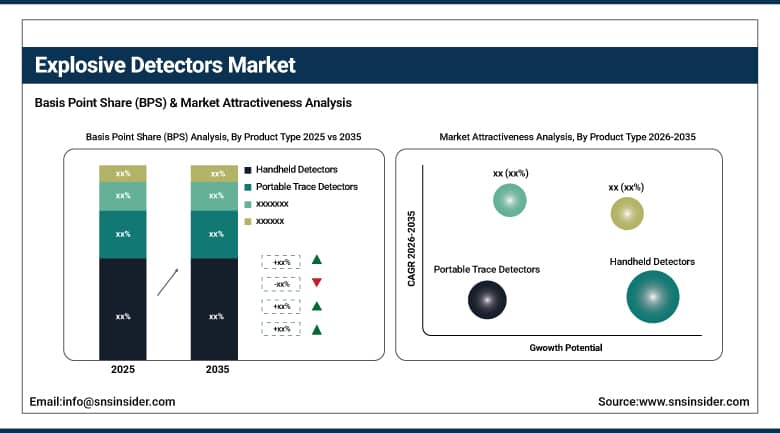
By Product Type, handheld detectors dominated the market with 41.35% share in 2025; while portable trace detectors are the fastest growing segment with CAGR of 15.60% during 2026 to 2035.
-
By Technology, ion mobility spectrometry (IMS) dominated the market with 38.90% share in 2025; while terahertz technology is the fastest growing segment with CAGR of 19.17% during 2026 to 2035.
-
By Detection Method, trace detection dominated the market with 44.80% share in 2025; while imaging-based detection are the fastest growing segment with CAGR of 16.64% during 2026 to 2035.
-
By End User, airports dominated the market with 46.25% share in 2025; while customs & border protection are the fastest growing segment with CAGR of 17.08% during 2026 to 2035.
By Product Type, handheld detectors dominated the explosive detectors market in 2025, while portable trace detectors are the fastest growing segment.
Handheld Detectors segment accounted for the dominated revenue share in the explosive detectors market in 2025 owing to their extensive installation in airports, borders and military applications. The detectors have high portability, fast response time and ease of use under field conditions. The growing number of security threats along with the increasing demand for efficient screening technologies has been boosting the uptake of the detectors by public safety and law enforcement agencies worldwide.
Portable Trace Detectors segment is projected to witness the fastest CAGR during 2026-2035. The growing demand for extremely sensitive detectors to detect trace amounts of explosives is boosting the market growth. Increasing focus towards the adoption of advanced screening techniques is driving the uptake in airports and customs. The incorporation of artificial intelligence (AI) and miniaturized sensors is improving the efficiency of detectors. Growing investment in new generation detectors is driving market growth globally.
By Technology, ion mobility spectrometry (IMS) dominated the explosive detectors market in 2025, while terahertz technology is the fastest growing segment.
Ion Mobility Spectrometry (IMS) segment held the dominated share of revenues in the explosive detectors market in 2025. This is attributed to its excellent sensitivity, fast and accurate detection and reliable identification of trace level of explosive devices. The technology is used extensively in airports and security check points. In addition to regulatory approval, its cost efficiency has made it popular in defense, aviation, and border security applications on a large scale.
Terahertz Technology segment is projected to be the fastest growing segment from 2026 to 2035. This growth is attributed to the superior non-invasive detection and its ability to detect concealed explosives irrespective of their material type. Increasing research and development activities for the next generation security system are increasing the adoption rate of this technology. Growing need for contactless security checks in high security areas is contributing to market expansion.
By Detection Method, trace detection dominated the explosive detectors market in 2025, while imaging-based detection are the fastest growing segment.
Trace Detection segment is leading in the explosive detectors market in terms of revenue share in 2025. The leading position of this segment is attributed to its extensive use in airports, border security, and defense screening applications. Highly sensitive to even small amounts of explosives particles helps in efficient threat detection. The requirement of regulatory bodies for safety of flights further encourages its usage. Technologies such as IMS help in increasing efficiency and effectiveness in the process of threat detection.
Imaging-based Detection segment is anticipated to grow at the fastest CAGR from 2026 to 2035. The fast growth of this segment can be attributed to increased demand for advance technology that will help in detection and prevention of threats from the non-intrusive approach. Usage of AI and machine learning in the system further enhances the accuracy of threat detection without false alarms. Increasing usage in automated luggage and cargo screening systems helps in driving this technology.
By End User, airports dominated the explosive detectors market in 2025, while customs & border protection are the fastest growing segment.
Airports sector holds the dominated share of revenue in the explosive detectors market in 2025. This is because of strict security measures in the aviation industry. The increasing number of air passengers worldwide is also contributing to the use of high-end detectors. Threat environments in aviation ports need to be monitored continuously. Investments in the modernization of airport infrastructure are contributing to the adoption of explosive detection devices.
Customs & Border Protection sector will experience the fastest CAGR from 2026 to 2035. The increase in cross-border security threats and illegal activities like smuggling and trafficking is driving the growth in the Customs & Border Protection sector. There are huge investments being made by governments in surveillance and detection systems. Increase in international business activities is creating a requirement for advanced border inspection systems.
Regional Analysis:
|
Region |
Major Country |
Share within Region, 2025(%) |
|---|---|---|
|
North America |
United States |
78.45% |
|
Europe |
Germany |
29.60% |
|
Asia Pacific |
China |
44.10% |
|
Middle East & Africa |
UAE |
18.80% |
|
Latin America |
Brazil |
47.20% |
North America Explosive Detectors Market Insights.
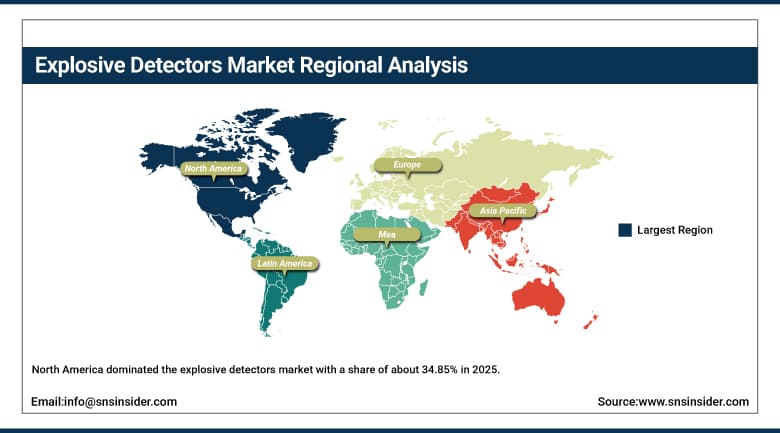
North America dominated the explosive detectors market with a share of about 34.85% in 2025 owing to rising homeland security requirements. The region benefits from strong airport security infrastructure and advanced defense modernization programs. Increasing adoption of IMS based and X ray screening systems is improving threat detection efficiency. Expansion of border surveillance and critical infrastructure protection programs is driving demand. Strong government investments in public safety technologies are further supporting market growth across key security applications.
According to security screening reports by the U.S. Transportation Security Administration and aviation security guidelines from the Department of Homeland Security, all checked luggage and passengers' carry-on bags in the U.S. airports have undergone multiple levels of explosive detection screening through advanced imaging and trace detection technologies in 2025. Moreover, according to the procurement data for the Department of Homeland Security, more than 95% of the U.S. airport checkpoints have installed advanced explosive detection systems with AI-enabled threat recognition capabilities.
Get Customized Report as Per Your Business Requirement - Enquiry Now
Europe Explosive Detectors Market Insights.
Europe explosive detectors market is characterized by steady growth in 2025 owing to strict aviation and border security regulations. Key countries include Germany, France, United Kingdom, and Italy. Rising terrorism threats are driving adoption of advanced detection technologies across airports and public spaces. Increasing focus on critical infrastructure protection is boosting system deployment. Expansion of cross border security cooperation is further supporting market growth across the region.
According to Eurostat air transport statistics, there have been over 1.1 billion air passengers transported through Europe in 2025, further strengthening the large-scale installation of explosive detection systems. According to security audit framework from the International Civil Aviation Organization, over 90% of the European airports comply with the requirements for explosive trace and imaging screening technology.
Asia Pacific Explosive Detectors Market Insights.
Asia Pacific is expected to register the fastest CAGR of about 14.81% during 2026-2035 in the explosive detectors market due to rapid airport expansion and infrastructure development. Increasing defense modernization programs and border security investments are driving strong demand across China, India, Japan, South Korea, and Southeast Asia. Rising geopolitical tensions are further accelerating deployment of advanced detection technologies. Growing focus on aviation security upgrades and smart surveillance systems is supporting continuous market expansion across the region.
According to findings from the International Civil Aviation Organization Security Audit and Asia Pacific Aviation Safety Guidelines, more than 90% of international airports in the Asia Pacific region meet the standardized aviation security screening protocol that involves the use of explosive trace detection and advanced imaging systems during passenger and luggage screening. In accordance with UNODC Transnational Crime Assessments until 2025, more than 70% of member states of Asia Pacific have improved their border security screening through the use of chemical and explosive detection technology.
Middle East & Africa and Latin America Explosive Detectors Market Insights.
The Middle East & Africa along with Latin America regions are experiencing steady growth due to increasing security investments and infrastructure development. Key contributing countries include Brazil, Mexico, UAE, Saudi Arabia, and South Africa. Rising concerns over terrorism and cross border trafficking are driving demand for advanced detection systems. Expanding airport infrastructure and public safety programs are supporting market growth. Increasing adoption of modern screening technologies is further boosting demand across regions.
According to the ICAO Aviation Security Manual and compliance assessments worldwide till 2025, 180 or more member countries have made it necessary to scan passengers and baggage using explosive trace detectors or advanced imaging technologies in international airports. According to the UNODC report, the illegal trafficking routes in Africa and Latin America contribute more than 30% of cocaine traffic in the world, making it imperative to increase the scanning of baggage for border security. According to the TSA report, 100% of checked luggage in commercial flights in the U.S. are scanned using explosive detection systems.
Market Dynamics:
Growth Drivers: Rising global security threats and terrorism concerns driving adoption of advanced explosive detection systems worldwide.
The increased global threats to security have caused a growing need for explosive detection systems in airports, borders, and even infrastructure facilities around the world. The increased occurrence of terrorist activities and illegal traffic has necessitated the need for more sophisticated surveillance systems. The use of IMS-based systems, X-ray machines, and other sophisticated trace detection systems is increasing at an alarming rate. There are also new security guidelines in aviation that necessitate the screening of passengers.
As per the UNODC Global Terrorism Index 2025 and ICAO’s aviation security requirements, more than 98% of international passenger baggage is currently undergoing explosive detection system screening at major airports around the world. In addition, over 60% of INTERPOL’s member countries have updated their border security protocols for incorporating technologies related to chemical and explosives detection.
Restraints: False alarm rates and operational limitations of detection technologies affecting efficiency and user confidence.
False alarms in explosive detection systems lead to inefficiency in terms of operation within busy security areas. There is an increase in time taken for passengers during secondary screening in airports. Environmental issues such as humidity and contamination may affect detection. Some systems have problems with differentiating between harmless substances and explosives. This leads to loss of confidence as well as operational inefficiency. There is need for constant calibration and improvement of algorithms within the systems.
Opportunities:Integration of artificial intelligence and machine learning in explosive detection systems enhancing accuracy and automation.
The incorporation of artificial intelligence and machine learning technology in explosive detection devices has brought about a transformation in explosive detection devices across the globe. Artificial intelligence helps in increasing accuracy through image and sensor analysis of any potential threat. Artificial intelligence and automation have helped speed up the scanning process in airports and at border crossings. Due to the learning process of the machine learning algorithm, the detection technology is likely to continue evolving. The increased investment in smart security technology has led to intelligent detection systems.
As per the security screening performance reports from the U.S. Department of Homeland Security Transportation Security Administration and EU aviation security rules, advanced imaging and computed tomography technologies are currently being used at over 90% of major airport security checkpoints in advanced nations by 2025.
According to the ICAO aviation security recommendations, there has been an increase in the deployment of automated algorithms for threat detection at the stage of screening, where the rate of reducing the false alarm rates has risen to nearly 40% through machine learning. Moreover, according to the DHS test procedure, the sensitivity rates in the AI-based explosive trace detection system have been raised to over 25%.
Recent Developments:
-
2026: OSI Systems developed AI-powered Rapiscan inspection technology systems for automated explosives detection and improved speed at the global market level for transport security.
-
2025: The Smiths Group added new airport security screening systems that include improved imaging detection technologies to meet aviation checkpoint upgrade programs.
-
2025: Leidos upgraded integrated aviation security screening systems for the U.S. aviation authorities using digital transformation and AI threat detection capabilities.
-
2024: Nuctech Company Limited expanded international deployment of intelligent cargo and baggage screening systems across multiple airport security infrastructure projects.
Explosive Detectors Market Key Players are:
-
Smiths Group
-
OSI Systems
-
Leidos
-
Thales Group
-
Safran
-
L3Harris Technologies
-
Teledyne Technologies
-
Thermo Fisher Scientific
-
Bruker Corporation
-
Chemring Group
-
Nuctech Company Limited
-
Analogic Corporation
-
Kromek Group
-
Westminster Group
-
Honeywell International
-
RTX Corporation
-
Robert Bosch GmbH
-
Astrophysics Inc.
-
Varex Imaging Corporation
-
CEIA S.p.A.
Explosive Detectors Market Report Scope:
| Report Attributes | Details |
|---|---|
| Market Size in 2025 | USD 11.33 Billion |
| Market Size by 2035 | USD 37.05 Billion |
| CAGR | CAGR of 12.60% From 2026 to 2035 |
| Base Year | 2025 |
| Forecast Period | 2026-2035 |
| Historical Data | 2022-2024 |
| Report Scope & Coverage | Market Size, Segments Analysis, Competitive Landscape, Regional Analysis, DROC & SWOT Analysis, Forecast Outlook |
| Key Segments | • By Product Type (Handheld Detectors, Vehicle-Mounted Systems, Fixed/Stationary Systems, Portable Trace Detectors, Others) • By Technology (Ion Mobility Spectrometry (IMS), X-Ray Imaging, Mass Spectrometry, Infrared Spectroscopy, Neutron Activation Analysis, Terahertz Technology) • By Detection Method (Trace Detection, Bulk Detection, Vapor Detection, Imaging-based Detection) • By End User (Airports, Defense Forces, Customs & Border Protection, Police Departments, Transportation Authorities, Others) |
| Regional Analysis/Coverage | North America (US, Canada), Europe (Germany, UK, France, Italy, Spain, Russia, Poland, Rest of Europe), Asia Pacific (China, India, Japan, South Korea, Australia, ASEAN Countries, Rest of Asia Pacific), Middle East & Africa (UAE, Saudi Arabia, Qatar, South Africa, Rest of Middle East & Africa), Latin America (Brazil, Argentina, Mexico, Colombia, Rest of Latin America). |
| Company Profiles | Smiths Group, OSI Systems, Leidos, Thales Group, Safran, L3Harris Technologies, Teledyne Technologies, Thermo Fisher Scientific, Bruker Corporation, Chemring Group, Nuctech Company Limited, Analogic Corporation, Kromek Group, Westminster Group, Honeywell International, RTX Corporation, Robert Bosch GmbH, Astrophysics Inc., Varex Imaging Corporation, CEIA S.p.A. |
Frequently Asked Questions
North America dominated the explosive detectors market in 2025 due to strong homeland security systems and advanced security infrastructure deployment.
The explosive detectors market was valued at USD 11.33 billion in 2025.
The major growth factors include rising security threats, increased airport and border security systems, adoption of IMS and X-ray technologies, defense investments, and demand for portable AI-enabled explosive detection solutions.
The explosive detectors market is expected to grow at a CAGR of 12.60% from 2026 to 2035.
The Handheld Detectors segment dominated the market in 2025 due to high portability, fast response time, wide use in airports and defense applications, and strong demand from law enforcement and security agencies worldwide.
