
Fantasy Sports Market Report Scope & Overview:
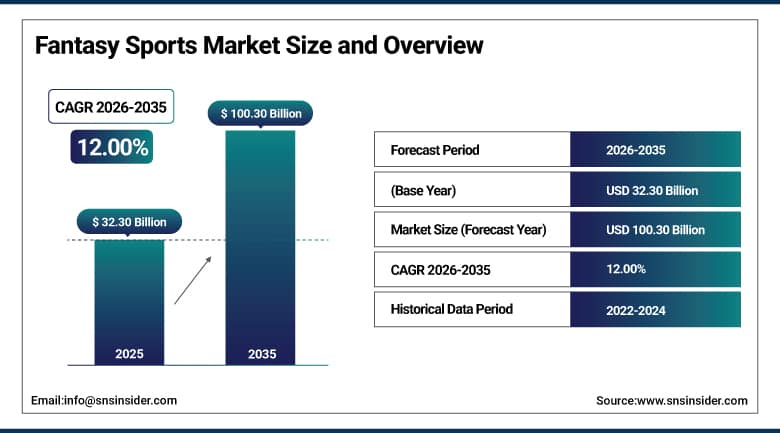
The Fantasy Sports Market was valued at USD 32.30 Billion in 2025 and is expected to reach USD 100.30 Billion by 2035, growing at a CAGR of 12.00% from 2026-2035.
Fantasy sports form a developing genre under digital entertainment and sports technology, which makes use of mobile apps, websites, and analytical software, enabling users to create a virtual team comprising real players and compete using their statistical performance in sports like football, cricket, basketball, and various others. The increase in smartphone usage, improved internet access, and sports fan participation keeps expanding the user base. Sports fans, fantasy sports fans, and growing esports fans use fantasy sports platforms to engage themselves in live games while competing against each other for prize money and recognition. Growth is driven by the adoption of artificial intelligence-powered recommendation systems for players, increasing legalization in emerging markets, and growing esports fantasy contests.
⮞In 2025, DraftKings continued expanding its product portfolio beyond traditional daily fantasy sports contests, integrating sportsbook, iGaming, and fantasy offerings within a unified platform designed to deepen user engagement across multiple product lines. The company stated the continued platform integration reflects sustained strategic focus on cross-selling opportunities among its expanding user base.
To Get More Information On Fantasy Sports Market - Request Free Sample Report
Fantasy Sports Market Trends
-
Growing integration of artificial intelligence-based player recommendation and analytics tools.
-
Rising popularity of esports fantasy contests driven by expanding competitive gaming tournament viewership.
-
Expanding legalization and regulatory clarity supporting market entry across previously restricted jurisdictions.
-
Increasing adoption of hybrid platforms combining mobile and web-based user experiences.
-
Rising user preference for short-duration daily fantasy contests over traditional season-long formats.
-
Growing brand sponsorship and advertising investment leveraging fantasy sports platform user engagement.
U.S. Fantasy Sports Market Overview
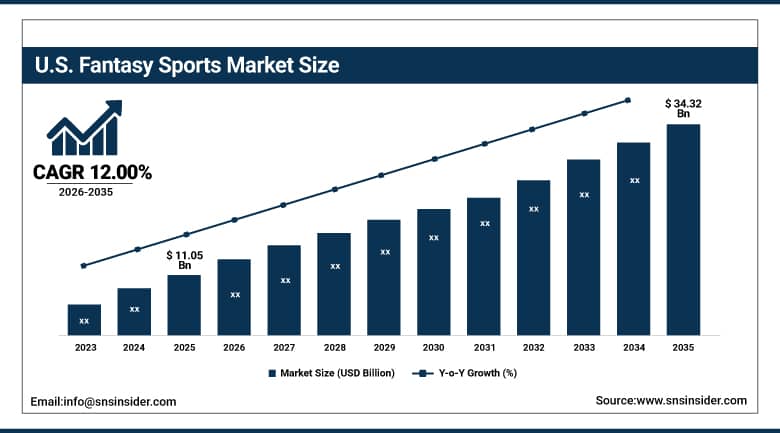
The U.S. Fantasy Sports Market was valued at USD 11.05 Billion in 2025 and is expected to reach USD 34.32 Billion by 2035, growing at a CAGR of 12.00% from 2026-2035.
The United States demand remains driven by an established fantasy football engagement culture coupled with increasing adoption of daily fantasy sports via smartphones in the sports entertainment industry within the nation. The platforms keep innovating to provide more product categories other than fantasy games to enhance engagement among users through inclusion of sportsbook and iGaming products, while investment in AI-powered analytical tools remains instrumental for competitive advantage. Regulatory clarity within various states is also contributing to growth of the market in the United States as more states legalize daily fantasy sports games.
⮞In 2025, FanDuel expanded upon their fantasy sports and sportsbook integration initiative by taking advantage of the existing large pool of customers and promoting daily fantasy games in addition to sportsbooks. As per FanDuel, this continued integration is due to the company's continued emphasis on maximizing the value of the user's lifetime.
Fantasy Sports Market Segment Analysis
-
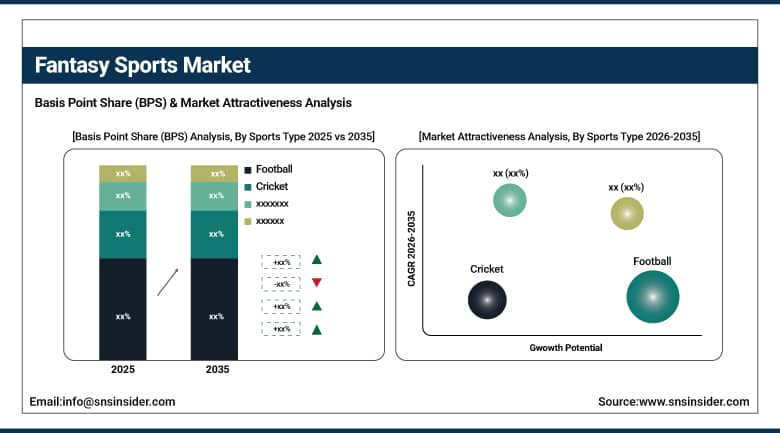
By Sports Type, the Football segment dominated the market with a 38.47% share in 2025, while the Cricket segment is the fastest growing with a CAGR of 16.72% during 2026-2035.
-
By Platform, the Mobile App segment dominated the market with a 51.35% share in 2025, while the Hybrid segment is the fastest growing with a CAGR of 17.28% during 2026-2035.
-
By Contest Format, the Season-Long Fantasy segment dominated the market with a 36.80% share in 2025, while the Daily Fantasy Sports (DFS) segment is the fastest growing with a CAGR of 14.80% during 2026–2035.
-
By Revenue Model, the Freemium segment dominated the market with a 45.62% share in 2025, while the Entry Fees segment is the fastest growing with a CAGR of 18.14% during 2026-2035.
By Sports Type, Football Dominates the Fantasy Sports Market and Cricket Grows Fastest
Football continues to command the largest sports type share due to its wide viewership audience and strong fan culture for participating in fantasy football. The reason why platform providers prefer this sports genre is the very large addressable user base provided by football's high-frequency game schedule, which keeps the fans involved week after week in playing their favorite sport through fantasy football. This sports genre is widely popular in North America and Europe, where fantasy football has been well integrated into the culture of major leagues' fan community.
Sports category of cricket has experienced the highest level of growth, attributed to huge participation numbers in India and other countries where cricket is played and fantasy cricket has been embraced by many people in line with their national and international tournaments. With growing popularity of the game in various countries thanks to T20 format and international tournaments, there is an ongoing narrowing of the gap between football and this sport category in terms of market demand.
By Platform, Mobile App Dominates the Fantasy Sports Market and Hybrid Grows Fastest
Mobile applications represent the largest platform category, reflecting the convenience and accessibility these apps provide for users wanting to manage fantasy rosters, make lineup decisions, and track live scoring updates throughout the day regardless of location. This mobile-first user preference continues to sustain app-based platforms as the dominant distribution channel across the broader market, particularly among younger demographic segments that have grown up with smartphone-native digital experiences.
Hybrid platforms combining mobile and web-based experiences are expanding at the fastest pace among platform categories, as operators increasingly recognize that different use cases favour different access methods, from quick mobile check-ins during live games to more detailed web-based roster research and analysis sessions. As platforms continue optimizing seamless experiences across both access methods, hybrid approaches continue to close the gap with mobile-only strategies in overall market demand.
By Revenue Model, Freemium Dominates the Fantasy Sports Market and Entry Fees Grow Fastest
The Season Long Fantasy was the top category within the Fantasy Sports Market in 2025 because of its large number of users, its constant engagement throughout the sports season, and how much it is used in professional leagues and tournaments. Users will create teams and select players in a long span of time, thus making sure that they have something to interact with. The format benefits from established fantasy communities, league-based competition, and social engagement among friends, colleagues, and sports enthusiasts. Its relatively mature presence across key markets, combined with broad availability across multiple sports, supports its leading position within the global fantasy sports market.
The Daily Fantasy Sports (DFS) segment is expected to register the fastest growth through 2035, owing to growing inclination towards short-term contests, frequent playing chances, and real-time sports participation. The DFS platform helps users make their teams for one single match or for short periods of contest, making it less time-consuming than the traditional season-long formats. The rising number of smartphone users, robust digital payments ecosystem, real-time sports information, and advanced fantasy platforms will be some of the key factors driving the growth of this segment.
By Revenue Model, Freemium Dominates the Fantasy Sports Market and Entry Fees Grow Fastest
Freemium revenue models continue to lead the broader market, reflecting platforms' strategic emphasis on maximizing user acquisition and engagement through free-to-play contest access before monetizing through advertising, premium features, and optional paid contest tiers. This low-barrier-to-entry approach continues to sustain freemium as the dominant revenue model category, particularly valuable for building the large, engaged user base that platforms ultimately convert toward higher-value paid offerings.
Entry fee-based contests have been experiencing the highest growth rate among the various categories of revenue models owing to the increasing confidence levels among users for participating in real money contests. The reason behind this can be attributed to the establishment of transparency and trust in the process of payout due to increasing regulatory credibility. This is because of the increased adoption of skill-based contests among the daily fantasy sports contests.
Regional Analysis
|
Region |
Major Country |
Share within Region, 2025 |
|---|---|---|
|
North America |
United States |
90.16% |
|
Asia Pacific |
India |
44.73% |
|
Europe |
United Kingdom |
33.29% |
|
Latin America |
Brazil |
46.08% |
|
Middle East & Africa |
United Arab Emirates |
28.94% |
North America Fantasy Sports Market Insights
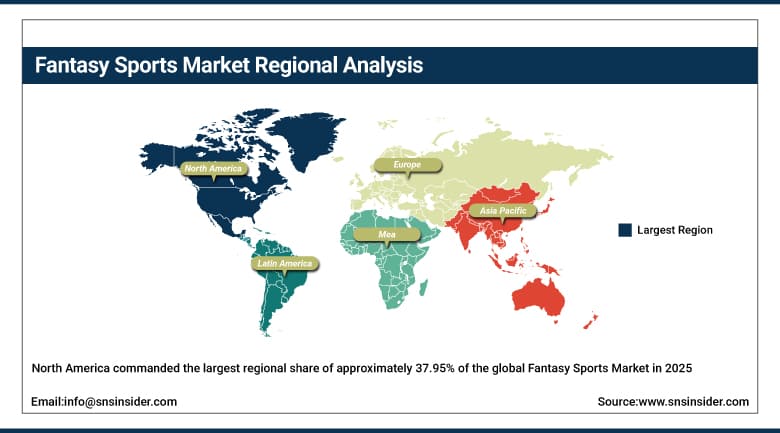
North America commanded the largest regional share of approximately 37.95% of the global Fantasy Sports Market in 2025, a position supported by deeply established fantasy football participation culture and a dense concentration of leading platform operators headquartered within the region. The United States shapes regional demand through its massive football fan base and favorable regulatory momentum across an increasing number of states legalizing daily fantasy sports contests.
Canada contributes additional regional demand through its participation in North American sports entertainment and platform distribution networks. Continued platform integration with sportsbook and iGaming offerings is expected to keep North America in the lead through the forecast period, even as growth in percentage terms trails faster-scaling Asia Pacific markets building out cricket-focused fantasy sports participation from a rapidly expanding user base.
Get Customized Report as Per Your Business Requirement - Enquiry Now
Asia Pacific Fantasy Sports Market Insights
Asia Pacific is expected to witness the fastest growth in the Fantasy Sports Market over the forecast period, with a projected CAGR of 16.80% during 2026-2035, driven primarily by explosive fantasy cricket adoption across India and other cricket-playing nations. India continues to anchor regional demand as domestic platforms have achieved extraordinary user growth tied to major domestic cricket league and international tournament schedules, supported by rapidly expanding smartphone penetration and affordable mobile data access.
With Pakistan, Bangladesh, and Sri Lanka providing additional depth with their large fanbases of cricket enthusiasts now using the fantasy platforms, Australia and other regional markets provide additional demand for both cricket and other sports fantasy games. The whole region is thus poised to grow at the highest percentage growth rate of any market worldwide up till 2035.
Europe Fantasy Sports Market Insights
Europe holds a meaningful share of the global market, underpinned by strong football fantasy participation culture and the rapid growth of the esports sector, which continues to expand user engagement through fantasy esports contest formats. The United Kingdom's substantial football fan base and well-established online gaming regulatory framework anchor regional demand, supported by growing fantasy esports participation among younger demographic segments.
Germany, France, among other major European countries, provide stable demand because the fantasy football culture is maturing well in the region along with the rise in esports tournaments, which helps in maintaining stable growth for the regional market in both sports and gaming fantasy.
MEA & Latin America Fantasy Sports Market Insights
Latin America's market is anchored by Brazil, where substantial football fan enthusiasm and growing smartphone penetration sustain steady platform user growth across both domestic and international league fantasy contests. Mexico and Argentina contribute further incremental growth as regional football fantasy participation continues expanding across the broader region.
The Middle East & Africa region remains one of the fastest-growing regions, having an exceptional record of growth in this period. The demand from South Africa and GCC countries like the United Arab Emirates is maintained by increased fan engagement in sports and development in the digital payment ecosystem.
Market Dynamics
Growth Drivers: Smartphone Penetration and Gamification Engagement
Growth factors like higher penetration rates of smartphones and more internet access serve as key drivers for growth in this market space, where increased mobile phone penetration means more users who can use fantasy sports websites. Sports awareness and game mechanics such as leaderboards and achievements add value by engaging more users in games and increasing retention rates and session frequency on the website.
Combining traditional games with modern digital markets and the advancement of mobile technology serves as yet another key demand driver since platforms are making the experience of fantasy sports more accessible to casual sports fans. Growth in the esports market and investments in competitive gaming tournaments serve as additional drivers of market growth since the format of contests is now being extended to the realm of esport.
Restraints: Regulatory Fragmentation and Problem Gambling Concerns
Regulatory fragmentation across differing jurisdictions remains a genuine restraint on market growth, as the distinction between legal fantasy sports and online gambling including sports betting continues to create compliance complexity for platforms seeking to operate across multiple states and countries simultaneously. This complexity particularly affects smaller platform operators, where the legal and compliance investment required to navigate varying jurisdictional frameworks can meaningfully exceed available resources relative to larger, better-capitalized competitors.
The issue of problem gambling is another barrier, as increased attention from the regulators on the real money format of contests leads to increasing demand for better consumer protection and spending limitations. Increased attention implies a need to keep a certain level of responsible gambling investments and player protection infrastructure, which could significantly influence user acquisition costs.
Opportunities: Esports Integration and AI-Driven Personalization
The continued evolution of formats in which the fantasy contest in eSports can be held is an excellent chance for the Fantasy Sports Market due to the fast growth of gaming tournaments, eSports community development, and participation of younger people, which opens up new ways for attracting users. The Fantasy platform can use increased popularity of esport through organizing gaming competitions and individual gaming results.
In parallel, the integration of AI-based player recommendation, predictive analytics, and personalized content tools presents another significant growth opportunity. These tools can assist the platform in providing personalized recommendations for teams, analyzing performance, and providing real-time decision support, making the user experience better. More reliance on these AI tools would allow premium services to stand out, help users stay loyal to the service, and provide a subscription-based model for users that play fantasy sports seriously.
Recent Developments:
-
2026: Dream11 completed its transition from a pure-play fantasy platform to an AI-first global sports engagement platform, discontinuing prizes while adding content, live streaming, statistics, community, experiences, and social contests.
-
2026: Sleeper expanded its fantasy offering with paid Player Picks and introduced Team Picks event contracts, broadening the platform beyond traditional fantasy leagues into additional sports-prediction products.
-
2026: Yahoo Sports strengthened its fantasy ecosystem by signing NFL analysts Josh Norris and Hayden Winks to multi-year deals, with their fantasy-focused show distributed exclusively through Yahoo Sports channels.
Fantasy Sports Market Key Players are:
- DraftKings Inc.
- FanDuel Group (Flutter Entertainment)
- Dream11 (Dream Sports)
- Sleeper
- Yahoo Fantasy Sports
- ESPN Fantasy Sports (Disney)
- CBS Sports Fantasy
- MyTeam11
- My11Circle (Games24x7)
- Fanteam
- PrizePicks
- Underdog Fantasy
- SuperDraft
- Mondogoal
- Oulala Games
- Fantasy Premier League (English Premier League)
- Howzat (Nazara Technologies)
- Rush (Winzo)
- Fancode Fantasy
- Fanhub Media
Fantasy Sports Market Report Scope :
| Report Attributes | Details |
|---|---|
| Market Size in 2025 | USD 32.30 Billion |
| Market Size by 2035 | USD 100.30 Billion |
| CAGR | CAGR of 12.00% From 2026 to 2035 |
| Base Year | 2025 |
| Forecast Period | 2026-2035 |
| Historical Data | 2022-2024 |
| Report Scope & Coverage | Market Size, Segments Analysis, Competitive Landscape, Regional Analysis, DROC & SWOT Analysis, Forecast Outlook |
| Key Segments | • By Sports Type (Football, Cricket, Basketball, Baseball, Motor Racing, Others) • By Platform (Mobile App, Web, Hybrid) • By Contest Format (Season-Long Fantasy, Daily Fantasy Sports (DFS), Micro / In-Play Fantasy, Best-Ball, Others) • By Revenue Model (Freemium, Entry Fees, Subscription, Advertising-Supported) |
| Regional Analysis/Coverage | North America (US, Canada), Europe (Germany, UK, France, Italy, Spain, Russia, Poland, Rest of Europe), Asia Pacific (China, India, Japan, South Korea, Australia, ASEAN Countries, Rest of Asia Pacific), Middle East & Africa (UAE, Saudi Arabia, Qatar, South Africa, Rest of Middle East & Africa), Latin America (Brazil, Argentina, Mexico, Colombia, Rest of Latin America). |
| Company Profiles | DraftKings Inc., FanDuel Group (Flutter Entertainment), Dream11 (Dream Sports), Sleeper, Yahoo Fantasy Sports, ESPN Fantasy Sports (Disney), CBS Sports Fantasy, MyTeam11, My11Circle (Games24x7), Fanteam, PrizePicks, Underdog Fantasy, SuperDraft, Mondogoal, Oulala Games, Fantasy Premier League (English Premier League), Howzat (Nazara Technologies), Rush (Winzo), Fancode Fantasy, Fanhub Media |

Frequently Asked Questions
Key players include DraftKings, FanDuel, Dream11, Sleeper, Yahoo Fantasy Sports, ESPN Fantasy Sports, CBS Sports Fantasy, MyTeam11, My11Circle, and Fanteam, among others.
Continued expansion of esports fantasy contest formats and the continued integration of AI-based player recommendation tools represent the two most significant opportunities shaping the market's next phase of growth.
Growth is primarily driven by increasing smartphone penetration and internet accessibility, combined with rising sports awareness and user engagement through gamification.
By Sports Type, Football dominated the market with a 38.47% share in 2025, reflecting the sport's massive global viewership base and established fantasy participation culture.
North America commanded the largest regional share in 2025, supported by deeply established fantasy football participation culture and favorable regulatory momentum.
