
FemTech Market Report Scope & Overview:
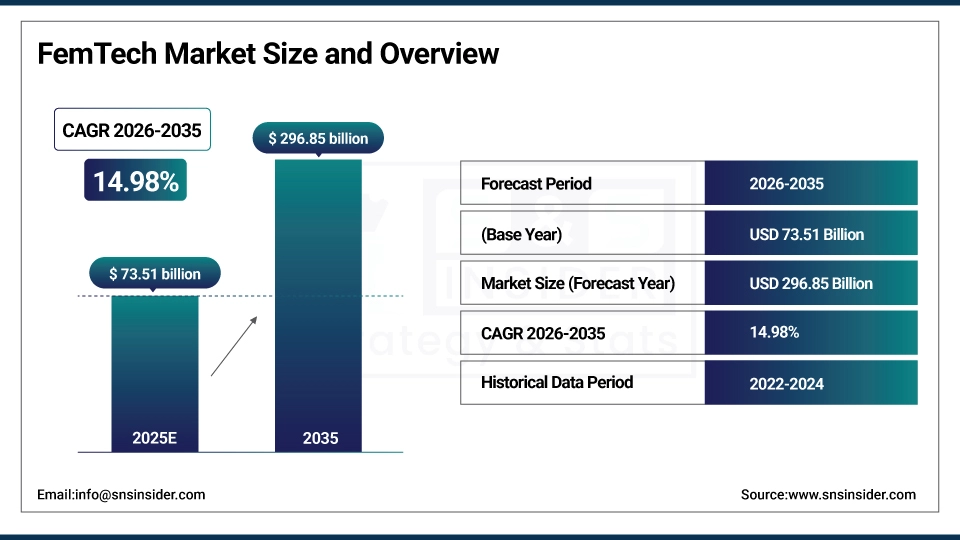
The FemTech Market size is estimated at USD 73.51 billion in 2025 and is expected to reach USD 296.85 billion by 2035, growing at a CAGR of 14.98% over the forecast period of 2026-2035.
The global FemTech market trend is a growing demand for women-centric healthcare solutions such as fertility tracking applications, pregnancy monitoring devices, and menstrual health management platforms. The growth of the market is driven by increasing smartphone penetration, growing awareness of women's health issues, and venture capital investment in female health technology startups. This trend is also driven by a growing adoption of telemedicine for gynecological consultations and the growing focus on personalized women's healthcare as healthcare providers become more focused on addressing unmet needs in female reproductive health and are more willing to invest in digital health technologies, resulting in growth in the domestic and international market for wearable devices and mobile health applications.
For instance, in March 2024, growing awareness and improved digital health adoption drove a 31% increase in FemTech application downloads for women's health platforms globally, boosting reproductive health monitoring and virtual consultation service utilization.
To Get more information on FemTech Market - Request Free Sample Report
FemTech Market Trends
-
FemTech solutions are being adopted because women demand personalized fertility tracking, hormone monitoring, and pregnancy care management through accessible digital platforms.
-
Customized reproductive health tools based on age groups, menstrual cycles, and fertility goals to improve women's health outcomes.
-
The development of AI-powered ovulation prediction, smart menstrual tracking devices, and telemedicine platforms to improve the communication between patients and providers and reduce healthcare access barriers.
-
Wearable fertility monitors, remote prenatal care, and virtual gynecology consultations are all available to ensure continuous healthcare delivery and treatment adherence.
-
Increased demand for mobile health applications, subscription-based wellness services and direct-to-consumer products to help accessibility and personalized care.
-
Collaboration between healthcare providers, technology startups and pharmaceutical companies to develop integrated women's health ecosystems and improve clinical validation.
-
FDA, EMA and national health authorities promoting standards for medical device approval, data privacy compliance, clinical efficacy requirements, and patient safety guidelines.
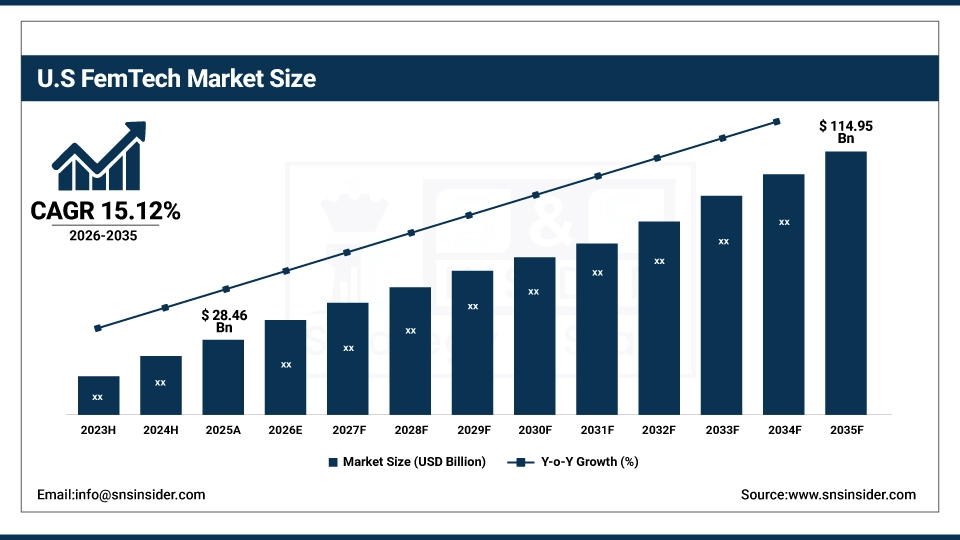
The U.S. FemTech Market is estimated at USD 28.46 billion in 2025 and is expected to reach USD 114.95 billion by 2035, growing at a CAGR of 15.12% from 2026-2035. The United States represents the largest market for FemTech, primarily driven by the high consumer spending on women's health products, advanced healthcare technology infrastructure, and strong venture capital funding for female health startups. Government support for women's healthcare initiatives, high levels of smartphone adoption and increased consumer awareness about reproductive health help to drive growth in the market. Also, the U.S. is the largest regional market in the world, due to the entrepreneurial ecosystem and swift adoption of subscription-based and direct-to-consumer women's health solutions.
FemTech Market Growth Drivers:
-
Rising Awareness and Investment in Women's Health is Driving the FemTech Market Growth
Rising awareness and investment in women's health take the center stage as a growth driver for the FemTech market share, and are driven by the increasing recognition of gender-specific healthcare gaps, venture capital funding surge, and corporate wellness program integration for female employees. These solutions for addressing reproductive health needs and menopause management are driving the base of the market, the penetration of mobile applications & wearable devices markets, and adding to the overall market share globally.
For instance, in June 2024, digital and connected FemTech solutions accounted for ~71% of the total global women's health technology investments, reflecting growing consumer preference and expanding market share.
FemTech Market Restraints:
-
Regulatory Uncertainty and Data Privacy Concerns are Hampering the FemTech Market Growth
Regulatory uncertainty & data privacy concerns of FemTech products also restrict the FemTech market growth, as a large number of startups face difficulties navigating medical device classification requirements and ensuring compliance with healthcare data protection regulations. This might lead to delayed product launches, limited market entry, and reduced consumer trust for women's health technology companies. As a result, innovation suffers, and market growth is stunted in regions where regulatory frameworks for digital health are underdeveloped and sensitive health data security standards are unclear.
FemTech Market Opportunities:
-
Expansion into Emerging Markets Drive Future Growth Opportunities for the FemTech Market
The opportunity in the expansion into emerging markets in FemTech market is in the form of affordable menstrual health products, mobile-first reproductive health applications, and culturally adapted women's wellness solutions. These solutions provide for improved access to gynecological care, individualized fertility management, and comprehensive maternal health monitoring. Through enhanced healthcare accessibility, maternal mortality reduction, and reproductive health education, particularly in areas with limited women's healthcare infrastructure, these technologies may improve outcomes, decrease preventable complications, and expand the market.
For instance, in April 2024, the World Health Organization reported that 64% of women in developing nations expressed interest in using digital health tools for reproductive care, highlighting rising platform demand and increasing need for accessible women's health solutions.
FemTech Market Segment Analysis
-
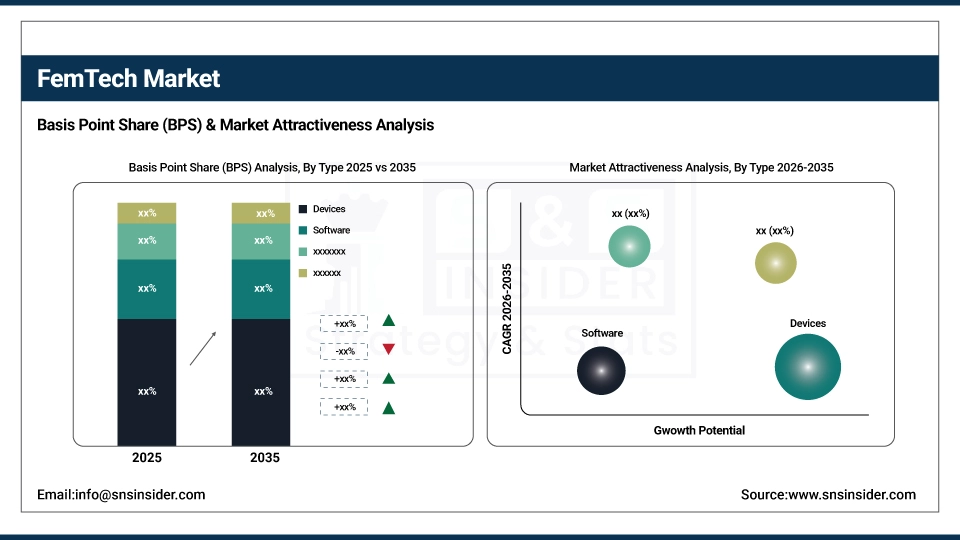
By type, devices held the largest share of around 42.18% in 2025E, and the software segment is expected to register the highest growth with a CAGR of 16.23%.
-
By application, pregnancy and nursing care segment dominated the market with approximately 28.56% share in 2025E, while the reproductive health & contraception is expected to register the highest growth with a CAGR of 15.87%.
-
By end-use, direct to consumer accounted for the leading share of nearly 48.92% in 2025E, and is expected to register the highest growth with a CAGR of 15.34%.
By Type, Devices Lead the Market, While Software Registers Fastest Growth
The devices segment accounted for the highest revenue share of approximately 42.18% in 2025, owing to established market presence of fertility monitors, breast pumps, and pelvic floor trainers, the tangible nature of hardware products, and strong consumer preference for clinically validated devices. Emerging trends, including increasing adoption of smart wearables for ovulation tracking and FDA-cleared medical devices. In comparison, the software segment is anticipated to achieve the highest CAGR of nearly 16.23% during the 2026–2035 period, driven by the rapid proliferation of period tracking applications, telehealth platforms for gynecological consultations, and AI-powered fertility prediction algorithms. Drivers include rising smartphone penetration, the preference for subscription-based health management services.
By Application, the Pregnancy and Nursing Care Segment dominates, while the Reproductive Health & Contraception Segment Shows Rapid Growth
By 2025, the pregnancy and nursing care segment contributed the largest revenue share of 28.56% due to high consumer spending on prenatal monitoring devices, lactation support products and maternal wellness applications. Growing adoption of remote pregnancy monitoring coupled with increased focus on maternal health outcomes, expectant mothers are increasingly investing in comprehensive care solutions. The reproductive health & contraception segment is projected to grow at the highest CAGR of about 15.87% between 2026 and 2035 due to the growing need for digital birth control management and personalized fertility optimization. Some of the reasons include better awareness of reproductive rights, increasing acceptance of hormone-free contraception methods, and millennials' preference for technology-enabled family planning solutions.
By End-Use, Direct to Consumer Lead, and Registers Fastest Growth
The direct to consumer segment accounted for the largest share of the FemTech market with about 48.92%, owing to consumer preference for privacy in purchasing women's health products, e-commerce platform convenience, and direct brand engagement capabilities. Reasons driving the direct to consumer segment include increasing online shopping behavior and subscription service popularity. In addition, it is slated to grow at the fastest rate with a CAGR of around 15.34% throughout the forecast period of 2026–2035, as women seek accessible health solutions, personalized product recommendations, and community-driven wellness platforms. Increased focus on patient empowerment and digital health literacy contribute to adoption, while improved product affordability and discreet delivery options drive continued investment.
FemTech Market Regional Highlights:
North America FemTech Market Insights:
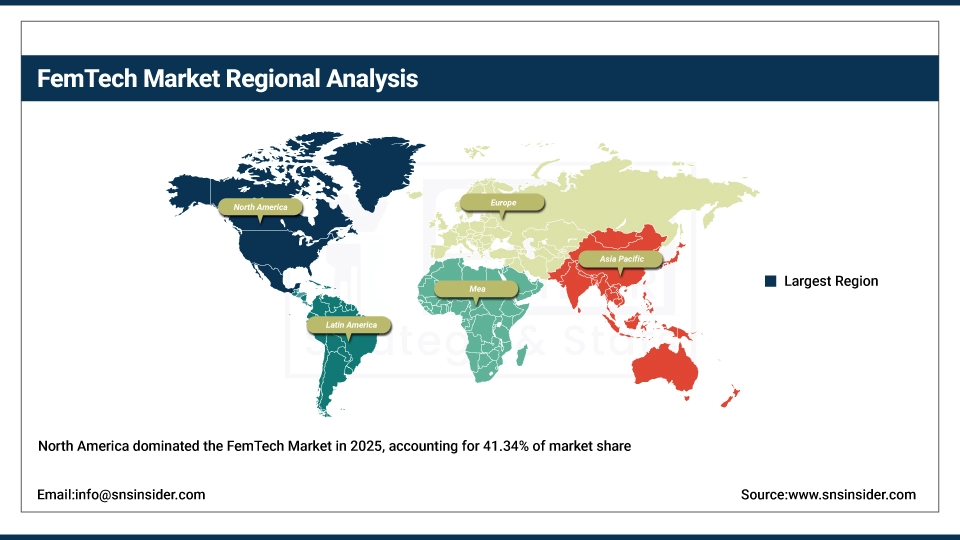
North America held the largest revenue share of over 41.34% in 2025 of the FemTech market due to an established technology innovation ecosystem, strong venture capital investment in women's health startups, and increased consumer awareness regarding the benefits of personalized healthcare. Drivers include ubiquitous use of smartphones, an advanced e-commerce infrastructure, growing women's health advocacy and greater acceptance of telemedicine services stemming from healthcare accessibility needs. At the same time, various corporate wellness program investments, insurance coverage expansion for digital health and enormous spending on reproductive health technology from healthcare organizations are anchoring FemTech products and services in the market, and ensuring multibillion dollar revenues around the world.
Get Customized Report as per Your Business Requirement - Enquiry Now
Asia Pacific FemTech Market Insights:
Asia Pacific is the fastest-growing segment in the FemTech market with a CAGR of 16.45%, as the awareness about women's reproductive health, mobile internet penetration, and healthcare infrastructure modernization in developing nations is growing. Factors including rapid urbanization, rising middle-class female population with disposable income, and growing uptake of digital health applications are stimulating the market growth. E-commerce expansion and local startup ecosystem development have been instrumental in improving access to women's health products, especially in countries with traditional healthcare access barriers. Government women's health initiatives and gender equality programs also help in advancing female healthcare delivery and wellness product adoption. Increase in demand in Asia Pacific region owing to rising women's healthcare expenditure against historical spending levels and growing affordability and accessibility of mobile-based FemTech solutions.
Europe FemTech Market Insights:
The FemTech market in Europe is the second-dominating region after North America on account of an increase in the adoption of digital health solutions, robust women's healthcare policies including gender equality initiatives, and increasing consumer empowerment movements across healthcare systems. Rising implementation of national reproductive health programs, advanced maternal care infrastructure, favorable government funding for women's health projects, and cross-border e-commerce facilitation are also contributing to the sustained growth of the market in leading European countries.
Latin America (LATAM) and Middle East & Africa (MEA) FemTech Market Insights:
In Latin America, and Middle East & Africa, the growing women's health awareness campaigns and increase in mobile device penetration with internet connectivity expansion support the FemTech market growth. The rising popularity of affordable menstrual health products and culturally sensitive health education platforms, along with international brand entry, will aid healthcare accessibility and women's wellness adoption. The increasing female workforce participation and improving women's economic independence in these regions are continuing to encourage market growth.
FemTech Market Competitive Landscape:
Flo Health Inc. (est. 2015) is a leading women's health application developer that focuses on AI-powered period and fertility tracking for personalized reproductive health management. It uses its extensive global user base and machine learning algorithms to produce cutting-edge menstrual cycle prediction technology with comprehensive symptom monitoring integration.
-
In February 2025, it expanded its platform capabilities with menopause symptom tracking and AI-driven health insights, aiming to improve women's lifecycle health monitoring and expand its user demographic across its global application network.
Ava Science Inc. (est. 2014) is a well-known medical technology company focused on fertility tracking wearables, ovulation prediction, and pregnancy monitoring solutions. It invests in clinical-grade sensor technology and data analytics platforms with the hopes of revolutionizing fertility awareness with scientifically validated, FDA-cleared, and user-friendly reproductive health devices.
-
In May 2024, launched an enhanced fertility bracelet featuring real-time physiological parameter tracking and integrated mobile application across North American and European markets, enhancing conception optimization, accuracy, and user experience delivery.
Natural Cycles Nordic AB (est. 2013) is a leading digital contraception provider in the fields of hormone-free birth control, fertility awareness, and FDA-cleared family planning applications. The company's FemTech product portfolio focuses on basal body temperature algorithms and personalized fertility insights, and features a strong commitment to clinical validation and continuous innovation to complement the strong market presence in both contraception and conception planning settings.
-
In September 2024, introduced advanced cycle prediction algorithms and integrated wearable device compatibility for its birth control application, strengthening contraceptive effectiveness and expanding adoption among women seeking hormone-free family planning solutions.
FemTech Market Key Players:
-
Ava Science Inc.
-
Natural Cycles Nordic AB
-
Clue by BioWink GmbH
-
Elvie
-
Tia Health
-
Glow Inc.
-
Willow
-
Bloomlife Inc.
-
Inne.io
-
Ovia Health
-
Embr Labs
-
Olivia
-
Progyny Inc.
-
Carrot Fertility
-
Kegg
-
Bellabeat Inc.
-
Nurture by Steelcase
| Report Attributes | Details |
|---|---|
| Market Size in 2025 | USD 73.51 billion |
| Market Size by 2035 | USD 296.85 billion |
| CAGR | CAGR of 14.98% From 2026 to 2035 |
| Base Year | 2025 |
| Forecast Period | 2026 to 2035 |
| Historical Data | 2022–2024 |
| Report Scope & Coverage | Market Size, Segments Analysis, Competitive Landscape, Regional Analysis, DROC & SWOT Analysis, Forecast Outlook |
| Key Segments | • By Type (Devices, Software, Services, Consumer Products) • By Application (Pregnancy and Nursing Care, Reproductive Health & Contraception, Menstrual Health, General Health, Pelvic & Uterine Health, Sexual Health, Womens Wellness, Menopause Care Longevity & Mental Health) • By End-Use (Direct to Consumer, Hospitals, Surgical Centers, Fertility Clinics, Diagnostic Centers, Others) |
| Regional Analysis/Coverage | North America (US, Canada, Mexico), Europe (Eastern Europe [Poland, Romania, Hungary, Turkey, Rest of Eastern Europe] Western Europe] Germany, France, UK, Italy, Spain, Netherlands, Switzerland, Austria, Rest of Western Europe]), Asia Pacific (China, India, Japan, South Korea, Vietnam, Singapore, Australia, Rest of Asia Pacific), Middle East & Africa (Middle East [UAE, Egypt, Saudi Arabia, Qatar, Rest of Middle East], Africa [Nigeria, South Africa, Rest of Africa], Latin America (Brazil, Argentina, Colombia, Rest of Latin America) |
| Company Profiles | Flo Health Inc., Ava Science Inc., Natural Cycles Nordic AB, Clue by BioWink GmbH, Elvie, Nurx Inc., Tia Health, Maven Clinic, Glow Inc., Willow, Bloomlife Inc., Inne.io, Ovia Health, Embr Labs, Olivia, Progyny Inc., Carrot Fertility, Kegg, Bellabeat Inc., Nurture by Steelcase |

Frequently Asked Questions
Ans: The FemTech Market is expected to grow at a CAGR of 14.98% over the forecast period.
Ans: The FemTech Market size was USD 73.51 billion in 2025 and is expected to reach USD 296.85 billion by 2035.
Ans: Rising Awareness and Investment in Women's Health is Driving the FemTech Market Growth.
Ans: The U.S. FemTech Market size was USD 28.46 billion in 2025 and is expected to reach USD 114.95 billion by 2035.
Ans: The Asia Pacific region is the fastest-growing, with a CAGR of 16.45%.
