
Fertility Tourism Market Report Scope & Overview:
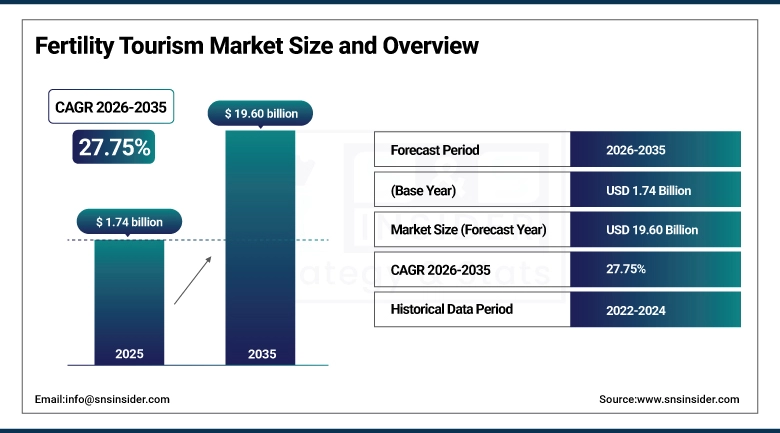
The Fertility Tourism Market size is estimated to grow from USD 1.74 Billion in 2025 to USD 19.60 Billion in 2035, at a Compound Annual Growth Rate (CAGR) of 27.75% from 2026 to 2035.
The Fertility Tourism Market analysis report offers an in-depth analysis of market dynamics, international reproductive care trends, treatment developments, and service market development. The Fertility Tourism Market growth is fueled by increasing infertility cases, delayed parenthood, ART adoption, favourable regulations in receiving countries, and medical tourism infrastructure development.
The demand for fertility treatments is increasing, with millions of patients seeking IVF, ICSI, egg donation, surrogacy, and other treatments in foreign countries every year.
To Get more information on Fertility Tourism Market - Request Free Sample Report
Fertility Tourism Market Trends:
-
Rise in cases of infertility and delayed conception are resulting in an increased need for ART treatments such as IVF and ICSI.
-
Rise in receptivity of single women and LGBTQ+ individuals toward fertility treatments is contributing to an increased patient base across the world.
-
Differential costs of fertility treatments in various countries are resulting in an increased preference for fertility treatments in other countries.
-
Superior success rates of genetic screening techniques such as PGD and PGS, and donor-based fertility treatments are attracting medical tourists.
-
Dedicated fertility clinics and medical tourism facilities are contributing to an increase in fertility treatments in other countries.
-
Supportive regulations in key source countries are facilitating surrogacy, egg donation, and other advanced fertility treatments.
U.S. Fertility Tourism Market Insights:
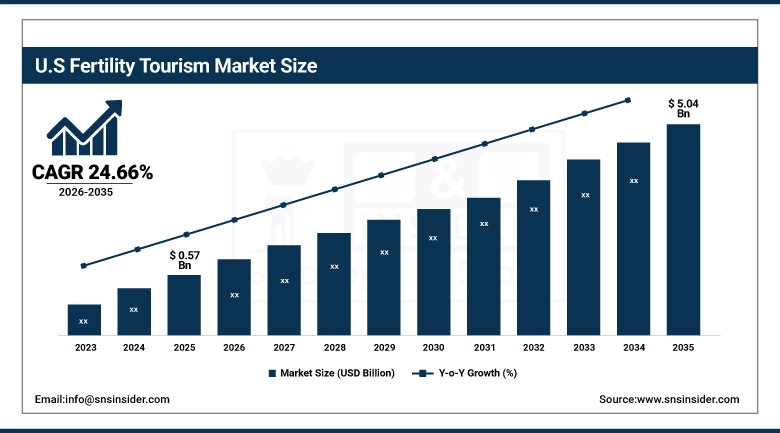
The U.S. Fertility Tourism Market is expected to grow from USD 0.57 Billion in 2025 to USD 5.04 Billion in 2035, with an expected CAGR of 24.66%. This is due to an increase in infertility cases, delayed conception, an increase in the number of people accepting ART treatments such as IVF and ICSI, an increase in fertility tourism, and an increase in the adoption of advanced reproductive techniques such as genetic screening, donor-based treatments, and surrogacy.
Fertility Tourism Market Growth Drivers:
-
Rise in infertility rates and delayed conception among couples, which is resulting in an increased preference for assisted reproductive technology (ART) and fertility tourism.
The rising rates of infertility, delayed conception among couples, and an increase in awareness of reproductive health are some of the major factors contributing to the growth of the Fertility Tourism Market. Patients are increasingly seeking cross-border fertility treatments such as IVF, ICSI, egg donation, and surrogacy in countries with better success rates, cost-effectiveness, and specialized fertility treatments. In addition, an increase in fertility clinics, better regulatory frameworks in key destination countries, and advancements in genetic screening such as PGD/PGS and donor-based treatments are further contributing to the growth of the Fertility Tourism Market.
More than 60% of international fertility patients in 2025 are opting for cross-border fertility treatments in specialized fertility clinics to avail of advanced ART treatments, cost-effectiveness, and better success rates.
Fertility Tourism Market Restraints:
-
High treatment costs, regulatory restrictions, and ethical concerns are limiting the growth of fertility tourism across certain regions.
High costs associated with assisted reproductive technologies (ART) such as IVF, ICSI, egg donation, and surrogacy remain a significant restraint for the Fertility Tourism Market. Additionally, varying legal frameworks, restrictions on surrogacy and donor programs, and ethical considerations across countries create barriers for cross-border fertility treatments. Lack of standardized regulations, complex documentation requirements, and limited insurance coverage for fertility procedures further discourage patients from accessing services abroad. Moreover, affordability challenges in developing economies and concerns over success rates, legal parentage, and treatment transparency continue to hinder widespread adoption, slowing overall market expansion despite rising infertility rates and growing demand for reproductive healthcare services.
Fertility Tourism Market Opportunities:
-
Expansion of cross-border medical tourism infrastructure and rising international fertility clinic cooperation are major growth prospects for the Fertility Tourism Market.
The expansion of specialized fertility centers, international patient facilitation, and cooperation between fertility clinics, travel agencies, and healthcare facilitators are creating an ideal environment for fertility tourism. In addition, governments of key fertility tourism destination countries are also promoting medical tourism through facilitative visas, regulations, and healthcare infrastructure. Furthermore, advancements in digital health technologies are also facilitating patient engagement through digital channels. These advancements are creating an opportunity for fertility clinics to expand their patient base across the world, especially those seeking affordable and advanced fertility treatments such as IVF, ICSI, and surrogacy.
In 2025, over 50% of fertility clinics servicing international patients are expanding cross-border cooperation and digital consultation capabilities to boost patient acquisition.
Fertility Tourism Market Segmentation Analysis:
-
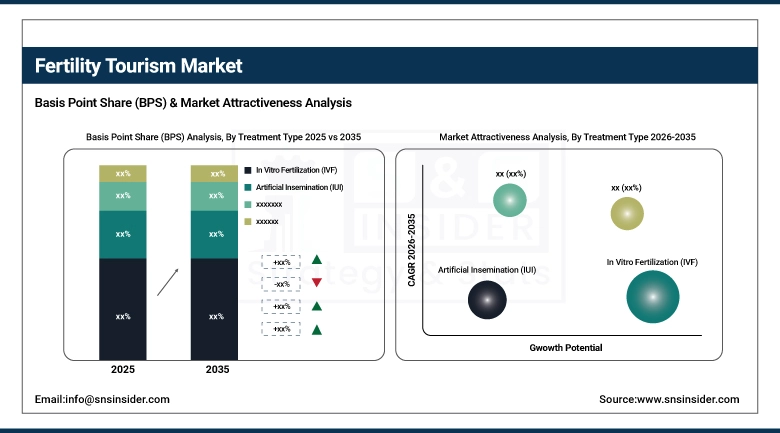
By Treatment Type, In Vitro Fertilization (IVF) held the largest market share of 50.25% in 2025, while Egg Donation is expected to grow at the fastest CAGR of 30.08% during 2026–2035.
-
By Patient Type, Couples dominated with a 65.21% market share in 2025, whereas LGBTQ+ Individuals are projected to record the fastest CAGR of 25.47% through 2026–2035.
-
By Age Group, 35–44 Years accounted for the largest share of 42.25% in 2025, while 45 Years & Above is anticipated to expand at the fastest CAGR of 28.25% during the forecast period.
-
By Service Type, Treatment Procedures held the largest share of 57.12% in 2025, while Travel & Accommodation Services are expected to grow at the fastest CAGR of 27.25% through 2026–2035.
-
By Technology / Procedure Complexity, Advanced Procedures (IVF, ICSI) dominated with a 65.25% share in 2025, while Genetic & Screening Technologies are projected to grow at the fastest CAGR of 25.13% during the forecast period.
By Treatment Type, In Vitro Fertilization (IVF) Dominates While Egg Donation Grows Rapidly:
In Vitro Fertilization (IVF) segment dominated the market due to its high success rates, widespread availability across fertility clinics, and strong preference among couples seeking assisted reproductive technologies abroad. IVF remains the most commonly performed procedure in fertility tourism destinations, supported by advanced clinical infrastructure and experienced specialists. In 2025, over 1.1 million IVF cycles were performed by international patients, reflecting its strong adoption across cross-border fertility care.
Egg Donation is the fastest-growing segment, driven by increasing demand from older patients, single women, and couples with infertility challenges requiring donor assistance. Rising awareness, improved donor programs, and higher success rates associated with donor eggs have significantly boosted adoption. In 2025, more than 420,000 egg donation cycles were conducted, particularly in regions offering favorable regulations and well-established donor networks, highlighting rapid expansion within this segment.
By Patient Type, Couples Dominate While LGBTQ+ Individuals Grow Rapidly:
Couples segment dominated the market, as infertility treatment is most commonly sought by partnered individuals facing reproductive challenges. Couples account for the majority of fertility tourism flows due to established social norms, higher treatment intent, and broader access to ART procedures such as IVF and ICSI across international clinics. In 2025, over 1.3 million couples pursued cross-border fertility treatments, indicating strong reliance on fertility tourism services.
LGBTQ+ Individuals are the fastest-growing segment, driven by increasing social acceptance, legal recognition in multiple countries, and expanding access to donor-based and surrogacy services. Fertility clinics in key destinations are increasingly tailoring services to meet the needs of same-sex couples and transgender individuals. In 2025, over 350,000 LGBTQ+ patients accessed fertility tourism services.
By Age Group, 35–44 Years Dominates While 45 Years & Above Grows Rapidly:
35–44 Years segment dominated the market due to declining natural fertility rates in this age group and higher dependence on assisted reproductive technologies. Patients in this category are more likely to seek advanced procedures such as IVF, ICSI, and donor-based treatments abroad to improve success rates. In 2025, more than 1.0 million patients within this age group opted for fertility tourism, highlighting its strong dominance in demand.
45 Years & Above is the fastest-growing segment, driven by delayed parenthood trends, increasing life expectancy, and growing willingness to pursue advanced fertility solutions later in life. In 2025, over 280,000 patients aged above 45 accessed fertility tourism services, reflecting increasing adoption among this demographic.
By Service Type, Treatment Procedures dominate while Travel & Accommodation Services grow rapidly:
The Treatment Procedures segment dominated the market due to its core role in delivering fertility tourism outcomes, encompassing services such as IVF, ICSI, egg donation, surrogacy, and other assisted reproductive technologies. In 2025, this segment accounted for the largest share of service demand, driven by high procedure volumes in fertility clinics and strong international patient inflow seeking advanced reproductive treatments.
Travel & Accommodation Services is the fastest-growing segment, supported by the increasing integration of healthcare with end-to-end travel facilitation. Rising demand for bundled medical tourism packages, improved coordination between clinics and travel providers, and enhanced patient convenience are accelerating adoption.
By Technology / Procedure Complexity, Advanced Procedures dominate while Genetic & Screening Technologies grow rapidly:
The Advanced Procedures segment dominated the market due to the widespread adoption of IVF and ICSI, which are considered standard and highly effective fertility treatments. These procedures are extensively used across fertility centers, particularly for international patients seeking higher success rates. In 2025, this segment represented the largest share of procedure complexity usage, indicating strong reliance on established reproductive techniques.
Genetic & Screening Technologies is the fastest-growing segment, driven by increasing demand for personalized fertility solutions and improved embryo selection outcomes through PGD and PGS technologies. Growing awareness of genetic testing, advancements in reproductive genetics, and rising preference for precision-based treatment approaches are accelerating adoption.
Fertility Tourism Market Regional Analysis:
Europe Fertility Tourism Market Insights:
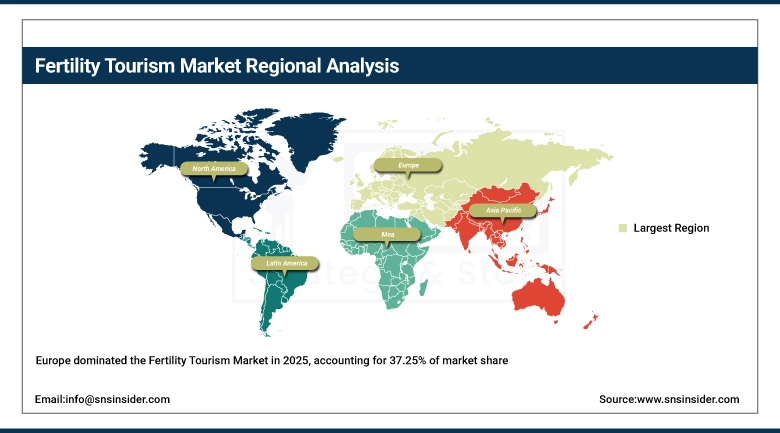
The Europe Fertility Tourism Market is dominated by this segment and holds the highest share of 37.25% in the year 2025. This is due to the presence of well-developed fertility clinic infrastructure and the presence of supportive legislation in some countries. Countries such as Spain, Greece, Czech Republic, and Denmark are the most popular fertility tourism destinations in Europe. This is due to these countries have advanced IVF services and the highest clinical success rates. The demand for egg donation and surrogacy services is increasing in this region. The presence of internationally accredited fertility clinics and patient facilitation services also contributes to the dominance of the Europe Fertility Tourism Market.
Get Customized Report as per Your Business Requirement - Enquiry Now
Germany Fertility Tourism Market Insights:
Germany is an important part of the European fertility tourism market, with access to state-of-the-art healthcare facilities, highly skilled fertility professionals, and stringent laws governing fertility treatments. The demand is fueled by increasing infertility rates, maternal age, and the adoption of assisted reproductive technologies. However, there are certain legal hurdles associated with donor-based treatments. However, there is still demand for fertility tourism services in other European countries from German patients. Improvements in fertility treatment standards, diagnostics, and patient care facilities have been consistent in Germany, making it a significant part of the European fertility tourism market.
Asia-Pacific Fertility Tourism Market Insights:
The Asia Pacific Fertility Tourism Market is the fastest-growing market, and this market is expected to grow at a CAGR of 32.43% from 2026-2035. The growth of this market can be attributed to the increase in infertility cases, growing awareness of ART, a growing middle-class population, and the increasing affordability of ART treatments. India, Thailand, Malaysia, Japan, and South Korea are becoming popular fertility tourism hubs. The affordability, pricing, and clinical expertise of these countries are making them popular destinations for fertility tourism. The growth of this market can be attributed to the increase in investments in reproductive healthcare facilities and the adoption of IVF, ICSI, donor-based treatments, and genetic screening.
China Fertility Tourism Market Insights:
The China market is an emerging market in the Asia-Pacific Fertility Tourism market, fueled by increasing infertility rates, trends in delayed parenthood, and increasing access to fertility treatments. It is also fueled by increasing investment in hospitals, increasing fertility clinics, and increasing use of advanced technologies in reproduction. Though the regulations are in an evolutionary stage, there is an increasing demand for assisted reproductive technologies such as IVF and ICSI in China. Improvements in healthcare quality, increasing awareness of fertility preservation, and gradual development of specialized centers in reproduction are making China an emerging market in the APAC Fertility Tourism market.
North America Fertility Tourism Market Insights:
North America’s fertility tourism market is influenced by factors such as the large demand for sophisticated fertility treatments, the presence of established healthcare infrastructure, and the presence of leading fertility clinics. The market is also influenced by factors such as the presence of sophisticated fertility treatments such as IVF, ICSI, and genetic screening, and the presence of donor-based treatments and high success rates of fertility treatments in the region. The presence of leading fertility clinics and the large demand for fertility treatments also influence the market in the region.
United States Fertility Tourism Market Insights:
The United States Fertility Tourism Market is one of the leading contributors to the North America fertility tourism market, which is influenced by factors such as the presence of sophisticated fertility treatments and infrastructure, and the presence of specialized fertility treatments in the region. The market is also influenced by factors such as the presence of IVF, ICSI, and genetic screening treatments and the large demand for fertility treatments in the country. The presence of fertility clinics and leading fertility specialists in the country also influence the market in the United States.
Latin America Fertility Tourism Market Insights:
The Latin America Fertility Tourism Market is growing due to increasing infertility rates, improved access to ART, and increasing demand for cost-effective ART services. Mexico, Brazil, Argentina, and other countries are emerging as new markets for the Fertility Tourism industry, with an increase in the number of fertility clinics in the region, coupled with gradual improvements in healthcare infrastructure.
Insights of Middle East and Africa Fertility Tourism Market:
The Middle East & Africa Fertility Tourism Market is growing due to increasing infertility rates, improved access to ART, and gradual improvements in healthcare infrastructure. The Middle East & Africa Fertility Tourism Market includes countries such as the UAE, Saudi Arabia, South Africa, and others, which are emerging as new markets for the Fertility Tourism industry, with an increase in the number of fertility clinics in the region, coupled with gradual improvements in healthcare infrastructure in the region. The government in the Middle East region is making efforts to improve access to healthcare services, which is acting as a catalyst for the growth of the Fertility Tourism industry in the region.
Fertility Tourism Market Competitive Landscape:
San Diego Fertility Center is a renowned fertility clinic in the United States that provides state-of-the-art assisted reproductive technologies, including IVF, ICSI, egg donation, and genetic testing. San Diego Fertility Center is known for its high success rates, personalized care, and high inflow of international patients, making it an important fertility tourism hub. The fertility clinic’s utilization of modern laboratory technologies, reproductive specialists, and individualized treatment protocols adds to its competitive advantage in fertility tourism.
-
In January 2025, San Diego Fertility Center expanded its donor egg program and upgraded its embryology lab infrastructure, enhancing IVF success rates and improving treatment outcomes for international patients seeking advanced reproductive care.
IVF-Life is a renowned network of fertility clinics in Europe, especially in Spain and abroad, that provides a range of fertility treatments, including IVF, egg donation, embryo adoption, and genetic diagnosis. The company is well known for its high success rate, state-of-the-art technology, and international patient service. IVF-Life's multidisciplinary approach, along with its patient coordination, makes it a popular choice for medical tourists seeking affordable and quality fertility treatments in Europe.
-
In March 2025, IVF-Life introduced enhanced preimplantation genetic testing (PGT-A) protocols across its clinics, improving embryo selection accuracy and increasing implantation success rates for international patients.
Barcelona IVF is an established fertility clinic in Spain that offers services in assisted reproductive technologies such as IVF, ICSI, egg donation, and fertility preservation. The clinic is recognized for providing high-quality services and is compliant with the regulations of the European fertility guidelines. The clinic receives a considerable number of international patients due to the positive legal conditions in Spain for donor treatments and the country’s position as one of the most popular fertility tourism hubs.
-
In April 2025, Barceona IVF expanded its donor matching program and upgraded its cryopreservation technologies, enabling improved embryo storage, higher success rates, and enhanced flexibility for international patients undergoing fertility treatments.
Fertility Tourism Market Key Players:
Some of the Fertility Tourism Market Companies are:
-
San Diego Fertility Center
-
IVI-RMA Global
-
Barcelona IVF
-
Apollo Fertility
-
Nova IVF Fertility
-
Indira IVF
-
Bourn Hall Fertility Clinic
-
Manchester Fertility
-
City Fertility Centre
-
Monash IVF Group
-
Alpha IVF & Women’s Specialists
-
Genesis Fertility Centre
-
The Fertility Partnership
-
Sims IVF
-
CARE Fertility Group
-
IVF Spain
-
TFP Fertility Group
-
Thomson Medical Group
-
Bumrungrad International Hospital
-
Fertility Associates New Zealand
| Report Attributes | Details |
|---|---|
| Market Size in 2025 | USD 1.74 billion |
| Market Size by 2035 | USD 19.60 billion |
| CAGR | CAGR of 27.75% From 2026 to 2035 |
| Base Year | 2025 |
| Forecast Period | 2026-2035 |
| Historical Data | 2022-2024 |
| Report Scope & Coverage | Market Size, Segments Analysis, Competitive Landscape, Regional Analysis, DROC & SWOT Analysis, Forecast Outlook |
| Key Segments | • By Treatment Type (In Vitro Fertilization (IVF), Artificial Insemination (IUI), Surrogacy, Egg Donation, Sperm Donation, Intracytoplasmic Sperm Injection (ICSI), Genetic Testing & Screening (PGD/PGS), Others) • By Patient Type (Couples, Single Women, Single Men, LGBTQ+ Individuals) • By Age Group (Below 25 Years, 25–34 Years, 35–44 Years, 45 Years & Above) • By Service Type (Consultation & Diagnostics, Treatment Procedures, Post-Treatment Services, Travel & Accommodation Services, Others) • By Technology / Procedure Complexity (Basic Procedures (IUI), Advanced Procedures (IVF, ICSI), Donor-Based Technologies, Genetic & Screening Technologies, Surrogacy Programs, Others) • By End-User (Fertility Clinics, Hospitals, Specialty Clinics, Homecare Settings, Others) |
| Regional Analysis/Coverage | North America (US, Canada), Europe (Germany, UK, France, Italy, Spain, Russia, Poland, Rest of Europe), Asia Pacific (China, India, Japan, South Korea, Australia, ASEAN Countries, Rest of Asia Pacific), Middle East & Africa (UAE, Saudi Arabia, Qatar, South Africa, Rest of Middle East & Africa), Latin America (Brazil, Argentina, Mexico, Colombia, Rest of Latin America). |
| Company Profiles | San Diego Fertility Center, IVF-Life, Barcelona IVF, Eva Fertility Clinics, The Surrey Park Clinic, Bumrungrad International Hospital, Assisted Reproduction and Gynecology Centre, Sincere IVF Center, Alpha IVF & Women’s Specialists, Genesis IVF, Manchester Fertility Services Ltd, Apollo Fertility, Nova IVF, City Fertility, Bourn Hall Ltd, The Fertility Partners Inc., Indira IVF, Freya Biosciences, Overture Life, Levy Health. |
Frequently Asked Questions
Europe dominated the market with 37.25% in 2025, while Asia-Pacific is the fastest-growing region, expected to expand at a 32.43% CAGR during 2026–2035.
In Vitro Fertilization (IVF) dominated with a 50.25% share in 2025, while Egg Donation is projected to grow at the fastest CAGR of 30.08% during 2026–2035.
Growth is driven by rising infertility rates, delayed parenthood, increasing acceptance of assisted reproductive technologies (ART), expanding cross-border fertility services, and advancements in IVF, ICSI, genetic screening, and donor-based treatments.
Ans: The market is valued at USD 1.74 Billion in 2025 and is projected to reach USD 19.60 Billion by 2035.
The Fertility Tourism Market is projected to grow at a CAGR of 27.75% during 2026–2035.
