
Surgical Polypropylene Mesh Market Report Scope & Overview:
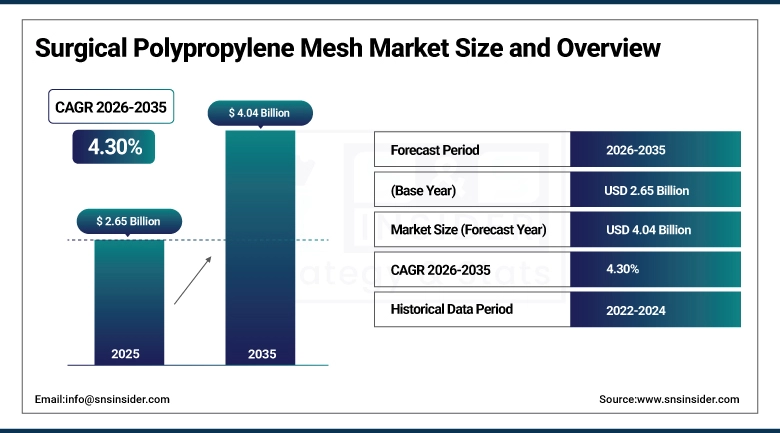
The Surgical Polypropylene Mesh Market was valued at USD 2.65 Billion in 2025 and is expected to reach USD 4.04 Billion by 2035, growing at a CAGR of 4.30% from 2026-2035.
The Surgical Polypropylene Mesh Market sits on one of the oldest and most consolidated product categories in general surgery, where growth now comes from how a mesh is used rather than whether surgeons will keep using one. Rising hernia prevalence tied to an aging population keeps surgical volume climbing steadily, while competitive activity has shifted toward lightweight, large-pore constructions and self-fixating designs meant to lower chronic pain and recurrence rates. A parallel shift toward laparoscopic and robotic-assisted repair is pulling demand toward mesh engineered for small-port, intracorporeal placement, a constraint that had minimal relevance when polypropylene mesh first became the default repair material decades ago. Supply chains for polypropylene resin and finished mesh are well diversified across multiple manufacturing regions, limiting the kind of single-source disruption risk that has affected other implantable device categories.
⮞Medtronic’s Sofradim Production subsidiary received FDA clearance in May 2026 for an expanded ProGrip Advanced self-gripping polypropylene mesh line, adding four new model sizes to the self-fixating platform originally built for open and laparoscopic hernia repair. The broader size range gives surgeons more options for matching mesh dimensions to defect size without additional trimming in the operating room.
To Get more information On Surgical Polypropylene Mesh Market - Request Free Sample Report
Surgical Polypropylene Mesh Market Trends
-
Lightweight, large-pore mesh constructions are displacing older heavyweight designs to reduce chronic pain.
-
Self-gripping and self-fixating mesh formats are reducing reliance on tacks and sutures during placement.
-
Robotic-assisted hernia repair is creating demand for mesh formats suited to small-port, intracorporeal delivery.
-
Surgeons are showing growing interest in antimicrobial or antibiotic-coated polypropylene mesh variants to reduce surgical site infection risk in contaminated fields.
-
Outpatient hernia repair volume is shifting from hospitals toward ambulatory surgical centers.
-
Absorbable and resorbable mesh variants are gaining interest for contaminated or high-infection-risk repairs.
U.S. Surgical Polypropylene Mesh Market Outlook
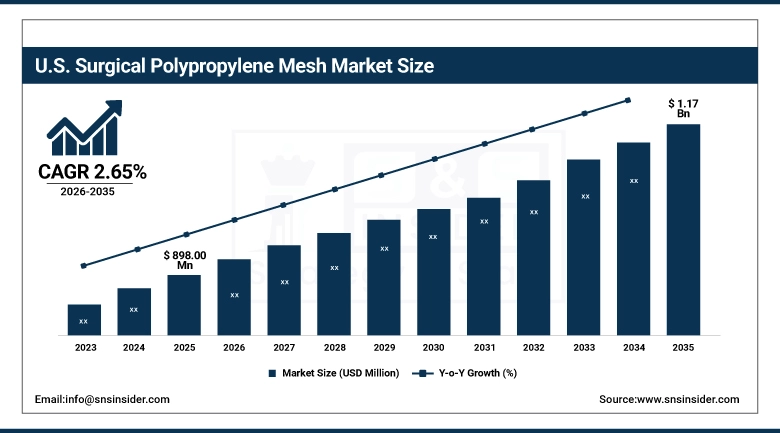
The U.S. Surgical Polypropylene Mesh Market was valued at USD 898.00 Million in 2025 and is expected to reach USD 1.17 Billion by 2035, growing at a CAGR of 2.65% from 2026-2035.
Hospital surgery departments and a fast-growing base of ambulatory surgical centers anchor U.S. demand, with general surgeons performing well over a million hernia repairs a year across both settings. Surgeon preference remains heavily weighted toward polypropylene over biologic or absorbable synthetic alternatives for routine inguinal and ventral repairs, largely on cost and decades of familiarity, which keeps U.S. revenue growth modest even as surgical volume keeps climbing. Surgeon training programs are increasingly incorporating robotic-assisted hernia repair modules, expanding the pool of surgeons comfortable adopting mesh formats built for robotic delivery. Private payer coverage policies increasingly favor ambulatory surgical center repairs over inpatient admission for straightforward inguinal hernia cases, reinforcing the outpatient shift already underway.
Surgical Polypropylene Mesh Market Segment Analysis
-
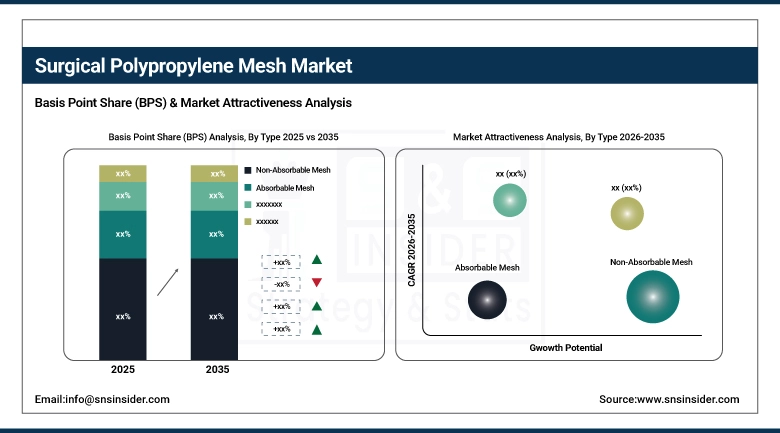
By Type, the Non-Absorbable Mesh segment dominated the Surgical Polypropylene Mesh Market with approximately 64.80% share in 2025, while the Absorbable Mesh segment is the fastest growing with a CAGR of approximately 6.25%.
-
By Application, the Hernia Repair segment dominated the Surgical Polypropylene Mesh Market with approximately 68.50% share in 2025, while the Traumatic or Surgical Wound segment is the fastest growing with a CAGR of approximately 5.85%.
-
By End User, the Hospitals & Clinics segment dominated the Surgical Polypropylene Mesh Market with approximately 70.40% share in 2025, while the Ambulatory Surgical Centers segment is the fastest growing with a CAGR of approximately 6.15%.
By Type, Non-Absorbable Mesh Dominates the Surgical Polypropylene Mesh Market and Absorbable Mesh Grows Fastest
Non-absorbable polypropylene mesh remains the default choice for routine inguinal and ventral hernia repair, since it keeps its full tensile strength permanently rather than losing integrity as the body resorbs it over months. Surgeons rely on that permanence for repairs where a recurrence years later would be far costlier and riskier to fix than the chronic foreign-body sensation some patients report with a permanent implant. Decades of surgeon familiarity, well-established reimbursement coding and a lower unit cost than biologic alternatives keep non-absorbable constructions dominant across the vast majority of elective hernia procedures performed worldwide.
Absorbable mesh is growing fastest as it serves cases where a permanent synthetic implant carries unacceptable risk, chiefly contaminated or infected surgical fields where leaving a non-absorbable material behind could lead to a chronic infection around the implant. Pediatric hernia repair and certain staged abdominal wall reconstructions are adding further volume, since surgeons there prize a scaffold that supports tissue healing and then disappears rather than one a growing body must carry for life. Manufacturers are extending absorbable product lines specifically to capture these higher-risk cases that non-absorbable mesh cannot safely serve.
By Application, Hernia Repair Dominates the Surgical Polypropylene Mesh Market and Traumatic or Surgical Wound Grows Fastest
Hernia repair accounts for the clear majority of polypropylene mesh use, since inguinal, ventral and incisional hernias are among the most common general surgery procedures performed anywhere in the world, and mesh reinforcement has been the standard of care for most of them for decades. Surgeons favor mesh-based repair over primary suture closure in nearly all but the smallest defects, since clinical evidence has shown markedly lower recurrence rates with a mesh reinforcement than without one. That evidence base, built up over more than thirty years of use, gives hernia repair a share of polypropylene mesh demand that substantially exceeds every other application.
Traumatic or surgical wound repair is growing fastest as abdominal wall reconstruction after trauma, tumor resection or a failed prior repair becomes a more standardized surgical pathway rather than a case-by-case approach. Larger, more complex wounds increasingly call for bridging or reinforcing mesh constructions distinct from a standard hernia patch, giving manufacturers room to sell differentiated, higher-value products into this smaller but expanding application. Trauma center volumes and an aging population carrying more prior abdominal surgeries are both widening the pool of patients who need this kind of reconstructive repair.
By End User, Hospitals & Clinics Dominate the Surgical Polypropylene Mesh Market and Ambulatory Surgical Centers Grow Fastest
Hospitals and clinics perform the majority of hernia and abdominal wall repairs, particularly complex, incisional and emergency cases that need a full surgical suite, intensive care backup or a multi-day stay. Large hospital systems also run the group purchasing contracts that set mesh pricing across an entire network, giving them outsized influence over which manufacturers win volume even as unit economics stay thin. Academic medical centers add a further layer of demand through residency training programs that standardize on a narrow set of mesh products across every case a trainee performs.
Ambulatory surgical centers are growing fastest as straightforward inguinal and smaller ventral hernia repairs continue shifting out of the hospital setting entirely, following the same outpatient migration already seen across much of elective general surgery. Lower facility fees and faster scheduling make ambulatory centers an increasingly attractive setting for payers and patients alike, and surgeons performing high repair volumes often prefer the standardized, faster-turnover environment an ambulatory center offers over a hospital operating room. Device makers are responding with pre-sized, ready-to-use mesh configurations suited to that faster-paced setting.
Regional Analysis
|
Region |
Major Country |
Share within Region, 2025 (%) |
|---|---|---|
|
North America |
United States |
81.00% |
|
Europe |
Germany |
23.50% |
|
Asia Pacific |
China |
30.80% |
|
Middle East and Africa |
UAE |
30.20% |
|
Latin America |
Brazil |
45.60% |
North America Surgical Polypropylene Mesh Market Insights
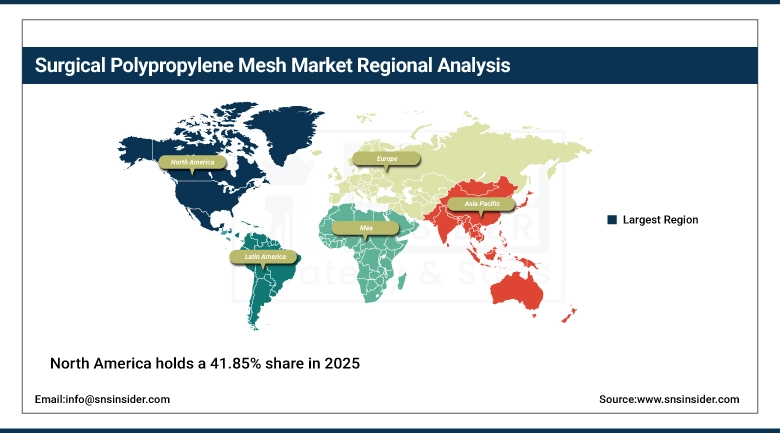
North America holds a 41.85% share in 2025, carried by a surgical volume base that is both the largest in absolute terms and among the most standardized on polypropylene as the default hernia repair material anywhere in the world. The United States drives nearly all of this activity, with a dense network of hospitals and a rapidly expanding ambulatory surgical center sector both running high repair volumes every year. Canada adds a smaller, publicly funded base where hospital procurement processes favor established, lower-cost mesh products over newer premium constructions.
Growth across the region trails the rest of the world, as the underlying surgical volume is already mature. Canadian provincial health technology assessment processes are increasingly scrutinizing new mesh constructions before public reimbursement approval, adding a review step not faced by manufacturers selling primarily into the U.S. private market. Private equity-backed ambulatory surgical center chains in the region are consolidating purchasing decisions, giving scale operators greater influence over which mesh manufacturers win network-wide contracts.
Get Customized Report as per Your Business Requirement - Enquiry Now
Europe Surgical Polypropylene Mesh Market Insights
Europe holds the second-largest position in 2025, anchored by Germany, France and the United Kingdom, where national health systems run large, standardized hernia repair volumes through public hospital networks. Centralized tendering processes common across European public health systems tend to award multi-year contracts to a small number of established manufacturers, which rewards long-standing polypropylene product lines over newer entrants trying to win share on clinical differentiation alone.
Growth is proceeding steadily rather than quickly, tracking overall hospital capital and procurement cycles more than any single regulatory trigger specific to this device category. Eastern European health systems, including Poland and Russia, are earlier in adopting lightweight and self-fixating mesh formats than Western Europe, leaving meaningful headroom as those products become more broadly available at lower price points. Smaller national markets continue to rely heavily on the clinical evidence and tender outcomes already established by Germany, France and the United Kingdom rather than running independent evaluations.
Asia Pacific Surgical Polypropylene Mesh Market Insights
Asia Pacific is projected to be the fastest-growing region at a CAGR of approximately 5.65% from 2026 to 2035, driven by rising hernia repair volumes as surgical capacity expands across China and India well ahead of the pace seen in mature Western markets. Both countries are building out general surgery capacity in tier-two and tier-three cities, bringing mesh-based hernia repair to populations that previously had far more limited access to a surgeon at all. Japan and South Korea contribute a smaller but steady base built on long-established hospital infrastructure rather than new capacity growth.
Local and regional manufacturers are increasingly competing with the established multinational mesh makers on price across China and India, widening access to polypropylene repair for patients who could not previously afford an imported premium product. Australia and the broader ASEAN countries are growing at a steadier pace closer to the regional average, reflecting hospital systems that already run mature surgical programs rather than ones just beginning to scale. The region's combination of rising surgical capacity and price-sensitive public and private insurance systems favors standard non-absorbable mesh over premium coated or composite constructions for the time being.
MEA & Latin America Surgical Polypropylene Mesh Market Insights
The Middle East and Africa combine a smaller but growing base of hospital-led demand in the Gulf states with far more limited surgical access across most of the rest of the continent. The UAE and Saudi Arabia are both investing in new private hospital capacity that treats a growing number of medical tourists seeking elective hernia repair, giving device makers a concentrated, well-funded customer base to sell into. South Africa remains the continent's most developed market outside the Gulf, carried by a more established private hospital sector.
Latin America's demand runs mainly through Brazil's large public and private hospital network, with Argentina, Mexico and Colombia following at a smaller scale. Public hospital budget constraints across the region keep pricing pressure high and slow adoption of newer, higher-cost mesh constructions relative to private hospitals serving insured or self-paying patients. Both regions remain earlier in their adoption curve than North America, Europe or Asia Pacific, with growth tied closely to broader investment in surgical infrastructure.
Market Dynamics
Growth Drivers: Rising hernia prevalence and the shift toward robotic repair
An aging population and rising obesity rates are the two demographic forces doing the most to keep hernia repair volume climbing in nearly every region, since both conditions are well-established risk factors for developing a hernia in the first place. That steady volume growth, more than any single new product launch, is what keeps polypropylene mesh demand expanding even in markets where surgical technique and material choice have barely changed in years. Health systems facing rising surgical backlogs are also prioritizing high-volume, relatively short procedures such as routine hernia repair to keep operating room throughput up.
A second driver sits in the adoption of robotic-assisted general surgery, which is expanding well beyond the urologic and gynecologic procedures where robotic platforms first gained traction. As robotic systems add cleared indications covering hernia repair, mesh manufacturers are extending self-gripping and fixation-free designs built for manual laparoscopic placement into formats suited to robotic instrument delivery. Hospitals that have already committed capital to a robotic platform have a direct incentive to push general surgery volume, including hernia repair, onto that same system.
Restraints: Mesh litigation and surgeon caution around newer constructions
Multidistrict litigation covering tens of thousands of hernia mesh injury claims has made manufacturers and hospital risk committees alike more cautious about adopting newer coatings and composite constructions than the category was in the 2000s and early 2010s. Surgeons who trained during that period of rapid product introduction and subsequent recalls often default to older, extensively studied plain polypropylene designs rather than a newer construction with a shorter track record, even when the newer product carries real clinical advantages.
A second restraint is the device category's inherent pricing ceiling: decades of competition among established manufacturers, combined with extended product lifecycles that let a given mesh design serve as the standard of care for a decade or more, leave limited room for average selling prices to rise even as procedure volume grows. Smaller and mid-sized manufacturers face real pressure to differentiate through specialty coatings or absorbable formats rather than compete directly on price against multinational incumbents with far greater manufacturing scale.
⮞In July 2023, the U.S. Food and Drug Administration published an updated review covering more than 55,000 adverse event reports on surgical mesh used in hernia repair filed over the preceding 22 years, noting reported complication rates for pain and surgical site infection that varied widely across the 45 studies it reviewed.
Opportunities: Robotic-compatible formats and emerging-market surgical capacity
The clearest near-term opportunity is designing and clearing mesh formats purpose-built for robotic-assisted delivery, since robotic general surgery platforms are actively seeking new cleared indications and manufacturers that move early can establish a robotic-compatible product as the default choice before competitors catch up. A mesh construction engineered for small-port, intracorporeal placement and robotic instrument handling is a meaningfully different design problem than one built for open or manual laparoscopic placement, giving an early mover real differentiation.
A second opportunity lies in the surgical capacity now being built out across China, India and other price-sensitive markets, where rising numbers of general surgery procedures are creating volume that did not exist a decade ago. Manufacturers able to offer a reliable, lower-cost polypropylene mesh suited to these markets, rather than only a premium product line priced for Western hospital budgets, stand to capture volume growth that mature markets simply no longer offer at the same pace.
Recent Developments:
-
In April 2025, Becton, Dickinson and Company launched the Phasix ST Umbilical Hernia Patch, which it described as the first and only fully absorbable hernia patch designed specifically for umbilical hernias. The patch is made of Poly-4-hydroxybutyrate and includes a hydrogel barrier layer, and is placed using the same technique surgeons already use for permanent mesh patches.
-
In April 2025, Davol, a BD subsidiary, received FDA clearance for labeling updates to its Bard Soft Mesh and Bard Soft Mesh Pre-Shaped polypropylene mesh lines to meet European Union Medical Device Regulation requirements, alongside documentation extending the largest available flat-sheet size to 12 inches by 12 inches.
-
In October 2025, Medtronic's Sofradim Production subsidiary received FDA clearance for its Parietene Flat Sheet Mesh, a polypropylene construction used in open and laparoscopic hernia repair, continuing the company's pattern of incremental regulatory updates across its established mesh portfolio.
-
In July 2026, Johnson & Johnson MedTech signed an exclusive distribution agreement with Device Technologies to supply its hernia mesh product portfolio across Australia, extending the reach of its polypropylene mesh lines in the region.
Surgical Polypropylene Mesh Market Key Players
-
Johnson & Johnson (Ethicon)
-
BD (Becton, Dickinson and Company)
-
Medtronic plc
-
B. Braun Melsungen AG
-
Atrium Medical Corporation (a Getinge company)
-
W. L. Gore & Associates, Inc.
Surgical Polypropylene Mesh Market Report Scope:
| Report Attributes | Details |
|---|---|
| Market Size in 2025 | USD 2.65 Billion |
| Market Size by 2035 | USD 4.04 Billion |
| CAGR | CAGR of 4.30% From 2026 to 2035 |
| Base Year | 2025 |
| Forecast Period | 2026-2035 |
| Historical Data | 2022-2024 |
| Report Scope & Coverage | Market Size, Segments Analysis, Competitive Landscape, Regional Analysis, DROC & SWOT Analysis, Forecast Outlook |
| Key Segments | • By Type (Non-Absorbable Mesh, Absorbable Mesh) • By Application (Hernia Repair, Traumatic or Surgical Wound) • By End User (Hospitals & Clinics, Ambulatory Surgical Centers, Other End Users) |
| Regional Analysis/Coverage | North America (US, Canada), Europe (Germany, UK, France, Italy, Spain, Russia, Poland, Rest of Europe), Asia Pacific (China, India, Japan, South Korea, Australia, ASEAN Countries, Rest of Asia Pacific), Middle East & Africa (UAE, Saudi Arabia, Qatar, South Africa, Rest of Middle East & Africa), Latin America (Brazil, Argentina, Mexico, Colombia, Rest of Latin America). |
| Company Profiles | Johnson & Johnson (Ethicon), BD (Becton, Dickinson and Company), Medtronic plc, B. Braun Melsungen AG, Atrium Medical Corporation (a Getinge company), W. L. Gore & Associates, Inc. |

Frequently Asked Questions
The market includes Johnson & Johnson (Ethicon), BD (Becton, Dickinson and Company), Medtronic plc, B. Braun Melsungen AG, Atrium Medical Corporation and W. L. Gore & Associates. These providers compete on product familiarity, lightweight and self-fixating mesh design, group purchasing contract coverage and, increasingly, compatibility with robotic-assisted surgery.
The main opportunities lie in developing mesh formats purpose-built for robotic-assisted delivery as robotic general surgery platforms gain new cleared indications, and in supplying lower-cost polypropylene mesh to expanding surgical capacity across China, India and other emerging markets.
The key growth factor is rising hernia prevalence tied to an aging population and growing obesity rates, which keeps surgical volume climbing steadily even as material choice and surgical technique change only gradually.
By type, the Non-Absorbable Mesh segment dominated the market with approximately 64.80% share in 2025, supported by its permanence and decades of surgeon familiarity. The Hernia Repair application and Hospitals & Clinics end-user segment led their respective axes.
North America dominated the market with approximately 41.85% share in 2025, supported by a large, mature surgical volume base and standardized use of polypropylene mesh. Asia Pacific is the fastest-growing region, driven by expanding surgical capacity in China and India.
