
Healthcare AI Governance Platform Market Report Scope & Overview:
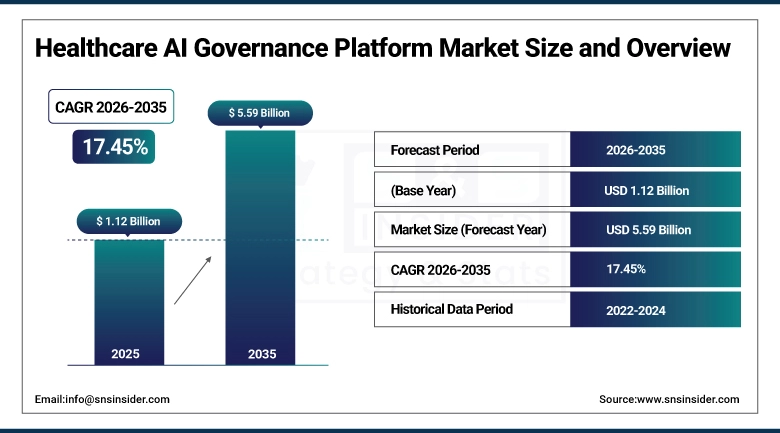
The Healthcare AI Governance Platform Market was valued at USD 1.12 Billion in 2025 and is expected to reach USD 5.59 Billion by 2035, growing at a CAGR of 17.45% from 2026-2035.
The Healthcare AI Governance Platform Market is shifting from committee-based algorithm review to software that governs AI continuously across its deployed lifetime. Health systems now run clinical algorithms across radiology, sepsis prediction, ambient documentation, and revenue cycle work, and tracking each one through a departmental log has stopped scaling. Frameworks such as the NIST AI Risk Management Framework and ISO/IEC 42001 give chief medical information officers a shared language for validation and bias testing that a governance platform can operationalize directly. Payers are governing claims and utilization-review algorithms under rising state scrutiny, while device makers fold governance evidence into their own regulatory submissions.
⮞In April 2026, Ferrum Health launched an AI Governance Suite on AWS Marketplace that the company says governs more than 45 million lives and spans more than 400 care sites internationally. The launch illustrates how governance vendors are packaging continuous monitoring and cross-site benchmarking into a single, vendor-neutral platform.
To Get more information On Healthcare AI Governance Platform Market - Request Free Sample Report
Healthcare AI Governance Platform Market Trends
-
Health systems are consolidating oversight of multiple AI vendors into a single governance inventory.
-
Regulators are formalizing total product life cycle expectations for AI-enabled medical devices.
-
Cloud-based governance platforms are gaining preference over on-premises deployments.
-
AI agent governance is emerging as a distinct capability as autonomous clinical agents enter use.
-
Venture funding is concentrating in start-ups that combine monitoring, validation, and audit trails.
-
Accreditation bodies are building formal AI certification programs on top of existing hospital standards.
U.S. Healthcare AI Governance Platform Market Outlook
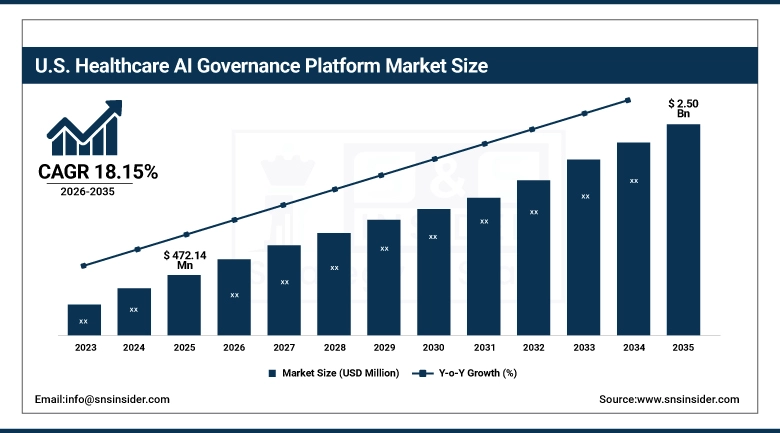
The U.S. Healthcare AI Governance Platform Market was valued at USD 472.14 Million in 2025 and is expected to reach USD 2.50 Billion by 2035, growing at a CAGR of 18.15% from 2026-2035.
State activity, including Colorado's algorithmic discrimination law, is pushing payers to govern claims and utilization-review models with the rigor long applied to clinical ones, and several additional states are drafting comparable statutes that vendors are already tracking. Venture-backed entrants headquartered in the country keep closing large rounds to extend platform reach into generative AI and autonomous agents. Integration with the electronic health record is the most common technical gate in a U.S. sales cycle, since a platform unable to ingest model metadata directly from systems already in place adds manual work rather than removing it. Hospital IT security review, not clinical sign-off alone, increasingly sets the pace at which a new governance vendor moves from pilot to enterprise contract.
⮞In April 2026, Credo AI joined the Coalition for Health AI's Partner Program, turning CHAI's governance framework into a dedicated healthcare policy pack with controls built into its platform as enforceable, auditable workflows mapped to HIPAA, HITRUST, NIST AI RMF, ISO 42001, and state insurance AI rules.
Healthcare AI Governance Platform Market Segment Analysis
-
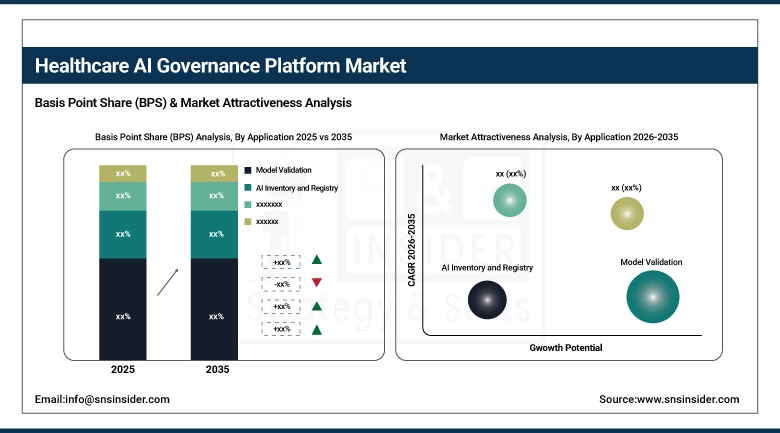
By Application, the Model Validation segment dominated the Healthcare AI Governance Platform Market with approximately 24.60% share in 2025, while the AI Agent Governance segment is the fastest growing with a CAGR of approximately 21.80%.
-
By Deployment, the Cloud-based segment dominated the Healthcare AI Governance Platform Market with approximately 64.30% share in 2025 and is also the fastest growing with a CAGR of approximately 19.40%.
-
By End Use, the Healthcare Providers segment dominated the Healthcare AI Governance Platform Market with approximately 47.80% share in 2025, while the Life Science Companies segment is the fastest growing with a CAGR of approximately 20.10%.
By Application, Model Validation Dominates the Healthcare AI Governance Platform Market and AI Agent Governance Grows Fastest
Every clinical algorithm needs documented proof that it performs as intended, both at go-live and across every retraining cycle that follows, which is why model validation carries the largest share of application spend. A sepsis-prediction tool and an imaging triage model rarely share a vendor, yet a validation module can hold both to one testing standard, sparing a health system from a separate review process per supplier. Accreditation bodies and payer contracts increasingly reference this evidence directly, turning validation into a running compliance artifact rather than a one-time clearance step.
AI agent governance is climbing fastest as autonomous systems move past single-prediction tools into software that takes multi-step actions, such as drafting a discharge summary or routing a prior-authorization request without a clinician approving every step. That shift raises oversight questions older monitoring tools were never built to answer, including what happens when an agent chains a wrong inference into a downstream action. Health systems piloting these agents are asking vendors for runtime guardrails and a human-in-the-loop checkpoint before any clinically consequential action executes.
⮞Solytics Partners was named a Category Leader in the 2026 Chartis Research RiskTech Quadrant for AI Governance Solutions in April 2026, with its Nimbus Uno and Vault platforms cited for lifecycle validation, continuous monitoring, and automated documentation spanning traditional, machine learning, and generative AI models.
By Deployment, Cloud-based Dominates the Healthcare AI Governance Platform Market and Also Grows Fastest
A regulatory template update can reach every connected hospital within a day only if the platform is centrally hosted, which is the structural reason cloud-based deployment leads. Multi-hospital systems favor a centrally managed inventory that gives a single compliance officer one current view of every AI tool across every site, rather than a different local install per campus. Cloud delivery also plugs more directly into the electronic health record and data-lake tooling that already runs in the cloud, cutting integration work a local server would otherwise require.
New health systems default to cloud options the first time they buy governance software, since there is no server to provision before a pilot can start, and that default is what makes the format the fastest growing as well as the largest. Larger systems carrying legacy on-premises installations are migrating as those contracts renew, a shift vendors are accelerating by building new features, including agent-governance modules, as cloud-only. HITRUST and SOC 2 certifications addressing healthcare-specific data handling have closed much of the hesitation systems once had about hosting governance records off-site.
⮞Pacific AI made its healthcare AI governance platform available on AWS Marketplace and Microsoft Azure Marketplace in June 2026, letting health systems install the full platform in their own cloud tenant in minutes while keeping the AI registry, model cards, and audit trails under the customer's own data controls.
By End Use, Healthcare Providers Dominate the Healthcare AI Governance Platform Market and Life Science Companies Grow Fastest
A poorly monitored imaging or sepsis-prediction algorithm carries direct patient-safety exposure in a way a misfiring recommendation engine in another industry does not, and that exposure is why healthcare providers hold the largest end-use share. Liability exposure reinforces the same pattern: hospital risk-management teams increasingly request governance documentation as evidence in malpractice reviews and payer audits, not solely as an internal IT record. Multi-hospital systems extend that same inventory across campuses with different clinical specialties, which keeps governance spending a budget priority even when other technology lines are cut.
Life science companies are adopting governance platforms fastest as drug and device makers apply AI across discovery, trial analysis, and the regulatory submissions that follow. A device maker embedding AI directly into its product must show life-cycle governance evidence as part of that product's own FDA filing, which ties governance software directly to a commercial approval timeline rather than to internal IT budgeting alone. Payers round out the segment at a smaller scale, applying governance to claims-review and utilization-management models facing separate regulatory scrutiny.
⮞Avanade and Duke Health announced a partnership in May 2025 to build SAIGE, described as a first-of-its-kind, healthcare-specific AI governance platform running on Microsoft Azure, built on Duke's Algorithmic-Based Clinical Decision Support methodology for institutions that still rely on manual, spreadsheet-based governance.
Regional Analysis
|
Region |
Major Country |
Share within Region, 2025 (%) |
|---|---|---|
|
North America |
United States |
79.42% |
|
Europe |
Germany |
23.18% |
|
Asia Pacific |
China |
31.76% |
|
Middle East and Africa |
UAE |
27.94% |
|
Latin America |
Brazil |
46.08R |
North America Healthcare AI Governance Platform Market Insights
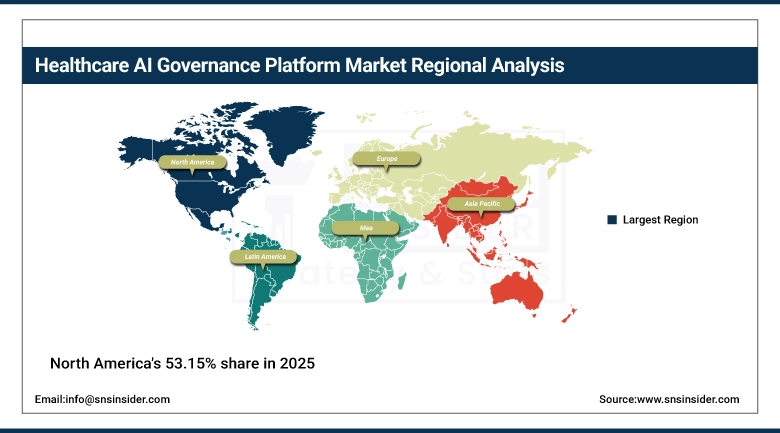
North America's 53.15% share in 2025 rests less on raw AI adoption, which is rising nearly everywhere, and more on being the first region where regulators put a name and a framework to governance obligations. The United States drives most of this activity through academic medical centers and multi-hospital systems that run formal governance committees under accreditation rules. Canada adds weight through its own health technology assessment processes and research ties across the border.
Almost every governance-focused start-up currently raising venture capital is headquartered somewhere in the region, which concentrates both supply and demand here first, and large systems are also the earliest to pilot governance for autonomous clinical and administrative agents rather than wait for a clearer mandate elsewhere. Smaller community hospitals still lean on manual committee review, which is less a sign of disinterest than of budget, leaving real headroom for platform adoption across the region as enterprise pricing tiers extend further down toward mid-sized health systems.
⮞The U.S. Food and Drug Administration issued draft guidance in January 2025 covering the complete life cycle of AI-enabled medical devices, after authorizing more than 1,000 such devices through established premarket pathways, giving validation vendors a clearer federal reference point for the evidence health systems should document.
Get Customized Report as per Your Business Requirement - Enquiry Now
Europe Healthcare AI Governance Platform Market Insights
Europe is the one region where a specific law, not a general sense of best practice, is setting the purchase timeline, and that regulatory pressure is pushing its growth to approximately 19.65% from 2026 to 2035, the second-fastest pace of any region, despite holding only the second-largest position today. Any high-risk AI system under the EU AI Act's Annex III must carry documented risk management and human oversight, an obligation that sits on top of what a governance platform already automates. Germany, the United Kingdom, and France host the largest concentrations of hospital systems now building toward that obligation.
National health systems add demand for centrally auditable oversight of publicly funded AI, and vendors are building data-residency options directly into their platforms to satisfy data-protection expectations that go beyond what U.S. buyers typically require. Smaller national markets lag Germany, the U.K., and France in adoption, a gap tied to hospital technology budgets rather than regulatory exposure, and growth should accelerate as compliance deadlines draw closer.
⮞European Union lawmakers reached political agreement on 7 May 2026 to postpone the compliance deadline for high-risk Annex III AI systems to 2 December 2027, a sixteen-month delay from the original date, giving governance vendors operating in the region additional time to build out compliance tooling ahead of enforcement.
Asia Pacific Healthcare AI Governance Platform Market Insights
Asia Pacific is projected to be the fastest-growing region at a CAGR of approximately 22.30% from 2026 to 2035, and its governance market looks less like North America's or Europe's than like several distinct national markets growing at once. China's NMPA is tightening review of AI-enabled devices, Japan's PMDA has its own software-as-a-medical-device pathway, and India's hospital networks are scaling clinical AI faster than any single national framework can standardize. That patchwork is exactly why platforms built to adapt documentation templates to different national requirements, rather than assume one regulatory shape, are winning early mandates across the region's large public and private hospital systems.
Regulators are still writing AI-specific guidance in most of the region, so individual hospital risk policy is currently doing more to drive adoption than any uniform national mandate, a dynamic that favors vendors able to sell directly to hospital boards rather than wait for a government standard. Investment in digital health infrastructure across South Korea and Australia is lifting major networks' capacity to run formal governance programs, and local vendors are beginning to compete alongside global platforms as that addressable base expands.
MEA & Latin America Healthcare AI Governance Platform Market Insights
The Middle East and Africa is building governance capacity alongside, rather than after, its AI deployments, which is a different sequence than North America followed. Gulf states investing heavily in new digital hospital infrastructure are inviting global health technology vendors in as early partners, so a governance layer often arrives bundled with the clinical AI itself rather than being retrofitted later. South Africa remains the continent's most established market, carried by research hospitals with longer-standing clinical AI pilots.
Latin America's demand runs through large public hospital networks in Brazil, Argentina, and Mexico, where rising use of AI in diagnostic imaging and administrative workflows is only now creating a governance need distinct from the clinical tool itself. Budget constraints at public hospitals slow adoption relative to private systems in the same countries, but regional health technology associations are starting to publish responsible-AI guidance that should support platform adoption as standards mature.
Market Dynamics
Growth Drivers: Regulatory alignment pressure and multi-vendor AI sprawl
Manual spreadsheet tracking stops working the moment a health system's algorithm count moves from a handful of pilots to dozens of production tools, and regulators formalizing life-cycle evidence requirements for AI-enabled devices are exactly what is forcing that count upward across imaging, triage, documentation, and administrative workflows. Boards and risk committees that once accepted a departmental log now ask for a single inventory view that can answer, in one place, which model is running where and when it was last validated.
A second driver sits one layer below the first: health systems are buying clinical algorithms from many different suppliers rather than standardizing on one, and without a vendor-neutral governance layer, each tool would need its own separate monitoring process, raising both cost and the odds that some tool escapes oversight unnoticed. Venture funding is reinforcing this pattern by capitalizing start-ups built specifically for cross-vendor monitoring rather than single-vendor dashboards, and early buyers are treating that neutrality as a selection criterion in its own right.
⮞In June 2025, Pacific AI declared its operational deployment certification intent under the Coalition for Health AI's assurance service provider process, committing to build a governance framework addressing privacy, security, data quality, and intellectual property protection ahead of becoming a CHAI Certified Assurance Service Provider.
Restraints: Budget constraints, fragmentation, and skills shortages
Knowing a governance platform would help is not the same as having budget for one, and that gap is widest at smaller hospitals and community health systems, where technology spending competes directly with clinical staffing. Integrating any governance platform with the clinical and IT systems a hospital already runs takes specialized staff that smaller organizations often do not have on payroll. Regulatory guidance also differs across countries and, within some countries, across separate regulatory bodies, complicating one program that satisfies every requirement at once.
A shortage of staff who combine clinical, data science, and regulatory expertise slows how quickly even a health system that has purchased a platform can operationalize it. Smaller vendors face pressure to meet the same security and compliance bar as larger, better-funded competitors, which can cost them enterprise contracts despite a comparable product. At some larger, longer-established institutions, institutional reluctance to replace a familiar committee process with software remains the biggest brake on the market.
Opportunities: AI agent governance and academic health system partnerships
The clearest emerging opportunity is one where the category is still being defined rather than contested: AI agent governance. Vendors that build runtime guardrails and human-oversight checkpoints specific to multi-step agents, instead of retrofitting tools designed for simpler predictive models, can capture share before the category settles into established incumbents. Health systems piloting generative AI assistants for documentation and patient communication are already asking suppliers how agent behavior will be monitored and controlled going forward.
A second opportunity sits in partnering directly with academic health systems that already run internal AI development, since a vendor that pairs its governance tooling with an academic system's own clinical models can reach the broader hospital networks that system serves rather than sell a standalone compliance add-on one hospital at a time. Marketplace listings with major cloud providers are also lowering the barrier for health systems to adopt new tools without a lengthy procurement cycle.
⮞The New Jersey Innovation Institute and Cognome announced a strategic partnership in March 2025 pairing Cognome's ExplainerAI governance platform, built on the NIH AI Governance framework, with NJII's professional services to bring the combined offering to academic and community health systems across New Jersey.
Recent Developments:
-
In July 2025, ModelOp launched an update to its ModelOp Center platform adding an agentic AI chat interface, an agent service for approving and halting autonomous agents, and a proxy service that blocks prompt-injection attacks, extending its governance toolset to cover multi-step agents alongside traditional and generative AI models.
-
In November 2025, ModelOp became a certified Assurance Resource Provider under the Coalition for Health AI, joining the group of vendors CHAI reviews against its healthcare AI governance standards.
-
In December 2025, ModelOp was named a Major Player in IDC's MarketScape for Worldwide Unified AI Governance Platforms, a general enterprise AI governance ranking that is not specific to healthcare, alongside competitors including Dataiku and Databricks.
-
In February 2026, Censinet unveiled Censinet GRC AI, an AI-powered governance, risk, and compliance platform using seven specialized agents to cover vendor risk, cybersecurity, regulatory compliance, and clinical safety, alongside systemic risk tools in Censinet RiskOps that operationalize the Health Sector Coordinating Council's SMART framework.
-
In July 2026, Hackensack Meridian Health became the first health system to earn The Joint Commission's responsible AI certification, launched that June, after a three-week evaluation across six governance domains spanning governance and oversight, data privacy, risk and bias reduction, safety and performance monitoring, patient-facing transparency, and staff training.
Healthcare AI Governance Platform Market Key Players
-
Ferrum Health
-
ModelOp
-
Solytics Partners
-
Pacific AI
-
Cognome
-
Qualified Health
-
ALIGNMT AI
| Report Attributes | Details |
|---|---|
| Market Size in 2025 | USD 1.12 Billion |
| Market Size by 2035 | USD 5.59 Billion |
| CAGR | CAGR of 17.45% From 2026 to 2035 |
| Base Year | 2025 |
| Forecast Period | 2026-2035 |
| Historical Data | 2022-2024 |
| Report Scope & Coverage | Market Size, Segments Analysis, Competitive Landscape, Regional Analysis, DROC & SWOT Analysis, Forecast Outlook |
| Key Segments | • By Application (AI Inventory and Registry, Model Validation, Bias and Fairness Monitoring, Performance and Drift Monitoring, Regulatory Documentation, AI Agent Governance) • By Deployment (Cloud-based, On-premises) • By End Use (Healthcare Providers, Payers, Life Science Companies) |
| Regional Analysis/Coverage | North America (US, Canada), Europe (Germany, UK, France, Italy, Spain, Russia, Poland, Rest of Europe), Asia Pacific (China, India, Japan, South Korea, Australia, ASEAN Countries, Rest of Asia Pacific), Middle East & Africa (UAE, Saudi Arabia, Qatar, South Africa, Rest of Middle East & Africa), Latin America (Brazil, Argentina, Mexico, Colombia, Rest of Latin America). |
| Company Profiles | Ferrum Health, ModelOp, Solytics Partners, Pacific AI, Cognome, Qualified Health, ALIGNMT AI |

Frequently Asked Questions
The market includes Ferrum Health, ModelOp, Solytics Partners, Pacific AI, Cognome, Qualified Health, and ALIGNMT AI. These providers compete on validation depth, cross-vendor monitoring, regulatory documentation, and, increasingly, AI agent governance.
The main opportunities lie in governing autonomous AI agents as they move into live clinical and administrative use, and in partnering directly with academic health systems that already run internal AI development to reach the broader hospital networks they serve.
The key growth factor is the formalization of regulatory life cycle expectations for AI-enabled medical devices combined with multi-vendor AI sprawl across health systems, which pushes organizations toward a single governance platform rather than manual, tool-by-tool review.
By application, the Model Validation segment dominated the market with approximately 24.60% share in 2025, supported by its role as the evidence base for every other governance function. The Cloud-based deployment mode and Healthcare Providers end-use segment led their respective axes.
North America dominated the market with approximately 53.15% share in 2025, supported by the earliest regulatory attention to AI-enabled medical devices and the largest base of governance vendors. Asia Pacific is the fastest-growing region, driven by the region's fragmented national AI regulations prompting hospital systems to adopt adaptable governance platforms.
