
Noninvasive Hemoglobin Monitors Market Report Scope & Overview:
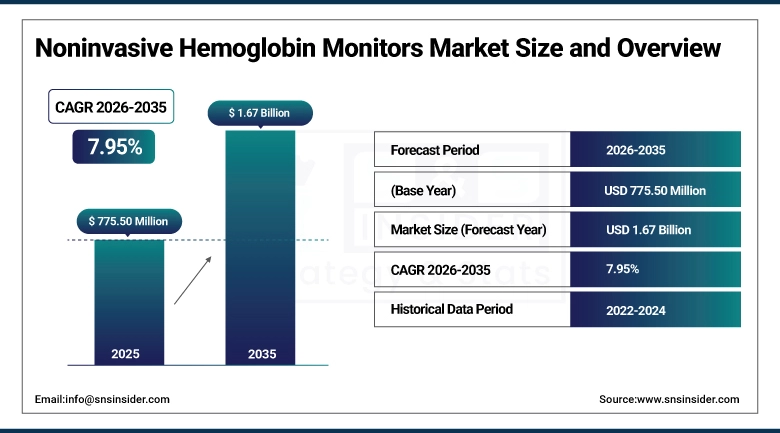
The Noninvasive Hemoglobin Monitors Market was valued at USD 775.50 Million in 2025 and is expected to reach USD 1.67 Billion by 2035, growing at a CAGR of 7.95% from 2026-2035.
The Noninvasive Hemoglobin Monitors Market is moving away from invasive lancet-based testing as the default way to check blood hemoglobin, in both hospital and outpatient settings. Occlusion-based and optical sensors now let clinicians read hemoglobin from a fingertip or earlobe in roughly a minute, sparing patients a needle stick and sparing blood banks the lancets, gloves and bandages invasive testing still requires. Surgical teams managing blood loss during an operation, and blood centers screening donors before a draw, are the two settings pulling adoption hardest: both need a fast hemoglobin reading rather than a laboratory turnaround. Smartphone- and camera-based estimation is widening the use case toward routine anemia screening outside a clinical setting, a shift that is still early but growing.
To Get more information On Noninvasive Hemoglobin Monitors Market - Request Free Sample Report
Noninvasive Hemoglobin Monitors Market Trends
-
Blood centers are replacing lancet-based donor screening with occlusion-based and optical sensors.
-
Perioperative blood management protocols are adding continuous noninvasive hemoglobin monitoring in the operating room.
-
Smartphone camera- and AI-based hemoglobin estimation is extending screening into home and low-resource settings.
-
Wearable hemoglobin tracking is gaining early traction among endurance athletes and chronic anemia patients.
-
National anemia-screening programs in South Asia are expanding demand for low-cost point-of-care devices.
-
Device makers are bundling noninvasive hemoglobin sensors into existing multiparameter patient monitors.
U.S. Noninvasive Hemoglobin Monitors Market Outlook
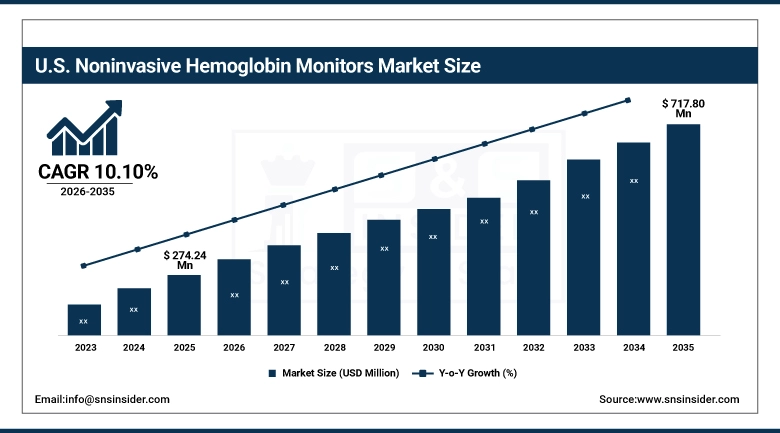
The U.S. Noninvasive Hemoglobin Monitors Market was valued at USD 274.24 Million in 2025 and is expected to reach USD 717.80 Million by 2035, growing at a CAGR of 10.10% from 2026-2035.
Blood centers and hospital perioperative units anchor U.S. demand, with large multi-site donor networks among the earliest and broadest adopters nationally. Academic medical centers running patient blood management programs have built continuous noninvasive hemoglobin monitoring into intraoperative protocols for high blood-loss procedures, reducing reliance on repeated laboratory draws during surgery. Group purchasing organizations increasingly bundle noninvasive hemoglobin sensors into broader patient-monitoring equipment contracts, which speeds adoption at hospital systems already enrolled in one of these purchasing networks. Rural and smaller community hospitals still rely mainly on laboratory testing for routine anemia checks, leaving room for adoption to broaden through 2035.
⮞In May 2025, the American Red Cross began rolling out a non-invasive, ring-shaped hemoglobin sensor across its U.S. blood drives, replacing the lancet-based test previously used to qualify donors. The organization, which collects roughly 40% of the nation's blood supply from nearly seven million donors a year, said it aimed to have the sensors in place at essentially all of its blood drives by the end of June 2025.
Noninvasive Hemoglobin Monitors Market Segment Analysis
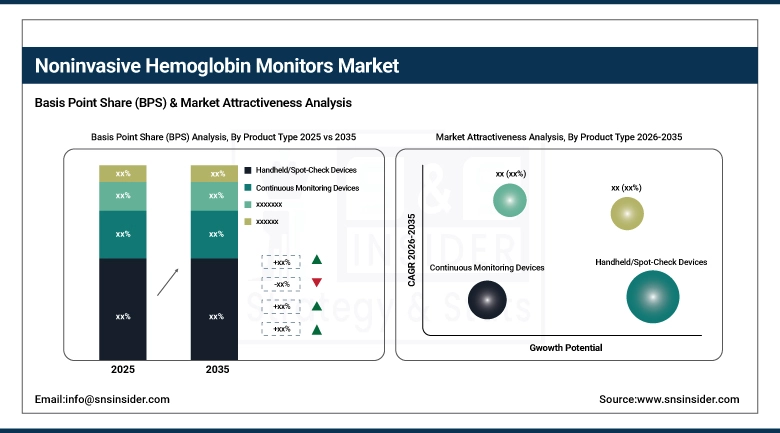
By Product Type, the Handheld/Spot-Check Devices segment dominated the Noninvasive Hemoglobin Monitors Market with approximately 41.20% share in 2025, while the Continuous Monitoring Devices segment is the fastest growing with a CAGR of approximately 12.85%.
By Technology, the Pulse CO-Oximetry/Optical Sensing segment dominated the Noninvasive Hemoglobin Monitors Market with approximately 58.90% share in 2025, while the Computer Vision & AI-Based Estimation segment is the fastest growing with a CAGR of approximately 13.75%.
By End User, the Hospitals & Clinics segment dominated the Noninvasive Hemoglobin Monitors Market with approximately 63.80% share in 2025, while the Home Healthcare segment is the fastest growing with a CAGR of approximately 13.20%.
By Product Type, Handheld/Spot-Check Devices Dominate the Noninvasive Hemoglobin Monitors Market and Continuous Monitoring Devices Grow Fastest
A handheld spot-check reader needs no installation, no capital budget sign-off and no integration with an existing monitor, which is why blood banks, donor centers and outpatient clinics buy it first and in the largest volume. A single unit can screen dozens of donors or patients in a shift, moving between stations rather than staying tethered to a single bedside monitor, a flexibility a fixed continuous sensor cannot match. Pre-donation anemia screening and routine outpatient anemia checks, both high-volume and low-acuity, keep this category's unit count well ahead of any other product type even as per-unit pricing stays modest.
Continuous monitoring devices are growing fastest as perioperative blood management programs increasingly want a running hemoglobin trend during surgery, not a single spot reading taken before or after. Anesthesia teams managing blood loss in spine, cardiac and major orthopedic procedures use a continuous trace to decide, in real time, whether to transfuse or hold, a decision a periodic fingerstick cannot support at the same speed. Hospitals expanding patient blood management programs to control transfusion costs are the main buyers pulling this segment's growth, and that program expansion is still in its early years across most mid-sized hospital systems.
By Technology, Pulse CO-Oximetry/Optical Sensing Dominates the Noninvasive Hemoglobin Monitors Market and Computer Vision & AI-Based Estimation Grows Fastest
Pulse CO-oximetry and other optical sensing methods lead as the only noninvasive approaches with more than a decade of clinical validation behind them, giving hospitals and blood centers confidence to retire an invasive method in favor of one. Multi-wavelength light absorption through a fingertip or earlobe produces a reading fast enough for a donor line or an operating room, and the sensors now ship as options on patient monitors many hospitals already own, lowering the barrier to adopt the capability rather than buy a dedicated device. Occlusion-based variants, which briefly stop blood flow to read hemoglobin more precisely, serve the donor-screening segment specifically.
Computer vision and AI-based estimation, which reads hemoglobin from a smartphone photo of a fingernail, conjunctiva or face rather than a dedicated optical sensor, is growing fastest, needing no extra hardware at all beyond a phone already in a user's pocket. That removes the largest cost and distribution barrier facing every other noninvasive technology, letting a screening program reach rural clinics, community health workers and individual users directly through an app rather than a shipped device. Accuracy is improving as training datasets grow, though most offerings remain positioned as a screening aid, not a diagnostic replacement.
⮞A study published in the Proceedings of the National Academy of Sciences in May 2025 found that an AI-augmented smartphone app estimating hemoglobin from fingernail photographs performed accurately against self-reported complete blood count results across more than 9,000 users, and had logged over 1.4 million uses that researchers used to build a real-time anemia prevalence map across the United States.
By End User, Hospitals & Clinics Dominate the Noninvasive Hemoglobin Monitors Market and Home Healthcare Grows Fastest
Hospitals and clinics hold the largest end-user share, running the two use cases that drive most device volume today, perioperative blood management and inpatient anemia monitoring for patients who would otherwise face repeated venous draws. A multi-site hospital system standardizing on one noninvasive platform across its operating rooms and wards buys in volumes no other end user approaches, and accreditation-linked blood management programs give purchasing committees a standing reason to keep budget allocated to the category year after year.
Home healthcare is growing fastest as chronic kidney disease, heart failure and oncology patients managing anemia between clinic visits adopt simpler handheld or wearable readers to track trends without a dedicated nurse visit for every check. Remote patient monitoring programs that already track blood pressure and oxygen saturation at home are starting to add hemoglobin as a further parameter, which gives device makers an existing distribution channel rather than a market with no distribution infrastructure of its own. Ambulatory surgical centers and diagnostic laboratories and blood banks round out the remaining end-user base, the latter concentrated in donor pre-screening.
Regional Analysis
|
Region |
Major Country |
Share within Region, 2025 (%) |
|---|---|---|
|
North America |
United States |
83.50% |
|
Europe |
Germany |
22.40% |
|
Asia Pacific |
China |
29.85% |
|
Middle East and Africa |
UAE |
29.60% |
|
Latin America |
Brazil |
44.75% |
North America Noninvasive Hemoglobin Monitors Market Insights
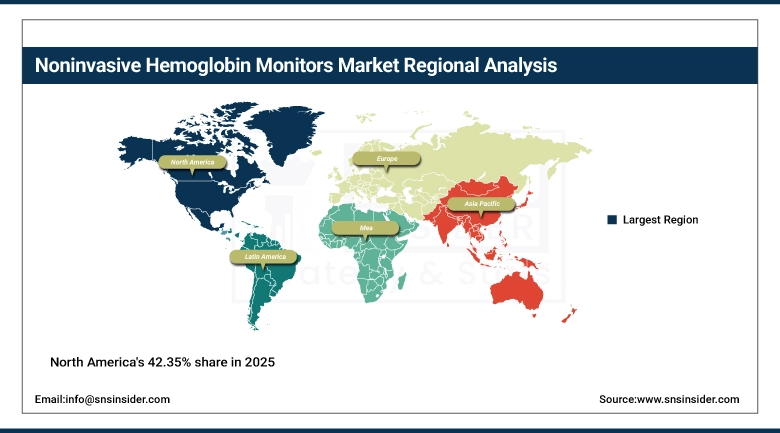
North America's 42.35% share in 2025 rests on the region's early and broad adoption of noninvasive hemoglobin sensing across both its blood-donation network and its hospital perioperative programs. The United States drives most of this activity, with national blood-collection organizations rolling out ring-shaped and spot-check sensors system-wide and academic hospitals folding continuous hemoglobin monitoring into established patient blood management protocols. Canada adds a smaller but steady base through its own blood-donation organizations and public hospital systems evaluating the same sensing technology.
Device makers headquartered in the region, led by the clinical pulse CO-oximetry pioneers that first brought noninvasive hemoglobin sensing to market, continue to concentrate their newest product launches and clinical studies here before expanding elsewhere. Clinical validation work at large academic medical centers and blood-collection networks produces much of the peer-reviewed evidence these device makers cite when entering other regions, reinforcing North America's role as the technology's proving ground. Rural areas and smaller community hospitals still lean mainly on laboratory testing for routine anemia checks, leaving real adoption headroom across the region through 2035.
Get Customized Report as per Your Business Requirement - Enquiry Now
Europe Noninvasive Hemoglobin Monitors Market Insights
Europe holds the second-largest position in 2025, carried by national blood-transfusion services and public hospital systems in Germany, the United Kingdom and France that have run noninvasive hemoglobin pilots alongside their North American counterparts for more than a decade. Centralized national blood services give device makers a smaller number of large institutional buyers to work with than the more fragmented U.S. blood-bank landscape, which has supported steady rather than rapid adoption. Public hospital procurement cycles tend to move more slowly than private U.S. systems, tempering the pace at which continuous monitoring reaches operating rooms.
Growth across the region is expected to track hospital capital-equipment replacement cycles rather than any single regulatory trigger, since the European Union has not issued hemoglobin-sensor-specific guidance comparable to its broader medical device regulation. Eastern European health systems, including Poland and Russia, are earlier in their adoption curve than Western Europe, representing the region's remaining headroom. Smaller national blood services are increasingly drawing on equipment evaluations already completed by larger neighboring countries rather than running independent trials.
Asia Pacific Noninvasive Hemoglobin Monitors Market Insights
Asia Pacific is projected to be the fastest-growing region at a CAGR of approximately 13.80% from 2026 to 2035, driven less by hospital capital spending than by large public anemia-screening programs. India's national anemia-reduction program has already supported state-level deployment of indigenous noninvasive hemoglobin screening devices through public-private partnerships between device makers and state health departments, giving the country a distribution model most other public health systems in the region have not yet built. China's hospital network is separately adopting continuous noninvasive monitoring in surgical settings as patient blood management programs spread from leading academic centers to provincial hospitals.
Japan and South Korea are growing more slowly than China and India, reflecting hospital systems that already run mature laboratory-based hemoglobin testing with little urgency to replace it, while Australia and the ASEAN countries sit in between, adopting noninvasive devices mainly through private hospital chains and donor organizations. The region's combination of large population-level screening need and price-sensitive public health budgets favors lower-cost handheld and smartphone-based approaches over premium continuous monitoring platforms, a different adoption pattern than North America's hospital-led growth.
MEA & Latin America Noninvasive Hemoglobin Monitors Market Insights
The Middle East and Africa combine a small but fast-growing base of hospital adopters in the Gulf states with much more limited access across the rest of the continent, where laboratory hemoglobin testing infrastructure itself remains uneven. The UAE and Saudi Arabia are investing in new hospital capacity that includes noninvasive patient monitoring as standard equipment on new builds, giving device makers an entry point tied to hospital construction rather than retrofit sales. South Africa anchors the sub-Saharan portion of the market through its more established private hospital sector and blood-service network.
Latin America's demand centers on Brazil's large public and private hospital network, with Argentina, Mexico and Colombia following at a smaller scale. Public hospital budget constraints slow adoption of continuous monitoring relative to private facilities in the same countries, pushing most near-term demand toward lower-cost handheld spot-check devices for both clinical anemia screening and blood-donation pre-screening. Both regions remain earlier-stage than North America, Europe or Asia Pacific, with growth tied closely to broader hospital infrastructure investment.
Market Dynamics
Growth Drivers: Rising demand for needle-free point-of-care anemia and donor screening
Blood centers and outpatient clinics are under constant pressure to screen more donors and patients without adding staff time or biohazard waste, and a noninvasive reading that takes about a minute answers both problems at once. Conventional lancet-based testing requires lancets, gauze, gloves and a disposal process for every single test, costs that a reusable optical or occlusion-based sensor avoids entirely after the initial purchase. Donor comfort has become a measurable retention lever for blood centers competing for a shrinking donor pool, giving administrators a concrete reason to switch screening methods beyond the underlying cost case.
A second driver sits in the operating room, where patient blood management programs are expanding to cut unnecessary transfusions and their associated cost and risk. Continuous noninvasive hemoglobin monitoring gives anesthesia teams a running trend during high blood-loss procedures instead of a single point-in-time laboratory value, supporting faster transfusion decisions without repeated venous draws. Hospitals expanding these programs are a smaller but higher-value buyer segment than blood centers, and growth in one segment is reinforcing device makers' incentive to keep investing in the other.
Restraints: Accuracy limits and reimbursement gaps versus laboratory testing
Noninvasive readings still trail laboratory hemoglobin assays on measurement precision in some patient populations, particularly those with low perfusion or certain skin pigmentation profiles, which keeps clinicians using these devices as a screening or trending tool rather than a full diagnostic replacement. That gap matters most in higher-acuity settings such as active hemorrhage, where a wrong reading could delay a needed transfusion, pushing some hospitals to keep a laboratory confirmation step in place even after adopting a noninvasive device.
Reimbursement for noninvasive hemoglobin monitoring generally follows the broader patient monitor or procedure it is attached to rather than its own dedicated billing code, which makes the purchase decision a capital-budget question for hospital administrators instead of a straightforward revenue-generating service line. Smaller hospitals and donor centers with tighter equipment budgets weigh a noninvasive sensor against several other competing capital priorities, slowing adoption outside large academic systems and national blood services that carry dedicated funding earmarked for donor-experience improvements.
Opportunities: Smartphone-based screening and expansion into emerging anemia programs
The clearest emerging opportunity is screening that needs no dedicated hardware at all, since an AI-augmented smartphone app can estimate hemoglobin from a photograph without a sensor, a cuvette or a lancet. That removes the distribution cost that has limited every prior noninvasive technology's reach into rural clinics, community health workers and individual consumers, letting a screening program scale through an app download rather than a shipped device. Developers that can keep accuracy high across diverse skin tones and lighting conditions stand to capture the broadest population-screening use case ahead of competitors still tied to dedicated hardware.
A second opportunity sits in large public anemia-screening programs across South Asia and Sub-Saharan Africa, where national health ministries are actively looking for lower-cost point-of-care alternatives to laboratory testing to reach rural and underserved populations at scale. India's public-private partnerships pairing indigenous device makers with state health departments offer a template other countries running similar maternal-anemia and child-nutrition programs could adopt, giving device makers a path to volume well beyond hospital and blood-bank sales alone.
⮞India's national anemia-reduction program moved to a strengthened operational framework in mid-2026, adding a reinforced digital monitoring component to an effort that has already supported state-level rollout of noninvasive screening devices, pointing to continued public-sector demand for point-of-care hemoglobin technology across the program's expanding scope.
Recent Developments:
-
In September 2025, Masimo Corporation announced an expansion of its multi-year strategic partnership with Koninklijke Philips N.V., extending Masimo's SpHb continuous noninvasive hemoglobin technology, along with its SET pulse oximetry and other measurement parameters, into a wider range of Philips patient monitors through 2026 and beyond. The companies also agreed to jointly develop AI-based monitoring technologies.
-
In April 2025, Sanguina Inc. launched Ruby, an expanded version of its AnemoCheck Mobile smartphone app that adds a patented fingernail-photograph analysis estimating iron deficiency risk alongside its existing noninvasive hemoglobin screening feature, broadening the company's blood-health platform beyond anemia detection alone.
-
In August 2025, Medtronic Monitoring, Inc. received U.S. Patent No. 12,376,768 for a non-invasive hemoglobin monitoring system that calculates concentration from the ratio of two measured light-emission wavelengths, a method the company says reduces errors from ambient light and sensor placement across adherent patches, finger clips and insertable devices.
-
In February 2026, Bosch Global Software Technologies received the Robert Bosch Innovation Award for Vivaray, its AI-based handheld hemoglobin screening device that reads results from a fingertip in under 30 seconds without blood draws or consumables, the first such award given for the India region.
Noninvasive Hemoglobin Monitors Market Key Players
-
Masimo Corporation (a Danaher Corporation company)
-
OrSense Ltd.
-
EzeRx
-
GE HealthCare Technologies, Inc.
-
Siemens Healthineers AG
-
Medtronic plc
-
Nihon Kohden Corporation
-
Sysmex Corporation
-
Robert Bosch GmbH (Bosch Global Software Technologies)
-
Mespere LifeSciences Inc.
-
Sanguina Inc.
-
Biosense Technologies Pvt. Ltd.
-
Tech4Life Enterprises Canada Inc.
Noninvasive Hemoglobin Monitors Market Report Scope:
| Report Attributes | Details |
|---|---|
| Market Size in 2025 | USD 775.50 Million |
| Market Size by 2035 | USD 1.67 Billion |
| CAGR | CAGR of 7.95% From 2026 to 2035 |
| Base Year | 2025 |
| Forecast Period | 2026-2035 |
| Historical Data | 2022-2024 |
| Report Scope & Coverage | Market Size, Segments Analysis, Competitive Landscape, Regional Analysis, DROC & SWOT Analysis, Forecast Outlook |
| Key Segments | • By Product Type (Handheld/Spot-Check Devices, Continuous Monitoring Devices, Wearable Devices, Sensors & Accessories) • By Technology (Pulse CO-Oximetry/Optical Sensing, Computer Vision & AI-Based Estimation, Others) • By End User (Hospitals & Clinics, Ambulatory Surgical Centers, Diagnostic Laboratories & Blood Banks, Home Healthcare, Research & Academic Institutions) |
| Regional Analysis/Coverage | North America (US, Canada), Europe (Germany, UK, France, Italy, Spain, Russia, Poland, Rest of Europe), Asia Pacific (China, India, Japan, South Korea, Australia, ASEAN Countries, Rest of Asia Pacific), Middle East & Africa (UAE, Saudi Arabia, Qatar, South Africa, Rest of Middle East & Africa), Latin America (Brazil, Argentina, Mexico, Colombia, Rest of Latin America). |
| Company Profiles | Masimo Corporation (a Danaher Corporation company), OrSense Ltd., EzeRx, GE HealthCare Technologies Inc., Siemens Healthineers AG, Medtronic plc, Nihon Kohden Corporation, Sysmex Corporation, Robert Bosch GmbH (Bosch Global Software Technologies), Mespere LifeSciences Inc., Sanguina Inc., Biosense Technologies Pvt. Ltd., Tech4Life Enterprises Canada Inc. |

Frequently Asked Questions
The market includes Masimo Corporation, now a standalone business unit of Danaher Corporation, OrSense Ltd., EzeRx, GE HealthCare Technologies, Siemens Healthineers AG, Medtronic plc, Nihon Kohden Corporation, Sysmex Corporation and Robert Bosch GmbH, among others. These providers compete on sensing accuracy, clinical validation depth, blood-bank donor-screening partnerships and integration with existing patient monitoring platforms.
The main opportunities lie in smartphone- and AI-based hemoglobin estimation that needs no dedicated sensor hardware, and in expanding into large public anemia-screening programs across South Asia and Sub-Saharan Africa that need low-cost point-of-care alternatives to laboratory testing.
The key growth factor is rising demand for needle-free point-of-care hemoglobin screening at blood donation centers, combined with hospital patient blood management programs that are adding continuous noninvasive hemoglobin monitoring to perioperative care.
By product type, the Handheld/Spot-Check Devices segment dominated the market with approximately 41.20% share in 2025, supported by its low cost and use across high-volume donor and outpatient screening. The Pulse CO-Oximetry/Optical Sensing technology and Hospitals & Clinics end-user segment led their respective axes.
North America dominated the market with approximately 42.35% share in 2025, supported by widespread blood-center donor-screening conversion and hospital patient blood management adoption. Asia Pacific is the fastest-growing region, driven by large national anemia-screening programs.
