
Financial Advisory Services Market Report Scope & Overview:
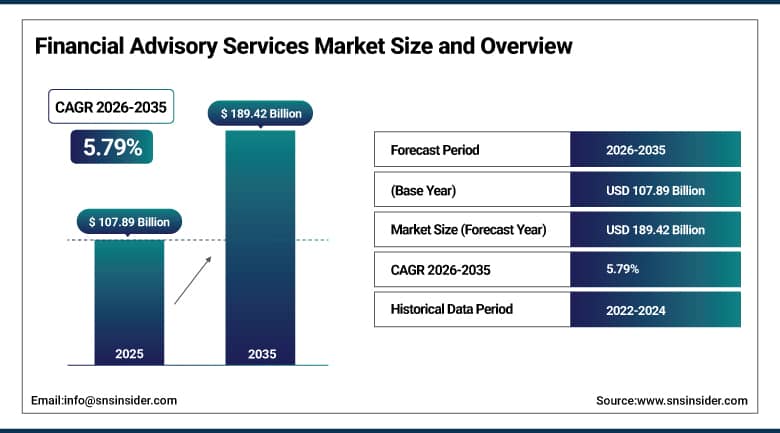
The Financial Advisory Services Market was valued at USD 107.89 Billion in 2025 and is expected to reach USD 189.42 Billion by 2035, growing at a CAGR of 5.79% from 2026 to 2035.
The Financial Advisory Services Market is witnessing growth on account of rising demand for customized financial planning, wealth management, and investment advisory services by consumers and corporations. The factors responsible for growth include the complexities of the financial markets, increasing disposable incomes, and growing concerns about retirement planning and tax planning. With digital transformation and the use of AI-based analytics, robo-advisory services, and cloud financial management systems, efficiency in providing such services and customer engagement have seen significant improvement. Moreover, increasing high net worth population, greater need for compliance with regulations, and demand for business financial advice are contributing to growth in the global market.
Federal Reserve survey data shows AI penetration among financial-services workers running between 20% and 40%, with year-on-year growth reaching up to 145% in some segments, underscoring how quickly artificial intelligence is being woven into day-to-day financial advisory workflows across the industry.
To Get More Information On Financial Advisory Services Market - Request Free Sample Report
Financial Advisory Services Market Trends
-
Rising demand for digital financial planning tools and robo-advisory platforms is transforming service delivery and client engagement models across the industry.
-
Increased focus on ESG and sustainable investing is shaping portfolio strategies and advisory mandates for both institutional and individual clients.
-
Growing complexity of regulations is driving demand for compliance advisory and risk management services alongside traditional investment guidance.
-
Hybrid delivery models that combine human judgment with algorithmic efficiency are gaining momentum, particularly among affluent millennial and Gen Z clients.
-
Advisors are increasingly integrating AI-driven predictive analytics into portfolio management, risk assessment, and personalized financial planning.
The U.S. Financial Advisory Services Market Outlook
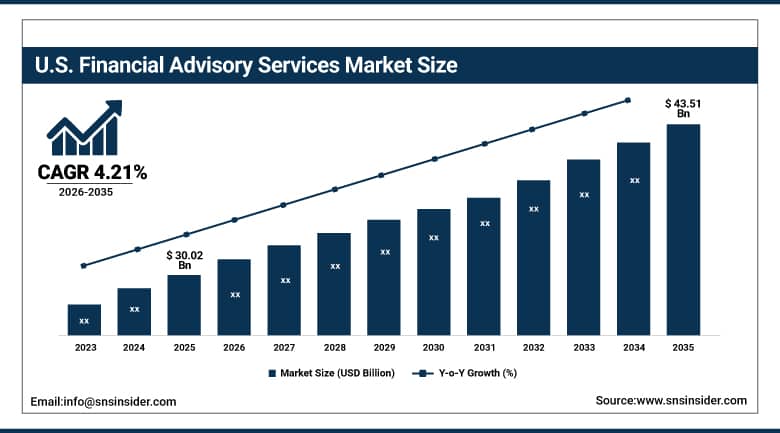
The U.S. Financial Advisory Services Market was valued at approximately USD 30.02 Billion in 2026 and is expected to reach approximately USD 43.51 Billion by 2035, growing at a CAGR of approximately 4.21%.
The U.S. market's expansion is attributed to the upsurge in digitally delivered advisory services, increasing complexity of individual portfolios, and heightened demand for retirement planning across an aging population with genuinely complicated financial needs. Changing investor preferences and regulatory stringency are driving rising reliance on advisors to optimize financial outcomes, especially as digital tools and wealth technologies enhance transparency, accessibility, and portfolio performance for both individual and institutional clients. The U.S. leads global market share due to an expansive advisor network, supportive regulatory reforms such as the SEC's Best Interest Regulation, and early adoption of digital advisory tools relative to most other national markets.
Kroll introduced a property insurance value platform in April 2023, designed to help clients navigate economic uncertainty by providing rapid, thorough, and expert-driven insights for property insurance assessment, part of a broader industry trend toward more technology-enabled, data-driven advisory tools across U.S. financial services.
Financial Advisory Services Market Segment Analysis
-
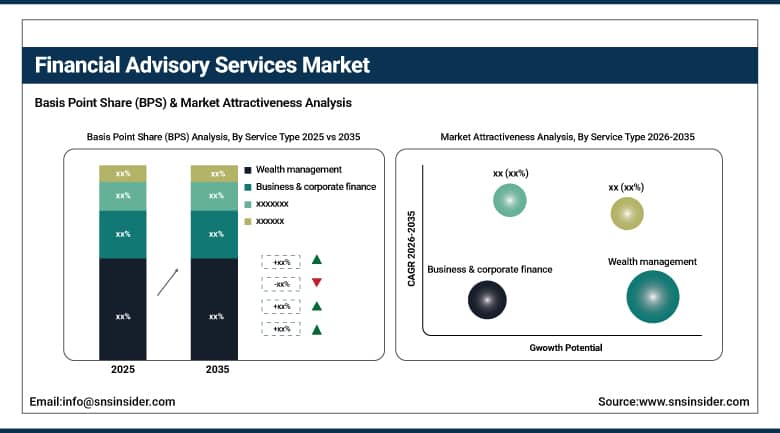
By Service Type, Wealth management segment dominated the Financial Advisory Services Market in 2025 with 34% share; Business & corporate finance segment is the fastest growing segment.
-
By Asset Class, Equities segment dominated the market in 2025 with 38% share; Alternative investments segment is the fastest growing segment.
-
By Organization Size, Large enterprises segment dominated the market in 2025 with 64% share; SMEs segment is the fastest growing segment.
-
By End Use, BFSI segment dominated the market in 2025 with 31% share; Healthcare segment is the fastest growing segment.
By Service Type, Wealth Management segment dominates the Financial Advisory Services Market, Business & Corporate Finance segment expected to grow fastest
Wealth Management dominates the Financial Advisory Services Market due to the emergence of wealth creation worldwide coupled with the rising requirement for personalized financial advice related to investment, retirement, taxation, and estate planning services. The increasing reliance on professional advisory services by high-net-worth individuals and rich investors to protect and enhance their assets as well as manage their financial risks makes wealth management the highest revenue generator among the different service types in the market.
Business & Corporate Finance is the fastest-growing service type as companies increasingly seek advisory services for mergers and acquisitions, capital generation, restructuring, valuation, and business expansion purposes. Increasing cross-border investments, startups, and private equity dealings are creating substantial demand for specialist financial knowledge. Business & Corporate Finance advisory services segment is experiencing rapid expansion owing to its ability to help businesses in efficient capital utilization and growth strategies.
By Asset Class, Equities segment dominates the Financial Advisory Services Market, Alternative Investments segment expected to grow fastest
Equities dominate the Financial Advisory Services Market owing to the fact that they continue to be favored by investors who seek to generate wealth through investment. The increasing participation of retail and institutional investors, greater investments in the stock market, and higher demand for professionally managed portfolios continue to contribute to their leadership. The high liquidity, clear pricing, diversified sectors, and positive return prospects have made equities the largest asset class among financial advisory services.
Alternative Investments are the fastest-growing asset class because more and more investors look into diversifying their investments beyond the typical stocks and bonds in order to optimize their gains and minimize their portfolio risk. Higher allocation of resources to the areas of private equity, real estate, infrastructure, hedge funds, venture capital, and cryptocurrencies creates a broader space for providing advisory services.
By Organization Size, Large Enterprises segment dominates the Financial Advisory Services Market, SMEs segment expected to grow fastest
Large Enterprises dominate the Financial Advisory Services Market, given their complicated financial dealings, heavy capital investment, and constant need for financial planning. The Large Enterprises always need advice on mergers and acquisitions, treasury management, regulation, investments, and risk management. With the help of large number of transactions, international business deals, and considerable amount of advisory spending, financial consultants can earn more money.
SMEs are the fastest-growing organization size as entrepreneurs want to take help from financial consultants in order to grow their businesses, invest in fundraising, digitize their business, and achieve efficiency. Availability of financial advice through digital means and growing entrepreneurship are contributing factors. Awareness about financial planning, government assistance schemes, and increasing investment needs are motivating SMEs to use financial advice services.
By End Use, BFSI segment dominates the Financial Advisory Services Market, Healthcare segment expected to grow fastest
BFSI dominates the Financial Advisory Services Market because banks, insurers, investment firms, and other financial institutions need constant financial advice for managing investments, planning capitals, adhering to regulatory guidelines, and performing enterprise risk management. This industry's complex financial instruments, changing regulations, and valuable deals create the need for consultancy on a consistent basis. With strong spending power in finances and continuous modernization activities, BFSI will remain the biggest end-use industry.
Healthcare is the fastest-growing end-use segment as more and more hospitals, pharmaceutical firms, healthcare organizations, and life sciences companies need financial advisory services for expansion, acquisitions, investment allocation, and regulatory compliance purposes. More financial investments in the healthcare industry, increased adoption of digital health, and investments by the private equity industry in the sector are driving advisory requirements.
Regional Analysis
|
Region |
Major Country |
Share within Region, 2025 (%) |
|---|---|---|
|
North America |
United States |
78.40% |
|
Europe |
United Kingdom |
25.70% |
|
Asia Pacific |
China |
27.90% |
|
Middle East & Africa |
UAE |
26.35% |
|
Latin America |
Brazil |
35.85% |
North America Financial Advisory Services Market Insights
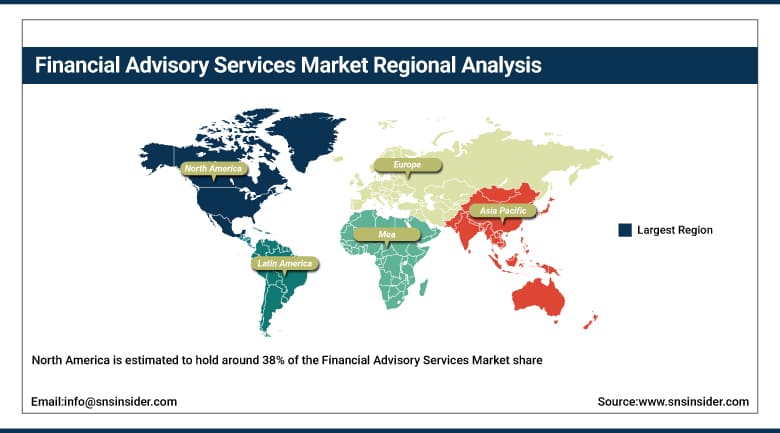
North America is estimated to hold around 38% of the Financial Advisory Services Market share, owing to factors like rapid digitization, high wealth concentration, and regulatory focus on the fiduciary obligations of the financial services industry in the region. This leadership position can also be attributed to growing wealth and retirement funds among households, leading to an increase in advisory services demand since people are able to gather sufficient complexity in their finances to warrant professional advice.
The US emerges as the major contributor to the dominance of the region, with about 78.40% of the total regional revenue, owing to a robust advisor base, conducive regulatory policies such as SEC's Best Interest regulation, and the early adoption of digital advisory services compared to most other national markets. Additionally, the presence of a mature wealth management structure in Canada will provide additional demand for the region.
Get Customized Report as Per Your Business Requirement - Enquiry Now
Europe Financial Advisory Services Market Insights
Europe maintained a significant market presence in 2025, due to the presence of strict regulations on investor protection, green finance policies, and mature wealth management capabilities in the main economies of the region. Changes in the regulatory environment and the increasing need for ESG investments are creating an increased need for specialized advice, especially where such investments require specialized knowledge.
The United Kingdom accounts for about 25.70% of the European revenue due to the role of London as a global financial hub as well as the presence of an established wealth management market in the country. There is also a significant contribution from Germany and France in addition to the continued changes in the regulatory environment regarding ESG.for financial advisory services climbing steadily through the forecast period.
Asia Pacific Financial Advisory Services Market Insights
Asia Pacific records the fastest growth, with a projected CAGR of approximately 8.67% through 2035, due to the growing number of people in the middle class, increasing wealth, and technological roll out of services in the largest economies of Asia Pacific. Due to growing disposable income levels and wealth digitization, there is growing adoption of advisory services as more people join the newly wealthy and seek advice.
China is the leading player in the region, contributing nearly 27.90% to the regional revenue, due to higher levels of wealth generation, adoption of fintech, and investment literacy initiatives launched by the government. There is growing demand for wealth management and investment advice in urban areas.
MEA & Latin America Financial Advisory Services Market Insights
The Middle East & Africa and Latin America are experiencing consistent growth in the demand for financial advisory services due to increasing wealth accumulation, greater recognition of financial planning professionals, and higher government emphasis on financial literacy within both regions. As the domestic capital markets of these regions keep developing into more sophisticated systems, advisory services become important tools for helping new rich and businesses make the most of the various investment opportunities that emerge.
The UAE is the leader of MEA demand, making up about 26.35% of regional revenue due to its role as the regional hub of wealth management and increasing number of wealthy people and family offices in the country. Saudi Arabia and South Africa also generate MEA demand for financial advisory services through developing their own wealth management markets. In Latin America, the country with the highest percentage of regional revenue is Brazil with its growing number of affluent people, making about 35.85%.
Market Dynamics
Growth Drivers: Rising client sophistication and demand for personalized planning
Increasing demand for personalized financial planning drives market expansion, as the growing complexity of investment options and a volatile macroeconomic environment prompt more clients to seek tailored financial planning and advisory services rather than generic, one-size-fits-all guidance. Increasing client sophistication, volatile markets, and regulatory complexity are collectively driving reliance on professional advisors, and that trend shows no sign of reversing even as digital tools continue improving in capability.
Growing complexity of regulations is reinforcing this driver further, as compliance advisory and risk management services become an increasingly essential component of the broader advisory relationship rather than an afterthought. As tax laws, ESG disclosure requirements, and fiduciary standards keep evolving across jurisdictions, both individual and institutional clients are increasingly turning to advisors not just for investment guidance but for genuine regulatory navigation, and that expanded scope of engagement is helping sustain steady demand growth across the industry.
Restraints: Rising competition from low-cost robo-advisory platforms
The increasing number of cost-efficient robo-advisory platforms can indeed be considered a real competitive constraint for the traditional financial advisory industry especially when it comes to managing simpler and more routine investments. As the technology of algorithmic portfolio management becomes increasingly efficient while lowering costs compared to traditional advisory significantly, some customers with fairly simple demands avoid working with human advisors altogether preferring robo-platforms.
This kind of disintermediation trend affects mostly young and relatively poor customers whose demands have not become sufficiently complicated to require a high fee paid for a financial advisor's services. Meanwhile, advisors who specialize in more complex tasks such as wealth management, M&A operations, and tax advisory are well-protected from such constraints due to the real expertise required in providing such services.
Opportunities: AI-driven personalization and SME market expansion
The use of AI and predictive analysis in a deeper sense presents a real chance for financial advisory firms that can distinguish themselves through the accuracy and speed of service provided rather than just a relationship. Individualized financial advice, predictive analysis, and deep data analysis provided by AI allow for the improvement of advisory processes, resulting in automated management of portfolios, personalized investments, and more accurate risk assessments that would be impossible to provide without such technology on a wider scale.
The third major opportunity is related to the underrepresented SME segment, since many SMEs begin to realize the need for professional financial advisory services concerning such issues as succession planning, tax optimization, and employee benefits while not receiving enough attention from the firms targeting large corporations and HNWI clients exclusively. Firms that offer advisory services via digital platforms and target SMEs specifically have a chance to grow in the client segment that just started valuing financial advisory.
Recent Developments:
-
2023: Kroll introduced a property insurance value platform, providing clients with rapid, thorough, and expert-driven insights for property insurance assessment amid economic uncertainty.
-
2023: Morgan Stanley Investment Management received approval from the China Securities Regulatory Commission to take a full controlling stake in Morgan Stanley Huaxin Funds, expanding its footprint in China.
Financial Advisory Services Market key players are:
-
Ameriprise Financial
-
Bank of America Merrill Lynch
-
BlackRock
-
Charles Schwab
-
Citigroup Inc.
-
Edward Jones
-
Fidelity Investments
-
Goldman Sachs
-
JPMorgan Chase & Co.
-
LPL Financial
-
Morgan Stanley
-
Raymond James Financial
-
UBS Group AG
-
Vanguard Group
-
Wells Fargo Advisors
-
PwC (PricewaterhouseCoopers)
-
Deloitte
-
Ernst & Young (EY)
-
KPMG
-
BNY Mellon Wealth Management
Financial Advisory Services Market Report Scope:
| Report Attributes | Details |
|---|---|
| Market Size in 2025 | USD 107.89 Billion |
| Market Size by 2035 | USD 189.42 Billion |
| CAGR | CAGR of 5.79% From 2026 to 2035 |
| Base Year | 2025 |
| Forecast Period | 2026-2035 |
| Historical Data | 2022-2024 |
| Report Scope & Coverage | Market Size, Segments Analysis, Competitive Landscape, Regional Analysis, DROC & SWOT Analysis, Forecast Outlook |
| Key Segments | • By Service Type (Investment advisory, Tax planning, financial planning, Risk management, Business & corporate finance, Wealth management, Others) • By Asset Class (Equities, Fixed income, Real estate, Alternative investments, Commodities, Others) • By Organization Size (SMEs, Large enterprises) • By End Use (Healthcare, E-commerce & retail, BFSI, IT & telecom, Manufacturing, Transportation & logistics, Others) |
| Regional Analysis/Coverage | North America (US, Canada), Europe (Germany, UK, France, Italy, Spain, Russia, Poland, Rest of Europe), Asia Pacific (China, India, Japan, South Korea, Australia, ASEAN Countries, Rest of Asia Pacific), Middle East & Africa (UAE, Saudi Arabia, Qatar, South Africa, Rest of Middle East & Africa), Latin America (Brazil, Argentina, Mexico, Colombia, Rest of Latin America). |
| Company Profiles | Ameriprise Financial, Bank of America Merrill Lynch, BlackRock, Charles Schwab, Citigroup Inc., Edward Jones, Fidelity Investments, Goldman Sachs, JPMorgan Chase & Co., LPL Financial, Morgan Stanley, Raymond James Financial, UBS Group AG, Vanguard Group, Wells Fargo Advisors, PwC (PricewaterhouseCoopers), Deloitte, Ernst & Young (EY), KPMG, BNY Mellon Wealth Management |
Frequently Asked Questions
The Financial Advisory Services Market is expected to grow at a CAGR of 5.79% from 2026 to 2035.
The Financial Advisory Services Market was valued at USD 107.89 Billion in 2025.
The major growth factor is digital transformation, demand for personalized financial planning, regulatory changes, rising wealth levels, and increasing risk management needs.
The Wealth Management segment dominated the Financial Advisory Services Market with a 29% share by service type in 2025.
North America dominated the Financial Advisory Services Market in 2025 with an estimated 38% share of total global market revenue.
