
Footwear Adhesives Market Report Scope & Overview:
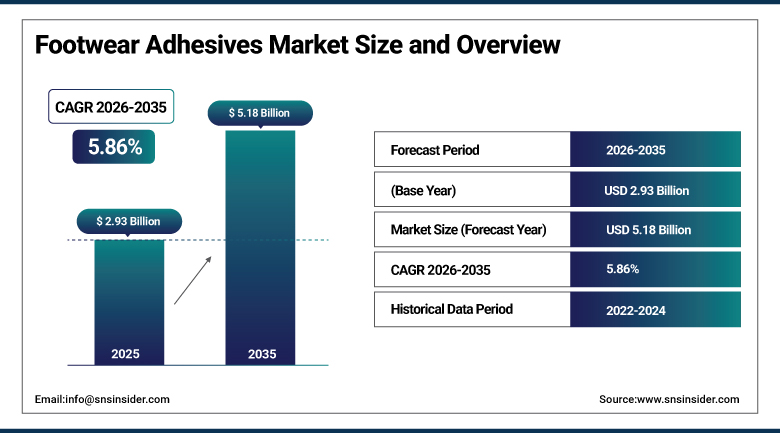
The Footwear Adhesives Market was valued at USD 2.93 Billion in 2025 and is expected to reach USD 5.18 Billion by 2035, growing at a CAGR of 5.86% from 2026-2035.
Footwear brands and their contract manufacturers are pushing bonding chemistry toward formulations that hold up across faster production lines without sacrificing the peel strength that athletic and safety footwear construction demands across every price tier. Solvent-based systems hold the largest adhesive-type share today because their fast initial tack still suits high-volume sole-to-upper assembly better than most alternatives, even as water-based chemistry grows fastest on tightening indoor air-quality rules worldwide. Asia Pacific holds 42.87% share in 2025 and is also the fastest-growing region, expanding at a CAGR near 7.02% from 2026 to 2035, as contract manufacturers across the region keep adding dedicated sole-to-upper assembly capacity.
⮞In February 2026, Henkel agreed to acquire Netherlands-based Stahl Group, a specialty coatings provider for flexible materials serving fashion and lifestyle brands, for EUR 2.1 billion (approximately USD 2.5 billion), with most of Stahl's revenue generated by water-based solutions. The deal, completed in October 2026, adds leather and synthetic-material coating capability to Henkel's Adhesive Technologies unit, which supplies footwear bonding systems.
To Get more information On Footwear Adhesives Market - Request Free Sample Report
Footwear Adhesives Market Trends
-
Contract manufacturers in Asia Pacific continue adding sole-to-upper assembly capacity rather than relying on existing plant footprints.
-
Water-based and bio-based adhesive chemistries are gaining share as regulators tighten indoor air-quality and solvent-exposure rules.
-
Material suppliers are introducing lighter synthetic midsole and outsole substrates that require reformulated bonding systems to match.
-
Some premium brands are experimenting with cord-based and mechanical-fastening construction that reduces reliance on wet adhesives entirely.
-
Adhesive makers are expanding joint development partnerships with footwear brands rather than selling standardized formulations alone.
U.S. Footwear Adhesives Market Outlook
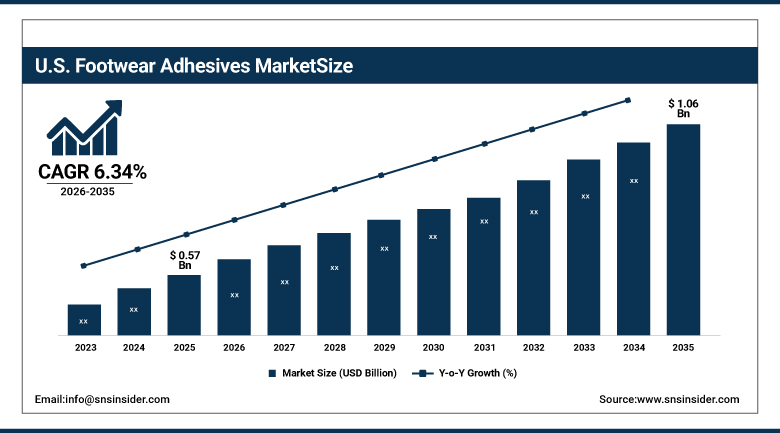
The U.S. Footwear Adhesives Market was valued at USD 0.57 Billion in 2025 and is expected to reach USD 1.06 Billion by 2035, growing at a CAGR of 6.34% from 2026-2035.
The U.S. Footwear Adhesives Market benefits from a renewed push toward U.S.-based athletic-footwear production that keeps a meaningful share of sole-to-upper and lamination bonding work inside the country rather than entirely offshore. Brands expanding U.S.-based manufacturing lines are prioritizing adhesive suppliers that can support rapid changeovers between running, lifestyle, and safety-footwear product lines on the same assembly floor. Regulatory pressure on solvent emissions is simultaneously accelerating adoption of water-based and hot-melt systems at newly opened or expanded U.S. facilities, even as some legacy lines continue running solvent-based formulations. That combination of reshored capacity and tightening emissions rules keeps adhesive suppliers closely engaged with U.S. footwear manufacturers' changing production requirements nationwide.
⮞In September 2025, New Balance opened a USD 65 million, 120,000-square-foot expansion at its Skowhegan, Maine factory, consolidating production from its closed Norridgewock plant onto eight lines capable of roughly one million pairs annually.
Footwear Adhesives Market Segment Analysis
-
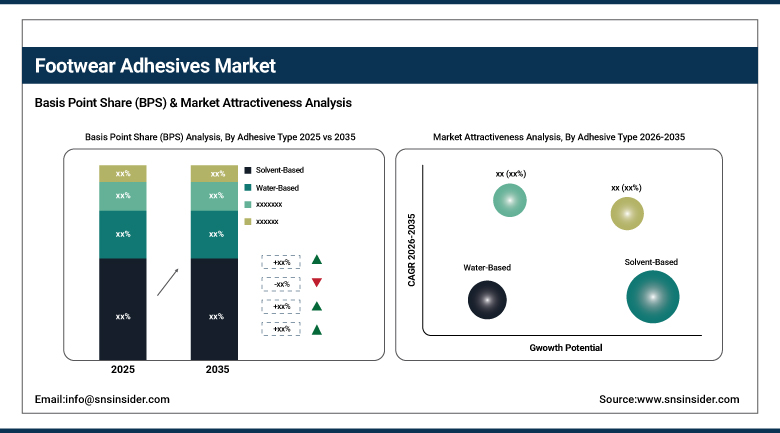
By Adhesive Type, the Solvent-Based segment dominated the Footwear Adhesives Market with approximately 41.82% share in 2025, while the Water-Based segment is the fastest growing with a CAGR of approximately 6.94%.
-
By Material and Substrate, the Leather segment dominated the Footwear Adhesives Market with approximately 33.76% share in 2025, while the Synthetic Materials segment is the fastest growing with a CAGR of approximately 6.78%.
-
By Application, the Sole-to-Upper Assembly segment dominated the Footwear Adhesives Market with approximately 46.12% share in 2025, while the same segment is also the fastest growing with a CAGR of approximately 6.85%.
-
By Footwear End-Use, the Casual and Lifestyle Footwear segment dominated the Footwear Adhesives Market with approximately 44.31% share in 2025, while the Athletic and Sports Footwear segment is the fastest growing with a CAGR of approximately 7.15%
By Adhesive Type, Solvent-Based Dominates the Footwear Adhesives Market and Water-Based Grows Fastest
Solvent-based adhesive holds the largest type share because its fast initial tack and strong bond on leather and rubber substrates still outperform most alternatives on high-speed sole-to-upper assembly lines. Contract manufacturers in established production hubs favor solvent-based formulations because operators already know their application windows and curing behavior across varied daily production runs. Suppliers continue refining solvent-based chemistry specifically to extend open time without slowing line speeds that high-volume athletic and casual footwear plants depend on to meet delivery schedules. That combination of bond strength and operator familiarity keeps solvent-based adhesive the dominant type category across footwear assembly operations worldwide today.
Water-based adhesive is growing fastest as regulators in major manufacturing countries tighten indoor air-quality and volatile-organic-compound exposure limits inside footwear assembly facilities. Brands increasingly specify water-based bonding systems for new production lines specifically to reduce worker exposure and simplify compliance across facilities operating under varied national solvent regulations. Suppliers are investing in water-based formulations that close the bond-strength gap with solvent-based systems without requiring manufacturers to slow existing assembly-line speeds. As compliance pressure continues steadily pushing more production toward lower-solvent chemistry worldwide, water-based adhesive is expected to keep growing noticeably faster than the broader type category through most of 2035.
⮞In June 2025, Nan Pao Resins Chemical Group, a leading Taiwanese footwear adhesive maker, said it was transitioning its product line from conventional solvent-based adhesives to water-based products as part of its sustainability efforts. The shift by a major supplier to contract shoe factories in Asia supports wider use of water-based bonding on high-volume lines.
By Material and Substrate, Leather Dominates the Footwear Adhesives Market and Synthetic Materials Grows Fastest
Leather holds the largest substrate share because formal, work-safety, and premium-casual footwear categories continue relying on leather uppers that require specialized bonding chemistry suited to its porous, variable surface. Adhesive suppliers maintain dedicated leather-bonding product lines because tanning methods and finishing treatments vary enough between individual tanneries and suppliers to meaningfully affect how any single formulation performs in practice. Premium and work-safety footwear brands prioritize leather-specific adhesive performance because any bond failure on higher-priced product carries disproportionate warranty and reputational cost. That combination of category durability and formulation specialization keeps leather the dominant substrate category across footwear adhesives worldwide today.
Synthetic materials are growing fastest as athletic and performance footwear brands increasingly specify lightweight foam, mesh, and thermoplastic substrates that traditional leather-bonding formulations were never designed to hold. Material suppliers are introducing new foam and thermoplastic substrates faster than adhesive makers can fully validate every combination, pushing bonding partners into closer joint-development arrangements. Brands favor synthetic substrates because they cut shoe weight meaningfully compared with leather while still meeting the durability standards performance footwear buyers expect. As lightweight synthetic substrates continue displacing leather across more performance footwear lines, this segment is expected to keep growing faster than the broader substrate category through 2035.
⮞In April 2026, Dongsung Chemical, a Korean supplier of shoe adhesives and polyurethane footwear materials, said its Floathane material had been applied to the midsoles of K2 running shoes and that it planned to accelerate partnerships with domestic and global footwear brands. Suppliers that make both synthetic midsole materials and adhesives can validate bonding performance on new substrates earlier in development.
By Application, Sole-to-Upper Assembly Dominates and Also Grows Fastest in the Footwear Adhesives Market
Sole-to-upper assembly holds the largest application share because every finished shoe requires this bond, making it the highest-volume application across every footwear category regardless of price point or construction method. Manufacturers prioritize sole-to-upper adhesive performance above other bonding steps because this joint carries the greatest structural load and sees the most repeated flex stress throughout a shoe's working life. Suppliers dedicate the largest share of footwear-specific product development resources to sole-to-upper formulations because even small performance gains translate into meaningful volume across every production run. That combination of universal need and structural importance keeps sole-to-upper assembly the dominant application category across footwear adhesives today.
Sole-to-upper assembly is also growing fastest as rising global footwear output and new lightweight sole constructions both add incremental bonding volume that other application categories are not capturing at the same pace. Contract manufacturers expanding assembly capacity are specifying newer, faster-curing sole-to-upper formulations specifically to keep pace with rising daily unit output across added production lines. Suppliers are prioritizing sole-to-upper research investment over insole and lamination bonding because this category alone determines whether new assembly lines can hit their targeted daily throughput. As global footwear output keeps rising alongside new lightweight sole construction, sole-to-upper assembly is expected to keep growing faster than the broader application category through 2035.
⮞In August 2025, Covestro acquired Pontacol AG, a Swiss manufacturer of multilayer adhesive films, adding dispersion and multilayer-film bonding technology to its existing footwear and leather-goods adhesive portfolio.
By Footwear End-Use, Casual and Lifestyle Footwear Dominates and Athletic and Sports Footwear Grows Fastest in the Footwear Adhesives Market
Casual and lifestyle footwear holds the largest end-use share because everyday walking, work, and leisure shoes represent the highest unit volume across virtually every regional footwear market globally. Adhesive formulators balance cost and bond performance differently for casual lines than for premium athletic product, since everyday footwear typically competes more on price than on specialized performance claims. Retailers continue expanding private-label casual and lifestyle footwear assortments that rely on standardized, cost-efficient bonding formulations rather than category-specific specialty adhesives. That combination of overall volume and price sensitivity keeps casual and lifestyle footwear the dominant end-use category across footwear adhesives worldwide today.
Athletic and sports footwear is growing fastest as performance brands keep launching new midsole, outsole, and upper constructions that each require their own validated bonding solution rather than a single shared formulation. Brands increasingly extend dedicated safety-footwear and work-boot lines built on athletic-style lightweight construction, further widening the range of substrates athletic-grade adhesives must reliably bond. Suppliers are prioritizing athletic and performance adhesive development specifically because new construction methods arrive here first before eventually filtering down into broader casual footwear lines. As performance brands keep introducing new construction methods across more product lines, athletic and sports footwear is expected to keep growing faster than the broader end-use category through 2035.
⮞In September 2026, Pidilite Industries entered a strategic partnership with South Korea-based Hwaseung Chemical to introduce footwear adhesive systems designed for high-volume manufacturing, including technologies used in sports footwear production, to the Indian market. The partnership brings adhesive formulations already used in international sports shoe production to India's growing athletic footwear base.
Regional Analysis
|
Region |
Major Country |
Share within Region, 2025 (%) |
|---|---|---|
|
North America |
United States |
80.47 |
|
Europe |
Germany |
23.84 |
|
Asia Pacific |
China |
39.62 |
|
Latin America |
Brazil |
45.73 |
|
Middle East and Africa |
Saudi Arabia |
28.91 |
Asia Pacific Footwear Adhesives Market Insights
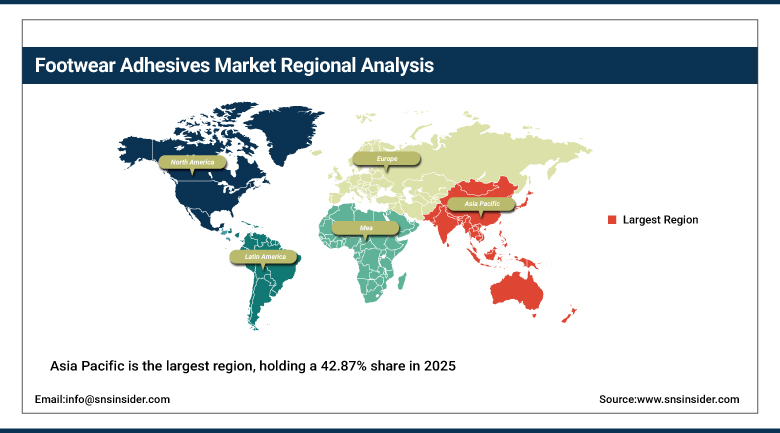
Asia Pacific is the largest region, holding a 42.87% share in 2025, a position built on the sheer concentration of contract footwear manufacturing capacity that global brands continue routing through the region. China supplies 39.62% of regional revenue, reflecting how a single manufacturing base continues anchoring regional sole-to-upper and lamination adhesive demand even as neighboring countries add capacity. India and Vietnam contribute additional regional demand through rapidly expanding contract-manufacturing footprints that global athletic and casual footwear brands continue directing new production toward. Local adhesive formulators across the region increasingly compete directly with established multinational suppliers for long-term contract-manufacturer accounts rather than ceding volume automatically.
Asia Pacific is also the fastest-growing region, projected to expand at a CAGR of 7.02% from 2026 to 2035, as brands continue directing new sole-to-upper assembly capacity toward the region rather than diversifying it elsewhere. Contract manufacturers across China, India, and Vietnam are simultaneously adding capacity and upgrading existing lines to handle newer lightweight synthetic substrates that require reformulated bonding systems. Regional governments are increasingly courting footwear joint ventures through incentive programs designed to attract additional contract-manufacturing investment. As brands keep directing new assembly capacity toward the region, Asia Pacific is expected to keep growing faster than every other region through the forecast period.
⮞In December 2025, Tex Year Group began mass production at its second Indian plant in the Mahad Industrial Area, Maharashtra, raising its total annual adhesive capacity in India from 3,400 tons to 10,000 tons, with a focus on hot melt, PUR and water-based adhesives. Local production of low-VOC adhesive grades shortens supply lead times for India's expanding manufacturing base.
Get Customized Report as per Your Business Requirement - Enquiry Now
North America Footwear Adhesives Market Insights
North America's footwear adhesives market is anchored by a renewed push toward U.S.-based athletic-footwear manufacturing that keeps a meaningful share of assembly work onshore despite higher labor costs than Asia Pacific. The United States supplies 80.47% of regional revenue, reflecting its concentration of both legacy and newly opened U.S. footwear assembly lines investing directly in bonding-equipment upgrades. Canada contributes additional regional demand through specialty and outdoor-footwear manufacturers that continue operating smaller local production runs alongside imported volume. Regulatory pressure on solvent emissions is simultaneously pushing newly opened or expanded facilities across the region toward water-based and hot-melt bonding systems faster than older plants typically convert.
Reshoring momentum tied to tariff uncertainty and brand marketing around U.S.-based manufacturing continues encouraging select athletic and work-footwear producers to add or expand North American assembly capacity. Adhesive suppliers serving newly opened U.S. lines are prioritizing formulations that support rapid changeovers between athletic, casual, and safety-footwear product lines on shared equipment. Labor availability constraints are simultaneously pushing manufacturers toward faster-curing adhesive systems that reduce manual handling time per unit on U.S. assembly lines. As reshoring momentum continues steadily alongside tightening solvent regulation, North America is expected to keep adding meaningful new bonding-equipment investment through most of the remaining forecast period ahead.
⮞In September 2025, the compliance date arrived for the U.S. Environmental Protection Agency's December 2024 rule prohibiting most industrial and commercial uses of trichloroethylene, although the agency issued an interim final rule that month extending deadlines for certain uses, and conditions on exempted uses were later postponed until the end of judicial review. The rule adds pressure on manufacturers still using chlorinated solvents in cleaning and bonding steps to adopt lower-solvent chemistry.
Europe Footwear Adhesives Market Insights
Europe's footwear adhesives market is shaped by strict chemical-safety regulation that continues pushing formulators toward lower-solvent chemistry faster than most other regions require. Germany supplies 23.84% of regional revenue, anchored by a concentration of specialty chemical suppliers serving both local footwear brands and export-oriented contract manufacturers across the wider European Union. Italy and Spain contribute additional regional demand through established premium and luxury leather-footwear manufacturing clusters that rely heavily on specialized, carefully formulated leather-bonding formulations. Regulators across the bloc continue tightening permitted solvent content in adhesives used across manufacturing facilities, steadily reshaping which specific formulations suppliers can continue offering regional customers.
European regulators are moving faster than most other regions to restrict specific solvents long used in footwear and other adhesive applications, forcing formulators to requalify products on a compressed timeline. Suppliers serving European customers are increasingly reformulating existing solvent-based products around newly restricted substances well ahead of required compliance deadlines. Smaller regional adhesive producers face a notably harder reformulation path than larger multinational suppliers that already maintain parallel water-based and hot-melt product lines ready elsewhere. As compliance deadlines continue approaching steadily, Europe's adhesive suppliers are expected to keep accelerating these lower-solvent product transitions through most of the forecast period still ahead.
⮞In June 2025, the European Union adopted Commission Regulation 2025/1090, restricting the solvents N,N-dimethylacetamide and 1-ethylpyrrolidin-2-one, both used in adhesive manufacturing, under its REACH chemicals framework effective later that same month.
MEA & Latin America Footwear Adhesives Market Insights
The Middle East and Africa region remains a smaller footwear adhesives market, with Saudi Arabia accounting for the largest regional share on the strength of its growing retail footwear and light-assembly base. South Africa has the region's most established footwear manufacturing sector, supported by the government's Retail-Clothing, Textile, Footwear and Leather Master Plan 2030, which aims to raise local sourcing by retailers. Ethiopia's leather industry and export-oriented shoe factories add smaller adhesive demand. Most countries still import finished footwear, so adhesive consumption depends on a limited number of local assembly plants, which suppliers often serve from distribution hubs in the United Arab Emirates.
Latin America's demand is concentrated in Brazil, which accounts for the largest regional share on the strength of its large footwear industry in Rio Grande do Sul and the Northeast, serving both local and export markets. Mexico adds demand through León, Guanajuato, its main footwear cluster, and through contract manufacturing for North American brands seeking shorter supply chains. Brazilian manufacturers use a high share of synthetic materials in casual and women's footwear, which supports demand for polyurethane and polychloroprene adhesives. Imports of low-cost Asian footwear remain the main pressure on local production and, in turn, on regional adhesive volumes.
⮞In May 2025, H.B. Fuller opened a new adhesive manufacturing facility in Ras Al Khaimah, United Arab Emirates, to serve customers across the Middle East and Africa. Local production shortens lead times and improves technical support for footwear and other assembly plants in the region that previously relied on imported adhesives.
Market Dynamics
Growth Drivers: New lightweight substrates and expanding contract-manufacturing capacity are lifting adhesive demand
Material suppliers are introducing new lightweight foam, thermoplastic, and composite substrates faster than adhesive formulators can fully validate bonding performance against each one, creating steady reformulation demand. Brands specifying these newer substrates increasingly require adhesive suppliers to participate directly in joint development rather than simply supplying a standardized formulation off a catalog. Contract manufacturers expanding assembly capacity across multiple regions are simultaneously specifying updated bonding systems rather than carrying forward older formulations onto brand-new production lines. Together these ongoing shifts are steadily widening adhesive suppliers' addressable opportunity across footwear categories that previously used a narrower range of standardized bonding chemistries.
A second important driver is the steady introduction of new performance outsole and midsole materials engineered specifically for traction, weight, or recyclability, each requiring its own validated bonding approach. Material developers are increasingly partnering directly with adhesive formulators during product development rather than finalizing a new substrate and only then searching for a compatible bonding solution. Footwear brands are responding by favoring adhesive suppliers that can demonstrate proven compatibility across the newest substrate chemistries entering the market. As new performance substrates continue arriving across more footwear categories, this driver is expected to keep broadening adhesive suppliers' development pipelines through most of the remaining forecast period.
⮞In March 2026, Nan Pao Resins Chemical said it planned to collaborate with international footwear brands to develop new adhesive materials and secure more orders, after weaker demand reduced revenue in its footwear adhesive segment. The plan reflects how adhesive makers are relying on joint development with brands to win business on new shoe constructions.
Restraints: Glue-free construction methods and tightening solvent regulation are slowing broader expansion
A small but growing number of premium footwear brands are experimenting with cord-based, mechanical-fastening, and modular assembly methods that eliminate wet adhesives from specific construction steps entirely. Brands pursuing these alternative construction methods frame them primarily as sustainability and disassembly features rather than cost-driven substitutes for conventional bonding. Adhesive suppliers may need to develop complementary bonding solutions for hybrid constructions to avoid losing volume in categories that remove wet adhesive steps. These experiments remain limited to premium and limited-edition product lines today, but they still signal a real long-term constraint on adhesive volume growth within specific footwear categories overall.
Tightening solvent-exposure and volatile-organic-compound regulation across major manufacturing countries simultaneously constrains broader category expansion, since formulators must requalify products faster than normal development cycles typically allow. Smaller regional adhesive producers face a harder compliance path than larger multinational suppliers that already maintain parallel lower-solvent product lines ready for faster market entry. Manufacturers switching to compliant formulations sometimes encounter noticeably slower line speeds or different curing behavior that requires retraining production staff before output returns to prior levels overall. Combined, these two factors remain the main restraints on market expansion.
⮞In February 2026, KEEN released the UNEEK 360, describing it as the brand's first solvent-free shoe, built using a cord and lace-lock toggle assembly system in place of traditional wet adhesives across its modular upper construction.
Opportunities: Bio-based chemistry and reshoring investment open new revenue paths
Bio-based and lower-carbon adhesive chemistry creates a meaningful opportunity for suppliers able to match conventional bond performance while meeting brands' published sustainability commitments on finished footwear. Suppliers that secure early qualification for bio-based formulations with major athletic and lifestyle brands are positioned to build switching costs that competitors entering later will find harder to overcome. Formulators are expanding bio-based raw-material sourcing specifically to serve brands that have already committed to published carbon-reduction targets covering their finished footwear supply chains. Suppliers that can document lower product carbon footprints for their adhesives are best placed to win specifications, as brands increasingly request this data when selecting materials.
A second opportunity lies in supporting reshoring and nearshoring investment as brands diversify footwear manufacturing capacity away from concentrated single-country sourcing following recent tariff and trade disruption. Suppliers with established technical-service capability in new manufacturing regions are positioned to capture share as brands qualify additional contract manufacturers outside their traditional sourcing base. Adhesive makers offering joint-development support alongside standardized formulations are increasingly favored by brands opening new assembly lines that need rapid line qualification. Companies that combine strong technical-service capability with multi-region manufacturing presence are positioned to capture a growing share of diversification-driven adhesive demand over the forecast period.
⮞In July 2025, Bostik launched Born2Bond Ultra K85, an instant cyanoacrylate adhesive formulated with 60% bio-based raw materials, extending its Born2Bond engineering adhesives range. The launch shows bio-based content reaching fast-curing adhesive grades that can be used for small-part bonding in footwear and accessories.
Recent Developments:
-
In October 2026, Henkel completed its acquisition of Stahl Group, which now operates as part of its Adhesive Technologies business unit.
-
In October 2026, Dongsung Chemical and CJ Biomaterials introduced ECOVIVA Hotmelt Adhesive, a PHA-based hot melt adhesive, in the United States.
-
In September 2026, Pidilite Industries said its partnership with Hwaseung Chemical would pair Hwaseung's adhesive formulations with Pidilite's local technical service for Indian footwear manufacturers.
Footwear Adhesives Market Key Players
-
Henkel AG & Co. KGaA
-
H.B. Fuller Company
-
Bostik SA (Arkema Group)
-
Nan Pao Resins Chemical Co., Ltd.
-
Pidilite Industries Limited
-
Sika AG
-
Hwaseung Chemical Co., Ltd.
-
HWA PAO Resins Co., Ltd.
-
Great Eastern Resins Industrial Co., Ltd.
Footwear Adhesives Market Report Scope:
| Report Attributes | Details |
|---|---|
| Market Size in 2025 | USD 2.93 Billion |
| Market Size by 2035 | USD 5.18 Billion |
| CAGR | CAGR of 5.86% From 2026 to 2035 |
| Base Year | 2025 |
| Forecast Period | 2026-2035 |
| Historical Data | 2022-2024 |
| Report Scope & Coverage | Market Size, Segments Analysis, Competitive Landscape, Regional Analysis, DROC & SWOT Analysis, Forecast Outlook |
| Key Segments | • By Adhesive Type (Solvent-Based, Water-Based, Hot Melt & Reactive) • By Material and Substrate (Leather, Rubber, Synthetic Materials & Others) • By Application (Sole-to-Upper Assembly, Insole and Sockliner Bonding & Upper Lamination and Stitching Support) • By Footwear End-Use (Athletic and Sports Footwear, Casual and Lifestyle Footwear & Formal and Industrial Footwear) |
| Regional Analysis/Coverage | North America (US, Canada), Europe (Germany, UK, France, Italy, Spain, Russia, Poland, Rest of Europe), Asia Pacific (China, India, Japan, South Korea, Australia, ASEAN Countries, Rest of Asia Pacific), Middle East & Africa (UAE, Saudi Arabia, Qatar, South Africa, Rest of Middle East & Africa), Latin America (Brazil, Argentina, Mexico, Colombia, Rest of Latin America). |
| Company Profiles | Henkel AG & Co. KGaA, H.B. Fuller Company, Bostik SA (Arkema Group), Nan Pao Resins Chemical Co., Ltd., Pidilite Industries Limited, Sika AG, Hwaseung Chemical Co., Ltd., HWA PAO Resins Co., Ltd., Great Eastern Resins Industrial Co., Ltd. |

Frequently Asked Questions
The market includes Henkel, H.B. Fuller, Bostik, Jowat, Nan Pao Resins, Pidilite Industries, Dongsung Chemical, Sika, 3M, Tex Year Industries, Hwaseung Chemical, HWA PAO Resins, Great Eastern Resins Industrial and Tavorn Chemical Industries, among others.
The main opportunities lie in bio-based and lower-carbon adhesive chemistry that matches conventional bond performance, and in supporting brands' reshoring and nearshoring investment as manufacturing diversifies beyond concentrated single-country sourcing.
The key growth factor is the steady introduction of new lightweight substrates and performance outsole and midsole materials that each require freshly validated, suppliers-developed bonding solutions.
By adhesive type, the Solvent-Based segment dominated the market with approximately 41.82% share in 2025, supported by its fast tack and strong bond on leather and rubber substrates.
Asia Pacific dominated the market with approximately 42.87% share in 2025 and is also the fastest-growing region, with a projected CAGR of approximately 7.02% from 2026 to 2035.
