
Gesture Recognition Market Report Scope & Overview:
The Gesture Recognition market is witnessing rapid growth owing to the growing need for intuitive and touch-free Human Computer Interaction across consumer electronics, automotive, healthcare, and smart home sectors around the globe. Moreover, the growth can be attributed to the rising use of AI, computer vision, machine learning, and sensors coupled with the growing trend towards contactless interaction. The gesture recognition technology enables users to interact with devices through hand and body movements without any physical contact. The increasing use of smart devices, connected cars, AR/VR, and IoT is further driving the process.
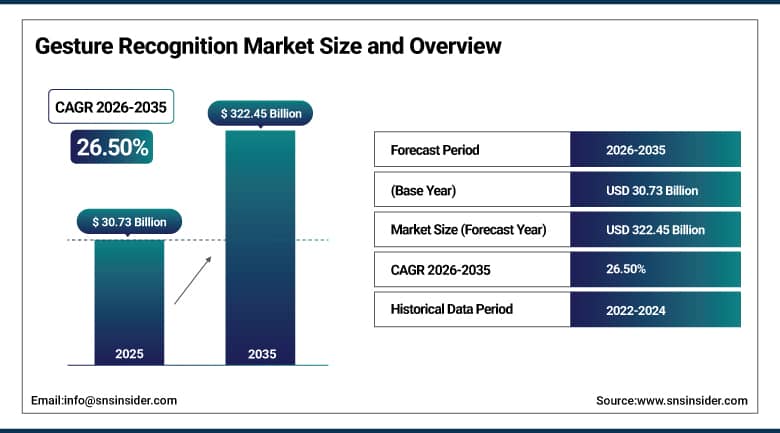
The Gesture Recognition Market was valued at USD 30.73 Billion in 2025 and is expected to reach USD 322.45 Billion by 2035, growing at a CAGR of 26.50% from 2026 to 2035.
In 2025, gesture recognition became integral to touchless interaction across industries, with 70% of smart devices and automotive systems adopting the technology, while AI-enhanced 3D sensing improved real-time accuracy, driving wider use in healthcare and industrial settings.
To Get More Information On Gesture Recognition Market - Request Free Sample Report
Gesture Recognition Market Trends
-
Rising adoption of touchless and human-machine interfaces is spreading across consumer electronics, automotive, healthcare, and gaming sectors alike.
-
Increasing demand for enhanced user experience, safety, and accessibility is accelerating deployment in smart devices, AR/VR systems, and vehicle infotainment platforms.
-
Advances in AI, machine learning, and 3D sensing technology keep improving gesture recognition accuracy and reliability across every application category.
-
Growing use in medical diagnostics and industrial automation is expanding the technology's footprint well beyond its consumer electronics origins.
-
Smart home and wearable device makers are increasingly integrating gesture recognition to enable seamless, genuinely touchless control across IoT ecosystems.
Key Market Highlights
|
Market Parameter |
Market Highlight / Data |
Key Growth Driver |
|---|---|---|
|
Largest Component |
Software – 45% share in 2025 |
Growing demand for sophisticated algorithms, AI models, and machine learning platforms. |
|
Fastest-Growing Component |
Services – Fastest growing segment |
Growing need for customized and integrated services related to gesture recognition technology. |
|
Largest Technology |
Vision-Based Systems – 38% share in 2025 |
Potential in providing accurate, natural, and contact-free interaction via cameras. |
|
Fastest-Growing Technology |
Touchless Gesture Recognition – Fastest growing segment |
Rising demand for hygienic, intuitive, and contact-free user interaction systems. |
|
Largest Application |
Consumer Electronics – 34% share in 2025 |
Increased use of gesture control systems in smartphones, smart TVs, and wearables. |
|
Fastest-Growing Application |
Smart Home & IoT – Fastest growing segment |
Increasing adoption of devices providing intelligent and hands-free control at home. |
|
Largest End User |
Individuals – 51% share in 2025 |
Largest user group of gesture-driven gadgets like smartphones and gaming consoles. |
|
Fastest-Growing End User |
Industrial Users – Fastest growing segment |
Increasing adoption in manufacturing, robotics, healthcare, logistics, and automation. |
|
Largest Region |
North America – 31.58% share in 2025 |
Early adoption of cutting-edge human-machine interface technology and leading companies. |
|
Fastest-Growing Region |
Asia Pacific – 28.00% CAGR |
Increased production of consumer electronics and adoption of smartphones and wearables. |
U.S. Gesture Recognition Market Outlook
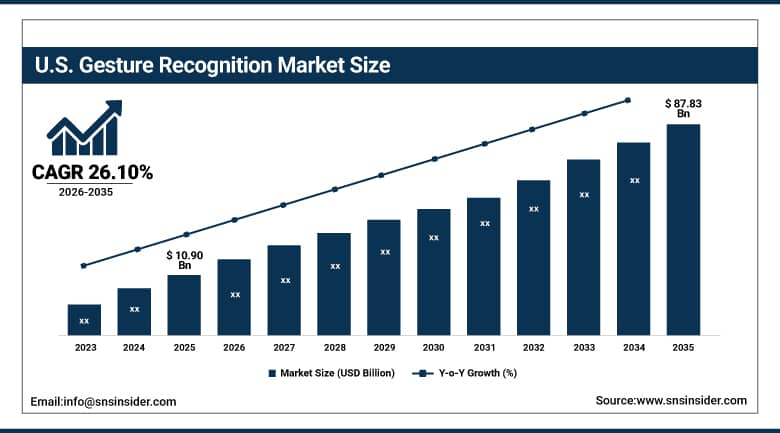
The U.S. Gesture Recognition Market was valued at approximately USD 10.90 Billion in 2026 and is expected to reach approximately USD 87.83 Billion by 2035, growing at a CAGR of approximately 26.10%.
Growth in the U.S. market is being driven by increasing adoption of touchless interfaces across consumer electronics, automotive, healthcare, and gaming sectors alike. Advancements in AI, machine learning, and 3D sensing technology, paired with rising demand for enhanced user experiences and safety, keep accelerating market expansion across American technology, automotive, and healthcare companies. Rising adoption of touchless interfaces across consumer electronics, automotive, and industrial applications is driving strong demand for gesture recognition technology nationwide, and the increasing need for hygienic, intuitive, and genuinely user-friendly interfaces has accelerated adoption across multiple industries, from smartphones and tablets integrating gesture-based controls to automotive manufacturers building gesture-controlled infotainment systems.
Apple launched the Apple Vision Pro in 2024, its spatial computing headset featuring advanced hand and eye gesture recognition as the primary input method, requiring no physical controllers whatsoever, a move that's meaningfully raised consumer expectations for what gesture-based interaction can deliver.
Gesture Recognition Market Segment Analysis
-
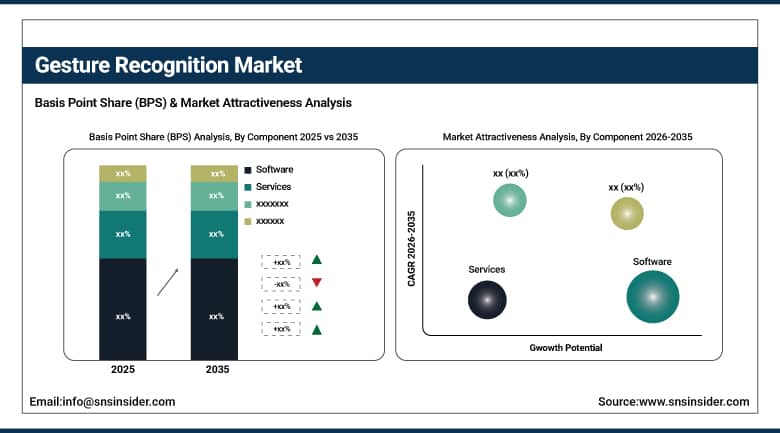
By Component, Software segment dominated the Gesture Recognition Market in 2025 with 45% share; Services segment is the fastest growing segment.
-
By Technology, Vision-Based Systems segment dominated the market in 2025 with 38% share; Touchless Gesture Recognition segment is the fastest growing segment.
-
By Application, Consumer Electronics segment dominated the market in 2025 with 34% share; Smart Home & IoT segment is the fastest growing segment.
-
By End User, Individuals segment dominated the market in 2025 with 51% share; Industrial Users segment is the fastest growing segment.
By Component, Software segment dominates the Gesture Recognition Market, Services segment expected to grow fastest
The Software segment dominated the Gesture Recognition Market in 2025 owing to growing demand for sophisticated algorithms, AI models, and machine learning platforms that allow for accurate gesture detection and analysis. Software is a vital segment offering various capabilities including motion detection and recognition and real-time processing on different devices and applications. The integration of gesture recognition technology in smartphones, automotive solutions, gaming consoles, and smart devices has greatly boosted the popularity of software and made it a leading component segment.
The Services segment is the fastest-growing due to growing need for customized and integrated services related to gesture recognition technology. Enterprises require specific services in order to implement and optimize gesture recognition solutions in various applications. Advancements in AI-powered interface, connected devices, and enterprise automation have boosted the need for professional services. Moreover, constant developments in hardware-software integration have spurred enterprises to spend on implementing and supporting services.
By Technology, Vision-Based Systems segment dominates the Gesture Recognition Market, Touchless Gesture Recognition segment expected to grow fastest
The Vision-Based Systems segment dominated the Gesture Recognition Market in 2025 owing to the potential of these systems in providing accurate, natural, and contact-free interaction via cameras and image processing technologies. These systems are increasingly used in consumer electronics, automotive interfaces, health care applications, and interactive displays. Development in the field of computer vision, artificial intelligence, and deep learning algorithms has contributed towards improved gesture detection accuracy and increased use of vision-based gesture recognition solutions.
The Touchless Gesture Recognition segment is the fastest-growing due to rapidly growing segments owing to rising demand for hygienic, intuitive, and contact-free user interaction systems. The increasing application in the health care industry, smart home, automotive, and public interfaces is further fueling the growth in the market. Developments in the field of sensors, AI-powered motion tracking, and 3D sensing technology are contributing towards improving the accuracy of gesture detection and responsiveness of touchless gesture technologies.
By Application, Consumer Electronics segment dominates the Gesture Recognition Market, Smart Home & IoT segment expected to grow fastest
The Consumer Electronics segment dominated the Gesture Recognition Market in 2025 owing to increased use of gesture control systems in smart phones, smart TVs, gaming consoles, and wearables. Users want to have more intuitive and convenient ways of interacting with their devices, which improves usability and user experience. With the advent of artificial intelligence, high-sensor technology, and immersive systems being used by consumers' electronic devices, the need for gesture recognition functions is growing, making it the biggest application segment across the globe.
The Smart Home & IoT segment is the fastest-growing due to increasing adoption of devices that provide an intelligent and hands-free way of controlling the environment at home. The gesture recognition technology has made the process of user interaction with smart lighting, smart security, smart appliances, and smart entertainment more comfortable. The investment in IoT ecosystem, AI-enabled home automation and voice + gesture interface is growing demand.
By End User, Individuals segment dominates the Gesture Recognition Market, Industrial Users segment expected to grow fastest
The Individuals segment dominated the Gesture Recognition Market in 2025 because individual consumers form the largest user group of gesture-driven gadgets like smartphones, gaming consoles, smart TVs, and wearables. Growing demand for interactive and engaging digital experience, better accessibility, and easy control of device has driven the usage among individuals. Ongoing developments in consumer electronics and increased use of AI-driven interfaces have helped sustain the dominant position of individual users in the gesture recognition market.
The Industrial Users segment is the fastest-growing due to the increasing adoption of gesture recognition technology in manufacturing, robotics, health care, logistics, and automation of workplaces. Industrial sector has started adopting touchless interface for improved efficiency and safety in operations, along with reduced human intervention with machines. Deployment of smart factories and collaborative robots and AI-driven industrial systems has increased the adoption of gesture recognition.
Regional Analysis
|
Region |
Major Country |
Share within Region, 2025 (%) |
|---|---|---|
|
North America |
United States |
80.85% |
|
Europe |
Germany |
24.30% |
|
Asia Pacific |
China |
32.65% |
|
Middle East & Africa |
UAE |
26.50% |
|
Latin America |
Brazil |
37.00% |
North America Gesture Recognition Market Insights
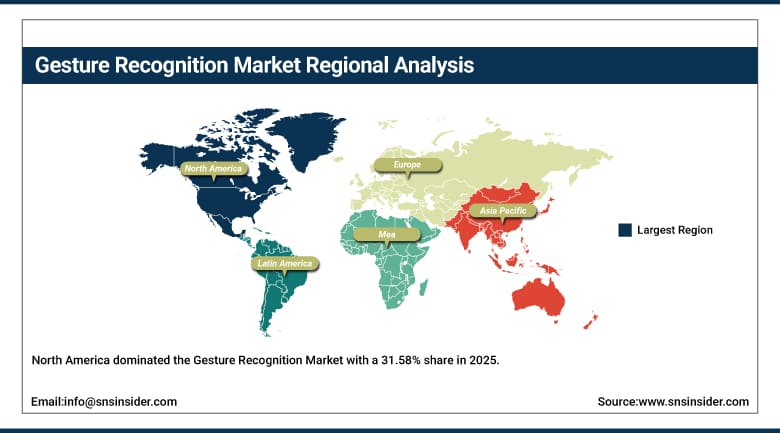
North America dominated the Gesture Recognition Market with a 31.58% share in 2025, due to early adoption of cutting-edge human-machine interface technology, high presence of leading companies in technology industry, and integration in consumer electronics, automotive and healthcare applications. The region is home to several leading technology companies which are engaged in the development of spatial computing and AI-based interface technology. Thus, North America continues to be the leader in almost all application categories.
The United States accounts for roughly 80.85% of regional revenue, growing usage of touchless interfaces in consumer electronics, automotive, healthcare and gaming industries, along with improvements in AI, machine learning and 3D sensing technologies. In addition to this, the presence of Canada in the region will add to the regional market demand as this country's technology and automotive industry has adopted gesture interface technology.
Get Customized Report as Per Your Business Requirement - Enquiry Now
Europe Gesture Recognition Market Insights
Europe occupies a significant share in the global gesture recognition market, driven by increasing use in automotive infotainment, consumer electronics, and healthcare applications in the leading economies in the region. Increasing usage of smart devices along with growing demand for touchless interfaces because of hygiene concerns and ongoing innovation in AI and sensor technologies are continuing to drive adoption in Europe.
Germany is the highest demand region, accounting for about 24.30% of European revenues because of its robust automotive industry and increasing use of gesture recognition technology in automotive infotainment systems and advanced driver assistance systems. UK and France are other regions driving demand in the region, and ongoing innovation in AI and sensors is expected to keep demand growing in Europe.
Asia Pacific Gesture Recognition Market Insights
Asia Pacific is expected to grow at the fastest CAGR of about 28.00% through 2035, propelled by increased production of consumer electronics, adoption of smartphones and wearables, and automotive applications in the region's biggest markets, the dominance of the region in global consumer electronics manufacturing provides it with a uniquely positive base on which to adopt gesture recognition due to the ongoing innovations in hardware that are occurring in the region itself.
The leader among all countries within the region, with its 32.65% share of regional revenue, is China, owing to its massive production of consumer electronics as well as a booming smartphone and wearable devices market in the country. With Japan, South Korea, and India making up for further demand, the Asia Pacific region's prospects look brighter than those of any other region considered in this study.
MEA & Latin America Gesture Recognition Market Insights
The Middle East & Africa and Latin America are both showing steady growth in gesture recognition adoption, owing to growing smart city implementations, increased penetration of smartphones and wearable devices, and enterprise interests in touchless technologies. With ongoing digital transformation in these regions, gesture recognition technologies are becoming an increasingly common element of consumer electronics and automotive applications launched in these regions.
The leading market in terms of gesture recognition technology demand in Middle East & Africa is the UAE market, which accounts for around 26.50% of the regional revenue due to the smart city implementation of the UAE, as well as its investments in human-machine interfaces. Demand for gesture recognition technologies in Middle East & Africa is fueled further by the presence of Saudi Arabia and South Africa, with their digital transformations. In Latin America, the biggest regional market in terms of revenue is Brazil, accounting for around 37.00%.
Market Dynamics
Growth Drivers: Rising demand for touchless interfaces and AI-enhanced sensing
Rising adoption of touchless and human-machine interfaces across consumer electronics, automotive, healthcare, and gaming sectors sits at the core of this market's exceptionally rapid growth. Increasing demand for enhanced user experience, safety, and accessibility keeps accelerating deployment in smart devices, AR/VR systems, and infotainment platforms, and advances in AI, machine learning, and 3D sensing technology continue improving accuracy and reliability in ways that make gesture-based interaction genuinely practical for everyday use rather than a novelty feature.
Growing use in medical diagnostics, industrial automation, and smart homes is further supporting sustained market expansion, as organizations across an increasingly wide range of industries discover practical applications for touchless, gesture-based control. In 2025, 60% of smart home and wearable device makers integrated gesture recognition, enabling seamless, touchless control and boosting user satisfaction by 35%, a clear signal of how quickly the technology has moved from experimental feature to genuine competitive differentiator across consumer product categories.
Restraints: Accuracy limitations and high development costs
Gesture recognition systems still face genuine accuracy challenges in complex or low-light environments, where sensor limitations can produce false positives or missed gestures that undermine user confidence in the technology. These reliability issues tend to be particularly pronounced in lower-cost hardware configurations, which creates a real trade-off between affordability and the consistent accuracy that keeps users actually relying on gesture control rather than falling back to traditional input methods.
The cost of developing genuinely sophisticated gesture recognition systems, particularly those combining multiple sensor types with AI-driven interpretation, remains a real barrier for smaller manufacturers and startups trying to compete against well-resourced incumbents. Building and continuously refining the machine learning models that power accurate gesture interpretation requires substantial ongoing investment in both data collection and computational resources, and that cost burden tends to concentrate innovation among larger, better-capitalized technology companies.
Opportunities: Expanding healthcare and industrial automation applications
Growing use in medical diagnostics represents a genuinely significant opportunity for gesture recognition vendors, as touchless, gesture-based control lets clinicians interact with medical imaging and diagnostic equipment without breaking sterile field protocols. That practical benefit, sterile, contamination-free device control in operating rooms and clinical settings, is opening up meaningful new healthcare applications well beyond the technology's consumer electronics origins.
Industrial automation represents a second substantial opportunity, as manufacturers increasingly look to gesture-based control for hands-free equipment operation in environments where workers' hands are often occupied or gloved. As Industry 4.0 initiatives keep pushing manufacturers toward more automated, sensor-driven operations, vendors offering rugged, reliable gesture recognition systems built specifically for industrial environments stand to capture meaningful new demand well beyond the technology's traditional consumer and automotive strongholds.
Recent Developments:
-
2024: Apple launched the Apple Vision Pro, its spatial computing headset featuring advanced hand and eye gesture recognition as the primary input method, requiring no physical controllers.
-
2025: Microsoft introduced Windows Gesture Studio, a developer platform enabling touchless gesture control across Windows 11, Copilot+ PCs, and Mixed Reality headsets using built-in front-facing cameras, requiring no depth sensor.
Gesture Recognition Market key players are:
-
Apple Inc.
-
Microsoft Corporation
-
Google LLC
-
Samsung Electronics Co., Ltd.
-
Sony Corporation
-
Qualcomm Incorporated
-
Intel Corporation
-
NVIDIA Corporation
-
Meta Platforms Inc.
-
Cognitec Systems GmbH
-
Elliptic Labs ASA
-
Leap Motion Inc.
-
GestureTek Inc.
-
Ultraleap Ltd.
-
Thalmic Labs Inc.
-
Microchip Technology Inc.
-
Synaptics Incorporated
-
Infineon Technologies AG
-
Texas Instruments Incorporated
-
Omron Corporation
Gesture Recognition Market Report Scope:
| Report Attributes | Details |
|---|---|
| Market Size in 2025 | USD 30.73 Billion |
| Market Size by 2035 | USD 322.45 Billion |
| CAGR | CAGR of 26.50% From 2026 to 2035 |
| Base Year | 2025 |
| Forecast Period | 2026-2035 |
| Historical Data | 2022-2024 |
| Report Scope & Coverage | Market Size, Segments Analysis, Competitive Landscape, Regional Analysis, DROC & SWOT Analysis, Forecast Outlook |
| Key Segments | • By Component (Hardware, Software, Services) • By Technology (Touch-Based Gesture Recognition, Touchless Gesture Recognition, Vision-Based Systems, Infrared & Ultrasonic Systems) • By Application (Consumer Electronics, Automotive, Healthcare, Gaming & Entertainment, Smart Home & IoT) • By End User (Individuals, Enterprises, Industrial Users, Healthcare Providers) |
| Regional Analysis/Coverage | North America (US, Canada), Europe (Germany, UK, France, Italy, Spain, Russia, Poland, Rest of Europe), Asia Pacific (China, India, Japan, South Korea, Australia, ASEAN Countries, Rest of Asia Pacific), Middle East & Africa (UAE, Saudi Arabia, Qatar, South Africa, Rest of Middle East & Africa), Latin America (Brazil, Argentina, Mexico, Colombia, Rest of Latin America). |
| Company Profiles | Apple Inc., Microsoft Corporation, Google LLC, Samsung Electronics Co., Ltd., Sony Corporation, Qualcomm Incorporated, Intel Corporation, NVIDIA Corporation, Meta Platforms Inc., Cognitec Systems GmbH, Elliptic Labs ASA, Leap Motion Inc., GestureTek Inc., Ultraleap Ltd., Thalmic Labs Inc., Microchip Technology Inc., Synaptics Incorporated, Infineon Technologies AG, Texas Instruments Incorporated, Omron Corporation |
Frequently Asked Questions
The Gesture Recognition Market is expected to grow at a CAGR of 26.50% from 2026 to 2035.
The Gesture Recognition Market was valued at USD 30.73 Billion in 2025.
The major growth factor is rising adoption of touchless and human-machine interfaces across consumer electronics, automotive, healthcare, and gaming sectors.
The Software segment dominated the Gesture Recognition Market in 2025.
North America dominated the Gesture Recognition Market in 2025 with a 31.58% share of total global market revenue.
