
Green Airport Market Size & Trends:
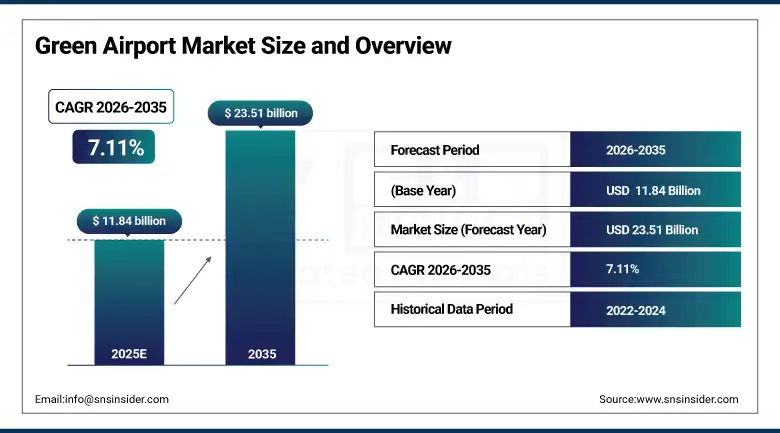
The Green Airport Market size was valued at USD 11.84 Billion in 2025 and is projected to reach USD 23.51 Billion by 2035, growing at a CAGR of 7.11% during 2026–2035.
The market is gaining pace as the airports worldwide are moving from conventional infrastructure to more sustainable and energy-efficient infrastructure. With the growing need to reduce carbon emissions and comply with global climate change goals, airports worldwide are actively investing in solar panel systems, green terminal buildings, electric ground handling vehicles, and sustainable aviation fuel infrastructure. Apart from meeting the regulatory requirements, sustainability is becoming a key focus area for airports to improve their brand reputation and efficiency. Energy-efficient systems, water management solutions, and waste reduction initiatives are being incorporated into new airport developments and upgrade projects.
To Get More Information On Green Airport Market - Request Free Sample Report
Key Trends in the Green Airport Market:
-
Growing commitment among airport authorities to achieve carbon-neutral and net-zero emission targets.
-
Rising installation of on-site renewable energy systems such as rooftop and ground-mounted solar plants.
-
Increasing transition to electric ground support equipment (e-GSE) to reduce airside emissions and fuel costs.
-
Stronger focus on green terminal design incorporating natural lighting, energy-efficient HVAC systems, and sustainable construction materials.
-
Expansion of sustainable aviation fuel (SAF) storage and refueling infrastructure at major international hubs.
-
Greater adoption of smart energy management platforms to monitor, optimize, and lower operational energy consumption.
-
Collaborations between airports, airlines, and clean energy providers to accelerate sustainability roadmaps.
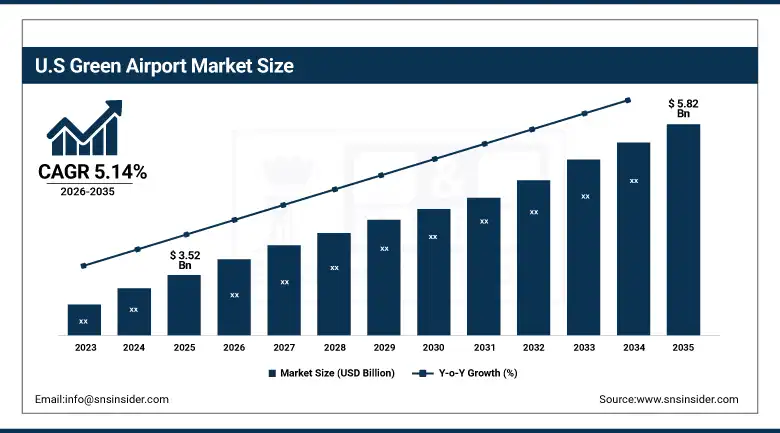
The U.S. Green Airport Market size was valued at USD 3.52 Billion in 2025 and is projected to reach USD 5.82 Billion by 2035, growing at a CAGR of 5.14%. Growth is being supported by federal sustainability initiatives, modernization of aging airport infrastructure, and increased investment in renewable energy, electrification of ground fleets, and energy-efficient terminal upgrades across major aviation hubs.
Green Airport Market Drivers:
-
Increasing Global Carbon Neutrality Commitments and Aviation Sustainability Targets
The increasing international emphasis on carbon neutrality and aviation sustainability is a key driving force behind the Green Airport Market. With governments and international aviation organizations increasingly enforcing stricter policies on carbon emissions, airports are being forced to make their operations more environmentally friendly. This is further being fueled by the increasing awareness of passengers about environmental responsibility, which is forcing airports to make their sustainability profile better. The financial benefits of green initiatives, green funding schemes, and carbon accreditation schemes are further propelling the modernization of infrastructure. As a result, airports are shifting from traditional energy-intensive operations to environmentally optimized operations, which is directly contributing to the growth of green airport technologies and sustainable development projects around the world.
Green Airport Market Restraints:
-
High Capital Investment Requirements and Long Payback Periods for Sustainable Infrastructure Projects
High initial capital outlay is a significant hindering factor for the Green Airport Market. The execution of renewable energy solutions, electric ground transportation, HVAC system upgrades, and terminal design modifications to align with green building standards is a capital-intensive process. Most airports, especially in developing countries, may have budget limitations and other pressing infrastructure development needs, making it difficult to pursue large-scale green initiatives. Moreover, the payback period for green infrastructure projects is often realized in the long term through energy cost savings and operational synergies, which might act as a deterrent for short-term adoption.
Green Airport Market Opportunities:
-
Expansion of Sustainable Aviation Fuel Infrastructure and Electrification Initiatives Across Major Global Airports
The growing investment in sustainable aviation fuel (SAF) infrastructure and electrification projects provides a huge opportunity for the Green Airport Market. With airlines pledging to lower lifecycle emissions, airports are emerging as key enablers by setting up SAF storage, blending, and fueling infrastructure. At the same time, the transition to electric ground service equipment and charging infrastructure is opening up new areas for technology suppliers and clean energy players. Government support, climate-smart public-private partnerships, and green finance tools are driving these changes. Airports that lead the way in alternative fuel and electrified airport operations can improve airline partnerships, improve their competitiveness, and meet long-term decarbonization strategies. This will create a continuous demand for comprehensive energy management solutions, grid solutions, and sustainable infrastructure solutions.
Green Airport Market Segmentation Analysis:
By Application, Civil & Commercial Airports Lead Market While Military Airports Register Fastest Growth
The Civil & Commercial segment dominated the market with 63% revenue share in 2025, because rising passenger traffic and stricter environmental regulations are compelling commercial airports to adopt renewable energy, electric ground fleets, and energy-efficient terminals. As airlines prioritize low-emission operations, airports are integrating sustainable aviation fuel infrastructure and smart energy systems, which directly increases green technology investments. Continuous terminal modernization and carbon accreditation initiatives further strengthen this segment’s leadership in the market.
The Military market is expected to register the highest CAGR of 8.96% between 2026 - 2035, due to the increasing use of self-reliant and energy-independent infrastructure by defense organizations. With the rising importance of energy security in military bases, they are implementing solar power grids, micro-grids, and bio-fuel ground systems, thus fueling the growth. Hybrid ground systems and energy storage solutions are also adding to this growth.
By Energy Type, Solar Power Dominates Market While Bioenergy Emerges as Fastest Growing Segment
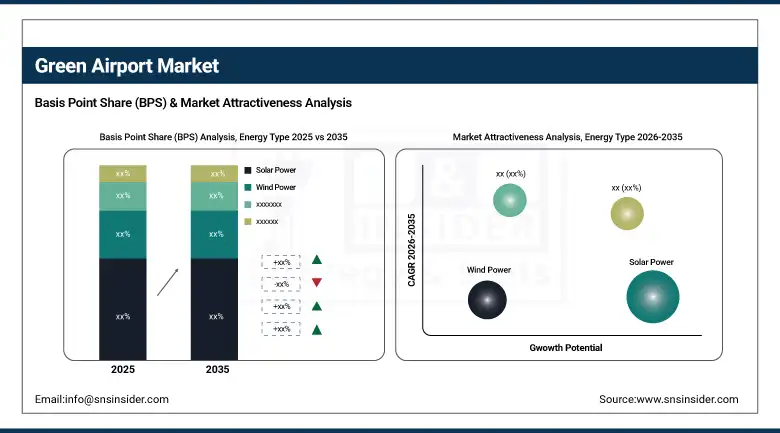
The Solar Power segment accounted for 43% of revenue in 2025, because airports require large-scale, cost-efficient renewable energy sources to offset high electricity consumption. As terminals, lighting systems, and airside operations demand continuous power, solar installations reduce long-term energy costs and carbon emissions. Advancements in high-efficiency photovoltaic panels and integrated battery storage systems are strengthening adoption, directly supporting the growth trajectory of the Green Airport Market.
The Bioenergy segment is expected to grow at the highest CAGR of 9.77% during 2026–2035, because airports are seeking diversified renewable sources beyond solar. As organic waste from terminals and nearby facilities increases, bioenergy systems convert waste into usable power, improving sustainability metrics. Development of advanced biofuel processing units and waste-to-energy plants enhances operational efficiency, thereby accelerating expansion within the Green Airport Market.
By Airport Class, Class A Airports Dominate Market While Class B Airports Show Accelerated Growth
The Class A market accounted for 52% revenue in 2025, as large global airports are under greater government and social pressure to control emissions. Since these airports have large passenger and flight traffic, they are investing heavily in green terminals, electric ground service equipment, and large-scale renewable energy systems. The constant development of infrastructure and the use of sophisticated energy management systems further cements the Class A position in the Green Airport Market.
The Class B segment is projected to grow at the fastest CAGR of 8.08% during 2026–2035, because mid-sized airports are increasingly modernizing aging infrastructure. As regional connectivity improves, these airports are implementing modular solar plants, electric vehicle charging systems, and energy-efficient retrofits. Development of cost-effective green technologies tailored for mid-scale operations is directly driving Class B participation in the Green Airport Market.
By Airport Type, International Airports Lead Market While Domestic Airports Witness Fastest Growth
The international segment accounted for 62% revenue share in 2025E, because global hubs face stronger international sustainability mandates and higher passenger expectations. As cross-border aviation expands, international airports are investing in sustainable aviation fuel infrastructure, large renewable energy plants, and smart carbon monitoring systems. Their scale of operations directly increases spending on sustainable technologies, reinforcing leadership in the Green Airport Market.
The Domestic segment is expected to register the highest CAGR of 8.70% during the forecast period, as the development of air travel in the region is leading to the development of infrastructure. With the development of domestic airports to handle the increasing number of passengers, they are implementing rooftop solar power, electric ground support equipment, and water conservation systems. The development of green products that are scalable and cost-effective is directly contributing to the growth of the Domestic segment in the market.
Green Airport Market Regional Insights:
North America Dominates Green Airport Market in 2025
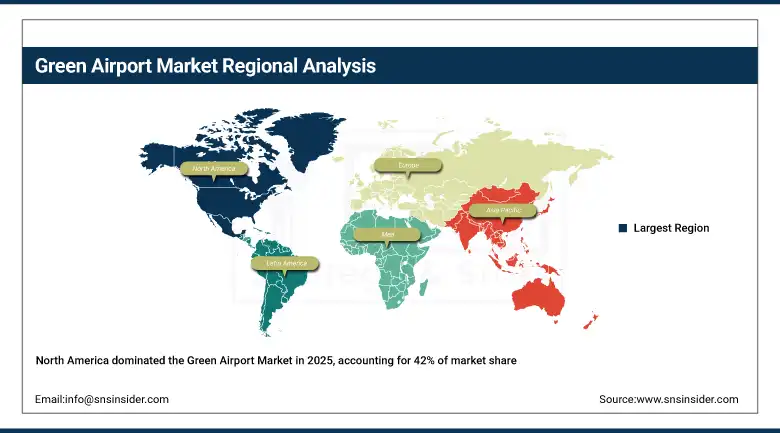
In 2025, North America accounts for an estimated 42% share of the Green Airport Market, supported by strong federal sustainability mandates and large-scale airport modernization funding. The region boasts the latest infrastructure, early adoption of renewable energy technologies, and rapid electrification of ground service equipment. The carbon reduction goals and government funding for clean energy projects accelerate solar energy adoption, sustainable aviation fuel, and smart energy management systems, making North America a pioneer in green airport renovations.
The United States leads the North American market because of its strong global hub network and supportive environment policies. The country’s major airports are pursuing in-house solar farms, electric vehicle fleets, and green airport renovations to support net-zero goals. Government infrastructure spending and state-level clean energy incentives are also fueling the trend. Canada’s carbon pricing policies and airport renewables projects add to the momentum, but the U.S. is the main driver in the North American market.
Get Customized Report as Per Your Business Requirement - Enquiry Now
Asia-Pacific is the Fastest-Growing Region in Green Airport Market, 2026–2035
The Asia-Pacific market is expected to register an estimated CAGR of 9.59% over the period from 2026 to 2035. The Asia-Pacific market is driven by the rapid expansion of airports and the growing number of air passengers. Government spending on sustainable infrastructure and clean energy integration is accelerating the adoption of solar energy, bio-energy solutions, and energy-efficient terminal development in emerging aviation markets.
China leads the Asia-Pacific Green Airport Market because of its massive airport development plans and the country’s aim for carbon neutrality. The country is incorporating green power production, electric ground services, and efficient building systems into new and expanded airports. Government-backed funding and policies facilitate the rapid adoption of green technology. Japan and India are also moving forward with green airport projects, but China’s infrastructure size and government-led development efforts make it the leader in the region.
Europe Green Airport Market Insights, 2025
Europe had a prominent share in the Green Airport Market in 2025, driven by the strict environmental norms and the need for decarbonization across the aviation sector. The focus in Europe is on carbon accreditation schemes, renewable power procurement, and green terminal development. The strict climate norms and carbon pricing policies in the EU drive the adoption of renewable energy, thus bolstering green airport infrastructure investments in Europe.
Germany dominates the European market due to its advanced engineering capabilities, strong renewable energy sector, and modernization of major international hubs. German airports are integrating large photovoltaic systems, energy-efficient buildings, and electrified airside vehicles. The country’s regulatory commitment to emissions reduction and infrastructure upgrades reinforces its leadership within Europe’s Green Airport Market.
Middle East & Africa and Latin America Green Airport Market Insights, 2025
The Middle East & Africa region in 2025 showed steady growth in the Green Airport Market due to large-scale airport expansion projects and national diversification strategies. Countries such as the UAE and Saudi Arabia are now incorporating solar energy and smart cooling technologies into their new airport designs to lower emissions.
Latin America is also experiencing steady development, mainly driven by Brazil and Mexico, who are upgrading airport infrastructure and embracing renewable energy sources. Publicly supported sustainability projects and rising passenger traffic are pushing the adoption of energy-saving lighting solutions, water management systems, and small-scale solar power projects. Both regions are moving towards more sustainable airport infrastructure solutions while taking into account cost factors.
Competitive Landscape of the Green Airport Market:
Siemens AG
Siemens AG is a globally operating company based in Germany, which is a leading player in the field of smart infrastructure, energy management, and automation solutions for airports around the world. The company provides comprehensive solutions for building management systems, smart grids, microgrids, electric vehicle charging infrastructure, and power distribution solutions that help airports achieve sustainability. Siemens AG is an essential part of the Green Airport Market, as it helps airports achieve optimal energy efficiency and reduce emissions.
-
In April 2024, Siemens AG announced the expansion of its smart infrastructure portfolio for airports, introducing advanced microgrid and digital energy management solutions designed to support net-zero airport operations and renewable integration.
Honeywell International Inc.
Honeywell International Inc. is a multinational conglomerate corporation based in the United States, with expertise in aerospace solutions, building solutions, energy solutions, and automation solutions. In the Green Airport Market, Honeywell International Inc. offers advanced building automation solutions, energy-efficient HVAC solutions, sustainable aviation fuel solutions, and airfield ground lighting solutions that help reduce emissions and improve airport performance. Honeywell International Inc. assists airports in tracking their real-time energy use, improving terminal efficiency, and integrating renewable energy solutions.
-
In February 2024, Honeywell International Inc. introduced upgraded sustainable aviation fuel processing technology and smart building optimization software aimed at helping airports reduce lifecycle emissions and improve overall energy efficiency.
Green Airport Market Companies are:
-
Siemens AG
-
Honeywell International Inc.
-
ABB Ltd.
-
General Electric Company (GE)
-
Schneider Electric SE
-
Johnson Controls International plc
-
IBM Corporation
-
SITA
-
Amadeus IT Group SA
-
Collins Aerospace
-
Thales Group
-
TKH Airport Solutions
-
Cisco Systems Inc.
-
Acciona, S.A.
-
Eaton Corporation
-
Leidos Holdings
-
Vanderlande Industries
-
AECOM
-
GMR Group
-
Skanska AB
| Report Attributes | Details |
|---|---|
| Market Size in 2025 | US$ 11.84 Billion |
| Market Size by 2035 | US$ 23.51 Billion |
| CAGR | CAGR of 7.11 % From 2026 to 2035 |
| Base Year | 2025 |
| Forecast Period | 2026-2035 |
| Historical Data | 2022-2024 |
| Report Scope & Coverage | Market Size, Segments Analysis, Competitive Landscape, Regional Analysis, DROC & SWOT Analysis, Forecast Outlook |
| Key Segments | • By Application (Civil & Commercial, Military) • By Energy Type (Wind Power, Bioenergy, Solar Power, Others) • By Airport Class (Class A, Class B, Class C) • By Airport Type (International, Domestic) |
| Regional Analysis/Coverage | North America (US, Canada), Europe (Germany, UK, France, Italy, Spain, Russia, Poland, Rest of Europe), Asia Pacific (China, India, Japan, South Korea, Australia, ASEAN Countries, Rest of Asia Pacific), Middle East & Africa (UAE, Saudi Arabia, Qatar, South Africa, Rest of Middle East & Africa), Latin America (Brazil, Argentina, Mexico, Colombia, Rest of Latin America). |
| Company Profiles | Siemens AG, Honeywell International Inc., ABB Ltd., General Electric Company (GE), Schneider Electric SE, Johnson Controls International plc, IBM Corporation, SITA, Amadeus IT Group SA, Collins Aerospace, Thales Group, TKH Airport Solutions, Cisco Systems Inc., Acciona, S.A., Eaton Corporation, Leidos Holdings, Vanderlande Industries, AECOM, GMR Group, Skanska AB |
Frequently Asked Questions
High initial investment costs and long payback periods for sustainable infrastructure projects remain major challenges.
Solar power leads the market because it offers cost-effective, large-scale renewable energy for airport operations.
Asia-Pacific is the fastest-growing region due to rapid airport expansion and government-backed sustainable infrastructure investments.
North America dominates due to strong sustainability policies, infrastructure funding, and early adoption of renewable and electrification technologies.
Rising carbon reduction targets, strict environmental regulations, and increasing investments in renewable energy and energy-efficient airport infrastructure are driving market growth.
