
Gum Arabic Market Report Scope & Overview:
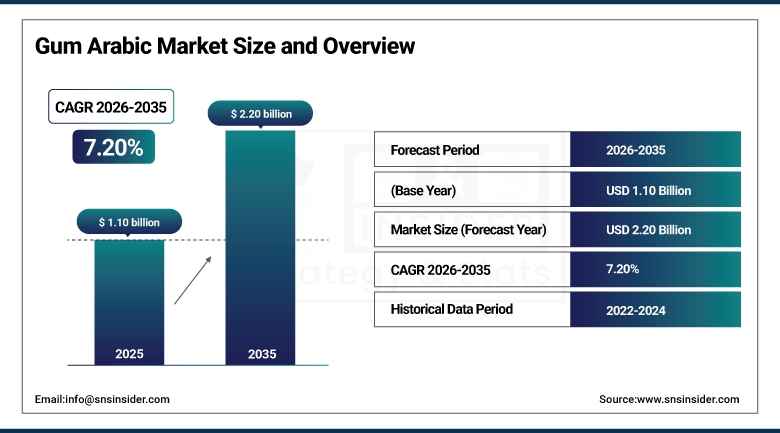
The Gum Arabic Market was valued at USD 1.10 Billion in 2025 and is expected to reach USD 2.20 Billion by 2035, growing at a CAGR of 7.20% from 2026 to 2035.
The global gum arabic market is expected to witness tremendous growth in coming years due to the growing demand for natural ingredients in food and beverages industry, growing application as stabilizer and emulsifier in confectionery and pharmaceutical preparations, and increasing consumer preference for plant-based additives over artificial ingredients. Gum arabic, which is a natural emulsifier derived from the sap of Acacia Senegal and Acacia Seyal trees, works as a stabilizer, thickening agent, and an encapsulating agent in beverages, confectionery, bakery products, and coating of pharmaceutical tablets. Moreover, increasing applications in nutraceuticals and pharmaceuticals using the encapsulation capabilities of gum arabic, increased trend among brands of moving away from artificial additives to natural ingredients, and technological advancements in the process of extraction and processing of gum arabic are also contributing to its growing market.
Nexira and Alland & Robert both expanded their sustainably sourced gum arabic processing capacity in 2026 to meet growing demand from food and beverage manufacturers seeking traceable, clean-label natural stabilizers amid tightening regulatory scrutiny of synthetic emulsifiers.
To Get more information Gum Arabic Market - Request Free Sample Report
Gum Arabic Market Trends
- Rising demand for natural and clean-label ingredients in the food and beverage industry is driving manufacturers to replace synthetic stabilizers and emulsifiers with gum arabic across product formulations.
- Growing pharmaceutical sector applications, particularly in tablet coatings and drug delivery excipients, are expanding gum arabic demand beyond its traditional food and beverage stronghold.
- Increasing emphasis on traceable, sustainable sourcing is driving supply chain transparency initiatives as brands seek to verify ethical harvesting practices across Sudan, Nigeria, and Chad production regions.
- Expanding technological advancement in extraction and processing methods is improving gum arabic quality and yield, enhancing product consistency for demanding food and pharmaceutical applications.
- Strategic partnerships among ingredient suppliers, food manufacturers, and sourcing cooperatives are supporting development of increasingly reliable, quality-consistent gum arabic supply chains.
U.S. Gum Arabic Market Outlook
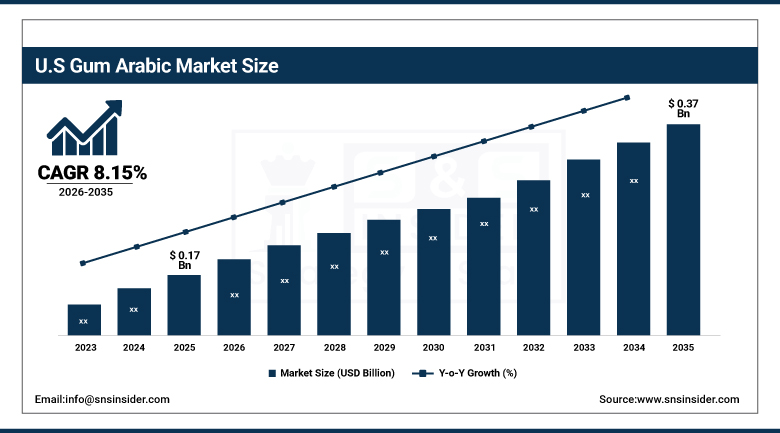
The U.S. Gum Arabic Market was valued at USD 0.17 Billion in 2025 and is projected to reach USD 0.37 Billion by 2035, growing at a CAGR of 8.15% during 2026–2035.
The companies leading the production of food and beverages and pharmaceuticals in the country are making continued progress in using gum arabic owing to the increasing demands of consumers for natural products and the functionality of the substance in emulsification, stabilization, and thickening. The pharmaceuticals sector is among the sectors where gum arabic is seeing rapid growth owing to an increasing demand for gum arabic in the formulation of drugs. The food and beverages sector is also rapidly growing due to increased demands from consumers for natural products.
Kerry Group expanded its U.S. stabilizer range of gum arabic in 2026 to cater to increasing demand from food and beverage manufacturers for natural emulsifiers.
Gum Arabic Market Segment Analysis
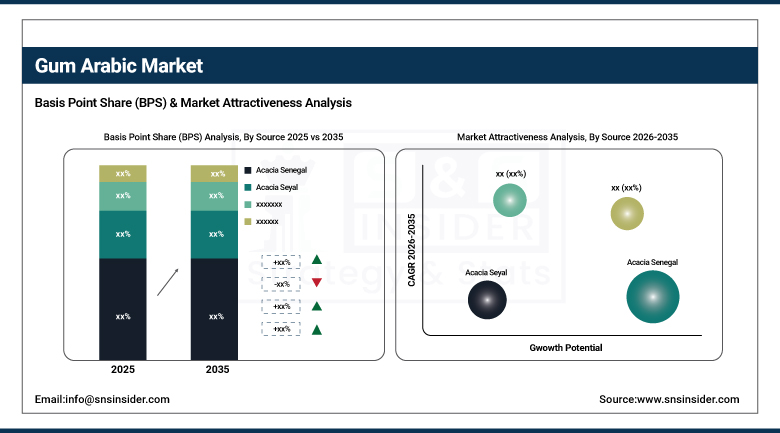
- By Source, acacia Senegal dominated the gum arabic market with around 65.00% share in 2025, while acacia Seyal is the fastest-growing source segment with a CAGR of 6.90% from 2026–2035.
- By Application, beverages dominated the gum arabic market with a 30.60% share in 2025, while pharmaceuticals is the fastest-growing application segment with a CAGR of 8.90% from 2026–2035.
- By Form, powder dominated the gum arabic market with a 54.30% share in 2025, while liquid is the fastest-growing form segment with a CAGR of 7.40% from 2026–2035.
- By Nature, conventional dominated the gum arabic market with a 71.60% share in 2025, while organic is the fastest-growing nature segment with a CAGR of 8.60% from 2026–2035.
By Source, Acacia Senegal dominated the Gum Arabic Market, while Acacia Seyal is the fastest-growing segment.
Acacia Senegal emerged as the leading segment in terms of revenue, holding a market share of around 65.00% in 2025. Acacia Senegal is still the primary source of gum arabic because of the outstanding emulsifying abilities of this plant species and a long-standing record of its application in top-tier food and drug products.
The segment of Acacia Seyal is expected to witness the fastest CAGR of 6.90% over the forecast period 2026-2035. Increasing consumer interest in the use of affordable alternative sources of gum arabic for less stringent thickening applications along with an increased capacity to cultivate and harvest from more African growing regions will boost the usage of Acacia Seyal gum arabic.
By Application, Beverages dominated the Gum Arabic Market, while Pharmaceuticals is the fastest-growing segment.
The beverages segment led the gum arabic market by accounting for a revenue share of 30.60% in 2025. Beverages continue to dominate the application categories due to the significance of gum arabic in soft drink beverages and flavored beverages as a natural emulsifier and texture enhancer where over 70% of global gum arabic has been used.
The pharmaceuticals segment is projected to have the highest CAGR of 8.90% during the forecast period from 2026 to 2035. Growth in the segment is driven by the growing usage of gum arabic in coatings for tablets, drug delivery, and encapsulation applications.
By Form, Powder dominated the Gum Arabic Market, while Liquid is the fastest-growing segment.
The powder segment dominated the gum arabic market with a revenue share of 54.30% in 2025. Powder form remains the dominant category owing to its extended shelf stability, ease of transport, and straightforward incorporation into dry mix formulations across food, pharmaceutical, and industrial manufacturing processes.
The Liquid segment is expected to witness the fastest CAGR of 7.40% during the forecast period 2026-2035. Growing demand for ready-to-use liquid gum arabic solutions among beverage and confectionery manufacturers seeking to streamline production processes and reduce dissolution time is driving rising adoption of this convenient form.
Regional Insights
|
Region |
Major Country |
Share within Region, 2025 (%) |
|
North America |
United States |
78.60% |
|
Europe |
Germany |
26.40% |
|
Asia Pacific |
China |
43.90% |
|
Middle East & Africa |
UAE |
25.70% |
|
Latin America |
Brazil |
37.60% |
North America Gum Arabic Market Insights
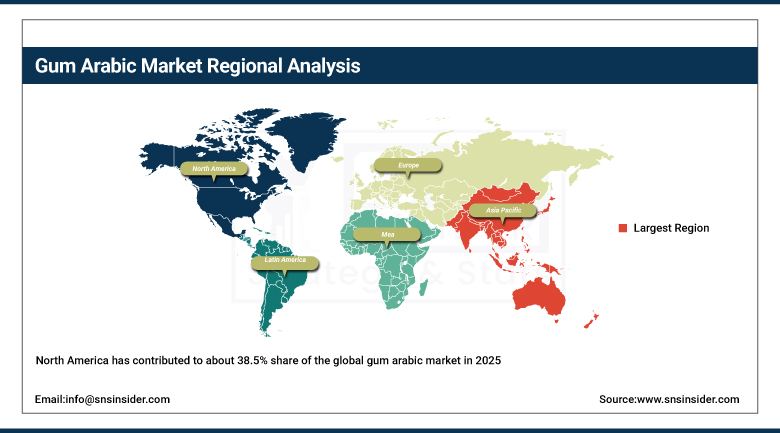
North America has contributed to about 38.5% share of the global gum arabic market in 2025 due to growing use of natural ingredients in the food and beverage industry, high growth of the pharmaceutical industry, and high use of plant-based ingredients.
The United States had been the dominant country in the North America Gum Arabic Market in 2025 contributing to 78.60% share of the market due to high food and beverage production capacity and high use of clean label ingredients. Canada has been making contributions to regional growth through high investments in natural ingredients sourcing and food production.
Get Customized Report as per Your Business Requirement - Enquiry Now
Europe Gum Arabic Market Insights
Europe region was a major contributor to the gum arabic market in 2025. This is attributed to the region's strong food and beverage manufacturing base, growing regulatory emphasis on ingredient transparency, and rising demand for natural stabilizers across confectionery and bakery applications.
Germany is one of the major markets in Europe owing to its strong food manufacturing base and growing consumer demand for natural, clean-label ingredients. Other countries such as France, the United Kingdom, and Italy are also contributing to market growth through expanding confectionery and pharmaceutical manufacturing investment.
Asia Pacific Gum Arabic Market Insights
Asia Pacific gum arabic market is expected to witness the fastest growth rate during the forecast period 2026-2035. The market growth is driven by rising consumer awareness regarding natural ingredients, growing health consciousness, and expanding food and pharmaceutical manufacturing capacity across the region's major economies.
China is one of the main growth drivers in the Asia Pacific Gum Arabic Market, owing to its massive food and beverage manufacturing base and growing demand for natural ingredients. India, Japan, and Southeast Asian nations are also contributing to regional growth through expanding pharmaceutical formulation demand and rising health-conscious consumer segments.
Middle East & Africa and Latin America Gum Arabic Market Insights
Middle East & Africa and Latin American regions play a unique dual role in the gum arabic market, serving as both major production sources and growing consumption markets as regional food processing and pharmaceutical manufacturing capacity expands.
Brazil is set to be a prominent Latin American consumption market fueled by growing food and beverage manufacturing investment. The Middle East & Africa region, home to Sudan, Nigeria, and Chad which together supply over 70% of the world's gum arabic, continues to see growing domestic processing investment alongside its role as the primary global raw material source.
Growth Drivers: Rising clean-label ingredient demand and pharmaceutical applications driving market growth
Increasing demands for natural and clean label ingredients in the food and beverages sector, increased use as stabilizer and emulsifier in confectionery and pharmaceutical formulations, and increasing consumer inclination towards using plant-based ingredients over synthetics are some of the key factors driving the Gum Arabic Market. Gum arabic plays an important role as an emulsifier, stabilizer, and encapsulator in a wide variety of industrial applications.
Technological developments in the process of extraction and production of gum arabic have led to improved quality and yield for its use in demanding food and pharmaceutical applications. Increasing use as nutraceutical and pharmaceutical applications utilizing encapsulating characteristics, and shifting brands towards natural ingredients and increased consumer knowledge about artificial additives are other factors aiding the market growth.
Restraints: Supply concentration risk and political instability limiting market expansion
One of the major threats to market expansion has been the industry's high dependence on the sourcing of raw materials from Sudan, where almost 80% of all the gum arabic produced in the world is generated, making the supply chain susceptible to frequent disruption due to the ongoing political volatility in the region.
Moreover, the disruptions in export of and changes in prices owing to the supply of gum arabic from a politically unstable region have resulted in the occurrence of problems related to availability and uncertainty in terms of costs for producers who are dependent on the regular supply of gum arabic.
Opportunities: Expansion of sustainable sourcing and pharmaceutical formulation creating new growth avenues
The rapid expansion of traceable, sustainable sourcing initiatives, growing pharmaceutical and nutraceutical formulation demand, and increasing diversification of production beyond traditional supply-concentrated regions are expected to generate substantial opportunities for the Gum Arabic Market. Rising demand for reliable, quality-consistent natural stabilizers is anticipated to support strong future demand.
There is a considerable growth opportunity in the continued development of certified organic and sustainably sourced gum arabic that commands premium pricing among clean-label-focused manufacturers. The expansion of cultivation and processing capacity across Nigeria, Chad, and emerging production regions such as Ghana is likely to unlock substantial new supply chain resilience and demand throughout the forecast period.
Recent Developments:
- 2026: Kerry Group introduced a new clean-label stabilizer blend incorporating gum arabic, targeting food and beverage manufacturers seeking to reformulate away from synthetic emulsifiers.
- 2026: Agrigum International expanded its gum arabic processing facility in Ghana, diversifying global supply chain sourcing beyond traditional Sudan-concentrated production.
- 2025: Nexira launched a new certified sustainable gum arabic sourcing program, providing food and pharmaceutical manufacturers with verified traceability from harvest through final ingredient delivery.
- 2025: Alland & Robert expanded its gum arabic processing capacity in France, increasing its ability to supply high-purity, pharmaceutical-grade gum arabic to European and international customers.
Gum Arabic Companies are:
- Nexira SAS
- Alland & Robert SAS
- Kerry Group plc
- Agrigum International Ltd.
- Gum Arabic Company Limited
- Farbest Brands
- Colloides Naturels International (CNI)
- ES Food Ingredients
- Import Kilimanjaro (IK)
- Vinayak Ingredients (India) Pvt. Ltd.
- Compagnie Agricole de Grande Culture (CAGC)
- Multi Trading Company
- Antah Agro Sdn Bhd
- Kerry Ingredients & Flavours
- Norevo GmbH
- Global Ingredients
- Al Jouf Agricultural Development Company
- Ashland Global Holdings Inc.
- Ingredion Incorporated
- DuPont de Nemours, Inc.
Gum Arabic Market Report Scope:
| Report Attributes | Details |
|---|---|
| Market Size in 2025 | USD 1.10 Billion |
| Market Size by 2035 | USD 2.20 Billion |
| CAGR | CAGR of 7.20% From 2026 to 2035 |
| Base Year | 2025 |
| Forecast Period | 2026-2035 |
| Historical Data | 2022-2024 |
| Report Scope & Coverage | Market Size, Segments Analysis, Competitive Landscape, Regional Analysis, DROC & SWOT Analysis, Forecast Outlook |
| Key Segments | • By Source (Acacia Senegal, Acacia Seyal) • By Application (Beverages, Confectionery, Pharmaceuticals, Bakery) • By Form (Powder, Granules, Liquid) • By Nature (Conventional, Organic) |
| Regional Analysis/Coverage | North America (US, Canada), Europe (Germany, UK, France, Italy, Spain, Russia, Poland, Rest of Europe), Asia Pacific (China, India, Japan, South Korea, Australia, ASEAN Countries, Rest of Asia Pacific), Middle East & Africa (UAE, Saudi Arabia, Qatar, South Africa, Rest of Middle East & Africa), Latin America (Brazil, Argentina, Mexico, Colombia, Rest of Latin America). |
| Company Profiles | Nexira SAS, Alland & Robert SAS, Kerry Group plc, Agrigum International Ltd., Gum Arabic Company Limited, Farbest Brands, Colloides Naturels International (CNI), ES Food Ingredients, Import Kilimanjaro (IK), Vinayak Ingredients (India) Pvt. Ltd., Compagnie Agricole de Grande Culture (CAGC), Multi Trading Company, Antah Agro Sdn Bhd, Kerry Ingredients & Flavours, Norevo GmbH, Global Ingredients, Al Jouf Agricultural Development Company, Ashland Global Holdings Inc., Ingredion Incorporated, and DuPont de Nemours, Inc. |
Frequently Asked Questions
The Gum Arabic Market is expected to grow at a CAGR of 7.20% from 2026 to 2035.
The Gum Arabic Market was valued at USD 1.10 Billion in 2025.
The market is driven by increasing demand for natural and clean-label ingredients in food and beverages, growing pharmaceutical applications, and rising consumer preference for plant-derived additives.
The Beverages segment dominated the Gum Arabic Market in 2025, accounting for approximately 30.60% market share.
The North America region dominated the Gum Arabic Market in 2025, driven by increasing demand for natural and clean-label ingredients in the food and beverage industry.
