
Handheld Ultrasound Devices Market Report Scope & Overview:
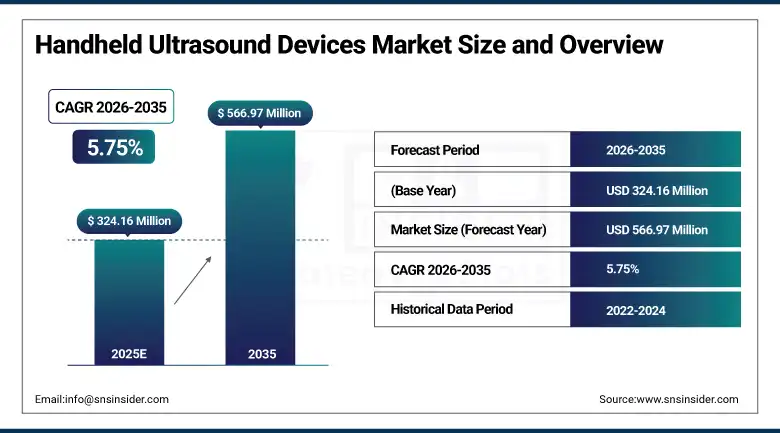
The Handheld Ultrasound Devices Market was estimated at USD 324.16 Million in 2025 and is expected to reach USD 566.97 Million by 2035 by 2035 and grow at a CAGR of 5.75% over the forecast period of 2026-2035.
The Handheld Ultrasound Devices Market analysis, driven by the growing adoption of point-of-care diagnostics across hospitals, emergency departments, and outpatient clinics. These devices enable rapid, real-time imaging at the patient’s bedside, supporting faster clinical decision-making and improving patient outcomes.
According to study, Handheld ultrasound reduces diagnostic decision time by nearly 30–50% compared to conventional imaging workflows.
Market Size and Forecast:
-
Market Size in 2025: USD 324.16 Million
-
Market Size by 2035: USD 566.97 Million
-
CAGR: 5.75% from 2026 to 2035
-
Base Year: 2025
-
Forecast Period: 2026–2035
-
Historical Data: 2022–2024
To Get more information On Handheld Ultrasound Devices Market - Request Free Sample Report
Handheld Ultrasound Devices Market Trends:
-
Rapid adoption of point-of-care ultrasound across emergency and primary care settings
-
Increasing use of handheld ultrasound devices for bedside and real-time diagnostics
-
Growing integration of handheld ultrasound with smartphones and cloud platforms
-
Rising deployment of handheld ultrasound in home healthcare and remote patient monitoring
-
Expanding use of portable imaging solutions in rural and underserved healthcare regions
-
Strong growth in telemedicine supported by compact, easy-to-share ultrasound imaging tools
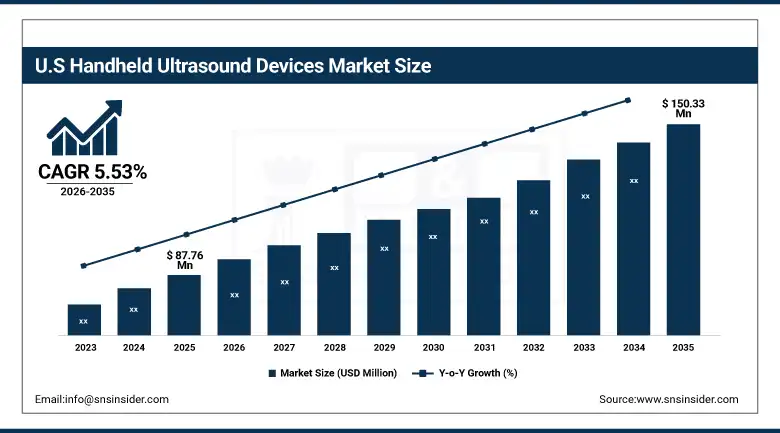
The U.S. Handheld Ultrasound Devices Market size valued at USD 87.76 Million in 2025 and is expected to reach USD 150.33 Million by 2035, growing at a CAGR of 5.53% over the forecast period of 2026-2035,
The U.S. handheld ultrasound devices market is highly developed, driven by advanced healthcare infrastructure, widespread adoption of point-of-care imaging, telemedicine integration, and strong presence of key players like GE HealthCare and Butterfly Network, supporting rapid bedside diagnostics and emergency care.
Handheld Ultrasound Devices Market Growth Drivers:
-
Growing Adoption of Point-of-Care Ultrasound Driving Market Expansion
The primary driver of the handheld ultrasound devices market is the rapid adoption of point-of-care ultrasound (POCUS) across hospitals, emergency departments, and outpatient clinics. Handheld ultrasound devices allow clinicians to perform real-time imaging at the patient’s bedside, enabling faster diagnosis and immediate clinical decisions without relying on centralized radiology departments. Their portability, ease of use, and ability to deliver quick, non-invasive assessments make them especially valuable in emergency medicine, critical care, and primary care. This shift toward decentralized, patient-centric healthcare is significantly increasing demand for handheld ultrasound solutions.
Over 55% of POCUS examinations are performed using portable or handheld ultrasound devices.
Handheld Ultrasound Devices Market Restraints:
-
Limited Imaging Depth Compared to Conventional Systems Restrains Market Growth
A key restraint for the market is the limited imaging depth and resolution of handheld ultrasound devices compared to traditional cart-based systems. While handheld devices are effective for basic and point-of-care applications, they may not always provide the detailed imaging required for complex diagnostics or advanced specialty procedures. This limitation can restrict adoption among radiologists and specialists who rely on high-end imaging accuracy. Additionally, operator dependency and the need for adequate training can affect image interpretation, slowing adoption in some healthcare settings.
Handheld Ultrasound Devices Market Opportunities:
-
Rising Demand for Home Healthcare and Remote Diagnostics Creating New Growth Opportunities
A major opportunity for the handheld ultrasound devices market lies in the growing demand for home healthcare and remote diagnostic services. As healthcare systems increasingly focus on reducing hospital visits and managing chronic conditions at home, handheld ultrasound devices offer a practical solution for remote patient monitoring and telemedicine. Their compatibility with smartphones and cloud-based platforms enables image sharing and remote consultation with specialists. This trend is particularly strong in rural and underserved regions, where access to advanced diagnostic infrastructure is limited, creating significant growth potential for manufacturers.
More than 60% of handheld ultrasound devices now support smartphone or cloud-based image sharing.
Handheld Ultrasound Devices Market Segmentation Analysis:
-
By Product Type: In 2025, Portable/Handheld Ultrasound Devices led the market with a share of 45.50%, while Wireless/Bluetooth Connected Devices is the fastest-growing segment with a CAGR of 9.20%.
-
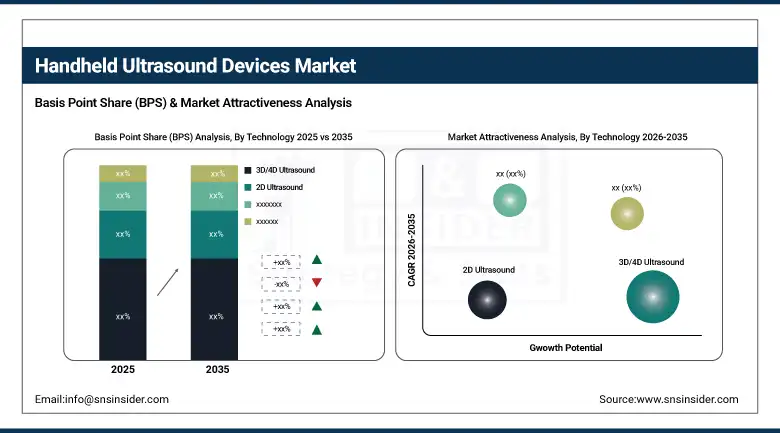
By Technology: In 2025, 3D/4D Ultrasound led the market with a share of 36.80%, while 2D Ultrasound is the fastest-growing segment with a CAGR of 8.60%.
-
By Application: In 2025, Obstetrics/Gynecology led the market with a share of 32.40%, while Trauma is the fastest-growing segment with a CAGR of 7.90%.
-
By End User: In 2025, Hospitals led the market with a share of 42.20%, while Point-of-Care Clinics is the fastest-growing segment with a CAGR of 8.30%.
By Product Type, Portable/Handheld Devices Lead Market and Wireless Devices Fastest Growth
Portable and handheld ultrasound devices dominate the market due to their widespread adoption in hospitals and emergency departments for rapid bedside imaging. Their compact design, ease of operation, and ability to deliver real-time diagnostic results make them highly suitable for critical care, primary care, and outpatient settings. Strong clinical acceptance and proven reliability continue to support their leading market position.
Wireless ultrasound devices are the fastest-growing segment, driven by advancements in cable-free technology and seamless smartphone connectivity. These devices offer enhanced mobility, easier disinfection, and improved compatibility with telemedicine platforms, making them ideal for home healthcare and remote diagnostics. Growing demand for flexible and digitally connected imaging solutions is accelerating adoption.
By Technology, 3D/4D Ultrasound Lead Market and 2D Ultrasound Fastest Growth
3D/4D ultrasound technology lead the market due to its superior imaging capabilities and detailed anatomical visualization. It is extensively used in obstetrics and gynecology for fetal monitoring and complex diagnostic assessments. Higher diagnostic accuracy and growing preference for advanced imaging in specialty care sustain strong demand for this segment.
2D ultrasound is the fastest-growing segment, supported by its affordability, simplicity, and broad clinical utility. Its ease of use makes it ideal for point-of-care applications, emergency diagnostics, and routine examinations. Increasing adoption in resource-limited settings and primary care environments is driving rapid growth.
By Application, Obstetrics/Gynecology Lead Market and Trauma Fastest Growth
Obstetrics and gynecology dominate the market owing to the routine and frequent use of ultrasound for prenatal care and gynecological assessments. Handheld ultrasound devices enable safe, non-invasive fetal monitoring and early detection of complications. Rising birth rates in developing regions and increased prenatal screening are reinforcing this segment’s leadership.
The trauma segment is witnessing the fastest growth as handheld ultrasound becomes essential in emergency and critical care settings. These devices support rapid internal injury assessment and guide immediate treatment decisions during accidents and acute medical situations. Their portability and speed make them highly valuable in ambulances and emergency rooms.
By End User, Hospitals Lead Market and Point-of-Care Clinics Fastest Growth.
Hospitals dominate the market due to high patient volumes and strong demand for rapid diagnostic imaging across multiple departments. Advanced infrastructure and the need for immediate clinical decision-making drive widespread adoption in emergency, ICU, and specialty units. Continuous investment in point-of-care technologies supports sustained dominance.
Point-of-care clinics represent the fastest-growing segment, fueled by the shift toward decentralized and outpatient healthcare delivery. These clinics rely on handheld ultrasound for quick, cost-effective diagnostics without dependence on centralized imaging facilities. Rising patient preference for convenient and accessible healthcare services is accelerating growth in this segment.
Regional Insights:
North America Handheld Ultrasound Devices Market Insights:
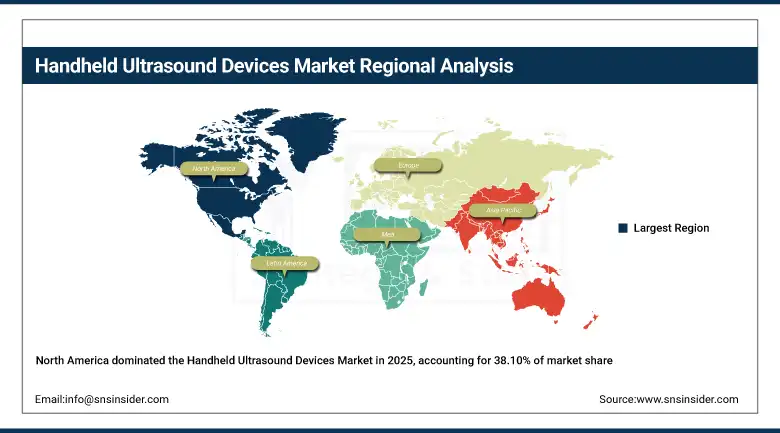
The North America dominated the Handheld Ultrasound Devices Market in 2025, with over 38.10% revenue share, due to advanced healthcare infrastructure, high adoption of point-of-care diagnostics, and increasing investments in telemedicine. Hospitals and emergency departments extensively use handheld devices for rapid bedside imaging, especially in critical care and trauma settings. The region also benefits from strong regulatory support, technological innovation, and the presence of major market players like GE HealthCare, Philips, and Butterfly Network. Rising chronic disease prevalence and the growing trend of decentralized healthcare further fuel market growth in this region.
The U.S. and Canada dominate North America’s handheld ultrasound market due to advanced healthcare infrastructure, high adoption of point-of-care imaging, telemedicine integration, and strong presence of major players like GE HealthCare and Philips.
Get Customized Report as per Your Business Requirement - Enquiry Now
Asia Pacific Handheld Ultrasound Devices Market Insights:
The Asia Pacific region is expected to have the fastest-growing CAGR 6.96%, driven by rising healthcare expenditures, expanding hospital networks, and increasing awareness of point-of-care imaging. Emerging economies such as China, India, and Japan are witnessing growing adoption in rural and semi-urban areas where access to conventional imaging is limited. Government initiatives promoting telemedicine and home healthcare, combined with the availability of cost-effective portable devices, are accelerating market growth. The large patient population and increasing incidence of chronic diseases further contribute to strong regional demand.
China and India Market Insights
China and India drive Asia Pacific growth with rising healthcare investments, large patient populations, rural healthcare expansion, and increasing demand for affordable, portable ultrasound devices for chronic disease management and telemedicine applications.
Europe Handheld Ultrasound Devices Market Insights
Europe holds a significant share of the handheld ultrasound devices market due to advanced medical infrastructure, high healthcare spending, and early adoption of innovative imaging technologies. The increasing use of portable ultrasound in emergency, primary care, and obstetrics/gynecology applications drives demand. Government support for telemedicine and point-of-care solutions enhances adoption across both hospitals and outpatient clinics. Key countries such as Germany, the UK, and France are witnessing steady growth, supported by skilled healthcare professionals and growing preference for minimally invasive diagnostic tools.
Germany and U.K. Market Insights
The U.K. and Germany lead Europe’s market with advanced medical facilities, early adoption of innovative ultrasound technologies, strong government support for point-of-care diagnostics, and growing use in emergency, obstetrics, and outpatient care settings.
Latin America (LATAM) and Middle East & Africa (MEA) Handheld Ultrasound Devices Market Insights
Latin America and the Middle East & Africa are emerging markets for handheld ultrasound devices, driven by improving healthcare infrastructure and increasing investments in telemedicine. Countries like Brazil, Mexico, South Africa, and the UAE are adopting portable ultrasound solutions to address limited access to conventional imaging in rural and underserved regions. Rising awareness of chronic disease management, emergency care needs, and home healthcare is fueling market adoption. Cost-effective devices and government initiatives promoting digital health further create opportunities for market expansion in these regions.
Competitive Landscape:
GE HealthCare is a leading player in the handheld ultrasound market, offering advanced point‑of‑care imaging solutions like the Vscan series. Its devices support rapid bedside diagnostics across emergency, cardiology, and primary care settings, strengthened by AI integration, wireless connectivity, and strong clinical acceptance in hospitals and healthcare systems.
-
In February 2024, GE HealthCare launched the Vscan Air SL wireless handheld ultrasound device with dual transducers designed for rapid cardiac and vascular assessments at the point of care.
Butterfly Network specializes in semiconductor‑based handheld ultrasound devices, notably the Butterfly iQ series, providing affordable, high‑quality imaging for diverse clinical needs. With smartphone compatibility, cloud connectivity, and robust tele‑ultrasound support, it drives widespread adoption in point‑of‑care, emergency, and remote healthcare environments.
-
In January 2025, Butterfly Network launched the Butterfly iQ3, a next-generation handheld ultrasound with advanced semiconductor technology and enhanced imaging modes to support diverse clinical applications.
Clarius Mobile Health focuses on wireless handheld ultrasound solutions with advanced imaging quality and AI‑enhanced workflow features. Its devices integrate seamlessly with mobile devices and cloud platforms, supporting point‑of‑care diagnostics, remote consultations, and efficient clinical workflows, rapidly expanding adoption across hospitals, clinics, and telemedicine users.
-
In January 2025, Clarius released new software and enterprise management tools with AI‑powered features to enhance workflow and billing integration for its handheld ultrasound systems.
Handheld Ultrasound Devices Market Key Players:
-
GE HealthCare
-
Philips Healthcare
-
Siemens Healthineers
-
Butterfly Network, Inc.
-
Clarius Mobile Health
-
Fujifilm Sonosite Inc.
-
Mindray Medical International Ltd.
-
Canon Medical Systems Corporation
-
Samsung Medison
-
Esaote SpA
-
Healcerion Co., Ltd.
-
Terason (Teratech Corporation)
-
EchoNous Inc.
-
BenQ Medical Technology
-
Shenzhen Landwind Industry
-
Shenzhen WELLD Medical Electronics Co., Ltd.
-
Shenzhen Ruqi Technology (MobiSante)
-
Draminski S.A.
-
Pulsenmore Ltd.
-
Viatom Technology Co., Ltd.
| Report Attributes | Details |
|---|---|
| Market Size in 2025 | USD 324.16 Million |
| Market Size by 2035 | USD 566.97 Million |
| CAGR | CAGR of 5.75% From 2026 to 2035 |
| Base Year | 2025 |
| Forecast Period | 2026-2035 |
| Historical Data | 2022-2024 |
| Report Scope & Coverage | Market Size, Segments Analysis, Competitive Landscape, Regional Analysis, DROC & SWOT Analysis, Forecast Outlook |
| Key Segments | • By Product Type (Portable/Handheld Ultrasound Devices, Tablet Based Ultrasound, Smartphone Based Ultrasound, Wireless/Bluetooth Connected Devices) • By Technology (2D Ultrasound, 3D/4D Ultrasound, Doppler Ultrasound, Pocket/Compact Imaging Systems) • By Application (Obstetrics/Gynecology, Cardiovascular, Urology, Gastroenterology, Musculoskeletal, Trauma) • By End User (Hospitals, Diagnostic Imaging Centers, Ambulatory Surgical Centers (ASC), Point of Care Clinics, Emergency Medical Services (EMS), Others) |
| Regional Analysis/Coverage | North America (US, Canada), Europe (Germany, UK, France, Italy, Spain, Russia, Poland, Rest of Europe), Asia Pacific (China, India, Japan, South Korea, Australia, ASEAN Countries, Rest of Asia Pacific), Middle East & Africa (UAE, Saudi Arabia, Qatar, South Africa, Rest of Middle East & Africa), Latin America (Brazil, Argentina, Mexico, Colombia, Rest of Latin America). |
| Company Profiles | GE HealthCare, Philips Healthcare, Siemens Healthineers, Butterfly Network, Inc., Clarius Mobile Health, Fujifilm Sonosite Inc., Mindray Medical International Ltd., Canon Medical Systems Corporation, Samsung Medison, Esaote SpA, Healcerion Co., Ltd., Terason (Teratech Corporation), EchoNous Inc., BenQ Medical Technology, Shenzhen Landwind Industry, Shenzhen WELLD Medical Electronics Co., Ltd., Shenzhen Ruqi Technology (MobiSante), Draminski S.A., Pulsenmore Ltd., and Viatom Technology Co., Ltd. |
Frequently Asked Questions
North America dominated the Handheld Ultrasound Devices Market in 2025.
The Portable/Handheld Ultrasound Devices segment dominated the Handheld Ultrasound Devices Market.
The major growth factor of the Handheld Ultrasound Devices Market is the rapid adoption of point-of-care ultrasound (POCUS) across hospitals, emergency departments, and outpatient clinics
The Handheld Ultrasound Devices Market size is USD 324.16 Million in 2025 and is expected to reach USD 506.68 Million by 2033.
The Handheld Ultrasound Devices Market is expected to grow at a CAGR of 5.75% during 2026-2033.
