
Healthcare API Market Report Scope and Overview:
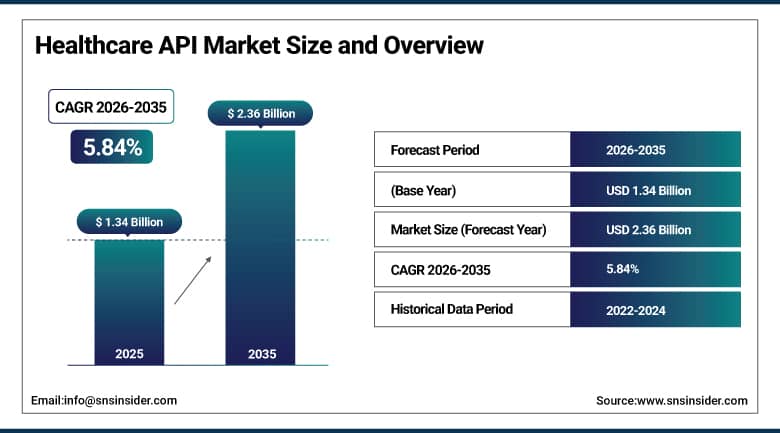
The Healthcare API Market was valued at USD 1.34 Billion in 2025 and is projected to reach USD 2.36 Billion by 2035, registering a CAGR of 5.84% from 2026 to 2035.
The Healthcare API Market is steadily reshaping how health data moves between providers, payers, patients, digital health apps and connected devices by replacing point-to-point interfaces with standardized, secure application programming interfaces. The market is characterized by rapid adoption of HL7 FHIR-based APIs driven by U.S. interoperability and patient-access rules, growing use of APIs to connect telehealth, remote patient monitoring and wearable devices into clinical workflows, and expanding cloud-native health data platforms from major technology companies. Significant growth is being witnessed in remote patient monitoring APIs and payer use cases, considering that healthcare organizations continue investing in real-time data exchange that reduces administrative burden and improves care coordination.
Apple introduced new HealthKit capabilities in June 2026, including APIs for workout zones and menopause tracking, further expanding the Apple Health ecosystem and strengthening the integration of wearable-generated health data into digital health applications and connected care platforms.
To Get More Information On Healthcare API Market - Request Free Sample Report
Healthcare API Market Trends:
-
Rising adoption of HL7 FHIR standards continues making healthcare APIs the default model for clinical data exchange.
-
Growing CMS interoperability and prior authorization rules continue driving payer-provider API deployment.
-
Expanding integration of wearables and remote monitoring devices continues feeding patient-generated data into EHRs.
-
Increasing use of APIs to connect AI applications continues accelerating AI-enabled clinical and administrative workflows.
-
Rising focus on API security and identity verification continues shaping consent and authentication frameworks.
U.S. Healthcare API Market Outlook:
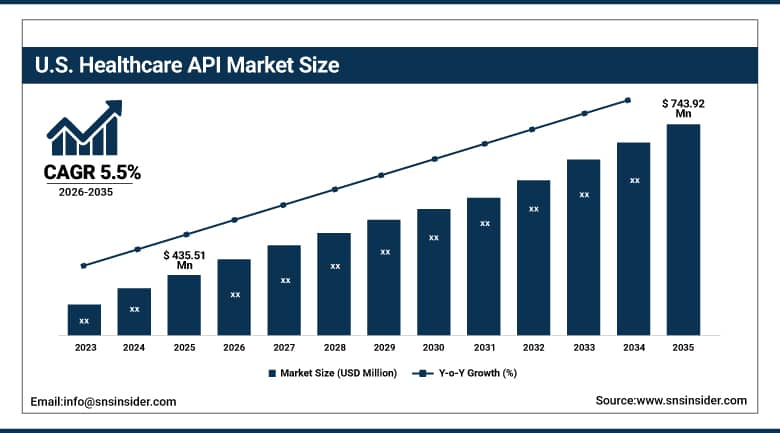
The U.S. Healthcare API Market was valued at approximately USD 435.51 Million in 2025 and is projected to reach approximately USD 743.92 Million by 2035, registering a CAGR of approximately 5.5% from 2026 to 2035.
Demand across the United States continued to be shaped by the 21st Century Cures Act requirement for standardized patient-access APIs, CMS interoperability and prior authorization rules that require payers to support FHIR APIs, and very high EHR adoption among hospitals and physician practices. Rising use of telehealth, remote patient monitoring and consumer health apps continued reinforcing the country's position as the largest national market. Growing venture investment in health AI and digital health platforms added further layers of sustained domestic demand, with providers and payers increasingly prioritizing secure, cloud-based API platforms that connect fragmented systems.
Oracle Health achieved CMS Aligned Network status in April 2026 and launched a digital identity verification and health record-sharing solution with CLEAR to support CMS's "Kill the Clipboard" initiative, enabling American patients to securely access and share their health records during check-in.
Healthcare API Market Segment Analysis:
-
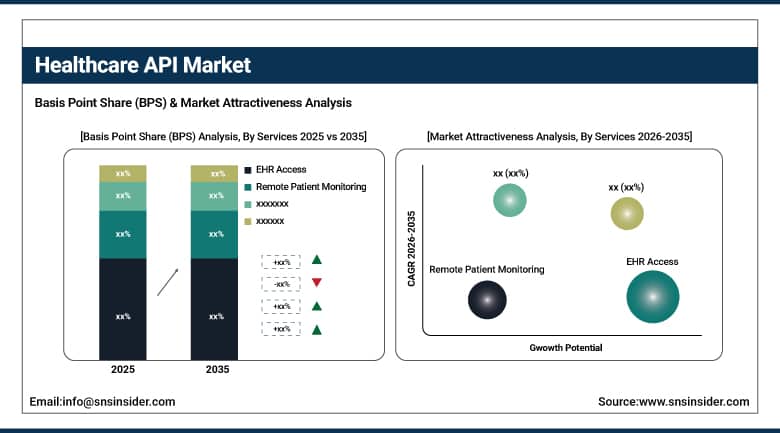
By Services, EHR Access segment dominated the Healthcare API Market in 2025 with 29% share; Remote Patient Monitoring segment is the fastest growing segment with a CAGR of approximately 7.1%.
-
By Deployment Model, Cloud Based segment dominated the Healthcare API Market in 2025 with 79% share and is also the fastest growing segment with a CAGR of approximately 6.3%.
-
By End Use, Providers segment dominated the Healthcare API Market in 2025 with 45% share; Healthcare Payers segment is the fastest growing segment with a CAGR of approximately 7.0%.
By Services: EHR Access Leads, Remote Patient Monitoring Grows Fastest
The EHR Access segment dominated the Healthcare API Market in 2025, driven by the central role of electronic health records in clinical care and regulatory requirements for standardized patient and third-party access to health data. FHIR-based EHR APIs allow hospitals, clinics, apps and payers to retrieve and exchange clinical information securely, supporting care coordination, patient engagement and AI analytics. Near-universal EHR adoption among U.S. providers and growing EHR use worldwide reinforced this segment's position as the largest contributor to total market revenue throughout the base year.
The Remote Patient Monitoring segment is the fastest growing in the Healthcare API Market owing to rising chronic disease prevalence and the shift toward home-based, continuous care. RPM APIs connect blood pressure cuffs, glucose monitors, ECG devices and smartwatches to clinical platforms, enabling real-time alerts and virtual care programmes. Reimbursement expansion for remote monitoring and the growth of hospital-at-home models are boosting the growth trajectory of this segment. Increasing adoption of consumer wearables adds to demand.
By Deployment Model: Cloud Based Leads and Grows Fastest
The Cloud Based segment dominated the Healthcare API Market because cloud API platforms offer scalability, lower upfront cost, faster deployment and built-in support for healthcare data standards such as HL7, FHIR and DICOM. Major cloud providers offer managed health data services that simplify interoperability for providers, payers and developers. Rapid migration of healthcare workloads to the cloud and integration with AI services reinforced this segment's dominant contribution to total market revenue throughout the base year and keep it the fastest-growing deployment model.
The On-Premise segment continues to serve organizations that require direct control over sensitive data, have strict internal security policies or operate in regions with data residency rules. Many large health systems have large legacy infrastructure and often run their own API gateways and integration engines on-premises, in addition to cloud services. A common approach is to combine on-premise integration with cloud analytics. However, the long-term trend of cloud-native platforms is expected to shrink the share of this segment over time.
By End Use: Providers Dominate, Healthcare Payers Grow Fastest
The Providers segment dominated the Healthcare API Market because hospitals, clinics and physician practices use APIs to connect EHRs with telehealth, scheduling, patient portals, imaging, laboratory systems and third-party apps. Providers face regulatory requirements to support patient data access and are under pressure to improve workflow efficiency and patient experience. Continued investment in digital front-door and interoperability programmes reinforced this segment's dominant contribution to total market revenue throughout the base year.
The Healthcare Payers segment is the fastest growing as insurers and government programmes implement APIs for patient access, provider directories, payer-to-payer data exchange and electronic prior authorization under CMS rules. APIs also support claims processing, eligibility verification and fraud detection. Rising regulatory deadlines and payer focus on reducing administrative costs continue accelerating API adoption. Growing value-based care arrangements further increase the need for real-time payer-provider data sharing.
Regional Analysis:
|
Region |
Major Country |
Share within Region, 2025 (%) |
|---|---|---|
|
North America |
United States |
88.80% |
|
Europe |
Germany |
22.70% |
|
Asia Pacific |
China |
33.40% |
|
Middle East and Africa |
Saudi Arabia |
29.20% |
|
Latin America |
Brazil |
44.10% |
North America Healthcare API Market Insights
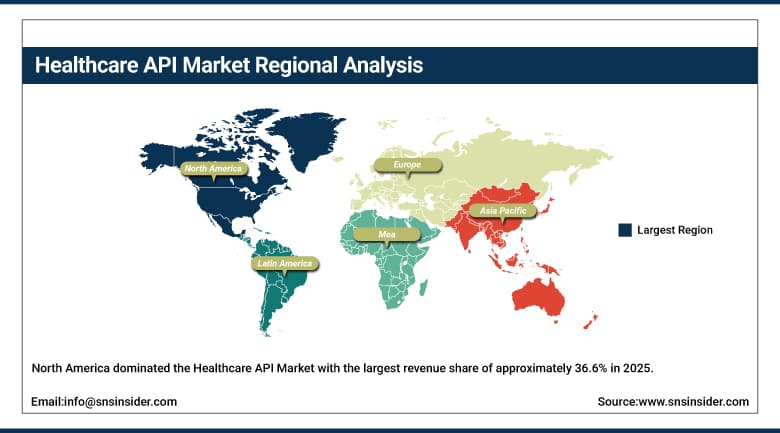
North America dominated the Healthcare API Market with the largest revenue share of approximately 36.6% in 2025. Advanced healthcare IT infrastructure, near-universal EHR adoption, strong federal interoperability regulation and the presence of leading EHR vendors, cloud providers and digital health companies continued reinforcing this dominant regional position. U.S. rules requiring FHIR-based patient-access and payer APIs created a large, standardized API ecosystem. Growing health AI investment further reinforced this region's leadership position.
The United States accounted for the substantial majority of regional revenue, anchored by regulatory mandates, high telehealth and RPM adoption and a large digital health start-up ecosystem. Canada added further demand through provincial digital health programmes and EHR interoperability initiatives, and that combined strength kept the region the largest addressable market for healthcare API vendors through the forecast period. Continued payer API deployment reinforced sustained demand.
Get Customized Report as Per Your Business Requirement - Enquiry Now
Europe Healthcare API Market Insights
Europe held a meaningful share of global revenue, supported by national digital health strategies, strong focus on interoperability and the planned European Health Data Space, which aims to enable cross-border health data access. GDPR has encouraged development of secure, consent-based API frameworks. Growing adoption of electronic health records and e-prescriptions across member states continued expanding API use. Rising telemedicine adoption further reinforced regional demand.
Germany continued to lead demand at roughly 22.70% of European revenue, supported by digital health legislation, its electronic patient record rollout and the DiGA digital health app framework. The UK, France and the Nordic countries contributed substantial additional demand through NHS digital programmes and national health data platforms, and continued European investment in interoperability should keep regional demand for healthcare APIs climbing through the forecast period. Additional demand from the Netherlands, Spain and Italy reinforced broader regional market strength.
Asia Pacific Healthcare API Market Insights
Asia Pacific is advancing at the fastest pace, growing at a CAGR of approximately 7.4% from 2026 to 2035. This growth is driven by rapid healthcare digitalization in China, India, Japan and Southeast Asia, national digital health infrastructure programmes and rising use of telemedicine and mobile health apps, with new hospital information systems and digital health platforms continuing to broaden the region's addressable base well beyond its traditional smaller footprint. Growing chronic disease burden further supports remote monitoring API adoption.
China held a substantial share of regional revenue, supported by large-scale hospital IT investment and internet hospital platforms. India contributed meaningful additional demand through the Ayushman Bharat Digital Mission and its open health data APIs, while Japan contributed through its national health information strategy, both reinforcing the region's position as the fastest-growing market tracked in this report. Australia, South Korea and Singapore contributed smaller but steadily growing regional demand throughout the period.
MEA and Latin America Healthcare API Market Insights
The Middle East and Africa and Latin America both showed steady growth, driven by government digital health initiatives, expanding EHR adoption and growing telemedicine use across both areas. As these markets build national health information exchanges, APIs offer an efficient way to connect public and private providers. Growing mobile health adoption across both regions further reinforced API demand.
Saudi Arabia, boosted by its national unified medical record and health transformation programmes under Vision 2030, along with the UAE’s advanced health information exchange platforms, led demand in the Middle East and Africa. Brazil was the biggest contributor to the regional revenue in Latin America, as the country’s national health data network and growing digital health sector continued to support the regional demand for healthcare APIs. Mexico and Argentina saw demand increase with the growth in telehealth services.
Market Dynamics:
Growth Drivers: Demand for Interoperability and Real-Time Data Exchange
The industry is driven by growing demand for interoperability and real-time data exchange across EHRs, telehealth platforms, pharmacies, payers and connected devices, along with regulations that mandate open, standardized APIs for patient data access. As healthcare organizations accelerate digital transformation and adopt patient-centric care models, demand for secure, FHIR-based APIs continues rising worldwide. Expansion of telemedicine and remote patient monitoring further reinforces this sustained industry-wide demand driver.
Rising adoption of cloud-native health data platforms and AI applications continues reinforcing this driver, as APIs provide the connections that allow AI tools, analytics and digital health apps to access clinical data. Growing API-first architectures among EHR vendors and payers continue simplifying integration, and that combination of regulatory push and technology pull keeps demand rising at a steady, sustained pace. Expanding developer ecosystems are further widening the addressable user base.
Restraints: Data Privacy, Security and Legacy Integration Challenges
Data privacy, security and cybersecurity risks associated with sharing sensitive patient information across multiple systems and third-party applications continue posing a restraint on faster market-wide expansion. Healthcare organizations must comply with HIPAA, GDPR and other regional rules, increasing implementation complexity and cost. Concerns about authentication, consent management and API-based data breaches slow adoption in some organizations.
Integration complexity with legacy healthcare systems and inconsistent implementation of standards continue posing a further restraint. Many smaller providers lack the IT resources to deploy and maintain APIs. Variability in interoperability regulation across countries continues prolonging adoption barriers in several regions.
Opportunities: Remote Patient Monitoring and Connected Care Ecosystems
The expansion of remote patient monitoring, wearable medical devices and virtual care platforms represents a significant opportunity, as healthcare systems seek to integrate patient-generated data into clinical workflows. Vendors positioned early in device-agnostic, secure API platforms stand to capture meaningful share as connected care becomes mainstream. Growing hospital-at-home and chronic care management programmes continue widening this addressable opportunity.
Rising adoption of AI-enabled healthcare applications offers a second substantial opportunity, as AI tools for documentation, prior authorization, clinical decision support and patient engagement depend on API access to health data. Vendors that combine API management, data normalization and AI integration stand to capture meaningful share. Continued growth of national digital health infrastructure across Asia, the Middle East and Latin America is further accelerating adoption.
Recent Developments:
-
May 2026: PriceMDs launched an API integration platform for PBMs, TPAs and healthcare organizations to streamline specialty medication sourcing, integrating real-time pricing, patient onboarding, compliance documentation, shipment tracking and claims reporting into existing systems.
-
May 2026: Microsoft continued expanding Azure Health Data Services with FHIR-compliant APIs and enterprise-grade health data services that support secure storage, exchange and integration of healthcare data and AI-driven analytics.
-
March 2025: Google introduced AI-powered health updates, including a medical records API for Android's Health Connect platform that lets apps read and write health record data in a standardized format.
Healthcare API Market key players are:
-
Microsoft Corporation
-
Oracle Corporation (Oracle Health)
-
Apple Inc.
-
Google LLC
-
Epic Systems Corporation
-
Salesforce, Inc. (MuleSoft)
-
GE HealthCare Technologies Inc.
-
athenahealth, Inc.
-
eClinicalWorks
-
Greenway Health, LLC
-
Practice Fusion, Inc.
-
Practo Technologies Pvt. Ltd.
-
Redox, Inc.
-
Innovaccer Inc.
-
Health Gorilla
-
1upHealth
-
Particle Health
Healthcare API Market Report Scope:
| Report Attributes | Details |
|---|---|
| Market Size in 2025 | USD 1.34 Billion |
| Market Size by 2035 | USD 2.36 Billion |
| CAGR | CAGR of 5.84% From 2026 to 2035 |
| Base Year | 2025 |
| Forecast Period | 2026-2035 |
| Historical Data | 2022-2024 |
| Report Scope & Coverage | Market Size, Segments Analysis, Competitive Landscape, Regional Analysis, DROC & SWOT Analysis, Forecast Outlook |
| Key Segments | • By Services (EHR Access, Appointments, Remote Patient Monitoring, Payment, Wearable Medical Device) • By Deployment Model (Cloud Based, On-Premise) • By End Use (Healthcare Payers, Providers, Patients, Vendors) |
| Regional Analysis/Coverage | North America (US, Canada), Europe (Germany, UK, France, Italy, Spain, Russia, Poland, Rest of Europe), Asia Pacific (China, India, Japan, South Korea, Australia, ASEAN Countries, Rest of Asia Pacific), Middle East & Africa (UAE, Saudi Arabia, Qatar, South Africa, Rest of Middle East & Africa), Latin America (Brazil, Argentina, Mexico, Colombia, Rest of Latin America). |
| Company Profiles | Microsoft Corporation, Oracle Corporation (Oracle Health), Apple Inc., Google LLC, Epic Systems Corporation, Salesforce, Inc. (MuleSoft), GE HealthCare Technologies Inc., athenahealth, Inc., eClinicalWorks, Greenway Health, LLC, Practice Fusion, Inc., Practo Technologies Pvt. Ltd., Redox, Inc., Innovaccer Inc., Health Gorilla, 1upHealth, Particle Health |
Frequently Asked Questions
Key players include Microsoft, Oracle Health, Apple, Google, Epic Systems, Salesforce (MuleSoft), GE HealthCare, athenahealth, eClinicalWorks, Redox, and Innovaccer.
Key opportunities include remote patient monitoring and wearable integration, AI-enabled healthcare applications, payer prior authorization APIs, and emerging-market digital health infrastructure.
The market is driven by demand for interoperability and real-time data exchange, FHIR and patient-access regulations, telehealth and RPM growth, and cloud adoption.
The EHR Access segment dominated the Healthcare API Market, accounting for approximately 29% market share.
The North America region dominated the Healthcare API Market in 2025 with approximately 36.6% share, driven by advanced healthcare IT infrastructure, high EHR adoption, and federal interoperability rules.
