
Diagnostics Device CDMO Market Report Scope and Overview:
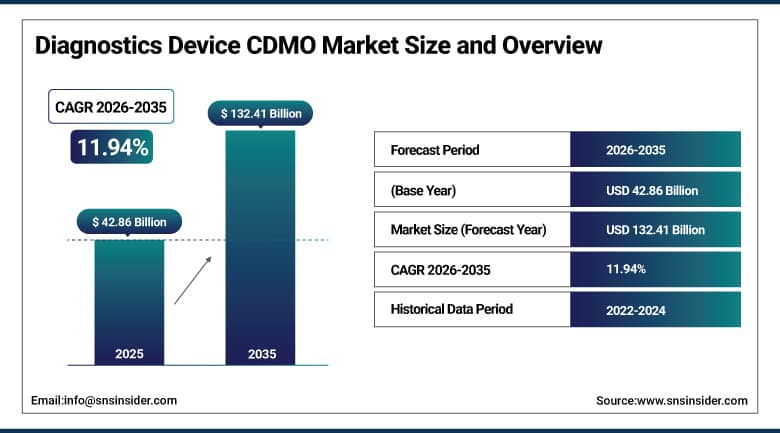
The Diagnostics Device CDMO Market was valued at USD 42.86 Billion in 2025 and is projected to reach USD 132.41 Billion by 2035, registering a CAGR of 11.94% from 2026 to 2035.
The Diagnostics Device CDMO Market is steadily reshaping how diagnostic products reach the market by shifting device design, engineering, component production, assembly, testing and regulatory work from in-house operations to specialized contract development and manufacturing organizations. The market is characterized by rising demand for in vitro diagnostic instruments, molecular and point-of-care testing platforms and companion diagnostics, growing complexity in microfluidics, biosensors and connected devices, and stricter regulatory requirements under the FDA framework and the EU In Vitro Diagnostic Regulation. Significant growth is being witnessed in contract development services and genetic and genomic testing applications, considering that OEMs, start-ups and pharmaceutical companies continue outsourcing to cut capital costs and accelerate time to market.
Quasar Medical acquired Nordson Medical's manufacturing facilities in Galway, Ireland and Tecate, Mexico in March 2026, expanding its network to more than ten global sites and reflecting the wave of capability- and capacity-building consolidation reshaping the medical and diagnostic device CDMO landscape.
To Get More Information On Diagnostics Device CDMO Market - Request Free Sample Report
Diagnostics Device CDMO Market Trends:
-
Rising outsourcing of end-to-end diagnostic device development continues expanding CDMO design and engineering roles.
-
Growing demand for point-of-care and home-use tests continues driving high-volume cartridge and reader manufacturing.
-
Expanding microfluidic, biosensor and connected-device integration continues raising the technical bar for CDMO partners.
-
Increasing EU IVDR compliance requirements continue pushing diagnostic firms toward experienced regulatory-capable CDMOs.
-
Rising regionalization and near-shoring of manufacturing continues reshaping CDMO capacity investments.
U.S. Diagnostics Device CDMO Market Outlook:
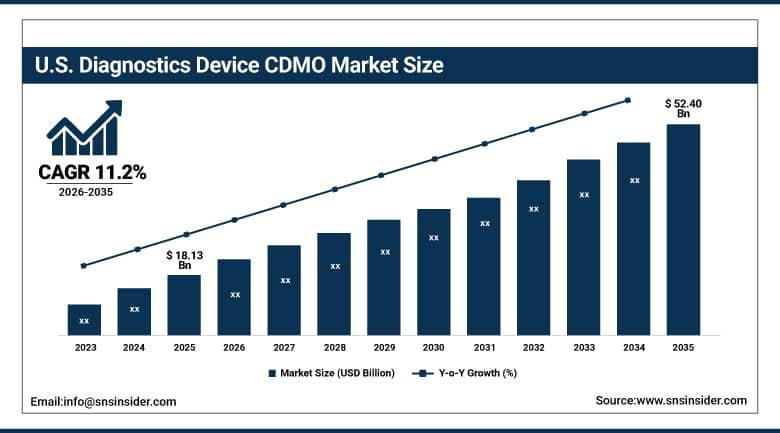
The U.S. Diagnostics Device CDMO Market was valued at approximately USD 18.13 Billion in 2025 and is projected to reach approximately USD 52.40 Billion by 2035, registering a CAGR of approximately 11.2% from 2026 to 2035.
Demand across the United States continued to be shaped by the country's position as the world's largest diagnostics market, a dense base of diagnostic OEMs, venture-backed start-ups and pharmaceutical companies developing companion diagnostics, and a well-established FDA regulatory pathway for IVD devices. Rising demand for molecular, point-of-care and at-home testing platforms continued reinforcing the country's position as the largest national market. Growing interest in domestic and near-shore manufacturing amid tariff and supply chain concerns added further layers of sustained demand, with OEMs increasingly prioritizing CDMOs that combine design, regulatory and commercial-scale manufacturing capabilities.
Flex Ltd. launched a new product introduction (NPI) center near Boston in March 2025 to serve healthcare customers, including diagnostics and medical device companies, from concept through to production transfer, strengthening domestic development support for American diagnostic OEMs.
Diagnostics Device CDMO Market Segment Analysis:
-
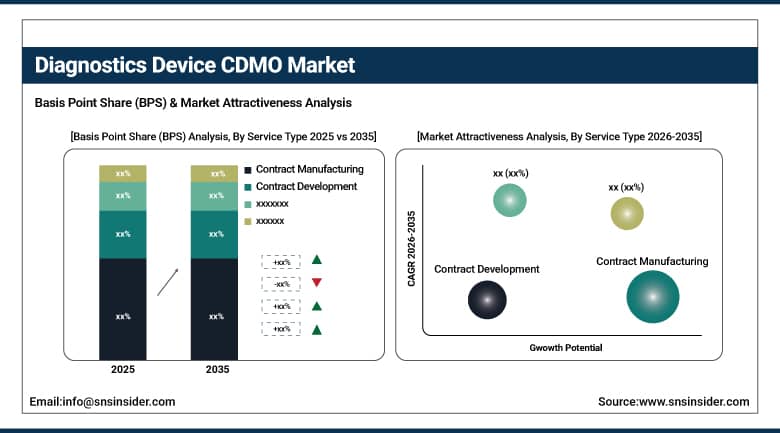
By Service Type, Contract Manufacturing segment dominated the Diagnostics Device CDMO Market in 2025 with 48% share; Contract Development segment is the fastest growing segment with a CAGR of approximately 14.1%.
-
By Class, Class II segment dominated the Diagnostics Device CDMO Market in 2025 with 79% share; Class III segment is the fastest growing segment with a CAGR of approximately 13.2%.
-
By Application, Infectious Disease Diagnostics segment dominated the Diagnostics Device CDMO Market in 2025 with 38% share; Genetic & Genomic Testing segment is the fastest growing segment with a CAGR of approximately 15.3%.
-
By End Use, Original Equipment Manufacturers (OEMs) segment dominated the Diagnostics Device CDMO Market in 2025 with 48% share; Pharmaceutical & Biopharmaceutical Companies segment is the fastest growing segment with a CAGR of approximately 13.6%.
By Service Type: Contract Manufacturing Leads, Contract Development Grows Fastest
The Contract Manufacturing segment dominated the Diagnostics Device CDMO Market in 2025, driven by large-scale outsourcing of component production, sub-assembly, device manufacturing and accessories such as cartridges and sample-collection parts. Diagnostic companies rely on CDMOs for high-precision molding, electronics assembly and cleanroom production to avoid heavy capital investment and maintain consistent quality at volume. Continued growth in instrument and consumable volumes reinforced this segment's position as the largest contributor to total market revenue throughout the base year.
The Contract Development segment is the fastest growing in the Diagnostics Device CDMO Market owing to rising demand for product design, prototyping, verification, validation and design transfer services. Start-ups and established OEMs increasingly outsource early engineering work to accelerate innovation and reduce R&D risk, particularly for complex molecular and point-of-care platforms. Rising integration of software, connectivity and AI into diagnostic devices is accelerating this segment's growth trajectory. Growing need for regulatory-ready design documentation further supports demand.
By Class: Class II Leads, Class III Grows Fastest
The Class II segment dominated the Diagnostics Device CDMO Market because most diagnostic analyzers, immunoassay systems, glucose monitors, molecular test kits and point-of-care platforms fall into this moderate-risk category. These devices require design controls and quality systems that many OEMs prefer to manage through experienced CDMO partners. High production volumes across hospital, laboratory and home-use settings reinforced this segment's dominant contribution to total market revenue throughout the base year.
The Class III segment is the fastest growing as companion diagnostics, high-risk molecular assays and devices that guide critical treatment decisions increase in number. These products require rigorous design controls, clinical validation and premarket approval, making specialized CDMO expertise especially valuable. Rising oncology and precision medicine pipelines continue attracting investment in Class III-capable CDMO capacity. Stricter EU IVDR classification of many assays further supports demand.
By Application: Infectious Disease Diagnostics Leads, Genetic & Genomic Testing Grows Fastest
The Infectious Disease Diagnostics segment dominated the Diagnostics Device CDMO Market because of the large global volume of rapid antigen tests, PCR systems, immunoassays and respiratory and sexually transmitted infection panels. Recurring outbreaks and growing antimicrobial resistance surveillance continue to require large-scale manufacturing of test kits, cartridges and instruments. The established installed base of infectious disease platforms reinforced this segment's dominant contribution to total market revenue throughout the base year.
The Genetic & Genomic Testing segment is the fastest growing due to rising adoption of precision medicine, next-generation sequencing, hereditary disease testing and companion diagnostics. These platforms require complex fluidics, optics and consumables that benefit from specialized CDMO capabilities. Falling sequencing costs and expanding clinical applications continue attracting investment in genomic diagnostic manufacturing. Growing oncology biomarker testing further accelerates demand.
By End Use: OEMs Dominate, Pharmaceutical & Biopharmaceutical Companies Grow Fastest
The Original Equipment Manufacturers (OEMs) segment dominated the Diagnostics Device CDMO Market because diagnostic OEMs outsource non-core manufacturing, assembly, testing and regulatory work to focus on R&D and commercialization. Large OEMs use CDMOs to add flexible capacity and regional production, while smaller firms rely on them for complete manufacturing. Continued expansion of diagnostic product portfolios reinforced this segment's dominant contribution to total market revenue throughout the base year.
The Pharmaceutical & Biopharmaceutical Companies segment is the fastest growing as drug developers increasingly co-develop companion diagnostics and patient-selection tests alongside targeted therapies. These companies typically lack in-house device manufacturing and depend on CDMOs for development, validation and commercial supply. Rising numbers of biomarker-driven drug approvals continue attracting pharma investment in diagnostic partnerships. Growing use of at-home monitoring devices in clinical trials further supports demand.
Regional Analysis:
|
Region |
Major Country |
Share within Region, 2025 (%) |
|---|---|---|
|
North America |
United States |
89.60% |
|
Europe |
Germany |
26.40% |
|
Asia Pacific |
China |
39.80% |
|
Middle East and Africa |
Saudi Arabia |
28.70% |
|
Latin America |
Brazil |
37.90% |
North America Diagnostics Device CDMO Market Insights
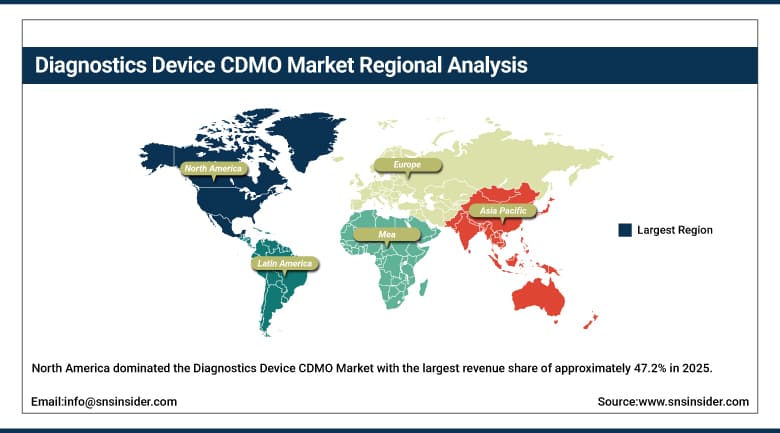
North America dominated the Diagnostics Device CDMO Market with the largest revenue share of approximately 47.2% in 2025. A large concentration of diagnostic OEMs and start-ups, strong venture and pharmaceutical investment, an established FDA regulatory pathway and the presence of leading global CDMOs continued reinforcing this dominant regional position. North American CDMOs offer deep capabilities in electronics, precision plastics, cleanroom assembly and regulatory support. Growing interest in domestic manufacturing further reinforced this region's leadership position.
The United States accounted for the substantial majority of regional revenue, anchored by its large diagnostics industry and high outsourcing rates among OEMs. Mexico added significant manufacturing capacity through near-shore facilities serving U.S. customers, while Canada contributed through its life science clusters, and that combined strength kept the region the largest addressable market for diagnostics device CDMOs through the forecast period. Continued capacity investment reinforced sustained demand.
Get Customized Report as Per Your Business Requirement - Enquiry Now
Europe Diagnostics Device CDMO Market Insights
Europe held a meaningful share of global revenue, supported by a strong diagnostics industry, advanced manufacturing infrastructure and specialized CDMOs in Germany, Ireland, the UK and Switzerland. Implementation of the EU In Vitro Diagnostic Regulation has increased documentation, performance evaluation and quality system demands, leading many diagnostic firms to rely on experienced CDMO partners. Growing investment in personalized medicine further reinforced regional demand.
Germany continued to lead demand at roughly 26.40% of European revenue, supported by its strong diagnostics and precision engineering base. Ireland, the UK and France contributed substantial additional demand through medtech manufacturing hubs and biotechnology investment, and continued European investment in diagnostic innovation should keep regional demand for CDMO services climbing through the forecast period. Additional demand from Switzerland, Italy and the Nordic countries reinforced broader regional market strength.
Asia Pacific Diagnostics Device CDMO Market Insights
Asia Pacific is advancing at the fastest pace, growing at a CAGR of approximately 14.4% from 2026 to 2035. This growth is driven by cost-effective manufacturing, expanding diagnostics industries in China, India, South Korea and Japan, rising government support for domestic medical device production and growing outsourcing by global OEMs, with new CDMO facilities and skilled engineering workforces continuing to broaden the region's addressable base well beyond its traditional smaller footprint. Growth of point-of-care and molecular testing further supports demand.
China held a substantial share of regional revenue, supported by its large diagnostics manufacturing base and strong government support for innovation. Japan and India contributed meaningful additional demand, with Japan's advanced diagnostics technology and India's lower operating costs and growing CDMO sector both reinforcing the region's position as the fastest-growing market tracked in this report. South Korea, Singapore and Malaysia contributed growing demand as regional electronics and medtech manufacturing hubs.
MEA and Latin America Diagnostics Device CDMO Market Insights
The Middle East and Africa and Latin America both showed steady growth, driven by efforts to build local diagnostic manufacturing capacity, rising healthcare investment and growing demand for affordable testing across both areas. Governments increasingly encourage local production to improve supply security following recent pandemic disruptions. Growing partnerships between regional firms and international diagnostics companies further reinforced CDMO demand.
Saudi Arabia led Middle East and Africa demand, supported by localization goals under Vision 2030 and new diagnostic manufacturing projects. South Africa and the UAE contributed further demand through healthcare manufacturing initiatives. In Latin America, Brazil accounted for the largest share of regional revenue, with its large diagnostics market and public health programmes continuing to anchor regional demand, while Mexico serves mainly as a near-shore hub for North American customers.
Market Dynamics:
Growth Drivers: Outsourcing of Diagnostic Device Development and Demand for Advanced Testing
The industry is driven by the growing outsourcing of diagnostic device design, development, prototyping, manufacturing and regulatory support, rising demand for in vitro diagnostic, molecular and point-of-care testing, and the increasing burden of chronic and infectious diseases. As diagnostic companies seek to reduce capital investment, shorten time to market and access specialized engineering, demand for full-service CDMO partners continues rising worldwide. Growth of companion diagnostics and precision medicine further reinforces this sustained industry-wide demand driver.
Rising technical complexity of diagnostic devices continues reinforcing this driver, as microfluidics, biosensors, automation, connectivity and AI-enabled software require expertise many OEMs prefer not to build in-house. CDMO investment in automation, cleanroom capacity and digital manufacturing continues improving quality and scalability, and that combination of demand and capability keeps the market rising at a steady, sustained pace. Expanding regional manufacturing networks are further widening the addressable customer base.
Restraints: Regulatory Compliance Complexity and Intellectual Property Concerns
Stringent and evolving regulatory requirements, including FDA quality system rules, ISO 13485 and the EU IVDR, continue posing a restraint by raising compliance costs and extending timelines for CDMOs and their customers. Maintaining consistent quality across multiple sites and suppliers adds operational complexity. Any quality failures or regulatory findings can delay launches and damage long-term partnerships.
Concerns about protecting intellectual property and maintaining control over critical manufacturing processes continue posing a further restraint, leading some OEMs to keep core production in-house. Supply chain disruptions for electronic components and specialty materials can affect delivery schedules. Pricing pressure from large OEM customers continues limiting margins for some CDMOs.
Opportunities: Precision Diagnostics Growth and Regional Manufacturing Expansion
Rising demand for companion diagnostics, multiplex molecular platforms, wearable and connected diagnostic devices, and AI-enabled testing represents a significant opportunity, as many emerging diagnostics companies lack the infrastructure to develop and scale these products themselves. CDMOs positioned early in integrated design, regulatory and commercial manufacturing capabilities stand to capture meaningful share as precision diagnostics expand. Growing pharma-diagnostics collaboration continues widening this addressable opportunity.
Expanding manufacturing capacity across Asia Pacific, Latin America, Eastern Europe and the Middle East offers a second substantial opportunity, as OEMs diversify supply chains and governments promote local production. CDMOs with cost-effective, compliant multi-region networks stand to capture meaningful share as diagnostic companies balance cost, resilience and market access. Continued near-shoring to Mexico and growth of Asian CDMO hubs are further accelerating this trend.
Recent Developments:
-
August 2026: KKR announced an agreement to acquire Integer Holdings Corporation, a leading medical device CDMO, in a transaction valued at about USD 5.7 billion that will take the company private.
-
August 2026: Co-Diagnostics reported that its joint venture CoMira Diagnostics had received Saudi approval for a manufacturing facility in the Kingdom of Saudi Arabia, alongside plans for an automated manufacturing line in Utah, supporting localized production of its PCR diagnostic platform.
-
January 2026: Jabil Inc. entered a partnership with TxSphere to support drug-device combination product manufacturing, extending its healthcare contract development and manufacturing capabilities.
Diagnostics Device CDMO Market key players are:
-
Jabil Inc.
-
Thermo Fisher Scientific Inc.
-
Integer Holdings Corporation
-
Flex Ltd.
-
Sanmina Corporation
-
Celestica Inc.
-
Phillips-Medisize (Molex)
-
Plexus Corp.
-
Nipro Corporation
-
Viant Technology LLC
-
Benchmark Electronics, Inc.
-
West Pharmaceutical Services, Inc.
-
Quasar Medical
-
DCN Diagnostics
-
Cirtec Medical
-
TE Connectivity (Medical)
Diagnostics Device CDMO Market Report Scope:
| Report Attributes | Details |
|---|---|
| Market Size in 2025 | USD 42.86 Billion |
| Market Size by 2035 | USD 52.40 Billion |
| CAGR | CAGR of 11.2% From 2026 to 2035 |
| Base Year | 2025 |
| Forecast Period | 2026-2035 |
| Historical Data | 2022-2024 |
| Report Scope & Coverage | Market Size, Segments Analysis, Competitive Landscape, Regional Analysis, DROC & SWOT Analysis, Forecast Outlook |
| Key Segments | • By Service Type (Contract Manufacturing, Contract Development, Packaging, Labelling & Sterilization, Regulatory Affairs, Others) • By Class (Class I, Class II, Class III) • By Application (Infectious Disease Diagnostics, Oncology Diagnostics, Cardiometabolic Diagnostics, Genetic & Genomic Testing, Respiratory & Critical Care Diagnostics, Others) • By End Use (Original Equipment Manufacturers (OEMs), Pharmaceutical & Biopharmaceutical Companies, Others) |
| Regional Analysis/Coverage | North America (US, Canada), Europe (Germany, UK, France, Italy, Spain, Russia, Poland, Rest of Europe), Asia Pacific (China, India, Japan, South Korea, Australia, ASEAN Countries, Rest of Asia Pacific), Middle East & Africa (UAE, Saudi Arabia, Qatar, South Africa, Rest of Middle East & Africa), Latin America (Brazil, Argentina, Mexico, Colombia, Rest of Latin America). |
| Company Profiles | Jabil Inc., Thermo Fisher Scientific Inc., Integer Holdings Corporation, Flex Ltd., Sanmina Corporation, Celestica Inc., Phillips-Medisize (Molex), Plexus Corp., Nipro Corporation, Viant Technology LLC, Benchmark Electronics, Inc., West Pharmaceutical Services, Inc., Quasar Medical, DCN Diagnostics, Cirtec Medical, TE Connectivity (Medical) |
Frequently Asked Questions
Key players include Jabil, Thermo Fisher Scientific, Integer Holdings, Flex, Sanmina, Celestica, Phillips-Medisize, Plexus, Nipro, and Viant.
Key opportunities include companion and precision diagnostics, connected and AI-enabled devices, end-to-end development services, and regional manufacturing expansion.
The market is driven by growing outsourcing of diagnostic device development and manufacturing, rising IVD and point-of-care demand, device complexity, and regulatory requirements.
The Contract Manufacturing segment dominated the Diagnostics Device CDMO Market, accounting for approximately 48% market share.
The North America region dominated the Diagnostics Device CDMO Market in 2025 with approximately 47.2% share, driven by a large diagnostics OEM base, strong investment, and leading CDMO presence.
